Why Tesla First Responder Programs Are Expanding in 2026
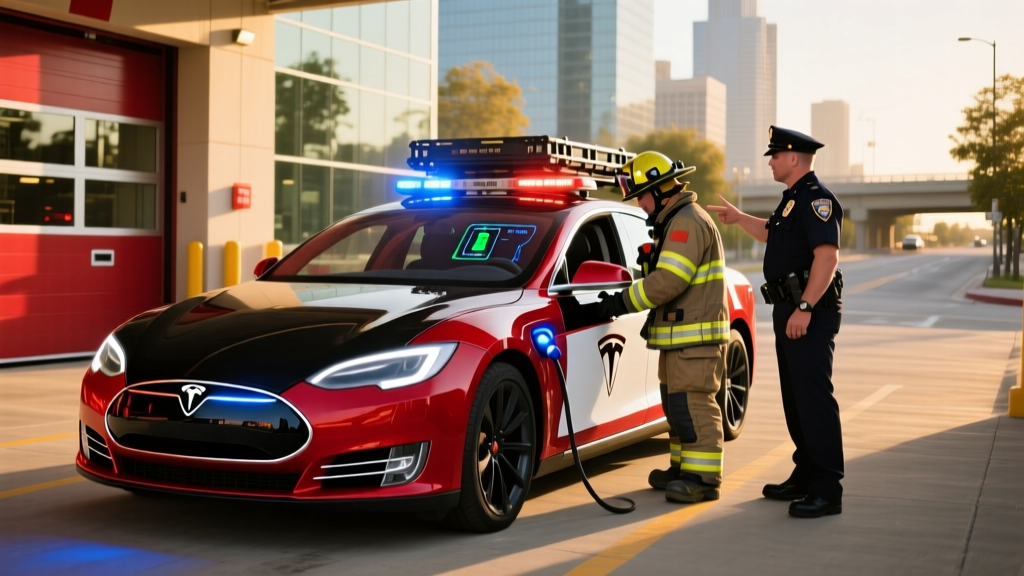
Police departments, fire agencies, and emergency medical services across the U.S. are accelerating their adoption of electric patrol vehicles, and Tesla sits at the center of that shift. The Tesla first responder movement isn't a single vehicle — it's a fleet strategy built around modified Model Y and Model 3 platforms that departments from South Pasadena, California to Fremont, Nebraska have already put into active duty. As of 2026, Tesla does not sell a dedicated, factory-built police interceptor like Ford's old Taurus-based Police Interceptor Sedan. Instead, agencies purchase retail Model Y Long Range AWD or Model 3 Long Range RWD units and outfit them through third-party upfitters with lightbars, prisoner transport cages, rifle racks, and dedicated auxiliary battery systems.
The appeal is straightforward: dramatically lower fuel and maintenance costs over a patrol vehicle's 5-7 year service life, instant torque for pursuit scenarios, and a growing Supercharger network that supports 24/7 operations. But the limitations are real too — upfit costs, range under heavy accessory load, and repair timelines that can sideline a unit for weeks. This profile breaks down the exact specs, economics, and operational realities of using a Tesla as a first responder vehicle in 2026.
Specs at a Glance: Model Y Long Range AWD (Primary Patrol Platform)
| Specification | 2026 Model Y Long Range AWD | 2026 Model 3 Long Range RWD |
|---|---|---|
| EPA Range | 320 miles | 363 miles |
| Battery Capacity (usable) | ~75 kWh (NMC chemistry) | ~75 kWh (NMC chemistry) |
| Drivetrain | Dual Motor AWD | Single Motor RWD |
| Horsepower | 384 hp (combined) | 271 hp |
| 0–60 mph | 4.8 seconds | 5.8 seconds |
| Top Speed | 135 mph | 125 mph |
| Max DC Fast Charge | 250 kW (peak) | 250 kW (peak) |
| 10–80% DC Charge Time | ~25 minutes | ~25 minutes |
| Level 2 Home/Depot Rate | 11.5 kW (~44 mi/hr) | 11.5 kW (~44 mi/hr) |
| EPA Efficiency | 122 MPGe (28 kWh/100mi) | 132 MPGe (25 kWh/100mi) |
| Cargo Volume | 76.2 cu ft (rear seats folded) | 23.0 cu ft (trunk + frunk) |
| Base MSRP | $44,990 | $38,990 |
| Battery Warranty | 8 yr / 120,000 mi | 8 yr / 120,000 mi |
Source: Tesla Model Y specs and fueleconomy.gov
Real-World Range: What Patrol Use Actually Does to the Battery
The Model Y Long Range AWD carries a 320-mile EPA estimate. In typical patrol use — idling with HVAC and lightbar running, frequent acceleration, stop-and-go city driving — expect effective range between 200 and 250 miles per charge cycle. Highway-only driving at 70 mph yields roughly 270–285 miles. In cold-weather climates (below 32°F), range drops an additional 15–25%, meaning a winter patrol shift in the Midwest may deliver only 170–200 usable miles.
Accessory load is the silent range killer for first responder EVs. A full Whelen lightbar, inverter for onboard electronics, prisoner cage lighting, and HVAC running continuously can draw 2–4 kW of continuous power. Over a 10-hour shift, that's 20–40 kWh consumed by accessories alone — roughly 25–50% of the usable battery capacity. Departments that have deployed Teslas report that mid-shift charging at a depot Level 2 charger or a quick 15-minute DC fast-charge top-up is often necessary for two-shift, 24-hour patrol operations.
The NMC (nickel manganese cobalt) chemistry in the Long Range battery provides higher energy density than LFP, which matters for patrol vehicles where every pound of upfit equipment reduces range. However, NMC batteries degrade slightly faster under sustained high-SoC operation, so fleet managers should configure charge limits to 80–90% for daily use rather than consistently charging to 100%.
Charging Infrastructure: Depot Level 2 and Supercharger Strategy
First responder Tesla deployments succeed or fail on charging logistics. Most agencies use a two-tier approach: overnight depot charging via Level 2 wall connectors, supplemented by Tesla Supercharger access during shifts when needed.
| Charging Method | Power (kW) | Miles Added per Hour | Typical Use Case |
|---|---|---|---|
| Level 1 (120V outlet) | 1.4 kW | ~5 mi/hr | Emergency backup only |
| Level 2 (Tesla Wall Connector, 48A) | 11.5 kW | ~44 mi/hr | Overnight depot charging (primary) |
| DC Fast (Supercharger V3) | 250 kW peak | ~1,000+ mi/hr (peak) | Mid-shift top-up, 10–80% in ~25 min |
| DC Fast (Supercharger V4) | 350 kW peak* | Faster taper curve | Available at select 2026 stations |
*V4 350 kW availability limited to newer stations; Model Y peak acceptance remains ~250 kW.
For a typical patrol depot, installing 4–8 Tesla Wall Connectors on dedicated 60A circuits costs between $3,000 and $7,000 per stall including electrician labor, conduit, and permits. A fleet of six Model Y patrol vehicles charging overnight at 11.5 kW will fully replenish from 20% to 100% SoC in approximately 7–8 hours — well within a standard off-shift window.
The Tesla Supercharger network remains a significant operational advantage. As of 2026, Tesla operates over 6,500 Supercharger stations in North America, and the network's reliability consistently outpaces CCS-based networks like Electrify America. For agencies in rural areas or highway patrol roles, mid-shift Supercharger stops add 150+ miles in a 15-minute break.
Upfit Costs and First Responder Modifications
Tesla does not offer a factory police package. Every first responder Tesla goes through an aftermarket upfitter — companies like EV Fleet, Setina Manufacturing, or local specialty shops. Here's what a typical patrol upfit includes and costs:
- Emergency lighting (LED lightbar, alley lights, takedown lights): $3,500–$6,000
- Siren and PA system: $1,200–$2,000
- Prisoner transport cage / partition: $2,500–$4,000
- Rifle lock / weapon mount: $800–$1,500
- Mobile data terminal mount and wiring: $1,500–$2,500
- Auxiliary 12V battery system (isolate accessories from traction battery): $2,000–$3,500
- Decals, push bumper, vinyl wrap: $2,000–$4,000
- Heavy-duty suspension / ride-height adjustment: $1,500–$3,000
Total upfit cost: $15,000–$26,500 per vehicle, depending on department requirements. This puts a fully outfitted Model Y patrol unit at roughly $60,000–$72,000 all-in — comparable to a fully upfitted Ford Explorer Police Interceptor Utility, which typically runs $55,000–$70,000 after modifications.
Operating Economics: Where the Tesla First Responder EV Wins
The financial case for a Tesla patrol vehicle centers on operating cost savings over a 5–7 year service life. Here's how the numbers break down for a typical city patrol unit driving 25,000 miles per year:
| Cost Category | Tesla Model Y AWD | Ford Explorer PIU (Gas) |
|---|---|---|
| Fuel/Energy (annual, 25k mi) | $1,875/yr (at $0.075/mi) | $5,250/yr (at $0.21/mi, 12 mpg avg) |
| Maintenance (annual) | $600–$900/yr | $2,200–$3,500/yr |
| Brake Pad Replacement | Every 80–100k mi (regen braking) | Every 25–40k mi |
| 5-Year Fuel + Maintenance | $12,375–$13,875 | $37,250–$43,750 |
| Estimated 5-Year Savings vs. Gas | $23,000–$30,000 | |
Departments that have published data — including the City of South Pasadena and Bargersville, Indiana — report annual fuel savings of $3,000–$5,000 per vehicle and maintenance savings of $1,500–$2,500 per vehicle. Regenerative braking alone saves thousands in brake pad and rotor replacement over the vehicle's life, a critical advantage in stop-heavy city patrol.
Tax Credit Eligibility for Fleet Purchases
Federal EV tax credits under IRS §30D have specific rules that affect government and fleet buyers:
- MSRP Cap: Model Y qualifies (SUV cap: $80,000); Model 3 qualifies (sedan cap: $55,000)
- Buyer Income Cap: $150,000 single / $300,000 joint — applies to individual taxpayers, not government entities
- Battery Sourcing: Critical minerals and battery component requirements must be met; Tesla's Fremont and Austin-built vehicles have varying compliance by build date
- Government Entity Exception: Municipalities and tax-exempt organizations cannot claim §30D directly but may qualify for §45W Commercial Clean Vehicle Credit (up to $7,500 for vehicles under 14,000 lb GVWR)
- Point-of-Sale Transfer: Available for individual buyers; government fleets must use the §45W elective pay mechanism
In practice, most city and county agencies leverage the §45W Commercial Clean Vehicle Credit through the IRS elective pay provision, which allows tax-exempt entities to receive a direct payment equivalent to the credit amount. This effectively reduces the net vehicle cost by up to $7,500 per unit. Consult your municipal finance office and a tax professional for current-year eligibility confirmation.
Technology, Safety, and Driver-Assist Features
The Model Y platform brings Tesla's full technology stack to patrol duty:
- 15.4-inch center touchscreen with navigation, fleet telematics integration capability, and dashcam functionality via Sentry Mode
- Tesla Autopilot (SAE Level 2): Adaptive cruise control, lane-keeping assist, and automatic emergency braking. Note: this is a driver-assist system, not autonomous driving. The officer must remain fully engaged at all times.
- Dashcam and Sentry Mode: Built-in cameras record all driving footage — departments use this as supplemental body-cam/DAS evidence, though it does not replace dedicated in-car camera systems
- Over-the-air updates: Tesla pushes software improvements remotely, reducing dealer service visits
- Preconditioning: Officers can remotely start HVAC via the Tesla app before shift start, ensuring a cooled or heated cabin without idling a gas engine
On safety, the Model Y earned a 5-star overall NHTSA rating and IIHS Top Safety Pick+ status — important for officer protection in a vehicle that may see aggressive driving conditions.
Pros and Cons: Tesla as a First Responder Vehicle
- $3,000–$5,000 annual fuel savings per vehicle vs. gas patrol units
- Minimal maintenance — no oil changes, fewer brake replacements, no transmission fluid
- Instant torque (384 hp, 4.8s 0–60) provides strong pursuit acceleration
- Regenerative braking reduces wear in stop-heavy patrol environments
- Supercharger network offers reliable mid-shift charging nationwide
- Low center of gravity (battery pack) improves handling stability
- Sentry Mode and built-in cameras provide supplemental evidence capture
- Quieter operation enables stealth approach in certain tactical scenarios
- Effective patrol range drops to 200–250 mi with accessories; 170–200 mi in cold weather
- Aftermarket upfit adds $15,000–$26,500; no factory police package available
- Collision repair timelines can exceed 3–6 weeks due to Tesla parts supply chain
- Push-bumper compatibility limited; not rated for PIT maneuvers at all speeds
- Ground clearance (6.6 in) lower than SUV-based interceptors — limits off-road pursuit
- No dedicated prisoner transport van variant available
- Accessory power draw (lightbar, HVAC, inverter) significantly reduces range
- Departments without depot charging infrastructure face major upfront install costs
Frequently Asked Questions
What is the real-world range of a Tesla first responder patrol vehicle?
With full emergency equipment running (lightbar, HVAC, inverter, data terminal), expect 200–250 miles from a Model Y Long Range AWD on a full charge in moderate weather. Highway-only driving yields ~270–285 miles. In sub-freezing temperatures, plan for 170–200 miles. This is sufficient for most single-shift city patrols (typically 80–150 miles per shift) but requires mid-shift charging for extended or double shifts.
How fast does a Tesla patrol EV charge at the depot and on the road?
At a depot Level 2 Tesla Wall Connector (11.5 kW / 48A), the Model Y gains roughly 44 miles of range per hour, fully recharging overnight in 7–8 hours. At a Tesla Supercharger V3 station, it peaks at 250 kW and charges from 10–80% in approximately 25 minutes, adding roughly 150+ miles in a 15-minute stop.
How much does a Tesla first responder vehicle cost after tax credits?
A 2026 Model Y Long Range AWD starts at $44,990 MSRP. After a typical patrol upfit ($15,000–$26,500) and a potential §45W Commercial Clean Vehicle Credit of up to $7,500 for qualifying government entities, the net cost ranges from roughly $52,500 to $64,000 per vehicle. Compare this to $55,000–$70,000 for a fully upfitted Ford Explorer Police Interceptor.
Is a Tesla first responder EV worth buying vs. a Ford Explorer or Chevy Tahoe?
For city patrol, suburban response, and highway interdiction where depot charging is available, the Tesla offers compelling 5-year savings of $23,000–$30,000 per vehicle in fuel and maintenance. For rural patrol, off-road pursuit, or departments without charging infrastructure, a traditional ICE interceptor remains more practical. The Tesla also cannot perform PIT maneuvers or sustained off-road operations as effectively as a body-on-frame SUV.
Does the Tesla Model Y qualify for the federal EV tax credit?
The Model Y qualifies under the MSRP cap ($80,000 for SUVs). Individual buyers must meet income caps ($150K single / $300K joint) and battery-sourcing requirements. Government agencies cannot claim §30D directly but may receive an equivalent benefit through the §45W Commercial Clean Vehicle Credit via IRS elective pay. Always verify current-year rules at irs.gov.
What are the biggest drawbacks of using a Tesla as a police vehicle?
The three most-cited issues from departments operating Tesla patrol units are: (1) reduced effective range due to constant accessory power draw, (2) longer collision-repair timelines compared to legacy OEMs with established fleet parts networks, and (3) limited aftermarket options for push bumpers and heavy-duty suspension compared to the Ford Explorer or Chevrolet Tahoe platforms.