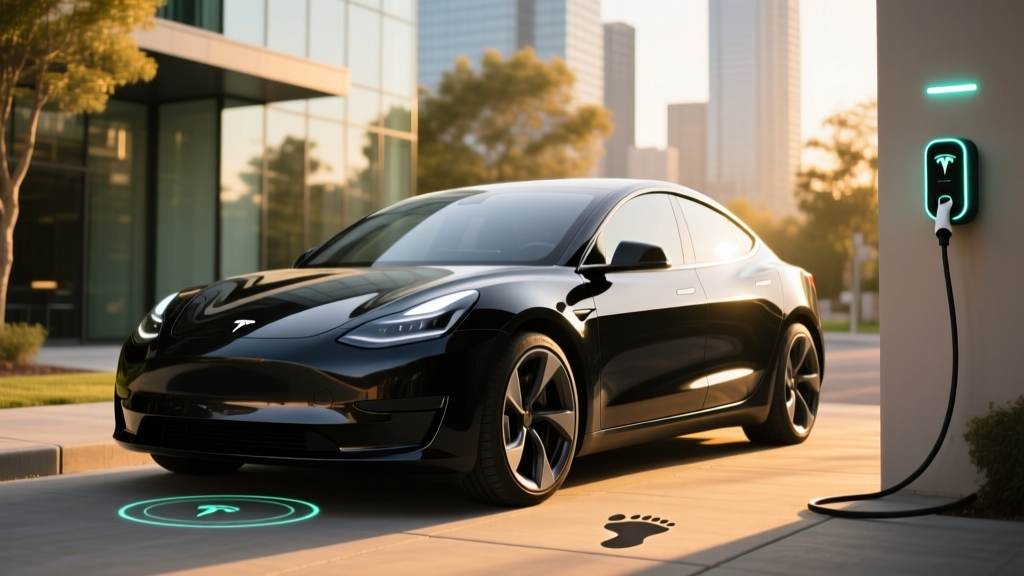
When Tesla launched the Model 3 in 2017, it wasn't just another electric sedan — it was the first mass-market EV from a company that had previously sold six-figure sports cars and luxury sedans. Nearly a decade later, the phrase "Tesla first model 3" still carries weight among buyers researching their entry into electrification. The Model 3 remains one of the best-selling electric vehicles in the United States, and the current-generation (Highland) platform has matured into a refined, efficient, and deeply integrated EV.
This review covers the 2026 Tesla Model 3 lineup with exact specs, real-world range expectations, charging behavior, and ownership economics — everything you need to decide if it's still the right entry point into the Tesla ecosystem.
2026 Tesla Model 3 at a Glance: Specs That Matter
| Specification | RWD (Base) | Long Range AWD | Performance |
|---|---|---|---|
| EPA Range | 341 mi | 363 mi | 315 mi |
| Battery (usable) | ~60 kWh (LFP) | ~75 kWh (NMC) | ~75 kWh (NMC) |
| Drivetrain | Rear-Wheel Drive | Dual-Motor AWD | Dual-Motor AWD |
| Horsepower | 271 hp | 346 hp | 510 hp |
| 0–60 mph | 5.8 sec | 4.1 sec | 2.9 sec |
| Peak DC Charge | 170 kW | 250 kW | 250 kW |
| 10–80% DCFC Time | ~25 min | ~25 min | ~25 min |
| Level 2 (240V/48A) | 11.5 kW (~44 mi/hr) | 11.5 kW (~44 mi/hr) | 11.5 kW (~44 mi/hr) |
| EPA Efficiency | 132 MPGe (25 kWh/100mi) | 130 MPGe (26 kWh/100mi) | 116 MPGe (29 kWh/100mi) |
| Cargo (trunk + frunk) | 23 cu ft combined (rear trunk ~19.8 + frunk ~3.1) | ||
| Rear Legroom | 35.2 in | ||
| Base MSRP (2026) | $38,990 | $45,990 | $52,990 |
| Battery Warranty | 8 yr / 100,000 mi | 8 yr / 120,000 mi | |
Sources: EPA / fueleconomy.gov, Tesla Model 3 design page.
Real-World Range: What to Actually Expect
EPA Sticker: 341 mi (RWD) / 363 mi (Long Range) / 315 mi (Performance)
Real-World Expectation: In mild conditions (65–70°F) with mixed city/highway driving, expect ~300–320 mi from the Long Range and ~280–300 mi from the RWD. Sustained highway speeds above 75 mph reduce range by roughly 10–15%. In cold weather (below 30°F), plan for a 20–30% reduction, bringing the Long Range down to ~250–275 mi and the RWD to ~230–250 mi.
The Highland platform's improved aerodynamics and heat pump (standard on all 2026 Model 3 trims) help mitigate cold-weather losses compared to pre-2024 models. The heat pump recovers waste heat from the drivetrain and cabin, reducing the energy penalty of cabin heating in winter. Still, LFP chemistry in the RWD variant is slightly more sensitive to cold-weather range loss than the NMC packs in the Long Range and Performance trims.
For road-trippers, the practical takeaway: the Long Range AWD comfortably handles 250-mile legs between Supercharger stops year-round in most U.S. climates, with a buffer. The RWD is better suited to commutes under 200 miles round-trip, especially in northern states.
Charging Speed: DC Fast and Home Level 2
| Charging Level | Power / Rate | Miles Added per Hour | Notes |
|---|---|---|---|
| Level 1 (120V / 12A) | ~1.4 kW | ~5 mi/hr | Emergency / trickle only |
| Level 2 (240V / 48A) | 11.5 kW | ~44 mi/hr | Full charge overnight (~7–8 hrs) |
| DC Fast Charge (RWD) | Peak 170 kW | — | 10–80% in ~25 min; taper above 60% |
| DC Fast Charge (LR / Perf) | Peak 250 kW | — | 10–80% in ~25 min; significant taper above 80% |
The 2026 Model 3 uses the NACS (North American Charging Standard) connector natively — the same connector Tesla has used since 2012, now adopted industry-wide. This means direct plug-in access to Tesla's Supercharger network (20,000+ stalls in North America) without an adapter.
Charging curve reality: The "peak 250 kW" figure applies only at low states of charge (roughly 10–30% SoC). By 50%, the rate drops to ~150 kW, and above 80% it falls below 50 kW. This is standard lithium-ion behavior — the battery management system (BMS) restricts current to protect cell longevity. For road trips, plan stops around the 10–80% window where charging is fastest.
Preconditioning matters. When you navigate to a Supercharger in the Tesla app or in-car navigation, the car automatically preconditions the battery — warming it to the optimal temperature for fast charging. Without preconditioning (e.g., arriving at a charger without navigation routing), peak charge rates can drop 30–50%, especially in cold weather.
Home charging: Tesla's Wall Connector ($420) delivers up to 48 amps on a 60-amp circuit, adding roughly 44 miles of range per hour. Most owners with a 200-amp electrical panel can install a NEMA 14-50 outlet (240V/50A) for $300–$800 depending on run length and local permitting. A full electrical panel upgrade (to 200A service) can add $1,500–$3,000 — consult a licensed electrician for your specific situation.
Performance and Driving Dynamics
The Model 3 Performance remains one of the quickest sedans under $60,000, hitting 60 mph in 2.9 seconds with 510 hp from its dual-motor setup. The Long Range AWD (346 hp, 4.1 sec) provides confident highway merging and all-weather traction. Even the base RWD (271 hp, 5.8 sec) feels responsive thanks to instant electric torque delivery.
The Highland redesign (introduced for 2024) brought meaningful improvements to ride quality: revised suspension tuning, acoustic glass, and improved sound insulation reduce cabin noise noticeably compared to 2017–2023 models. The steering is precise and communicative for a luxury sport sedan, though the regenerative braking in 2026 models offers only a single "Standard" mode — Tesla removed the user-selectable regen strength that earlier models had. One-pedal driving is possible but requires more pedal modulation than in some competitors.
Pricing, Trims, and the Federal Tax Credit
| Trim | Base MSRP | Est. §30D Credit | Effective Price |
|---|---|---|---|
| RWD | $38,990 | Up to $7,500 | ~$31,490 |
| Long Range AWD | $45,990 | Up to $7,500 | ~$38,490 |
| Performance | $52,990 | Up to $7,500 | ~$45,490 |
All 2026 Model 3 trims fall under the $55,000 MSRP cap for sedans under IRS §30D clean vehicle credit rules. However, the full $7,500 credit is not guaranteed for every buyer. Eligibility depends on:
- Buyer income caps: AGI must not exceed $150,000 (single), $225,000 (head of household), or $300,000 (joint filing).
- Battery sourcing requirements: A percentage of critical minerals and battery components must be sourced from the U.S. or FTA partners. These thresholds tighten annually — check the DOE/Fuel Economy tax credit lookup tool for the specific Model 3 VIN's eligibility at time of purchase.
- Point-of-sale transfer: As of 2024, buyers can transfer the credit to the dealer at purchase, reducing the sale price directly rather than waiting for a tax refund. The dealer handles the IRS registration.
- Tax liability: If transferred at point of sale, the credit is no longer limited by your tax liability (it functions as a down payment reduction).
Important: Battery sourcing rules change annually and can vary by production batch. Always verify the specific vehicle's eligibility before purchase — do not assume the full $7,500 applies. Consult a tax professional for your individual situation.
Tech, Driver Assistance, and Interior
The Model 3 interior is minimalist by design: a single 15.4-inch center touchscreen handles navigation, media, climate, and vehicle settings. There is no instrument cluster — speed and driving info appear on the left edge of the main screen. The Highland refresh added ventilated front seats, ambient lighting, a rear 8-inch touchscreen for passengers, and power-folding side mirrors.
Driver assistance — SAE Level 2, not self-driving:
Tesla Autopilot (standard) and Full Self-Driving (Supervised) ($8,000 option or $99/month) are both SAE Level 2 systems. The driver must remain fully attentive, hands on or near the wheel, and ready to take over at any moment. These are not autonomous driving systems. Only Level 4 services (like Waymo robotaxis operating in geofenced areas) qualify as "self-driving."
Autopilot includes adaptive cruise control, lane centering, and automatic emergency braking. FSD (Supervised) adds features like Navigate on Autopilot (highway on/off-ramp handling), autosteer on city streets, and Smart Summon. In practice, FSD's city-street performance varies significantly by location and conditions — it requires constant supervision and is not a substitute for an attentive driver.
Notable drawbacks:
- No Apple CarPlay or Android Auto — Tesla's proprietary infotainment only
- Rear-seat headroom is tight for passengers over 6'2"
- Turn-signal stalks removed in Highland — signals are now on the steering wheel (controversial)
- No physical buttons for climate or mirror adjustment
Pros and Cons
Pros
- Class-leading Supercharger network access (NACS native)
- Excellent efficiency: 130+ MPGe across most trims
- Over-the-air updates continuously add features
- Strong resale value relative to most EVs
- Heat pump standard — better cold-weather range retention
- Refined ride and cabin quietness (Highland platform)
Cons
- No Apple CarPlay / Android Auto
- Steering-wheel turn signals require adaptation
- Rear seat space is tighter than Hyundai Ioniq 6 or BMW i4
- FSD (Supervised) is expensive and still requires full driver attention
- Insurance premiums tend to be above segment average
- RWD (LFP) battery less ideal for extreme cold climates
Who Should Buy the Tesla Model 3?
Choose the Model 3 RWD if: You commute under 150 miles round-trip, live in a mild climate, have home Level 2 charging, and want the lowest entry price into the Supercharger network.
Choose the Model 3 Long Range AWD if: You take regular road trips (250+ mi legs), live in a region with cold winters, need all-wheel drive, and want maximum range buffer.
Choose the Model 3 Performance if: Acceleration and handling are top priorities and you're willing to trade ~50 miles of range for 2.9-second 0–60 times.
Look elsewhere if: You need rear-seat space for tall adults regularly, want Apple CarPlay, or prefer physical buttons and a traditional instrument cluster. Consider the Hyundai Ioniq 6, BMW i4, or Polestar 2 as alternatives.
Frequently Asked Questions
What is the real-world range of the Tesla Model 3?
The EPA rates the 2026 Model 3 Long Range at 363 miles, but real-world mixed driving yields approximately 300–320 miles. Highway-only driving at 75+ mph drops this to ~280–300 miles, and cold weather (below 30°F) can reduce range by 20–30%, to roughly 250–275 miles for the Long Range.
How fast does the Model 3 charge at home and on the road?
On a Level 2 home charger (240V/48A), the Model 3 adds about 44 miles of range per hour, fully charging overnight in 7–8 hours. On a DC fast charger, the Long Range and Performance peak at 250 kW, reaching 10–80% in approximately 25 minutes. The RWD peaks at 170 kW with similar 10–80% times due to its smaller battery.
How much does the Model 3 cost after the federal tax credit?
If you qualify for the full §30D credit ($7,500), the RWD drops to roughly $31,490, the Long Range to ~$38,490, and the Performance to ~$45,490. Eligibility depends on buyer income, battery sourcing compliance, and MSRP caps. Verify your specific vehicle's credit status before purchase via the fueleconomy.gov tax credit tool.
Does the Tesla Model 3 qualify for the federal EV tax credit?
All 2026 Model 3 trims are under the $55,000 sedan MSRP cap. Whether you receive the full $7,500, a partial credit, or none depends on your adjusted gross income, the battery's critical-mineral and component sourcing at time of manufacture, and point-of-sale transfer elections. Check the IRS and DOE resources for your specific VIN.
Is the Model 3 worth buying vs. competitors like the Ioniq 6 or BMW i4?
The Model 3's strongest advantage is Tesla's Supercharger network and software ecosystem. The Hyundai Ioniq 6 offers more rear-seat space and Apple CarPlay. The BMW i4 provides a more traditional luxury interior. If charging infrastructure access and OTA updates are your priorities, the Model 3 remains hard to beat. If interior space or CarPlay matter more, cross-shop the alternatives.
What is the LFP vs. NMC battery difference in the Model 3?
The RWD uses an LFP (lithium iron phosphate) battery — it's more durable over thousands of cycles and can be charged to 100% daily without degradation concerns, but it has lower energy density and worse cold-weather performance. The Long Range and Performance use NMC (nickel manganese cobalt) chemistry — higher energy density for more range, but Tesla recommends charging to 80% daily and only going to 100% for trips.
How long does the Model 3 battery last?
Tesla warranties the battery for 8 years / 100,000 miles (RWD) or 8 years / 120,000 miles (LR/Performance), guaranteeing at least 70% capacity retention. Real-world data from high-mileage Model 3 owners shows typical degradation of 10–15% over 100,000 miles, suggesting the battery will outlast the warranty period in most cases.