Searches for "Tesla fires" spike every time a viral video shows a burning electric vehicle on the highway. But headlines rarely tell you what actually happened, how often it happens, or how Tesla's fire risk compares to the gas car sitting next to you at the stoplight. As an EV analyst who has owned and tracked multiple Teslas over the years, I want to cut through the noise with data — not fear, not hype.
This article tackles the real question behind the keyword: Are Tesla vehicles safe from fire risk in 2026? Along the way, I'll give you a complete ownership profile of Tesla's two best-selling models — the Model Y and Model 3 — including range, charging speed, pricing, tax credit eligibility, and who should (and shouldn't) buy one.
The Data on Tesla Fires: What NHTSA and Insurance Records Actually Show
Let's start with the uncomfortable truth: EVs can catch fire, and when lithium-ion battery packs experience thermal runaway, those fires burn hotter and are harder to extinguish than gasoline fires. But frequency matters far more than intensity when you're evaluating personal risk.
According to data compiled by the National Fire Protection Association (NFPA) and referenced in NHTSA safety reports, the fire incident rate for internal combustion engine (ICE) vehicles is roughly 1,529 fires per 100,000 vehicles. For electric vehicles broadly, that figure drops to approximately 25 fires per 100,000 vehicles. Hybrids, interestingly, sit highest at around 3,474 per 100,000 — likely because they carry both a fuel system and a high-voltage battery.
Tesla's own Impact Report claims a rate of roughly 1 fire per 130 million miles driven across its fleet, though independent verification of this figure is limited. What we can verify is that Tesla vehicles consistently earn top ratings from both NHTSA (5 stars across all categories for Model Y and Model 3) and the IIHS (Top Safety Pick+ designations).
What Causes Tesla Battery Fires — and How Tesla Has Engineered Around Them
The Tesla fires that make the news typically trace back to three scenarios:
- High-energy impacts — severe crashes that physically penetrate or deform the battery pack, damaging cells and triggering thermal runaway.
- Manufacturing defects — rare cell-level anomalies (misaligned electrodes, contaminant particles) that create internal short circuits, sometimes manifesting days or weeks after production.
- Charging system faults — electrical faults in the charge port, onboard charger, or high-voltage cabling that generate excessive heat.
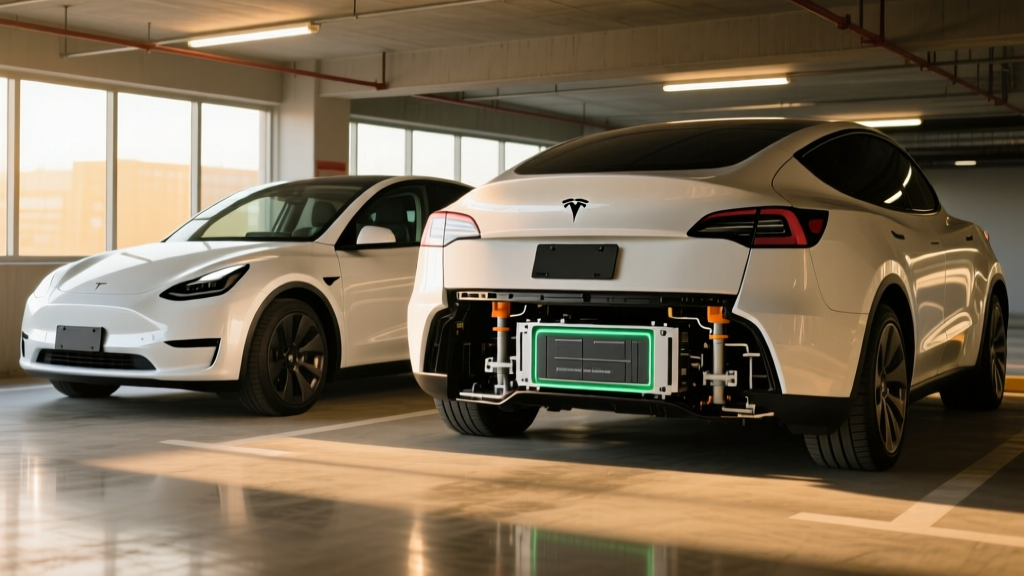
Tesla has iteratively improved its pack-level safety architecture. The current Model Y (built on the 4680-cell structural battery pack at Giga Texas) uses a fire-retardant potting compound between cells, a reinforced steel-and-aluminum underbody shield, and a cell-to-cell thermal barrier designed to prevent a single failing cell from cascading to its neighbors. The Model 3 Highland refresh (2024+) uses similar isolation strategies with its CATL-sourced LFP packs and Panasonic/LG NMC packs depending on trim.
It's worth noting that Tesla issued several recalls in 2024–2025 related to software monitoring of battery health — specifically, over-the-air updates to improve early detection of anomalous cell voltage behavior. These recalls actually demonstrate the monitoring systems working as intended: catching potential issues before they become fires.
2026 Tesla Model Y: Full Specs, Range, and Safety Profile
The Model Y remains Tesla's volume leader and the best-selling EV in the United States. Here's the complete spec profile for the 2026 model year:
| Spec | Long Range AWD | Performance |
|---|---|---|
| EPA Range | 320 miles | 295 miles |
| Battery (usable) | ~75 kWh, NMC (4680 structural) | ~75 kWh, NMC (4680 structural) |
| Efficiency | 122 MPGe / 27 kWh/100mi | 117 MPGe / 29 kWh/100mi |
| 0–60 mph | 4.8 sec | 3.5 sec |
| Horsepower | 384 hp (dual motor) | 456 hp (dual motor) |
| Max DC Fast Charge | 250 kW peak | 250 kW peak |
| 10–80% DCFC Time | ~27 minutes | ~27 minutes |
| Level 2 Home Charge | 11.5 kW (~44 mi/hr) | 11.5 kW (~44 mi/hr) |
| Cargo Volume | 76 cu ft (rear seats folded) | 76 cu ft (rear seats folded) |
| Rear Legroom | 41.6 in | 41.6 in |
| Base MSRP | $46,630 | $51,630 |
| Battery Warranty | 8 yr / 120,000 mi | 8 yr / 120,000 mi |
2026 Tesla Model 3: Full Specs, Range, and Safety Profile
The refreshed Model 3 (Highland and subsequent updates) is Tesla's entry point and a perennial best-seller. Here's the 2026 breakdown:
| Spec | RWD (Standard Range) | Long Range AWD | Performance |
|---|---|---|---|
| EPA Range | 272 miles | 341 miles | 315 miles |
| Battery (usable) | ~57.5 kWh, LFP (CATL) | ~75 kWh, NMC | ~75 kWh, NMC |
| Efficiency | 132 MPGe / 25 kWh/100mi | 130 MPGe / 26 kWh/100mi | 120 MPGe / 28 kWh/100mi |
| 0–60 mph | 5.8 sec | 4.2 sec | 2.9 sec |
| Horsepower | 271 hp (RWD) | 346 hp (dual motor) | 510 hp (dual motor) |
| Max DC Fast Charge | 170 kW peak | 250 kW peak | 250 kW peak |
| 10–80% DCFC Time | ~30 minutes | ~25 minutes | ~25 minutes |
| Level 2 Home Charge | 11.5 kW (~44 mi/hr) | 11.5 kW (~44 mi/hr) | 11.5 kW (~44 mi/hr) |
| Cargo Volume | 23 cu ft (rear up) | 23 cu ft (rear up) | 23 cu ft (rear up) |
| Rear Legroom | 35.3 in | 35.3 in | 35.3 in |
| Base MSRP | $38,990 | $45,630 | $52,990 |
| Battery Warranty | 8 yr / 100,000 mi | 8 yr / 120,000 mi | 8 yr / 120,000 mi |
Charging Speed in Detail: What Tesla Owners Actually Experience
Charging speed is where Tesla still holds an edge — not because of peak kW numbers, but because of the Supercharger network. As of 2026, Tesla operates over 6,500 Supercharger stalls in the US, and the navigation system automatically preconditions the battery en route to a charger, which is critical for hitting advertised charge speeds.
| Charging Level | Power (kW) | Miles Added per Hour | Use Case |
|---|---|---|---|
| Level 1 (120V household) | ~1.4 kW | ~3–5 mi/hr | Emergency / overnight trickle |
| Level 2 (240V home, Wall Connector) | 11.5 kW | ~44 mi/hr | Daily home charging |
| DC Fast (V3 Supercharger, NMC trims) | 250 kW peak | ~200 mi in 15 min | Road trips |
| DC Fast (V3 Supercharger, LFP RWD) | 170 kW peak | ~140 mi in 15 min | Road trips (slower curve) |
Charging curve reality check: The 250 kW peak on NMC trims only holds roughly from 10% to 30% state of charge. By 50%, you're at ~150 kW. By 80%, you've tapered to ~60 kW. The 10–80% time of 25 minutes is accurate, but don't expect 250 kW sustained — that's not how lithium-ion charging physics works. LFP trims have a flatter, lower curve, which means more consistent but slower charging throughout the session.
Pricing, Tax Credits, and True Cost to Buy
Tesla pricing has fluctuated frequently, but as of early 2026, here's where the lineup sits — and more importantly, what you'll actually pay after the federal EV tax credit.
| Model / Trim | Base MSRP | §30D Credit | Effective Price* |
|---|---|---|---|
| Model 3 RWD | $38,990 | $3,750–$7,500 | $31,490–$35,240 |
| Model 3 Long Range AWD | $45,630 | $3,750–$7,500 | $38,130–$41,880 |
| Model Y Long Range AWD | $46,630 | $3,750–$7,500 | $39,130–$42,880 |
| Model Y Performance | $51,630 | $3,750–$7,500 | $44,130–$47,880 |
*Effective price assumes full credit eligibility. Actual credit amount depends on battery sourcing compliance.
- MSRP cap: Sedans (Model 3) must be under $55,000; SUVs/trucks (Model Y) under $80,000 — all trims qualify.
- Income cap: Buyer AGI must not exceed $150,000 (single), $225,000 (head of household), or $300,000 (joint filers).
- Battery sourcing: The credit splits into two halves — $3,750 for critical minerals sourcing and $3,750 for battery component manufacturing. Tesla's US-built 4680 cells and domestic pack assembly generally satisfy the component requirement, but critical mineral sourcing (lithium, nickel) compliance varies by batch and model year. Check the official fueleconomy.gov listing for your specific VIN before purchase.
- Point-of-sale transfer: As of 2024, you can transfer the credit to the dealer at purchase, reducing your out-of-pocket cost immediately rather than waiting until tax filing.
Consult a tax professional or the IRS §30D page for your specific eligibility.
Standout Tech and Notable Drawbacks
What Tesla does better than anyone:
- Supercharger network: Still the most reliable, best-maintained DC fast-charging network in North America. Plug-and-charge with no app fumbling.
- Over-the-air updates: Tesla pushes meaningful software improvements (efficiency tweaks, new features, safety patches) regularly — your car genuinely improves after purchase.
- Thermal management: Tesla's heat pump and octovalve system remain class-leading for efficiency in cold weather and charge preconditioning.
- Infotainment: The 15.4-inch center screen is fast, responsive, and integrates navigation, media, and vehicle controls seamlessly. No Apple CarPlay or Android Auto, but the native system is good enough that most owners stop missing them.
Where Tesla still falls short:
- No Apple CarPlay / Android Auto: For a $40K+ vehicle in 2026, this remains a dealbreaker for some buyers.
- Build quality inconsistency: Panel gaps, paint imperfections, and interior rattle complaints persist, though they've improved markedly since the Fremont-only era.
- Autopilot / FSD is Level 2 — NOT self-driving: Tesla's Full Self-Driving (Supervised) is a capable Level 2 driver-assist system, but you must keep your eyes on the road and hands ready to intervene. It does not drive the car autonomously. Only Level 4 services like Waymo operate without a human driver.
- LFP cold-weather limitations: The base Model 3 RWD's LFP battery loses more range in freezing temps and charges slower on DCFC than NMC trims.
- Minimalist interior: No instrument cluster, no physical stalks (turn signals are on the steering wheel buttons in the refreshed Model 3). Some drivers adapt quickly; others never do.
✓ Pros
- Best-in-class Supercharger network access
- Excellent efficiency (122–132 MPGe)
- Top NHTSA/IIHS safety ratings
- OTA updates keep the car current
- Strong acceleration across all trims
- Point-of-sale tax credit transfer available
✗ Cons
- No CarPlay/Android Auto
- LFP RWD struggles in cold weather
- Build quality still inconsistent
- FSD costs $8,000 extra and is Level 2 only
- Rear seat space tight in Model 3
- Insurance premiums above segment average
Is a Tesla Worth Buying vs. Key Competitors in 2026?
The Model Y competes directly with the Hyundai Ioniq 5, Ford Mustang Mach-E, Kia EV6, and Chevrolet Equinox EV. The Model 3 faces the Hyundai Ioniq 6, BMW i4, and Polestar 2.
Choose Tesla if: You prioritize charging infrastructure reliability, software sophistication, and efficiency above all else. The Supercharger network is a genuine competitive moat for road-trippers, and Tesla's energy management is still the benchmark.
Choose a competitor if: You want CarPlay, prefer a more traditional interior layout, need a smoother ride (Tesla's suspension tuning is firm), or want to avoid Tesla brand association. The Ioniq 5 charges faster on 350 kW chargers (800V architecture), and the Mach-E offers a more conventional crossover feel.
On fire safety specifically: there is no evidence that Tesla vehicles present a higher fire risk than competing EVs. The Hyundai Ioniq 5, Ford Mach-E, and Chevrolet Bolt have all had their own battery-related recalls. This is an industry-wide engineering challenge, not a Tesla-specific one.
Who Should Buy a Tesla — And Who Shouldn't
Best for:
- Home-charging commuters who can install a Level 2 charger and wake up to a full battery every morning — the daily ownership experience is unbeatable.
- Tech-forward buyers who value software updates, app integration, and a minimalist interface.
- Frequent road-trippers who will leverage the Supercharger network for multi-state travel.
- Model Y families needing crossover cargo space with EV running costs.
Skip if:
- You live in an apartment without charging access and your area has sparse public charging.
- You drive in extreme cold regularly and want maximum winter range (consider the Long Range AWD trims, not the LFP RWD).
- You need CarPlay or physical controls and know they're dealbreakers for you.
- You're buying primarily on safety fears about "Tesla fires" — the data shows EVs are statistically safer from fire than gas cars, across all brands.
Frequently Asked Questions
How common are Tesla fires compared to gas cars?
Based on NFPA and NHTSA data, EVs experience roughly 25 fires per 100,000 vehicles, while gasoline vehicles experience approximately 1,529 per 100,000. Tesla's rate is in line with or slightly below the EV average. You are statistically far more likely to experience a fire in a gas car.
What is the real-world range of the Model Y and Model 3?
The Model Y Long Range AWD delivers 260–285 real-world highway miles (EPA: 320). The Model 3 Long Range AWD achieves roughly 290–310 miles (EPA: 341). The Model 3 RWD with LFP battery manages 230–250 miles in fair weather and 190–215 in freezing temps (EPA: 272).
How fast does a Tesla charge at home and on the road?
At home on a Level 2 Wall Connector (11.5 kW), both models add roughly 44 miles of range per hour — a full overnight charge from 20% to 100% takes about 7–8 hours. On a V3 Supercharger, NMC trims peak at 250 kW (10–80% in ~25 min), while the LFP RWD peaks at 170 kW (10–80% in ~30 min).
Does Tesla qualify for the $7,500 federal tax credit?
Yes, but eligibility depends on your income (AGI caps apply), the vehicle's MSRP (all current trims fall under the cap), and battery sourcing compliance. The credit can be $3,750 or $7,500 depending on critical mineral and component sourcing. Verify at fueleconomy.gov for your specific VIN and consult a tax professional. Point-of-sale transfer is available.
Is Tesla's Autopilot or FSD actually self-driving?
No. Both Autopilot and Full Self-Driving (Supervised) are SAE Level 2 driver-assist systems. You must remain alert, keep your eyes on the road, and be ready to take over at any moment. They are not autonomous. Only Level 4 services like Waymo operate without a human driver in the loop.
Are LFP batteries safer from fire than NMC?
LFP (lithium iron phosphate) chemistry is inherently more thermally stable than NMC (nickel manganese cobalt). LFP cells are less prone to thermal runaway and release less oxygen during failure, making fires less likely and less intense. The Model 3 RWD's LFP pack is, from a chemistry standpoint, the safest battery Tesla offers.
What does Tesla's battery warranty cover?
Tesla covers the battery and drive unit for 8 years / 100,000 miles (RWD trims) or 8 years / 120,000 miles (Long Range and Performance trims). The warranty guarantees the battery will retain at least 70% of its original capacity during the coverage period. If degradation exceeds 30%, Tesla will repair or replace the pack.