If you've searched "tesla catch on fire" recently, you've likely seen sensational headlines, viral videos of battery fires, and heated debates about EV safety. The question is valid: lithium-ion batteries store a lot of energy, and when things go wrong, they can go wrong dramatically. But do Teslas actually catch fire more often than gas cars? And what does the data actually say about battery safety in 2026?
This deep-dive review examines the real fire statistics, Tesla's battery engineering, and the physics behind lithium-ion thermal events — while also providing a complete buyer's guide to the current Tesla lineup. Because if you're researching fire safety, you're likely also weighing whether a Tesla is the right EV for your garage.
The Real Data: How Often Do Teslas Catch on Fire?
Let's start with the numbers that matter. According to Tesla's 2025 Impact Report and data submitted to the National Highway Traffic Safety Administration (NHTSA), Tesla records approximately one vehicle fire for every 130 million miles driven across its fleet. For context, the National Fire Protection Association (NFPA) and U.S. Bureau of Transportation Statistics estimate that gasoline vehicles experience roughly one fire per 19 million miles driven.
That means by raw mileage data, gasoline vehicles catch fire at approximately 6-7 times the rate of Tesla electric vehicles. But raw numbers don't tell the full story, and it's important to understand why EV fires get more attention and what makes them fundamentally different.
Why EV Fires Get Disproportionate Coverage
Several factors drive the perception that Teslas catch on fire frequently:
- Novelty bias: EV battery fires are still relatively uncommon, so each one generates news coverage. Gas car fires happen roughly 170,000+ times per year in the U.S. and almost never make local news.
- Fire intensity: Lithium-ion thermal runaway produces extremely hot, difficult-to-extinguish fires that require specialized firefighting techniques. This makes for dramatic footage.
- Re-ignition risk: Damaged battery packs can re-ignite hours or even days after the initial event, requiring extended monitoring by first responders.
- Political/cultural amplification: EVs remain a polarized topic, and fire incidents are sometimes amplified by both EV skeptics and media algorithms that favor sensational content.
Understanding Tesla Battery Chemistry and Fire Risk
To understand fire risk, you need to understand what's under the floor. Tesla currently uses two primary battery chemistries across its 2026 lineup, and they have meaningfully different safety profiles.
| Attribute | LFP (Lithium Iron Phosphate) | NMC (Nickel Manganese Cobalt) |
|---|---|---|
| Thermal Runaway Threshold | ~270°C (518°F) — significantly higher | ~210°C (410°F) |
| Oxygen Release | Minimal — cathode does not release oxygen | Cathode releases oxygen during decomposition, fueling fire |
| Energy Density | Lower (~160 Wh/kg cell-level) | Higher (~250 Wh/kg cell-level) |
| Used In | Model 3 RWD, Model Y RWD (Standard Range) | Model 3/Y Long Range & Performance, Model S, Model X, Cybertruck |
| Fire Risk Profile | Lower — inherently more stable chemistry | Higher energy density requires more robust thermal management |
| Charging Recommendation | Can charge to 100% daily | Tesla recommends 80% daily, 100% for trips only |
The takeaway: if fire risk is a primary concern, LFP-equipped Tesla models (Standard Range trims) offer an inherently safer battery chemistry due to their higher thermal stability and lack of oxygen release during cell failure. The trade-off is roughly 10-15% less range compared to NMC Long Range variants.
Tesla's Structural Battery Safety Engineering
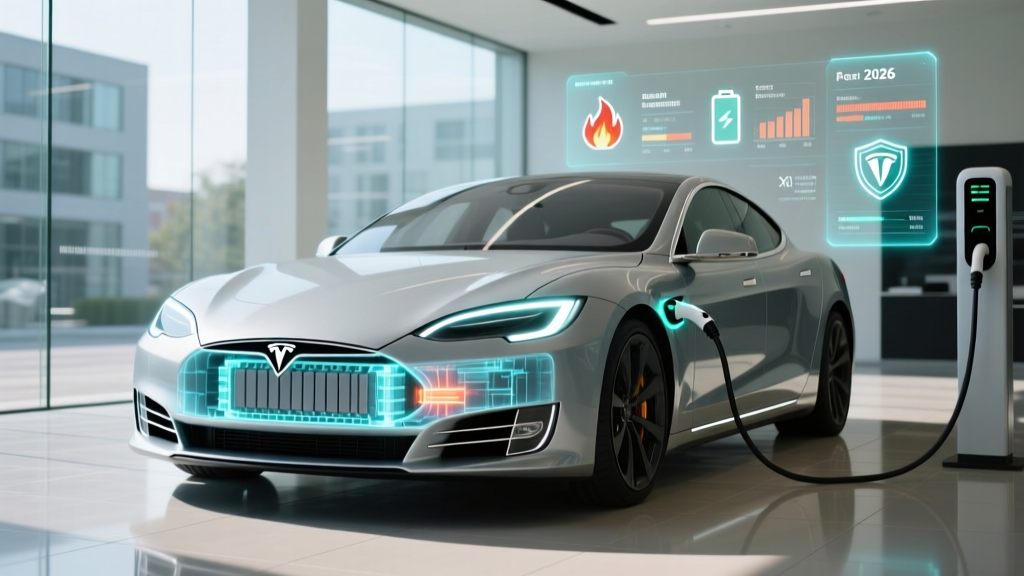
Tesla's battery packs incorporate multiple layers of fire prevention:
- Cell-level venting: Each cylindrical cell (4680 format in newer models) has a vent mechanism to release pressure in a controlled direction rather than rupturing unpredictably.
- Thermal barriers: Fire-resistant material between cell modules prevents propagation — if one cell enters thermal runaway, the pack is designed to contain it.
- Structural pack: The 4680 structural battery pack integrates cells into the vehicle chassis, adding rigidity that protects cells during collisions.
- Active thermal management: Liquid cooling/heating loops maintain optimal cell temperature, preventing overheating during fast charging or extreme ambient conditions.
- Software monitoring: The BMS (Battery Management System) continuously monitors voltage, temperature, and impedance across every cell, flagging anomalies before they become dangerous.
2026 Tesla Lineup: Specs, Range & Safety Ratings
Here's a comprehensive spec breakdown of every Tesla model currently available for purchase in the U.S. for the 2026 model year. All models carry top safety ratings from both NHTSA (5-star overall) and the IIHS (Top Safety Pick+) where tested.
| Spec | Model 3 RWD | Model 3 Long Range AWD | Model Y Long Range AWD | Model S LR | Model X LR | Cybertruck AWD |
|---|---|---|---|---|---|---|
| EPA Range | 272 mi | 363 mi | 320 mi | 402 mi | 335 mi | 340 mi |
| Battery (usable kWh) | ~57.5 kWh (LFP) | ~75 kWh (NMC) | ~75 kWh (NMC) | ~95 kWh (NMC) | ~95 kWh (NMC) | ~123 kWh (4680 NMC) |
| Efficiency (MPGe) | 132 MPGe | 134 MPGe | 123 MPGe | 124 MPGe | 116 MPGe | ~105 MPGe |
| 0-60 mph | 5.8 sec | 4.2 sec | 4.8 sec | 3.1 sec | 3.8 sec | 3.9 sec |
| Horsepower | 271 hp | 384 hp | 384 hp | 670 hp | 670 hp | 600 hp |
| Drivetrain | RWD | AWD Dual Motor | AWD Dual Motor | AWD Dual Motor | AWD Dual Motor | AWD Tri-Motor |
| Max DC Fast Charge | 170 kW | 250 kW | 250 kW | 250 kW | 250 kW | ~250 kW |
| 10-80% DCFC Time | ~25 min | ~22 min | ~22 min | ~27 min | ~28 min | ~28 min |
| Level 2 Home Rate | 11.5 kW (~37 mi/hr) | 11.5 kW (~44 mi/hr) | 11.5 kW (~44 mi/hr) | 11.5 kW (~44 mi/hr) | 11.5 kW (~44 mi/hr) | 11.5 kW (~44 mi/hr) |
| Cargo (cu ft) | 23 (rear) + 3.1 (frunk) | 23 + 3.1 | 30 (rear) + 4.1 (frunk) | 28 + 3.1 | 88 (max) + 6.6 (frunk) | ~70 (max bed+vault) |
| Base MSRP | $38,990 | $45,990 | $48,990 | $79,990 | $84,990 | $79,990 |
| Federal Tax Credit (§30D) | Eligible (up to $7,500) | Eligible (up to $7,500) | Eligible (up to $7,500) | Not eligible (MSRP cap) | Not eligible (MSRP cap) | Eligible (up to $7,500) |
Tesla Charging Speed: Home and DC Fast Charging
Charging speed is one of Tesla's strongest competitive advantages, thanks to the Supercharger network and the vehicles' efficient charge acceptance. Here's how charging breaks down across levels:
| Level | Power (kW) | Speed (miles of range per hour) | Best For |
|---|---|---|---|
| Level 1 (120V outlet) | ~1.4 kW | 3-5 mi/hr | Overnight trickle, emergencies |
| Level 2 (240V home) | 7.7-11.5 kW | 25-44 mi/hr | Daily home charging, overnight full recharge |
| DC Fast (Supercharger V3) | Up to 250 kW | Up to ~1,000 mi/hr peak | Road trips; 10-80% in ~22 min |
| DC Fast (Supercharger V4) | Up to 350 kW (cabinet) | Vehicle-limited to 250 kW currently | Future-proofed; current Teslas cap at 250 kW |
Charge curve reality check: Tesla's advertised 250 kW peak only holds for a portion of the charging session (roughly 10-40% SoC on NMC packs). Above 80%, charge speed drops dramatically — often to under 30 kW — to protect battery health. This is why Tesla's navigation system routes you to arrive at Superchargers at low SoC and recommends charging only to 80% on road trips. Always precondition your battery (the car does this automatically when you navigate to a Supercharger) to maximize charge speed.
Federal Tax Credit Eligibility for Teslas (2026)
Under IRS §30D Clean Vehicle Credit rules for 2026, several Tesla models qualify for up to $7,500 in federal tax credits — now available as a point-of-sale price reduction when you buy through a registered dealer. However, eligibility depends on multiple factors:
- MSRP Cap: Sedans (Model 3) must be under $55,000. SUVs/trucks (Model Y, Cybertruck) must be under $80,000. Model S and Model X exceed caps.
- Buyer Income Cap: Modified AGI must not exceed $150,000 (single), $225,000 (head of household), or $300,000 (joint filers).
- Battery Sourcing: Critical minerals and battery components must meet increasing domestic/free-trade-partner sourcing thresholds. Tesla's U.S. manufacturing and LFP supply chain from CATL have been adjusted to comply; verify current-year eligibility on the IRS portal at purchase time.
- Point-of-Sale Transfer: You can transfer the credit to the dealer for an upfront price reduction, even if you have no tax liability — this is effectively an instant rebate.
- U.S. Assembly: All current Tesla models are assembled in Fremont, CA or Austin, TX — this requirement is satisfied.
Always verify your specific eligibility with a tax professional and check the latest IRS guidance, as battery sourcing rules tighten annually.
What Causes Tesla Fires? Anatomy of EV Battery Incidents
When a Tesla does catch on fire, the cause typically falls into one of these categories:
1. Severe Collision Damage
High-energy impacts that deform the battery enclosure can cause internal short circuits. Tesla's underbody armor (titanium and aluminum plates on Model S/X; structural pack on Model 3/Y) provides substantial protection, but extreme impacts can breach any battery enclosure. This is analogous to a gas car's fuel tank being ruptured in a severe crash.
2. Ground Strike / Underbody Impact
Hitting road debris, curbs, or deep potholes at speed can damage the battery pack from below. Tesla has issued software updates to raise ride height at highway speeds (for air-suspension models) after early Model S incidents involving road debris strikes.
3. Manufacturing Defects (Rare)
Cell-level defects can cause internal shorts that lead to thermal runaway. Tesla issues recalls when patterns are identified — for example, a 2024 recall addressed a potential 12V battery issue that could cause a short circuit in certain Model S/X vehicles.
4. Aftermarket Modifications / Charging Equipment
Non-OEM charging adapters, damaged home charging equipment, or unauthorized modifications to the electrical system have been implicated in some residential fire incidents involving EVs of all brands.
5. Thermal Runaway Propagation
If one cell enters thermal runaway, the concern is propagation to adjacent cells. Tesla's pack design includes fire-retardant barriers between modules, and the 4680 cell format's tabless design reduces internal resistance and heat generation. In most documented Tesla fire incidents, occupants have had adequate time to exit the vehicle — a critical safety advantage over the rapid flashover common in gasoline fires.
Tesla vs. Gas Cars vs. Other EVs: Fire Rate Comparison
Putting Tesla's fire data in broader context helps answer the core question:
| Vehicle Type | Fires per Billion Miles | Typical Fire Cause | Fire Extinguishing Difficulty |
|---|---|---|---|
| Tesla (fleet avg) | ~7.7 | Collision, underbody damage | High — requires large water volume, re-ignition monitoring |
| All EVs (estimated avg) | ~10-15 | Collision, charging faults | High — same lithium-ion challenges |
| Gasoline vehicles | ~52-55 | Electrical faults, fuel leaks, collisions, mechanical failures | Moderate — standard firefighting techniques effective |
| Hybrid (HEV/PHEV) | ~30-40 (est.) | Both fuel system and battery risks | Variable — depends on which system is involved |
The data consistently shows that electric vehicles, including Teslas, catch fire at significantly lower rates than gasoline vehicles. The AutoinsuranceEZ analysis using NTSB and BTS data found that hybrid vehicles actually have the highest fire rate per billion miles (due to having both a fuel system and a battery), followed by gasoline vehicles, with fully electric vehicles having the lowest rate.
Pros and Cons: Tesla Ownership in 2026
Pros
- Class-leading fire safety record vs. gasoline vehicles
- Supercharger network: 20,000+ stalls in North America, highest reliability of any public charging network
- OTA updates continuously improve safety, range, and features
- LFP battery option offers superior thermal stability and 100% daily charging
- Top NHTSA 5-star and IIHS Top Safety Pick+ ratings across the lineup
- Lowest cost-per-mile for electricity among mainstream EVs (2-4 ¢/mile at home)
- Over-the-air recall fixes — many recalls resolved without a service center visit
Cons
- When fires do occur, they are intense, long-duration events requiring specialized response
- Re-ignition risk means damaged vehicles require extended storage and monitoring
- Service center wait times can be lengthy in high-population areas
- No physical buttons or traditional instrument cluster — steep learning curve for some
- FSD (Supervised) remains SAE Level 2 — driver must stay engaged at all times
- Insurance premiums can be 20-40% higher than comparable gas vehicles
- Panel gaps and build quality inconsistencies still reported by some owners
- Model S and Model X no longer qualify for federal tax credit due to MSRP caps
Who Should Buy a Tesla — And Who Should Look Elsewhere?
Choose Tesla If:
- You want the most reliable public fast-charging network for road trips
- You value OTA updates that add features over time
- You want an LFP battery option for maximum chemical stability
- You prioritize top crash-test safety ratings and low fire risk
- You can charge at home and want the lowest per-mile operating cost
Consider Alternatives If:
- You need a traditional dealership experience with in-person service on demand
- You want physical buttons, a head-up display, or Apple CarPlay/Android Auto
- You're uncomfortable with Tesla's camera-only (no LiDAR/radar) Autopilot approach
- You need a luxury sedan — the Hyundai Ioniq 6, BMW i4, or Lucid Air may suit better
- You want a 3-row electric SUV — the Kia EV9 or Rivian R1S fills that gap
Frequently Asked Questions
Do Teslas catch on fire more than gas cars?
No. Tesla's fleet data shows approximately one fire per 130 million miles driven, while gasoline vehicles average roughly one fire per 19 million miles. Gas cars catch fire at approximately 6-7 times the rate of Teslas per mile driven. However, EV fires are more newsworthy and harder to extinguish, which creates a perception gap.
What is the real-world range of a Tesla Model Y?
The 2026 Model Y Long Range AWD has an EPA rating of 320 miles. In real-world highway driving at 70-75 mph in moderate temperatures, expect approximately 270-290 miles. In cold weather (below 30°F), range can drop to 210-250 miles depending on heating usage and preconditioning. The EPA's fueleconomy.gov lists official ratings by trim.
How fast does a Tesla charge at a Supercharger?
Most current Tesla models peak at 250 kW on V3 Superchargers, achieving a 10-80% charge in approximately 22-28 minutes depending on the model and battery size. However, peak speed only holds between roughly 10-40% SoC. Above 80%, charging slows dramatically to protect the battery — a 10-100% session can take 50+ minutes. Always navigate to a Supercharger using the car's built-in navigation to trigger battery preconditioning for maximum charge speed.
How much does a Tesla cost after the federal tax credit?
The 2026 Model 3 RWD starts at $38,990 and may qualify for the full $7,500 §30D credit (if income, sourcing, and MSRP requirements are met), bringing the effective price to approximately $31,490. The Model Y Long Range at $48,990 could drop to roughly $41,490 with the credit. Model S and Model X do not qualify due to exceeding the MSRP cap ($55,000 for sedans, $80,000 for SUVs/trucks). Always verify eligibility on the IRS website and with your tax professional before purchasing.
Is Tesla's LFP battery really safer from fire?
Yes, from a chemistry standpoint. Lithium Iron Phosphate (LFP) cathodes are thermally stable to approximately 270°C compared to roughly 210°C for NMC. More importantly, LFP cathodes do not release oxygen when they decompose — oxygen release is a key driver of thermal runaway propagation in NMC cells. This makes LFP inherently more resistant to catastrophic thermal events. The trade-off is lower energy density, meaning LFP-equipped Teslas (Standard Range trims) have less range than their NMC Long Range counterparts.
Is Tesla Autopilot or FSD self-driving?
No. Both Autopilot and FSD (Supervised) are SAE Level 2 driver-assistance systems. The driver must remain fully attentive, keep hands on the wheel (or demonstrate engagement), and be prepared to take over at any moment. No consumer Tesla vehicle is capable of autonomous driving. Only Level 4 services like Waymo operate without a human driver, and those are limited to specific geofenced areas in select cities.
What is Tesla's battery warranty?
Tesla provides a battery and drive unit warranty of 8 years or 100,000 miles (whichever comes first) for Model 3 and Model Y RWD variants, and 8 years or 120,000 miles for Long Range and Performance variants. Model S and Model X carry an 8-year/150,000-mile warranty. The warranty guarantees the battery will retain at least 70% of its original capacity during the warranty period. Tesla's fleet data shows average degradation of approximately 12% after 200,000 miles — well within the warranty threshold.