Why Tesla Feedback Matters More Than Spec Sheets
Numbers on a window sticker tell one story. Six months of daily driving, road trips, and Supercharger stops tell another. The 2026 Tesla Model Y Long Range AWD remains the best-selling EV in the United States, but the gap between marketing claims and garage reality is where purchase decisions are actually made. This review synthesizes owner-reported Tesla feedback — range observations, charging-curve realities, software quirks, and long-term satisfaction — alongside verified EPA and manufacturer data to give you the full picture before you sign.
If you are cross-shopping the Model Y against the Hyundai Ioniq 5, Ford Mustang Mach-E, or Chevrolet Equinox EV, the details below will surface the trade-offs that spec sheets bury.
2026 Model Y Long Range AWD: Core Specifications
| Attribute | Value |
|---|---|
| EPA Estimated Range | 320 miles |
| Battery (Usable) | ~75 kWh, NMC (Nickel Manganese Cobalt) |
| Drivetrain | Dual-Motor AWD |
| Horsepower | 384 hp (combined) |
| 0–60 mph | 4.8 seconds |
| Peak DC Fast Charge | 250 kW (CCS via NACS adapter or native NACS) |
| 10–80% DC Fast Charge | ~27 minutes |
| Level 2 Home Charge Rate | 11.5 kW (~44 miles/hr) |
| EPA Efficiency | 122 MPGe combined / 28 kWh/100 mi |
| Cargo Volume (rear seats up / folded) | 34.3 cu ft / 76.2 cu ft |
| Rear Legroom | 37.0 inches |
| Battery & Drive Unit Warranty | 8 years / 120,000 miles |
| Base MSRP | $44,990 (before destination) |
Real-World Range: What Owners Actually Report
Real-World Expectation: 260–290 miles at highway speeds (70–75 mph); 200–230 miles in sub-30°F winter conditions with cabin heat.
The most consistent piece of Tesla feedback from Model Y owners is that the EPA 320-mile figure is achievable in mixed city driving at moderate temperatures, but highway-heavy trips shave 10–15% off that number. At a sustained 75 mph on a flat interstate in 70°F weather, expect roughly 275 miles before the buffer warning. Add a headwind or mountain passes and 260 miles is a safer planning number.
Cold weather is where NMC chemistry shows its limits. Below freezing, owners report 20–30% range reduction depending on whether the car is preconditioned and garaged. Tesla's heat pump — standard on the refreshed Model Y — recovers some efficiency versus older resistive heaters, but physics still wins. If your commute is under 60 miles round-trip and you garage the car, winter range loss is an inconvenience rather than a crisis. For 300-mile winter road trips, plan a charge stop you wouldn't need in July.
Source: EPA Fuel Economy — 2026 Tesla Model Y
Charging Speed: DC Fast, Level 2, and the Curve Reality
The 2026 Model Y Long Range peaks at 250 kW on a V3 Supercharger or equivalent CCS station. But peak kW is not sustained kW — this is where owner Tesla feedback diverges sharply from marketing bullet points.
| Charging Level | Power (kW) | Miles Added per Hour | Typical Use Case |
|---|---|---|---|
| Level 1 (120V household) | ~1.4 kW | ~5 mi/hr | Emergency / trickle top-up |
| Level 2 (240V, 48A Wall Connector) | 11.5 kW | ~44 mi/hr | Overnight home charging |
| DC Fast (peak) | 250 kW | ~1,000 mi/hr (at peak) | Road trips, 10–80% in ~27 min |
| DC Fast (sustained avg 10–80%) | ~130 kW avg | — | Real-world average across curve |
The charge curve is aggressive: the car pulls close to 250 kW only between roughly 10–25% State of Charge (SoC). By 50% SoC, power tapers to around 120 kW, and above 80% it drops below 50 kW to protect the NMC cells. This is why Tesla and the Supercharger network default to an 80% charge limit at busy stations. For road-trip planning, the practical metric is 10–80% in approximately 27 minutes — enough for a restroom break and coffee, but not a full sit-down meal.
Preconditioning matters. If you navigate to a Supercharger using the car's built-in navigation, the battery thermal management system begins warming the pack 10–20 miles out, enabling faster initial charge rates. Owners who report slow initial charging often skipped preconditioning by using third-party routing or arriving at a charger without navigation guidance.
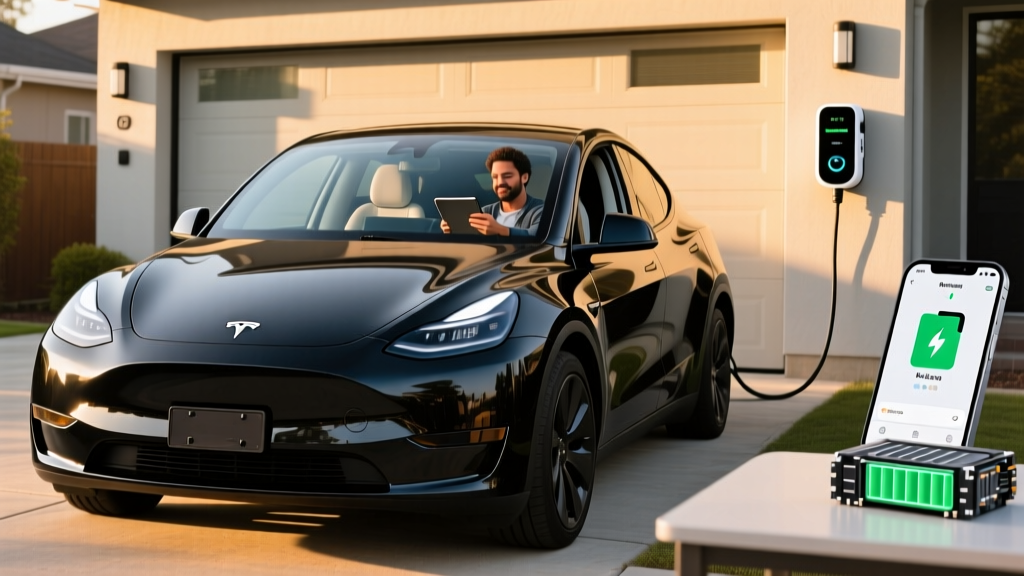
Home charging on a Tesla Wall Connector (48A, 240V) delivers a full charge from 20% to 100% in roughly 7–8 hours — sufficient for any daily commute. Installation costs vary widely: expect $500–$2,500 depending on panel proximity and whether your home needs a 200A service upgrade. Always get a quote from a licensed electrician before purchasing equipment.
Performance, Efficiency, and Daily Drivability
The dual-motor AWD powertrain produces 384 hp and launches the Model Y to 60 mph in 4.8 seconds. That is genuinely quick for a family crossover, and the instantaneous torque makes highway merging effortless. Regenerative braking is strong enough for one-pedal driving in most scenarios, though Tesla removed the user-adjustable regen setting in recent years — it is now a fixed, aggressive calibration that new EV adopters need a week to acclimate to.
Efficiency is a Tesla strong point. At 122 MPGe combined (28 kWh/100 mi), the Model Y Long Range is among the most efficient vehicles in its class. For context, that translates to roughly $0.04–$0.06 per mile on residential electricity at $0.15/kWh, versus $0.12–$0.14/mile for a 28-MPG gas crossover at $3.50/gallon. Over 15,000 annual miles, the fuel savings alone run $900–$1,200 per year before accounting for reduced maintenance (no oil changes, minimal brake wear from regen).
Interior, Cargo, and Tech: The Owner Experience
The minimalist interior is polarizing — Tesla feedback consistently splits between owners who love the clean aesthetic and those who miss physical controls. The 15.4-inch center touchscreen handles everything: climate, mirrors, glovebox, media, and vehicle settings. There is no instrument cluster; speed and navigation appear in the top-left corner of the central display.
Cargo practicality is excellent. With 34.3 cu ft behind the second row and 76.2 cu ft with seats folded, the Model Y swallows more gear than most competitors. The rear trunk floor is low and flat, and the front trunk (frunk) adds useful space for charging cables or a small bag. Rear legroom at 37.0 inches is adequate for adults on shorter trips but tighter than the Ioniq 5's 39.4 inches for tall passengers on long drives.
Infotainment and software remain a Tesla advantage. Over-the-air updates arrive regularly, the built-in navigation is EV-aware (routing through Superchargers with SoC predictions), and the Tesla app provides remote preconditioning, charge monitoring, and vehicle location. Wireless phone mirroring is absent — Tesla uses its own native apps for Spotify, YouTube, etc. — which frustrates CarPlay/Android Auto loyalists.
Autopilot and FSD (Supervised): Standard Autopilot includes adaptive cruise and lane-centering and is competent for highway use. Full Self-Driving (Supervised), an $8,000 option or $99/month subscription, adds automatic lane changes, traffic-light recognition, and city-street navigation. However, FSD is an SAE Level 2 system: the driver must remain fully engaged, hands on the wheel, eyes on the road. It is not autonomous driving. Owner feedback on FSD is mixed — impressive in well-marked suburban areas, unpredictable in construction zones or faded lane markings.
Pricing, Tax Credit Eligibility, and Total Cost
The 2026 Model Y Long Range AWD starts at $44,990 (plus ~$1,390 destination). A Performance trim, with a 3.5-second 0–60 time and 285-mile range, starts at $48,990. As tested with FSD, upgraded wheels, and premium paint, a Long Range can reach $56,000–$58,000.
| Trim | Base MSRP | §30D Credit Eligibility | Effective Price (if eligible) |
|---|---|---|---|
| Long Range AWD | $44,990 | Up to $7,500 (see rules below) | ~$37,490 |
| Performance AWD | $48,990 | Up to $7,500 (see rules below) | ~$41,490 |
Federal §30D tax credit rules (2026): The Model Y qualifies as an SUV under the IRS vehicle-classification, so the MSRP cap is $80,000 — both trims clear this easily. However, the full $7,500 credit depends on:
- Buyer income caps: Modified AGI ≤ $150,000 (single), $225,000 (head of household), $300,000 (joint).
- Battery sourcing: A percentage of critical minerals and battery components must be sourced from the U.S. or free-trade-agreement countries. Tesla has progressively shifted Model Y battery supply to meet these thresholds, but the exact credit amount ($3,750 or $7,500) can change as sourcing rules tighten annually. Verify current eligibility at IRS.gov — Clean Vehicle Credits.
- Point-of-sale transfer: As of 2024+, you can transfer the credit to the dealer at purchase, reducing your out-of-pocket cost immediately rather than waiting for tax filing.
This is not a guaranteed $7,500 for every buyer. Consult a tax professional and check the IRS qualified-vehicles list before relying on a specific credit amount.
Owner Pros and Cons: Unfiltered Tesla Feedback
✓ Pros
- Class-leading efficiency (122 MPGe combined)
- Supercharger network reliability — consistently the most dependable DC fast-charging network in North America
- Strong cargo capacity (76.2 cu ft) with a usable frunk
- Over-the-air updates add features post-purchase
- Low running costs: ~$0.05/mi electricity, minimal brake wear
- 8-yr/120,000-mi battery & drive unit warranty
✗ Cons
- No Apple CarPlay / Android Auto — Tesla-native apps only
- FSD ($8,000) remains Level 2 and inconsistent in complex scenarios
- Rear legroom (37.0 in) trails Hyundai Ioniq 5 and Kia EV6
- Minimalist interior lacks physical buttons — climate/mirrors all on-screen
- NMC battery degrades faster than LFP if routinely charged to 100%
- Insurance premiums 15–30% higher than comparable gas crossovers
Model Y vs. Key Competitors: Is It Still the Default Choice?
The Model Y's dominance faces real pressure in 2026. Here is how it stacks up on the metrics owners care about most:
| Metric | Tesla Model Y LR | Hyundai Ioniq 5 LR AWD | Ford Mustang Mach-E ER AWD |
|---|---|---|---|
| EPA Range | 320 mi | 290 mi | 305 mi |
| Battery (usable) | ~75 kWh NMC | 84 kWh NMC | 91 kWh NMC |
| Peak DC Charge | 250 kW | 238 kW | 150 kW |
| 10–80% DC Time | ~27 min | ~26 min | ~41 min |
| Efficiency (MPGe) | 122 | 110 | 101 |
| Rear Legroom | 37.0 in | 39.4 in | 38.1 in |
| Starting MSRP | $44,990 | $48,500 | $46,995 |
| Charging Network Advantage | Supercharger (native) | CCS (NACS adapter 2025+) | CCS (NACS adapter 2025+) |
The Model Y wins on efficiency, charging infrastructure access, and price. The Ioniq 5 wins on rear-seat comfort and 800V architecture flexibility. The Mach-E appeals to buyers who want a more traditional driving feel and Ford dealer service access. If Supercharger access is your top priority — and for apartment dwellers without home charging, it should be — the Model Y retains a structural advantage even as other brands gain NACS adapter compatibility.
Frequently Asked Questions
What is the real-world range of the 2026 Tesla Model Y?
The EPA rates the Model Y Long Range AWD at 320 miles. In real-world highway driving at 70–75 mph, expect 260–290 miles depending on temperature and terrain. In sub-freezing winter conditions, plan for 200–230 miles. These numbers assume no roof rack and standard 19-inch wheels; the 21-inch wheels reduce EPA range to approximately 295 miles.
How fast does the Model Y charge at home and on the road?
On a Level 2 Tesla Wall Connector (11.5 kW / 48A), the Model Y adds roughly 44 miles of range per hour — a 20–80% charge takes about 4 hours overnight. On a 250 kW DC fast charger, 10–80% takes approximately 27 minutes, though sustained average power is closer to 130 kW due to the charge curve taper above 50% SoC.
Does the 2026 Model Y qualify for the federal EV tax credit?
Yes, the Model Y is on the IRS qualified-vehicles list and clears the $80,000 SUV MSRP cap. However, the full $7,500 credit depends on your income (≤$150K single / ≤$300K joint), and battery critical-mineral and component sourcing requirements that tighten annually. The credit can be transferred to the dealer at point of sale. Always verify current eligibility at IRS.gov and consult a tax professional.
Is the Model Y worth buying vs. the Ioniq 5 or Mach-E?
If you prioritize efficiency, lowest cost per mile, and the most reliable DC fast-charging network, the Model Y is the strongest choice. If rear-seat comfort and physical controls matter more, the Ioniq 5 is a compelling alternative. The Mach-E suits buyers who prefer Ford's dealer network for service. All three are strong — the right answer depends on your commute pattern, passenger needs, and charging access.
How long will the Model Y battery last?
Tesla warranties the battery and drive unit for 8 years or 120,000 miles (whichever comes first), guaranteeing at least 70% capacity retention. Long-term fleet data suggests NMC packs in Teslas lose roughly 10–12% capacity over 100,000 miles when charged primarily to 80% SoC. Habitually charging to 100% accelerates degradation. Unlike LFP batteries (used in the Model 3 RWD), NMC chemistry does not tolerate sustained high-SoC storage well — set your daily charge limit to 80% and only charge to 100% before road trips.
Who is the 2026 Model Y best suited for?
The Model Y Long Range is ideal for: daily commuters with home Level 2 charging, small families needing cargo versatility, road-trippers who want Supercharger network access, and tech-forward buyers comfortable with screen-based controls. It is less ideal for: buyers who need maximum rear-seat legroom for tall adults, those who insist on Apple CarPlay, and fleet or high-mileage drivers who might benefit more from LFP battery chemistry's longer cycle life.
Sources: EPA Fuel Economy (fueleconomy.gov), Tesla Model Y Specifications, IRS Clean Vehicle Tax Credits, IIHS Safety Ratings.