The Quirkiest Easter Egg in EV History — and the Car Behind It
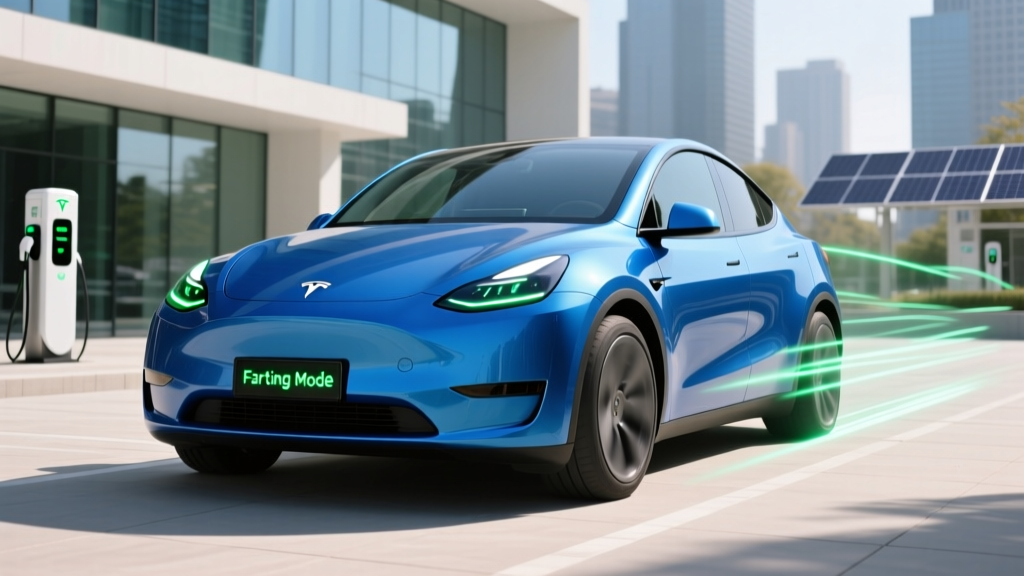
Search "Tesla farting" and you will find thousands of videos, forum threads, and owner demonstrations of one of the most bizarre — and oddly beloved — software features ever put into a production vehicle. Tesla's Fart Mode, buried in the Toybox menu, allows owners to remotely trigger a whoopee-cushion sound through any individual speaker in the cabin via the Tesla mobile app. It is juvenile, it is hilarious, and it has become a cultural shorthand for Tesla's software-first approach to car ownership.
But strip away the prank potential and you are left with a serious question: is the 2026 Tesla Model Y — the vehicle most associated with this Easter egg — actually a compelling EV underneath the novelty? With a refreshed Juniper design, updated battery chemistry options, and a starting price hovering around $44,990, the 2026 Model Y demands a rigorous, number-driven evaluation. This review covers every metric that matters: real-world range, charging curves, tax credit eligibility, and whether this crossover still earns its spot against rivals like the Hyundai Ioniq 5 and Ford Mustang Mach-E.
Range, Battery, and Efficiency: The Numbers That Matter
The 2026 Tesla Model Y Long Range AWD carries an EPA-estimated range of 320 miles on a full charge, powered by an 82 kWh usable battery pack. Tesla has shifted the Long Range variant to a nickel-manganese-cobalt (NMC) chemistry for energy density, while the base Rear-Wheel-Drive trim uses a lithium iron phosphate (LFP) pack rated at approximately 60 kWh usable and 270 miles EPA.
EPA sticker: 320 miles (Long Range AWD). In mixed highway driving at 70-75 mph, expect 275–295 miles before needing a charger. In freezing temperatures (below 32°F), range can drop to 230–260 miles due to battery resistance and cabin heating demands. City driving with regen braking can push closer to or slightly above the EPA figure. Plan road trips around 250-mile legs for a comfortable buffer.
| Spec | RWD (Base) | Long Range AWD | Performance |
|---|---|---|---|
| EPA Range | 270 mi | 320 mi | 295 mi |
| Battery (usable) | ~60 kWh (LFP) | ~82 kWh (NMC) | ~82 kWh (NMC) |
| Efficiency | 133 MPGe / 26 kWh/100mi | 122 MPGe / 28 kWh/100mi | 111 MPGe / 30 kWh/100mi |
| 0–60 mph | 6.6 sec | 4.8 sec | 3.5 sec |
| Horsepower | 295 hp | 384 hp | 456 hp |
| Drivetrain | RWD (single motor) | AWD (dual motor) | AWD (dual motor) |
| Top Speed | 135 mph | 135 mph | 155 mph |
Efficiency on the Long Range AWD sits at approximately 122 MPGe combined (28 kWh per 100 miles), per fueleconomy.gov. That is competitive with the segment, though the Hyundai Ioniq 5 edges slightly ahead at 114 MPGe combined with a larger battery. The Model Y's heat pump — standard across all trims — helps mitigate cold-weather efficiency loss compared to resistive-heater-equipped rivals.
Charging Speed: DC Fast Charging and Home Level 2
Charging speed remains a Tesla stronghold. The 2026 Model Y Long Range supports a peak DC fast-charge rate of 250 kW on Tesla's V3 and V4 Superchargers (CCS-compatible via the NACS connector, now the North American standard). In practice, the charge curve tells the full story:
| Charging Level | Power / Rate | Speed (miles added) | Notes |
|---|---|---|---|
| Level 1 (120V) | ~1.4 kW | ~4 mi/hr | Emergency/trickle only |
| Level 2 (240V, 48A) | 11.5 kW | ~37 mi/hr | Home Wall Connector; full charge in ~7.5 hr |
| DC Fast (peak) | 250 kW | ~200 mi in 15 min | Peak rate up to ~40% SoC |
| DC Fast (10–80%) | — | — | ~22 minutes with battery preconditioned |
The 10–80% time of approximately 22 minutes assumes you have preconditioned the battery — either by navigating to a Supercharger in the car's nav system (which triggers automatic thermal prep) or by manually enabling it. Without preconditioning, especially in cold weather, peak charge rates can be cut in half for the first several minutes as the battery warms. Above 80% State of Charge (SoC), the charge curve tapers significantly; charging from 80–100% can take as long as the 10–80% session. For road trips, the practical play is to charge to 80% and go.
At home, Tesla's Wall Connector delivers up to 11.5 kW (48 amps) on a NEMA 14-50 or hardwired 60A circuit. Most owners report adding roughly 37 miles of range per hour of Level 2 charging, meaning a full overnight session easily replenishes a day's driving. Installation typically runs $800–$2,000 depending on panel proximity and local permitting, though some homes may need a $2,000–$4,000 panel upgrade to support a 60A circuit.
Performance, Ride, and the Juniper Refresh
The Juniper refresh (introduced for the 2025 model year and carried into 2026) brought meaningful improvements to the Model Y's driving dynamics. The Long Range AWD's dual-motor setup produces 384 horsepower and a 0–60 mph time of 4.8 seconds — brisk for a family crossover that weighs roughly 4,400 pounds. The Performance trim drops that to 3.5 seconds with 456 hp, putting it in sports-sedan territory.
Ride quality, historically a Model Y weak point, has improved with revised damping and acoustic glass. Road noise is noticeably lower than pre-2025 models, though the firmer suspension tuning still transmits more impact harshness than a Hyundai Ioniq 5 or Kia EV6 over broken pavement. The steering is quick and precise, if somewhat numb — typical of Tesla's electric power steering calibration.
Regenerative braking remains strong and effectively enables one-pedal driving in most scenarios. Tesla removed the user-adjustable regen setting several years ago, so the intensity is fixed — a point of contention for buyers transitioning from EVs with customizable regen levels.
Interior, Tech, and Yes — the Tesla Farting Easter Egg
The 2026 Model Y interior reflects the Juniper redesign: a cleaner dashboard, ventilated front seats, ambient lighting, a rear-seat touchscreen for passengers, and improved material quality. Cargo space remains a class strength at 30.2 cubic feet behind the second row and 72.1 cubic feet with the rear seats folded — plus an additional 4.1 cubic feet in the front trunk (frunk). Rear legroom measures approximately 41.6 inches, adequate for adults on longer trips.
The 15.4-inch center touchscreen runs Tesla's proprietary infotainment OS — no Apple CarPlay or Android Auto, which remains a dealbreaker for some buyers. What you do get is native Spotify, YouTube, Netflix (while parked), a full web browser, and over-the-air (OTA) software updates that regularly add features.
And then there is the Toybox. The Tesla farting feature — officially called "Fart Mode" — lives here. Using the Tesla mobile app, you can select a specific seat (driver, passenger, rear left, rear right) and trigger one of several whoopee-cushion-style sound effects through that seat's nearest speaker. It has become a rite of passage for new Tesla owners and a popular way to prank passengers. Other Toybox features include Light Show (synchronized headlight and music displays), Sketchpad, and various sound effects for turn signals. These features cost Tesla nothing to develop in relative terms but generate enormous social-media engagement and brand loyalty — a masterclass in software-defined brand personality.
On the driver-assistance front, the Model Y comes standard with Tesla Autopilot (adaptive cruise control + lane centering). The optional Full Self-Driving (Supervised) package, currently priced at $8,000 or $99/month, adds automated lane changes, traffic-light recognition, and city-street navigation. It is critical to understand: FSD is an SAE Level 2 system. The driver must remain fully engaged, hands on or near the wheel, and eyes on the road at all times. It is not autonomous driving.
Tesla Autopilot and FSD (Supervised) are SAE Level 2 driver-assistance systems. They do NOT make the vehicle self-driving. The driver is legally and practically responsible for all vehicle operation at all times. Never rely on these systems in construction zones, during heavy precipitation, or in situations requiring rapid evasive action without driver input.
Pricing, Tax Credits, and Ownership Cost
The 2026 Model Y lineup starts at $44,990 for the Rear-Wheel-Drive trim, $48,990 for the Long Range AWD, and $53,990 for the Performance variant (all prices include destination but exclude options). An as-tested Long Range with FSD, premium paint, and 20-inch wheels can push past $60,000.
| Trim | Base MSRP | §30D Credit Potential | Effective Price (if eligible) |
|---|---|---|---|
| RWD | $44,990 | Up to $7,500 | ~$37,490 |
| Long Range AWD | $48,990 | Up to $7,500 | ~$41,490 |
| Performance | $53,990 | Up to $7,500 | ~$46,490 |
Federal tax credit eligibility under IRS §30D is not guaranteed for every buyer. Key requirements for 2026 include:
- MSRP cap: SUVs/crossovers must be below $80,000 — all Model Y trims qualify.
- Buyer income cap: Modified AGI must not exceed $150,000 (single), $225,000 (head of household), or $300,000 (joint).
- Battery sourcing: A percentage of critical minerals and battery components must be sourced from the U.S. or free-trade-agreement partners. Tesla's U.S. production gives the Model Y an advantage here, but exact credit amounts ($3,750 or $7,500) depend on current-year sourcing thresholds.
- Point-of-sale transfer: Eligible buyers can transfer the credit to the dealer at purchase, reducing the upfront cost rather than waiting for a tax refund.
Always verify current eligibility on IRS.gov and consult a tax professional before relying on the credit in your purchase decision. Rules have shifted annually since the Inflation Reduction Act took effect.
Tesla's battery and drive-unit warranty covers 8 years or 120,000 miles (whichever comes first) on the Long Range and Performance trims, with a minimum 70% capacity retention threshold. The RWD (LFP) variant carries the same 8-year term but at 100,000 miles. The basic vehicle limited warranty is 4 years / 50,000 miles.
Model Y vs. the Competition: Is It Still the One to Beat?
The electric midsize crossover segment is crowded in 2026. Here is how the Model Y Long Range stacks up against its two most-cited alternatives:
| Attribute | Tesla Model Y LR | Hyundai Ioniq 5 Limited | Ford Mustang Mach-E Premium |
|---|---|---|---|
| EPA Range | 320 mi | 305 mi | 312 mi |
| Battery | 82 kWh (NMC) | 84 kWh (NMC) | 91 kWh (NMC) |
| Peak DC Charge | 250 kW | 240 kW | 150 kW |
| 10–80% Time | ~22 min | ~18 min | ~36 min |
| 0–60 mph | 4.8 sec | 5.1 sec | 5.2 sec |
| Base MSRP (AWD) | $48,990 | $53,100 | $51,875 |
| Cargo (rear seats up) | 30.2 cu ft | 27.2 cu ft | 29.7 cu ft |
| Apple CarPlay | No | Yes | Yes |
The Ioniq 5 charges slightly faster (10–80% in roughly 18 minutes thanks to its 800V architecture) and offers CarPlay, but trails on range and cargo space. The Mach-E has a comfortable ride and Ford's BlueCruise, but its 150 kW peak charge rate is a significant road-trip handicap. The Model Y's combination of Supercharger network access, cargo volume, and efficiency keeps it at the top of the segment for most buyers — provided you accept the no-CarPlay stance and Tesla's minimalist interior philosophy.
- Class-leading cargo capacity (30.2 cu ft + frunk)
- Supercharger network reliability — best public charging experience in the U.S.
- Strong efficiency (28 kWh/100mi) translates to lower charging costs
- Continuous OTA updates add features post-purchase
- 250 kW peak DC charging is fast for a 400V architecture
- Fart Mode and Toybox: genuinely fun software touches
- No Apple CarPlay or Android Auto — a hard no for some buyers
- Ride quality improved but still firmer than Ioniq 5 / Mach-E
- FSD at $8,000 remains expensive for a Level 2 system
- Fixed regen intensity — no driver adjustment
- Insurance premiums run 15–30% higher than comparable ICE crossovers
- Panel upgrade may be needed for home Level 2 installation
Choose the Model Y if: you prioritize cargo space, want the most reliable public charging network, value OTA software updates, and don't need CarPlay. It excels as a daily commuter, family hauler, and road-trip vehicle.
Look elsewhere if: you require Apple CarPlay, prefer a softer ride (Ioniq 5), need faster peak charging (Ioniq 5's 800V system), or want a more traditional dealership service experience.
Frequently Asked Questions
What exactly is Tesla Fart Mode and how do I use it?
Fart Mode is a free Easter egg in the Tesla Toybox menu. Open the Tesla app on your phone, navigate to Toybox, and select Fart Mode. You can choose which seat to target (driver, passenger, rear left, rear right) and pick from several sound-effect variations. The sound plays through the speaker nearest to the selected seat. It works whether you are inside the car or standing outside — making it a popular prank tool. Tesla has iterated on the feature over several OTA updates, adding new sounds and even a "Fart on Approach" option that triggers when a specific phone key unlocks the car.
What is the real-world range of the 2026 Tesla Model Y?
The EPA rates the Long Range AWD at 320 miles. Real-world highway driving at 70–75 mph typically yields 275–295 miles. In sub-freezing temperatures, expect 230–260 miles due to battery chemistry limitations and heating loads. City driving with frequent regenerative braking can match or slightly exceed the EPA number.
How fast does the Model Y charge at home and on the road?
On a DC fast charger (Supercharger V3/V4), the Model Y peaks at 250 kW and charges from 10–80% in approximately 22 minutes with a preconditioned battery. At home on a Level 2 Wall Connector (11.5 kW / 48A), it adds about 37 miles of range per hour, fully charging overnight in roughly 7.5 hours.
Does the 2026 Model Y qualify for the $7,500 federal EV tax credit?
All Model Y trims fall under the $80,000 MSRP cap for SUVs. However, full $7,500 eligibility depends on your income (under $150K single / $300K joint), the battery's critical-mineral and component sourcing percentages for the current tax year, and whether you have not exceeded the per-manufacturer credit phase-out. Check the latest rules at IRS.gov and consult a tax professional.
Is the Model Y worth buying over the Ioniq 5 or Mach-E?
For most buyers, yes — the Model Y's Supercharger access, cargo space, efficiency, and resale value give it an edge. If CarPlay support, a softer ride, or faster peak charging (800V architecture) are top priorities, the Ioniq 5 is a strong alternative. The Mach-E appeals to those who prefer a traditional dealer service network and BlueCruise hands-free driving on mapped highways.
How long will the Model Y battery last?
Tesla warranties the Long Range battery for 8 years / 120,000 miles with at least 70% capacity retention. Independent data from Tesla's annual impact reports and third-party fleet analyses suggest NMC packs in Model Y vehicles retain approximately 85–90% capacity at 100,000 miles under normal use. LFP packs (RWD trim) generally show even slower degradation and tolerate regular 100% charging, which Tesla recommends for LFP chemistry.