Why Tesla Fart Noises Became an EV Phenomenon
Search "tesla fart noises" in any EV forum and you'll find threads stretching back to 2019. What started as a hidden Easter egg buried in Tesla's software has become one of the brand's most recognizable — and polarizing — features. The premise is simple: using the car's external pedestrian warning speaker (PWS) or internal cabin speakers, owners can blast a library of flatulence sound effects at unsuspecting passersby, passengers, or friends in the next lane.
But underneath the juvenile humor sits a legitimate question for EV shoppers: what does the presence of features like fart mode tell you about Tesla's software-defined vehicle architecture, and does the underlying hardware — range, charging, battery tech — still compete in 2026? This guide covers the fart-noise feature itself, then dives into the full specs of every current Tesla model that supports it.
How Tesla Fart Mode Actually Works
Tesla's fart sound library lives inside the Toybox menu on the central touchscreen (typically 15.4 inches on Model 3/Y, 17 inches on Model S/X). The feature first appeared via an over-the-air (OTA) update in late 2019 and has been expanded with additional sounds in subsequent software releases.
There are two delivery methods:
- Internal speakers: Plays through the cabin audio system — useful for pranking passengers.
- External Boombox (PWS): On vehicles equipped with the pedestrian warning speaker (standard on all US-market Teslas since 2019 to comply with NHTSA quiet-vehicle rules), you can project sounds outside the car. This is the version that went viral on TikTok and YouTube.
To trigger it: tap Controls → Toybox → Boombox (or Fart Mode depending on software version). You can select from a rotating library of named sounds (e.g., "Chest Bump," "Gone With the Wind," "Riplet," "Not a Fault") and choose whether they play internally, externally, or both. Some owners pair Boombox with the Tesla smartphone app to trigger sounds remotely.
2026 Tesla Lineup: Full Specs at a Glance
Every current-production Tesla — Model 3, Model Y, Model S, and Model X — supports Boombox/fart noises via OTA software. Below is a consolidated spec table for the 2026 model year.
| Spec | Model 3 RWD | Model 3 Long Range AWD | Model Y Long Range AWD | Model S LR | Model X LR |
|---|---|---|---|---|---|
| EPA Range | 363 mi | 346 mi | 320 mi | 402 mi | 335 mi |
| Battery (usable) | ~60 kWh LFP | ~75 kWh NMC | ~75 kWh NMC | ~100 kWh NMC | ~100 kWh NMC |
| Max DC Charge | 170 kW | 250 kW | 250 kW | 250 kW | 250 kW |
| 10–80% DC Time | ~28 min | ~22 min | ~24 min | ~27 min | ~29 min |
| Level 2 Rate | 11.5 kW / ~44 mi/hr | 11.5 kW / ~44 mi/hr | 11.5 kW / ~42 mi/hr | 11.5 kW / ~40 mi/hr | 11.5 kW / ~38 mi/hr |
| 0–60 mph | 5.8 sec | 4.2 sec | 4.8 sec | 3.1 sec | 3.8 sec |
| Horsepower | 271 hp | 346 hp | 384 hp | 670 hp | 670 hp |
| Drivetrain | RWD | Dual-Motor AWD | Dual-Motor AWD | Dual-Motor AWD | Dual-Motor AWD |
| MPGe (combined) | 132 MPGe | 125 MPGe | 117 MPGe | 120 MPGe | 105 MPGe |
| Base MSRP | $39,990 | $47,990 | $48,990 | $79,990 | $84,990 |
Source: fueleconomy.gov and Tesla.com configurator, 2026 model year. Specs reflect current production as of early 2026.
Real-World Range: What the EPA Sticker Doesn't Tell You
Tesla's EPA range figures are among the most accurate in the industry, but real-world conditions still shift the needle significantly:
- Highway driving (75+ mph): Expect 85–90% of EPA. A Model 3 LR rated at 346 mi will deliver ~295–310 mi on a flat interstate at 75 mph.
- Cold weather (below 32°F): Range drops 20–30% due to battery resistance and cabin heating demands. The same Model 3 LR may yield 240–275 mi in single-digit temperatures.
- City / stop-and-go with regen: Often exceeds EPA by 5–10% thanks to regenerative braking recapturing energy.
- Model S/X 100 kWh pack: The larger battery provides a buffer, but the heavier vehicles consume more energy at highway speeds — expect ~340–360 mi real-world for the Model S on a road trip.
Tesla's heat pump (standard on all current models) mitigates cold-weather loss compared to older resistive-heater EVs, but physics still wins in extreme cold.
Charging Speed: Supercharger Network & Home Setup
Tesla's Supercharger network remains the gold standard for DC fast charging reliability in North America, with over 6,500 stalls operational in the US as of 2026. Here's what charging looks like in practice:
| Charging Level | Power | Miles Added/Hour | Best For |
|---|---|---|---|
| Level 1 (120V outlet) | ~1.4 kW | 3–5 mi/hr | Emergency top-ups, overnight for low-mileage drivers |
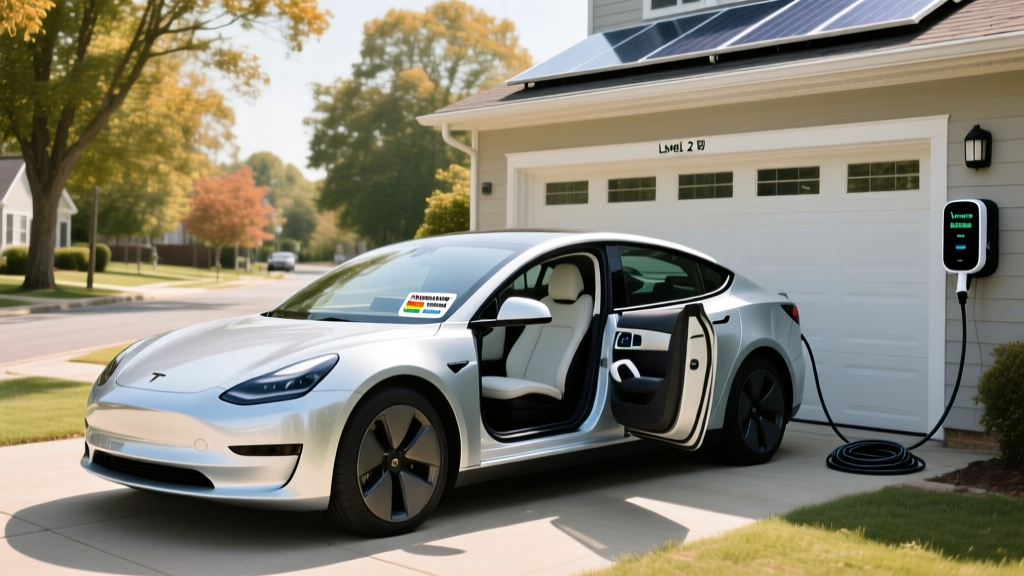
| Level 2 (240V, home Wall Connector) | 11.5 kW | 38–44 mi/hr | Daily home charging — 8 hours adds ~300 mi |
| DC Fast (V3 Supercharger) | Up to 250 kW peak | ~1,000 mi/hr (peak) | Road trips — 10–80% in ~22–29 min depending on model |
| DC Fast (V4 Supercharger) | Up to 350 kW (capable) | ~1,200+ mi/hr (peak) | Newer installations; Tesla vehicles currently limited to ~250 kW intake |
Charging curve reality: Tesla's 250 kW peak rate applies only between roughly 10–30% State of Charge (SoC). Above 50%, the rate tapers significantly — often below 100 kW — and above 80% it drops to under 40 kW. This is why Tesla (and all EV makers) quote 10–80% times rather than 0–100%. If you're road-tripping, plan to charge from 10–80% and skip the slow final 20%.
Home charging cost: A Tesla Wall Connector costs $475 (hardware). Professional installation on a 60A/240V circuit typically runs $500–$1,500 depending on panel proximity and local permitting. If your home electrical panel needs an upgrade to 200A service, budget an additional $1,500–$3,000. Total home setup: $1,000–$5,000.
NACS connector note: All Teslas use the North American Charging Standard (NACS) connector natively. Since 2025, most competing EVs (Ford, GM, Rivian, Hyundai/Kia, Volvo) have adopted NACS as well, meaning Tesla's Supercharger network is now open to a growing share of non-Tesla EVs — a significant competitive moat.
Battery Chemistry: LFP vs. NMC in the Tesla Lineup
Not all Tesla batteries are created equal. Understanding the chemistry matters for longevity, charging habits, and cold-weather performance:
| Attribute | LFP (Lithium Iron Phosphate) | NMC (Nickel Manganese Cobalt) |
|---|---|---|
| Used in | Model 3 RWD | Model 3 LR, Model Y LR, Model S, Model X |
| Cycle life | 3,000–5,000+ cycles | 1,500–2,500 cycles |
| Recommended daily SoC | 100% (charge to full regularly) | 80% daily; 100% only before trips |
| Cold-weather performance | Slightly worse in extreme cold | Better low-temp energy delivery |
| Energy density | Lower (heavier pack for same kWh) | Higher (lighter, more range per kg) |
| Cost | Lower — contributes to RWD's lower MSRP | Higher |
| Long-term degradation | Typically 5–8% over 100k mi | Typically 8–12% over 100k mi |
Practical takeaway: If you charge at home every night and want to minimize long-term degradation anxiety, the LFP-equipped Model 3 RWD is arguably the most durable daily-driver battery Tesla sells. The trade-off is less range and no AWD.
Federal Tax Credit Eligibility (§30D) — 2026 Rules
The federal EV tax credit under IRS §30D remains available for qualifying new EV purchases, but eligibility is a moving target. Here's the 2026 framework:
- Maximum credit: Up to $7,500 ($3,750 for critical minerals + $3,750 for battery component sourcing)
- MSRP caps: Sedans ≤ $55,000 | SUVs/pickups/vans ≤ $80,000
- Buyer income caps (AGI): Single ≤ $150,000 | Head of household ≤ $225,000 | Joint ≤ $300,000
- Battery sourcing: Critical minerals and battery components must meet phased-in domestic/free-trade-partner thresholds per the Inflation Reduction Act
- Point-of-sale transfer: Eligible buyers can apply the credit as an instant rebate at the dealer rather than waiting for tax filing
- FEOC exclusion: Vehicles with battery components from a "foreign entity of concern" (primarily Chinese suppliers) are disqualified
Source: IRS.gov §30D. Eligibility changes frequently — always verify at purchase time.
| Model / Trim | Base MSRP | Est. Credit | Effective Price | Credit Status (2026) |
|---|---|---|---|---|
| Model 3 RWD | $39,990 | $7,500 | ~$32,490 | ✅ Likely eligible (LFP sourcing varies — verify) |
| Model 3 Long Range AWD | $47,990 | $7,500 | ~$40,490 | ✅ Eligible (under $55k sedan cap) |
| Model Y Long Range AWD | $48,990 | $7,500 | ~$41,490 | ✅ Eligible (SUV cap $80k) |
| Model S Long Range | $79,990 | $0 | $79,990 | ❌ Exceeds $55k sedan cap |
| Model X Long Range | $84,990 | $0 | $84,990 | ❌ Exceeds $80k SUV cap |
Critical nuance on Model 3 RWD LFP credit: The LFP battery cells in the RWD trim have historically been sourced from CATL (China), which triggers FEOC disqualification concerns. Tesla has been reshoring and diversifying supply chains, and eligibility has fluctuated quarter to quarter. Always confirm current credit status with Tesla or your tax professional at point of purchase.
Interior, Cargo, and Daily Practicality
Passenger Space
| Dimension | Model 3 | Model Y | Model S | Model X |
|---|---|---|---|---|
| Front legroom | 42.7 in | 41.8 in | 42.7 in | 41.2 in |
| Rear legroom | 35.2 in | 41.6 in | 35.4 in | 40.9 in |
| Seating capacity | 5 | 5 (optional 7) | 5 | 5–7 |
Cargo Volume
| Model | Rear Cargo (seats up) | Rear Cargo (seats folded) | Frunk |
|---|---|---|---|
| Model 3 | 23 cu ft | ~56 cu ft | 3.1 cu ft |
| Model Y | 30 cu ft | ~72 cu ft | 4.1 cu ft |
| Model S | 28 cu ft | ~63 cu ft | 3.1 cu ft |
| Model X | ~37 cu ft (behind 2nd row) | ~85 cu ft | 3.4 cu ft |
The Model Y's hatchback design and optional third row make it the clear family hauler. The Model 3's trunk is a traditional sedan opening — adequate for commuting but awkward for bulky items. Model S and X offer luxury-tier space, though the Model X's falcon-wing rear doors require adequate overhead clearance in garages.
Standout Tech & Notable Drawbacks
- Supercharger network access (most reliable DC fast-charging in North America)
- OTA software updates continuously add features (including Toybox/Easter eggs like fart mode, light shows, Sentry Mode)
- Class-leading efficiency (kWh/100mi) across the lineup
- Autopilot standard; FSD (Supervised) available as add-on
- Minimal maintenance — no oil changes, minimal brake wear from regen
- Strong resale value relative to most EV competitors
- NACS connector is now the industry standard
- Minimalist interior not for everyone — no physical buttons, no instrument cluster
- FSD (Supervised) is still SAE Level 2 — requires constant driver attention despite the name
- Service center wait times can stretch weeks in some metro areas
- Insurance premiums 15–30% higher than comparable gas vehicles
- Model S/X pricing exceeds §30D tax credit caps entirely
- Panel gap and paint quality inconsistencies still reported by owners
- No Apple CarPlay or Android Auto — Tesla's proprietary infotainment only
- Ride quality on Model 3/Y can be firm on rough pavement
Tesla's Autopilot (standard) and Full Self-Driving Supervised ($8,000 add-on or $99/month subscription) are SAE Level 2 driver-assistance systems. This means the driver must remain fully engaged, hands on or near the wheel, and eyes on the road at all times. The vehicle can steer, accelerate, and brake under certain conditions, but it does not drive itself. Only Level 4 systems like Waymo's robotaxi service operate without a human driver. Despite the "Full Self-Driving" branding, treat FSD Supervised as an advanced cruise-control-plus-lane-keeping system — nothing more. (NHTSA AV safety info)
Warranty Coverage
| Coverage | Model 3 | Model Y | Model S / X |
|---|---|---|---|
| Basic Vehicle | 4 yr / 50,000 mi | 4 yr / 50,000 mi | 4 yr / 50,000 mi |
| Battery & Drive Unit | 8 yr / 100,000 mi (RWD) 8 yr / 120,000 mi (LR) | 8 yr / 120,000 mi | 8 yr / 150,000 mi |
| Capacity retention threshold | 70% minimum SoH | 70% minimum SoH | 70% minimum SoH |
If your battery degrades below 70% State of Health within the warranty period, Tesla will replace or refurbish it at no charge. In practice, Tesla battery degradation data from large fleet samples shows most packs retain 85–90% capacity at 100,000 miles — well above the warranty threshold.
Who Should Buy a Tesla in 2026?
- Daily commuter (under 60 mi/day): Model 3 RWD at ~$32,490 after tax credit is one of the cheapest-per-mile vehicles on the road. LFP battery loves daily 100% charges.
- Family of 4–5 needing cargo space: Model Y Long Range AWD at ~$41,490 after credit offers 30 cu ft hatchback cargo, optional 3rd row, and 320 mi range.
- Frequent road-tripper: Tesla's Supercharger network is still the most reliable and widespread DC fast-charging ecosystem. No other brand matches it for cross-country ease.
- Tech-forward buyer who values OTA updates: Tesla pushes meaningful software updates monthly — from UI improvements to new Easter eggs to efficiency tweaks.
- You want Apple CarPlay/Android Auto: Tesla doesn't support either. If phone-mirroring is non-negotiable, consider Hyundai Ioniq 5, Kia EV6, or Ford Mustang Mach-E.
- You need luxury sedan prestige: Model S competes on specs but not on interior material quality vs. BMW i5, Mercedes EQE, or Lucid Air.
- Service access is limited in your area: Check Tesla's nearest Service Center before buying. Rural owners in some states face 2+ hour drives for warranty work.
- You want physical controls: Everything — including glovebox opening, mirror adjustment, and vent direction — is touchscreen-controlled. Some drivers love it; others find it distracting.
Frequently Asked Questions
Can I use Tesla fart noises while driving?
Yes, technically. Boombox/Fart Mode can be triggered from the Toybox menu while the vehicle is in motion. However, using external sounds to startle pedestrians, cyclists, or other drivers while moving could expose you to reckless-driving citations in some jurisdictions. The feature is best used in Park or at very low speeds in safe, controlled situations.
Do all Tesla models have fart mode?
Every Tesla built since 2019 with the pedestrian warning speaker (PWS) supports Boombox, which includes the fart sound library. This covers all current-production Model 3, Model Y, Model S, and Model X vehicles. Very early Model 3 vehicles (pre-2019) without PWS hardware may only support internal-cabin fart sounds.
Does using Boombox drain the battery?
Negligibly. The PWS speaker and cabin audio system draw minimal power — fractions of a watt-hour per use. You could trigger fart sounds thousands of times before it registered on your battery gauge. It's not a range concern.
Can I add custom sounds to Tesla Boombox?
No. Tesla provides a curated (and periodically updated) library of sounds through OTA updates. There is no user-upload functionality for Boombox sounds. Tesla has added and rotated sounds over the years, but the selection is entirely manufacturer-controlled.
What is the real-world range of the Model Y Long Range?
The EPA rates the 2026 Model Y LR AWD at 320 miles. In real-world highway driving at 75 mph, expect approximately 270–290 miles. In cold weather (below freezing), plan for 220–260 miles. City driving with regenerative braking can push slightly above the EPA figure.
How fast does a Tesla charge at home?
Using a Tesla Wall Connector on a 60A/240V circuit, all current Tesla models charge at up to 11.5 kW, adding roughly 38–44 miles of range per hour. A full overnight charge (8 hours) restores approximately 300 miles — more than enough for any daily commute. On a standard 120V household outlet (Level 1), expect only 3–5 miles per hour.
Is the Tesla Model 3 still worth buying vs. competitors in 2026?
At ~$32,490 after the federal tax credit, the Model 3 RWD remains one of the most compelling EVs on the market. It competes with the Hyundai Ioniq 6, Chevrolet Equinox EV, and upcoming entries from Toyota and Honda. The Model 3's advantages are Supercharger access, proven software, and best-in-class efficiency. Its disadvantages are the touchscreen-only interface, firm ride, and Tesla's variable build-quality reputation. Test-drive both the Model 3 and at least one competitor before deciding.
Does the Model 3 RWD qualify for the $7,500 federal tax credit?
It depends on current battery-sourcing rules. The Model 3 RWD uses an LFP battery that has historically been sourced from Chinese manufacturers (CATL), which triggers the FEOC (Foreign Entity of Concern) exclusion under §30D. Tesla has been diversifying supply chains, and eligibility has shifted over time. As of early 2026, the Model 3 RWD's credit status fluctuates — always confirm with Tesla or a tax professional before purchasing. The Model 3 Long Range and Model Y Long Range more consistently qualify.