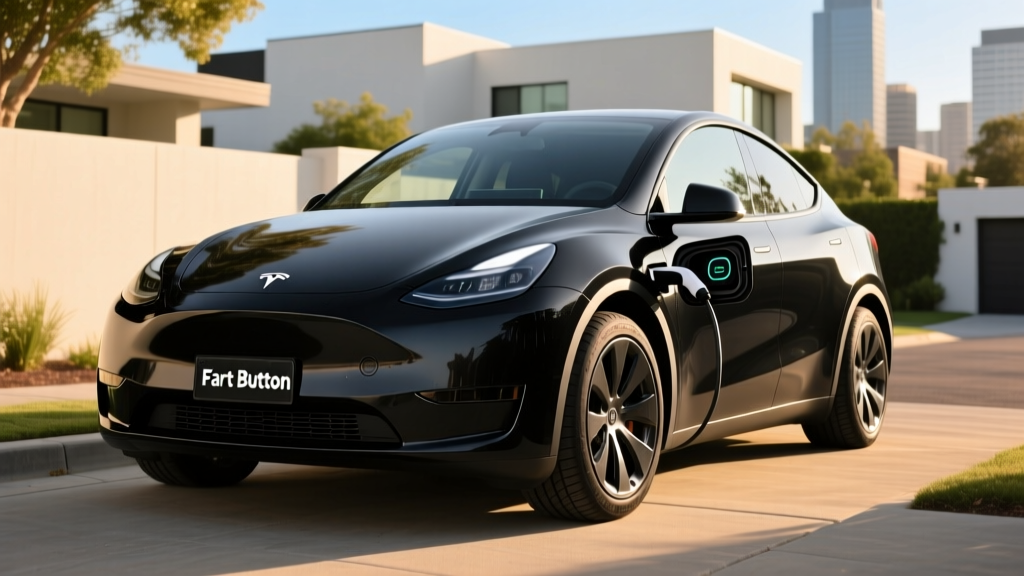
If you've searched for the Tesla fart button, you've likely stumbled into one of the most oddly viral Easter eggs in the EV world. Hidden inside Tesla's software is a whoopee-cushion sound effect triggered from the center touchscreen — a novelty that's become shorthand for Tesla's playful (and sometimes polarizing) approach to in-car entertainment. But beyond the giggles, the fart button lives inside one of the most consequential EVs on the market: the Tesla Model Y.
This review covers the 2026 Tesla Model Y in full — range, charging, battery chemistry, pricing, tax credit eligibility, and whether the Juniper-refreshed crossover still justifies its spot at the top of global EV sales charts.
What Is the Tesla Fart Button (and Where Do You Find It)?
The Tesla fart button is an Easter egg buried in the Toybox menu of Tesla's infotainment system. Tap the whoopee cushion icon, and the car emits a cartoonish flatulence sound through the exterior pedestrian warning speaker (PWS) or the cabin audio, depending on your settings. You can trigger it manually or, in some software versions, tie it to the turn signal or a scheduled time.
It's harmless fun, but it highlights something more substantive: Tesla's over-the-air (OTA) software pipeline. The same system that delivers prank sounds also pushes performance upgrades, new driver-assist features, and efficiency tweaks — sometimes adding 10+ miles of range to existing cars without a service visit. The fart button is the tip of a very large, very sophisticated software iceberg.
2026 Tesla Model Y Quick Specs
| Spec | Long Range RWD | Long Range AWD | Performance |
|---|---|---|---|
| EPA Range | 320 mi | 305 mi | 285 mi |
| Battery (usable) | ~75 kWh (LFP) | ~75 kWh (NMC) | ~75 kWh (NMC) |
| Horsepower | 295 hp | 384 hp | 456 hp |
| 0–60 mph | 5.8 sec | 4.8 sec | 3.5 sec |
| Drivetrain | RWD | Dual-Motor AWD | Dual-Motor AWD |
| Peak DC Charge Rate | 170 kW (LFP) | 250 kW | 250 kW |
| 10–80% DC Time | ~35 min | ~25 min | ~25 min |
| Level 2 (11.5 kW AC) | ~44 mi/hr | ~44 mi/hr | ~44 mi/hr |
| MPGe (combined) | 120 MPGe | 115 MPGe | 108 MPGe |
| Base MSRP | $44,990 | $47,990 | $53,990 |
Source: fueleconomy.gov and Tesla's official 2026 spec sheet.
Real-World Range: What the EPA Sticker Doesn't Tell You
Real-World Highway (70 mph): ~255–275 mi
Cold Weather (below 32°F): ~210–240 mi
Efficiency: 26–28 kWh/100 mi combined
Tesla's EPA numbers are among the most accurate in the industry for mixed city/highway driving, but physics still applies. At sustained 70+ mph highway speeds, aerodynamic drag pushes consumption to roughly 30–32 kWh/100 mi, shrinking effective range to around 255–275 miles. In winter conditions, the LFP battery in the RWD variant loses more capacity than NMC chemistry — expect a 20–30% reduction if you're not preconditioning the pack.
The Juniper-refreshed Model Y includes a standard heat pump, which significantly reduces cabin-heating energy draw compared to resistive heaters. Preconditioning while plugged in is the single biggest range-preservation habit an owner can adopt, especially in sub-freezing climates.
Charging Speed: DC Fast, Home Level 2, and the LFP Curve
| Charging Method | Power | Rate | Notes |
|---|---|---|---|
| DC Fast (V3 Supercharger) | Up to 250 kW (NMC) / 170 kW (LFP) | 10–80% in 25 min (NMC) | Peak rate not sustained; tapers above 60% |
| DC Fast (V4 Supercharger) | Up to 250 kW | Similar to V3 for Model Y | CCS/NACS combo connector |
| Home Level 2 (Tesla Wall Connector) | 11.5 kW (48A) | ~44 mi/hr added | Full charge in ~7–8 hours |
| Level 1 (120V outlet) | ~1.4 kW | ~3–4 mi/hr | Emergency/trickle only |
The LFP (lithium iron phosphate) battery in the Long Range RWD charges at a lower peak rate (~170 kW) than the NMC packs in the AWD and Performance trims. This is a known trade-off: LFP chemistry offers superior cycle life, lower degradation, and the ability to charge to 100% daily without harm — but it sacrifices peak charge speed and energy density.
On Tesla's V3 Supercharger network, the NMC variants hit 250 kW briefly around 15–20% SoC, then taper progressively. Real-world 10–80% sessions average 25–28 minutes depending on pack temperature. Always precondition before arriving at a Supercharger — the car does this automatically when you navigate to one.
Performance, Drivetrain, and Ride Quality
The 2026 Model Y lineup offers three distinct personalities:
- Long Range RWD: 295 hp, 0–60 in 5.8 seconds. Adequate for commuting and highway merging. The lightest variant, which helps efficiency.
- Long Range AWD: 384 hp, 0–60 in 4.8 seconds. Dual-motor all-wheel drive adds confidence in rain and snow. The sweet spot for most buyers.
- Performance: 456 hp, 0–60 in 3.5 seconds. Track mode, lowered suspension, 21" wheels. Thrilling but sacrifices ~20 miles of range and some ride comfort.
The Juniper refresh brought a revised suspension tune that addresses the pre-2025 Model Y's most common complaint: a harsh, under-damped ride over broken pavement. The 2026 model is noticeably more compliant while retaining flat cornering. Road noise has also been reduced through additional acoustic insulation.
Pricing, Tax Credits, and Total Cost
| Trim | Base MSRP | Est. After §30D Credit | Destination |
|---|---|---|---|
| Long Range RWD | $44,990 | ~$37,490* | $1,390 |
| Long Range AWD | $47,990 | ~$40,490* | $1,390 |
| Performance | $53,990 | ~$46,490* | $1,390 |
*Tax credit estimates assume full §30D eligibility. See rules below.
The federal EV tax credit under IRS §30D offers up to $7,500, split into two halves: $3,750 for battery-component sourcing and $3,750 for critical-minerals sourcing. Eligibility depends on:
- MSRP cap: SUVs/vans/pickups must be under $80,000 — all Model Y trims qualify.
- Buyer income cap: AGI must not exceed $150,000 (single), $225,000 (head of household), or $300,000 (joint).
- Battery sourcing: Specific percentages of critical minerals and battery components must be sourced from the U.S. or free-trade-agreement countries. Tesla's U.S.-built LFP cells (sourced from CATL via licensing) have faced scrutiny; confirm current-year eligibility on the IRS qualified vehicles list before purchasing.
- Point-of-sale transfer: The credit can be applied as a discount at the dealer rather than waiting for a tax refund.
Important: Tax credit rules change frequently. The LFP RWD variant's eligibility has fluctuated due to battery-sourcing requirements. Always verify on fueleconomy.gov before finalizing a purchase.
Interior, Cargo, and Tech
The Juniper interior is a meaningful step up from the pre-refresh Model Y. Ventilated front seats, ambient lighting, a rear-seat touchscreen, and power-folding second-row seats are now standard or widely available.
- Cargo (rear seats up): 30.2 cu ft
- Cargo (rear seats folded): 72.1 cu ft
- Frunk: 4.1 cu ft
- Rear legroom: 41.6 inches
The 15.4-inch center touchscreen handles everything — climate, media, navigation, vehicle settings, and yes, the Toybox menu where the fart button lives. There are no physical buttons for climate or volume; everything is screen-based, which some buyers love and others find distracting. A rear 8-inch screen lets passengers control their own climate and media.
Autopilot (basic) is standard and includes adaptive cruise control and lane centering. Full Self-Driving (Supervised) remains a $8,000 add-on or $99/month subscription. To be clear: FSD is SAE Level 2 — you must remain engaged and ready to take over at all times. It is not autonomous driving.
Pros and Cons
Pros
- Access to Tesla's Supercharger network — the most reliable DC fast-charging infrastructure in North America
- Class-leading software and OTA update pipeline
- Strong real-world efficiency (26–28 kWh/100 mi)
- Improved ride quality post-Juniper refresh
- Generous cargo volume with flat-folding rear seats
- LFP battery option allows daily 100% charging without degradation concern
Cons
- LFP RWD charges slower on DC (170 kW peak) than NMC competitors
- All-screen interface can be distracting; no physical volume knob
- Insurance premiums run 15–25% higher than comparable ICE crossovers
- FSD (Supervised) costs $8,000 and remains Level 2 — not autonomous
- Build quality improved but still occasionally inconsistent vs. legacy OEMs
- Pricey when optioned with FSD, premium paint, and 20" wheels
Warranty and Long-Term Ownership
Tesla covers the Model Y with:
- Basic vehicle warranty: 4 years / 50,000 miles
- Battery & drive unit: 8 years / 120,000 miles (Long Range & Performance)
- Battery capacity retention: Guaranteed above 70% during warranty period
LFP batteries in the RWD variant generally exhibit slower degradation than NMC, with many owners reporting 95%+ State of Health (SoH) after 50,000 miles. NMC packs typically settle around 90–93% SoH at the same mileage. Tesla's 70% retention floor is conservative — actual replacements under warranty are rare.
Who Should Buy the 2026 Model Y?
Choose the Long Range AWD if: You live in a four-season climate, take regular road trips, and want the best combination of range, charge speed, and traction. This is the default recommendation for most buyers.
Choose the Performance if: You prioritize acceleration and handling over range and comfort, and you understand the ~20-mile range penalty and firmer ride.
Look elsewhere if: You need three rows (consider the Kia EV9), want physical buttons (Hyundai Ioniq 5), or need a truck bed (Ford F-150 Lightning, Rivian R1T).
Frequently Asked Questions
What is the real-world range of the Tesla Model Y?
The EPA rates the Long Range AWD at 305 miles, but expect 255–275 miles on sustained highway trips and 210–240 miles in cold weather below freezing. City driving with regenerative braking often meets or slightly exceeds the EPA figure.
How fast does the Model Y charge at home and on the road?
At home on a Level 2 Tesla Wall Connector (11.5 kW / 48A), you add about 44 miles per hour — a full overnight charge from 20% takes roughly 7 hours. On a V3 Supercharger, the NMC variants peak at 250 kW with a 10–80% time of about 25 minutes. The LFP RWD peaks lower at ~170 kW, taking about 35 minutes for the same session.
Does the 2026 Model Y qualify for the $7,500 federal tax credit?
It depends. The MSRP and buyer income caps are met by all trims, but the battery-sourcing requirements under §30D are strict and change yearly. The LFP RWD variant's eligibility has been inconsistent. Check the fueleconomy.gov qualified vehicle list and consult a tax professional before relying on the credit.
Is the Model Y worth it vs. the Hyundai Ioniq 5 or Ford Mustang Mach-E?
The Model Y wins on Supercharger network access, software maturity, and cargo volume. The Ioniq 5 offers faster 800V charging (~18 min 10–80%), a more distinctive design, and physical buttons. The Mach-E offers a more traditional driving feel and available NACS adapter access to Superchargers. If charging infrastructure reliability is your top priority, the Model Y still leads.
Where is the Tesla fart button?
Open the center touchscreen, tap the car icon, go to Toybox, and select the whoopee cushion icon. You can trigger the sound through the cabin speakers or the exterior pedestrian warning speaker. It's an Easter egg — not related to any emissions system, despite what internet rumors claim.
Is Tesla's FSD actually self-driving?
No. Full Self-Driving (Supervised) is an SAE Level 2 driver-assist system. You must remain alert, keep your hands on or near the steering wheel, and be prepared to take over instantly. Tesla's naming has drawn scrutiny from NHTSA. True Level 4 driverless service currently exists only in commercial robotaxi fleets like Waymo in select cities.
The Tesla fart button may be a novelty, but the 2026 Model Y it lives inside is anything but. With a refined ride, strong efficiency, the industry's best charging network, and competitive pricing after tax credits, it remains the default EV crossover recommendation — even if the whoopee cushion sound is its most-searched feature.