If you've just taken delivery of a Tesla—or any electric vehicle—you've probably stared at a standard 120-volt wall outlet and wondered: Can I use an extension cord to charge my Tesla? The short answer is that while it is technically possible under very specific conditions, it introduces fire risks, slows charging to a crawl, and violates most manufacturer and electrician recommendations. In this guide, we'll explain exactly why, what the physics demand, and how to set up safe, reliable home charging for your Tesla in 2026.
The Short Answer: Tesla's Official Stance on Extension Cords
Tesla's owner manuals explicitly advise against using extension cords, adapters, or multi-outlet power strips for charging. The reason is straightforward physics: EV charging draws sustained, high-amperage current for many hours—far more than typical household appliances. Most consumer extension cords are not rated for continuous 12-amp or higher loads over 8+ hour sessions, and the resulting voltage drop and heat buildup can melt insulation, damage connectors, or start an electrical fire.
That said, there is a narrow scenario where a heavy-duty, short, properly rated extension cord can work for Level 1 (120V) trickle charging in a pinch. But the margin for error is slim, and the consequences of getting it wrong are severe. Let's break down what you need to know about the electrical requirements before you plug anything in.
Understanding Tesla Charging Levels: Power, Amperage, and What Your Wiring Must Handle
To understand why extension cords are problematic, you need to understand the power demands at each charging level. Remember the critical distinction: kW (kilowatts) measures power—the rate of energy delivery—while kWh (kilowatt-hours) measures energy, or the total capacity of your battery.
| Level | Voltage | Amperage | Power (kW) | Miles of Range Per Hour |
|---|---|---|---|---|
| Level 1 (Standard Outlet) | 120V | 12A continuous | ~1.4 kW | 3–5 miles |
| Level 2 (Home Wall Connector) | 240V | 32A–48A | 7.7–11.5 kW | 30–44 miles |
| DC Fast Charging (Supercharger) | 400V+ | Varies | Up to 250 kW (V3) | Up to 200 miles in 15 min |
Level 1 charging from a standard NEMA 5-15 outlet delivers roughly 1.4 kW. That sounds modest, but it means a continuous 12-amp draw for potentially 24–48 hours to fill a depleted battery. Most household extension cords are rated for intermittent use—think a vacuum cleaner running for 20 minutes—not a multi-day sustained load that heats every connection point along the circuit.
When an Extension Cord Might Work (and When It Absolutely Won't)
The Narrow "Emergency Only" Scenario
If you are in a situation with no other option—say, visiting a relative with no outdoor outlet and you need to add 30–40 miles of range overnight—a heavy-duty extension cord can work for Level 1 charging if it meets all of the following criteria:
- Gauge: 12 AWG (American Wire Gauge) or thicker (10 AWG is better). Never use 14 AWG or 16 AWG cords.
- Length: 25 feet maximum. Longer cords increase resistance, voltage drop, and heat.
- Rating: Rated for at least 15 amps and labeled for outdoor/heavy-duty use.
- Condition: No kinks, cuts, exposed wire, or loose plug ends.
- Single cord only: Never daisy-chain multiple extension cords together.
- No power strips or multi-outlet adapters anywhere in the circuit.
When You Must Never Use an Extension Cord
- Level 2 charging (240V): No consumer extension cord is rated for 240V/48A continuous duty. This requires a hardwired or properly installed NEMA 14-50 outlet on a dedicated circuit.
- Any cord longer than 25 feet at Level 1, due to unacceptable voltage drop.
- Indoor cords used outdoors—moisture and UV exposure degrade insulation rapidly.
- Cords run under rugs, through doorways, or across walkways—a fire and trip hazard.
- Any situation where the cord feels warm to the touch during charging. Stop immediately.
The Real Solution: Proper Home Charging Setup for Your Tesla
Rather than gambling with an extension cord, the correct approach is to invest in a proper home charging installation. Here's what that looks like for Tesla owners in 2026.
Option 1: Tesla Wall Connector (Level 2, Recommended)
The Tesla Wall Connector ($475 for the unit) hardwires directly to a dedicated 60-amp circuit, delivering up to 11.5 kW (48 amps) of continuous power. On a Model 3 Rear-Wheel Drive, this adds roughly 44 miles of range per hour of charging—enough to fully replenish the battery in about 6–7 hours from near-empty.
Option 2: NEMA 14-50 Outlet (Level 2, Portable)
A licensed electrician can install a NEMA 14-50 outlet on a dedicated 50-amp circuit. Using Tesla's Mobile Connector with the 14-50 adapter, you'll get up to 9.6 kW (32 amps), adding roughly 30 miles of range per hour. This is the same outlet type used for electric ranges and RV hookups.
Option 3: Standard 120V Outlet (Level 1, No Cord Needed)
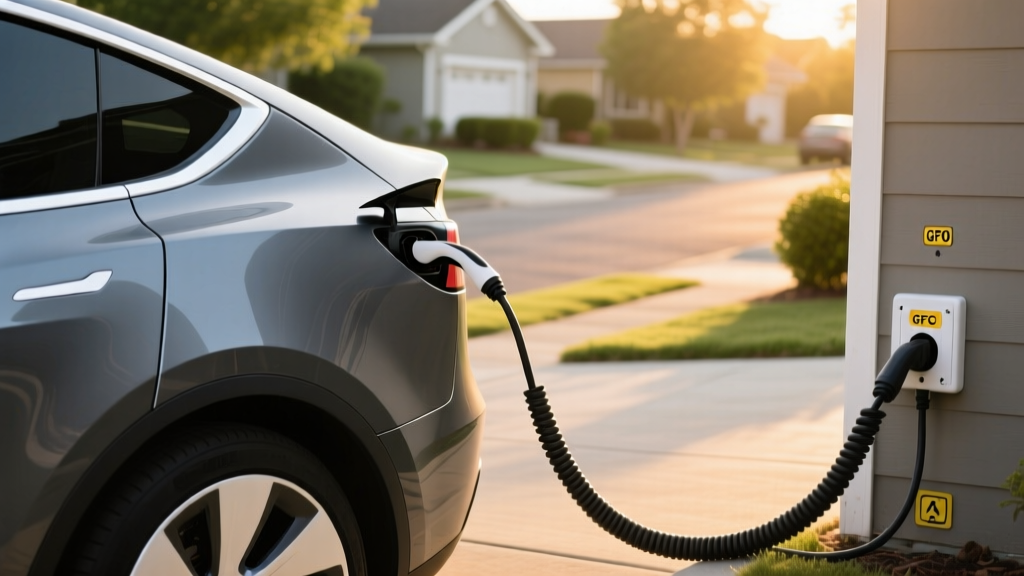
If your parking spot is near a standard outlet, simply plug the Tesla Mobile Connector directly into the wall—no extension cord. You'll get 3–5 miles of range per hour, which is sufficient for drivers who travel under 40 miles per day and can charge overnight.
| Component | Level 1 (120V) | Level 2 NEMA 14-50 | Level 2 Wall Connector (Hardwired) |
|---|---|---|---|
| Equipment | $0 (included Mobile Connector) | $45 (14-50 adapter) | $475 (Wall Connector) |
| Electrician (labor + materials) | $0–$200 (outlet check) | $500–$1,500 | $800–$2,000 |
| Panel upgrade (if needed) | Unlikely | $1,000–$3,000 | $1,000–$3,000 |
| Permit | $0–$50 | $50–$200 | $50–$200 |
| Total estimated cost | $0–$250 | $600–$4,750 | $1,325–$5,675 |
The wide range in Level 2 costs reflects variables like panel capacity (older homes may need a 200-amp service upgrade), distance from the panel to the garage, and local permit requirements. Always get quotes from a licensed electrician who has EV charger installation experience. The IRS also offers the Alternative Fuel Vehicle Refueling Property Credit (Form 8911), which can cover up to 30% of home charging equipment and installation costs (capped at $1,000), subject to income and census-tract eligibility.
What Extension Cord Gauge Do You Need? The Physics Explained
If you've decided to use an extension cord for emergency Level 1 charging, wire gauge is the single most important specification. AWG (American Wire Gauge) works inversely: a lower number means a thicker wire that can carry more current with less resistance and heat.
| Wire Gauge | Max Length for 12A | Voltage Drop at 25 ft | Safe for EV Charging? |
|---|---|---|---|
| 16 AWG | Not recommended | ~4.0% | ❌ Never — fire risk |
| 14 AWG | Not recommended | ~2.5% | ❌ Not for sustained loads |
| 12 AWG | 25 ft max | ~1.6% | ⚠️ Minimum acceptable, emergency only |
| 10 AWG | 50 ft max | ~1.0% | ✅ Best option if you must use a cord |
A voltage drop above 3% is generally considered unacceptable for continuous loads. At 12 amps, a 16 AWG cord at 50 feet would drop nearly 8%—meaning your Tesla's onboard charger receives only ~110V instead of 120V, which can trigger charging errors, extend charge times further, and overheat the cord. The Tesla Mobile Connector has built-in temperature sensors at the plug end and will throttle or halt charging if it detects excessive heat, but this is a safety backstop, not a substitute for proper wiring.
Tesla Model 3 and Model Y: Charging Specs and Range at a Glance
Since most Tesla owners asking this question drive a Model 3 or Model Y, here are the current 2026 specs to help you plan your charging strategy.
| Specification | Model 3 RWD | Model 3 Long Range AWD | Model Y Long Range AWD |
|---|---|---|---|
| EPA Range | 363 miles | 341 miles | 320 miles |
| Battery Capacity (usable) | ~57.5 kWh (LFP) | ~75 kWh (NMC) | ~75 kWh (NMC) |
| Max DC Fast Charge | 170 kW | 250 kW | 250 kW |
| 10–80% DC Fast Charge | ~25 min | ~27 min | ~27 min |
| Level 2 Charge Rate | 11 kW (48A) | 11.5 kW (48A) | 11.5 kW (48A) |
| Level 1 Charge Rate | ~1.4 kW (12A) | ~1.4 kW (12A) | ~1.4 kW (12A) |
| 0–60 mph | 5.8 sec | 4.2 sec | 4.8 sec |
| Horsepower | 271 hp | 346 hp | 384 hp |
| Drivetrain | RWD (single motor) | AWD (dual motor) | AWD (dual motor) |
| MPGe (combined) | 132 MPGe | 125 MPGe | 117 MPGe |
| Efficiency | 25 kWh/100mi | 27 kWh/100mi | 28 kWh/100mi |
Battery Chemistry: LFP vs. NMC in Tesla's 2026 Lineup
The Model 3 RWD uses a lithium iron phosphate (LFP) battery, while Long Range and Performance variants use nickel manganese cobalt (NMC) chemistry. LFP offers a longer cycle life and can be charged to 100% daily without degradation concerns, but has lower energy density and worse cold-weather performance. NMC provides more range and better cold-weather behavior but benefits from daily charge limits of 80–90% for longevity. Both chemistries carry Tesla's standard battery warranty of 8 years/100,000 miles (120,000 miles on Long Range models) with a guaranteed minimum 70% capacity retention.
The Cost of Cutting Corners: What Can Go Wrong
Using an undersized or damaged extension cord for EV charging doesn't just risk slow charging—it creates genuine hazards:
- Melted plugs and outlets: Sustained 12A loads on a 16 AWG cord can heat plug prongs to over 200°F, deforming the plastic and creating arc-fault conditions.
- Voltage drop damage: If voltage at the car drops below ~105V, the onboard charger may cycle on and off repeatedly, stressing electrical components.
- Voided warranty: Tesla's warranty excludes damage caused by "improper electrical supply." If a fire or component failure is traced to an inadequate extension cord, you may be liable for repairs.
- Insurance complications: Home insurers may deny fire claims if the investigation finds an improperly rated extension cord was the cause.
The Mobile Connector's thermal protection will reduce charging current or stop charging entirely if it detects overheating at the plug—but by the time it triggers, the cord or outlet may already be damaged.
Pros and Cons: Extension Cord Charging vs. Proper Installation
✅ Proper Home Charging Installation
- Safe, code-compliant, no fire risk
- Level 2 adds 30–44 miles of range per hour
- Full battery overnight (6–8 hours)
- Eligible for up to $1,000 federal refueling tax credit
- Protects vehicle warranty
- Increases home resale value
❌ Extension Cord Charging (Level 1)
- Fire and electrical damage risk
- Only 3–5 miles of range per hour
- Full charge can take 24–48+ hours
- May void Tesla warranty if damage occurs
- Voltage drop triggers charging errors
- Cannot use for Level 2 (240V) at all
Frequently Asked Questions
Can I use an extension cord with my Tesla Mobile Connector for Level 1 charging?
Tesla officially recommends against it. If you have no alternative, use only a 10 AWG or 12 AWG heavy-duty cord no longer than 25 feet, rated for 15A, and monitor it for heat. This should be a rare exception, not a daily routine.
Can I use an extension cord for Level 2 (240V) Tesla charging?
No. No consumer extension cord is rated for 240V at 32–48 amps continuous. Level 2 requires a properly installed NEMA 14-50 outlet or a hardwired Wall Connector on a dedicated circuit. Attempting this with an extension cord is extremely dangerous.
Will using an extension cord void my Tesla warranty?
If Tesla determines that damage to the vehicle's charging system or battery was caused by an improper electrical supply (including an inadequately rated extension cord), that specific repair may not be covered under warranty. The rest of your warranty remains intact.
How long does it take to charge a Tesla on a standard 120V outlet?
At ~1.4 kW (Level 1), a Tesla Model 3 RWD with a 57.5 kWh battery would take approximately 40–48 hours from near-empty to full. In practice, Level 1 is best used to maintain charge or add 30–50 miles overnight, not to recharge from a depleted state.
What's the best extension cord for Tesla charging if I absolutely need one?
Look for a 10 AWG, 15-amp rated, outdoor-rated cord no longer than 25 feet with a NEMA 5-15 configuration. Brands like Coleman Cable and US Wire produce heavy-duty options in the $40–$70 range. But again, this is for emergency use only—not a permanent charging solution.
Does Tesla sell an official extension cord?
No. Tesla does not manufacture or sell any extension cord for EV charging. The company's Mobile Connector is designed to plug directly into a wall outlet. Third-party EV-specific extension cords exist (such as those from Camco for RV applications), but Tesla does not endorse their use.
How much does it cost to install a proper Tesla home charger?
A Level 2 installation typically costs between $600 and $2,000 for homes with adequate panel capacity. If your electrical panel needs upgrading from 100A to 200A service, add $1,000–$3,000. The IRS Form 8911 Alternative Fuel Vehicle Refueling Property Credit may cover up to 30% of equipment and installation costs (max $1,000), depending on your income and census-tract eligibility.
The Bottom Line: Skip the Extension Cord, Install a Proper Charger
Can you use an extension cord to charge your Tesla? Technically yes, in a narrow emergency scenario with the right gauge and length. Should you? Almost never. The risks—fire, equipment damage, warranty complications, and painfully slow charging—far outweigh the convenience. A proper Level 2 home installation costs as little as $600 in straightforward setups, pays for itself in convenience within weeks, and is eligible for federal tax incentives. If you're relying on Level 1 from a nearby outlet, plug the Mobile Connector directly into the wall with no extension cord. Your Tesla, your home, and your insurance company will all thank you.
Sources: Tesla Home Charging Installation, U.S. Department of Energy / FuelEconomy.gov, IRS Clean Vehicle Credits, NFPA Electrical Safety.