Search for "Tesla exploding" online and you will find a chaotic mix of viral dashcam footage, sensationalized headlines, and legitimate safety questions. As EV adoption accelerates through 2026, battery fire concerns remain one of the most emotionally charged topics for prospective buyers. This article separates verified incident data from internet noise, then delivers a full technical review of the vehicle most often at the center of these searches: the current-generation Tesla Model Y.
The Reality of Tesla Battery Fires: What the Data Shows
Tesla's own Impact Report states that from 2012 to 2024, there was approximately one Tesla vehicle fire for every 130 million miles traveled. For context, the National Fire Protection Association (NFPA) and U.S. Fire Administration data show internal-combustion engine vehicles experience roughly one fire for every 19 million miles traveled. On a per-mile basis, EVs — including Teslas — catch fire at a significantly lower rate than gasoline vehicles.
However, lithium-ion battery fires behave differently than gas-car fires. When a battery pack undergoes thermal runaway, the fire burns hotter (up to 2,700°F), is harder to extinguish, and can reignite hours or even days after the initial event. This makes EV fires more newsworthy and more difficult for first responders — which skews public perception relative to the actual frequency.
The most common causes of Tesla battery fires include:
- Severe high-speed impacts that breach the battery enclosure and damage cells
- Ground strikes to the undercarriage at speed, compromising the pack's armor plate
- Aftermarket modifications or improper repair work that damages high-voltage wiring
- Manufacturing defects (rare, and typically addressed via NHTSA recalls)
Notably, Tesla's over-the-air software updates and Battery Management System (BMS) continuously monitor cell voltage, temperature, and impedance — flagging anomalies before they escalate. Spontaneous fires in parked, undamaged Teslas are extremely rare and usually traceable to prior collision damage that was not properly repaired.
2026 Tesla Model Y: Core Specifications
| Specification | Long Range RWD | Long Range AWD | Performance |
|---|---|---|---|
| EPA Range | 320 mi | 308 mi | 285 mi |
| Battery (usable) | ~75 kWh (NMC) | ~75 kWh (NMC) | ~75 kWh (NMC) |
| Drivetrain | RWD, single motor | AWD, dual motor | AWD, dual motor |
| Horsepower | 295 hp | 384 hp | 456 hp |
| 0–60 mph | 6.5 sec | 4.8 sec | 3.5 sec |
| Max DC Fast Charge | 250 kW | 250 kW | 250 kW |
| 10–80% DC Time | ~25 min | ~25 min | ~25 min |
| Level 2 Home Charge | 11.5 kW (~44 mi/hr) | 11.5 kW (~44 mi/hr) | 11.5 kW (~44 mi/hr) |
| MPGe (combined) | 123 MPGe | 117 MPGe | 111 MPGe |
| Efficiency | 27 kWh/100 mi | 29 kWh/100 mi | 30 kWh/100 mi |
| Cargo (rear seats up) | 30.2 cu ft | ||
| Cargo (rear seats folded) | 72.0 cu ft | ||
| Rear Legroom | 41.6 in | ||
| Base MSRP | $44,990 | $47,990 | $52,490 |
Real-World Range: What to Actually Expect
Tesla's heat pump (standard on all 2026 Model Y trims) significantly reduces cold-weather energy consumption compared to resistive cabin heaters, but physics still wins: cold electrolyte is less efficient, and cabin heating draws real energy. The best practice for maximizing winter range is to precondition the battery while still plugged in and rely on heated seats and steering wheel rather than cranking the cabin to 72°F.
Charging Speed: DC Fast Charge and Home Setup
The Model Y uses the NACS (North American Charging Standard) connector natively — no adapter needed for Tesla Superchargers. As of 2026, the Supercharger network has over 25,000 stalls in North America, with V3 stalls delivering up to 250 kW and newer V4 stalls beginning to appear at select corridors.
| Charging Level | Power (kW) | Miles Added per Hour | Typical Use Case |
|---|---|---|---|
| Level 1 (120V outlet) | ~1.4 kW | ~5 mi/hr | Overnight emergency trickle |
| Level 2 (240V, 48A Wall Connector) | 11.5 kW | ~44 mi/hr | Primary home charging |
| DC Fast (Supercharger V3) | Up to 250 kW | ~1,000+ mi/hr (peak) | Road trips, quick top-ups |
Charge curve reality check: The Model Y peaks near 250 kW only between roughly 10–30% State of Charge (SoC). By 50%, the rate tapers to approximately 120–140 kW, and above 80% it drops to under 50 kW. A 10–80% session takes about 25 minutes at a V3 Supercharger, but an 80–100% top-off can add another 25–30 minutes. For road trips, the practical strategy is to charge from 10–80% and drive on.
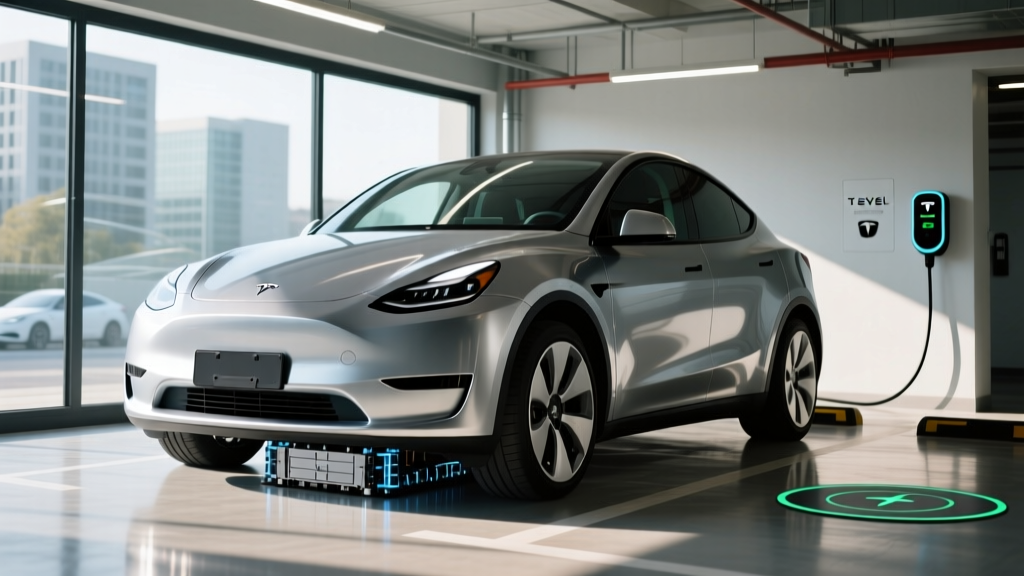
For home charging, the Tesla Wall Connector ($475) on a 60A circuit delivers the full 11.5 kW, replenishing a depleted pack in about 7–8 hours. Installation costs typically range from $800–$2,500 depending on panel proximity and whether a panel upgrade (to 200A service) is needed. A licensed electrician should assess your panel capacity before committing.
Safety Ratings, Battery Chemistry, and Fire Mitigation
The 2026 Model Y earned a 5-star overall safety rating from NHTSA, with top marks in frontal crash, side crash, and rollover resistance. The IIHS has historically named the Model Y a Top Safety Pick+ when equipped with standard LED headlights.
Tesla uses NMC (nickel manganese cobalt) chemistry in the Model Y Long Range and Performance trims. NMC offers higher energy density than LFP (lithium iron phosphate), which is why it's used in the range-maximizing configurations. However, NMC cells have a lower thermal runaway onset temperature (~210°C) compared to LFP (~270°C). Tesla mitigates this through:
- A reinforced steel and aluminum battery enclosure that doubles as a structural floor member
- Intercell barriers and venting channels designed to prevent thermal propagation between cells
- Real-time BMS monitoring of every cell group's voltage and temperature
- Over-the-air updates that can adjust charge limits and thermal management parameters
For buyers specifically prioritizing fire resistance, the base Model Y RWD (available in some markets) has historically used LFP cells, which are more thermally stable. However, the trade-off is lower energy density and slightly reduced range. Check Tesla's configurator for current chemistry availability by trim, as Tesla has shifted cell sourcing between Panasonic, LG, and CATL over successive model years.
Pricing, Tax Credits, and Ownership Cost
| Trim | Base MSRP | Est. After §30D Credit | Eligible for $7,500 Credit? |
|---|---|---|---|
| Long Range RWD | $44,990 | ~$37,490* | Yes (if sourcing rules met) |
| Long Range AWD | $47,990 | ~$40,490* | Yes (if sourcing rules met) |
| Performance | $52,490 | ~$44,990* | Yes (if sourcing rules met) |
*Critical §30D eligibility requirements (2026):
- MSRP cap: SUVs/vans/pickups must be under $80,000 — all Model Y trims qualify.
- Buyer income cap: Modified AGI must not exceed $150,000 (single), $225,000 (head of household), or $300,000 (joint).
- Battery sourcing: A percentage of critical minerals and battery components must be sourced from the U.S. or FTA partners. Tesla has steadily increased North American sourcing, but the exact credit amount ($3,750 or $7,500) depends on whether both the minerals and components thresholds are met for the specific build week. Check the fueleconomy.gov tax credit lookup and confirm with your tax professional before purchase.
- Point-of-sale transfer: As of 2024, the credit can be transferred to the dealer at purchase, reducing your out-of-pocket cost immediately rather than waiting for tax filing.
Tech, Interior, and Daily Livability
The 2026 Model Y interior follows Tesla's minimalist philosophy: a single 15.4-inch center touchscreen handles infotainment, climate, navigation, and vehicle settings. There is no traditional instrument cluster — speed and range appear in the top corner of the main display. The refreshed "Juniper" interior (introduced for the 2025 model year and carried into 2026) adds ventilated front seats, ambient lighting, a rear-seat touchscreen, power-folding second row, and improved cabin insulation that noticeably reduces road noise compared to pre-refresh models.
Driver assistance: Tesla's Basic Autopilot (traffic-aware cruise control and lane centering) is standard. Full Self-Driving (Supervised) remains a $8,000 add-on or $99/month subscription. FSD is an SAE Level 2 system — it does not make the car self-driving, and the driver must remain engaged with hands on the wheel and eyes on the road at all times. Tesla's camera-only vision stack has improved substantially, but it is not a substitute for an attentive driver, particularly in construction zones, heavy rain, or unmapped areas.
Cargo and space: With 30.2 cu ft behind the second row and 72.0 cu ft with seats folded, the Model Y offers crossover-SUV practicality. The rear frunk (front trunk) adds roughly 4.1 cu ft for charging cables or groceries. Rear legroom at 41.6 inches is generous for adults. An optional third row (7-seat config) is available but best suited for small children — adults will find it cramped.
Pros, Cons, and Verdict
Pros
- Class-leading Supercharger network access (25,000+ stalls)
- Strong real-world efficiency (27–30 kWh/100 mi)
- 5-star NHTSA safety rating, excellent crash structure
- Over-the-air updates continuously add features
- Practical cargo space and comfortable refreshed interior
- Qualifies for up to $7,500 federal tax credit
Cons
- No instrument cluster or physical buttons — screen-only interface
- FSD (Supervised) is expensive and still requires full driver attention
- Regenerative braking is not fully adjustable (no creep mode in latest builds)
- Build quality, while improved, still trails legacy automakers in panel gaps
- Insurance premiums run 15–25% higher than comparable gas SUVs
- NMC battery chemistry is less thermally stable than LFP alternatives
Who the Model Y suits best: Commuters with home charging access, small families needing cargo flexibility, and road-trippers who value the Supercharger network. It is less ideal for buyers who want physical controls, those without reliable home or workplace charging, or anyone expecting FSD to be a chauffeur — it is not.
Frequently Asked Questions
Do Teslas actually explode?
No. Teslas do not "explode" in the way a gasoline fuel tank might rupture and ignite. In rare cases of severe battery damage (typically from high-speed impacts), lithium-ion cells can enter thermal runaway, producing an intense fire that is difficult to extinguish and may reignite. However, per-mile fire rates for EVs are significantly lower than for internal combustion vehicles, according to NHTSA and NFPA data.
What is the real-world range of the 2026 Model Y?
The EPA rates the Long Range AWD at 308 miles. Real-world mixed driving yields approximately 260–285 miles. Sustained highway speeds above 75 mph reduce that to around 240–260 miles, and freezing temperatures can drop range by 20–30% to roughly 215–245 miles.
How fast does the Model Y charge at home and on the road?
At home on a Level 2 Wall Connector (11.5 kW), the Model Y adds about 44 miles of range per hour, fully recharging overnight. On a V3 Supercharger (250 kW peak), a 10–80% charge takes approximately 25 minutes, though the rate tapers significantly above 50% SoC.
Does the 2026 Tesla Model Y qualify for the $7,500 federal tax credit?
All Model Y trims fall under the $80,000 SUV MSRP cap. Eligibility for the full $7,500 depends on your income (must be under $300,000 joint AGI), and on whether the specific vehicle's battery meets 2026 critical-mineral and component sourcing thresholds. Verify on fueleconomy.gov and consult a tax professional before purchase.
Is the Model Y worth buying over the Hyundai Ioniq 5 or Ford Mustang Mach-E?
The Model Y's strongest advantage is the Supercharger network and Tesla's software ecosystem. The Ioniq 5 offers faster peak charging (up to 350 kW on 800V architecture) and a more conventional interior. The Mach-E provides a more engaging driving feel. If Supercharger access and over-the-air feature updates are priorities, the Model Y remains the default choice. If you value physical controls, faster DC charging, or a more traditional cockpit, the Ioniq 5 deserves a serious look.
Is Tesla's Full Self-Driving actually self-driving?
No. FSD (Supervised) is an SAE Level 2 driver-assistance system. It can handle steering, acceleration, and braking on highways and many city streets, but the driver must remain fully engaged and ready to take over at any moment. It is not autonomous driving. Only Level 4 services like Waymo operate without a human driver — and those are limited to geofenced urban areas in select cities.