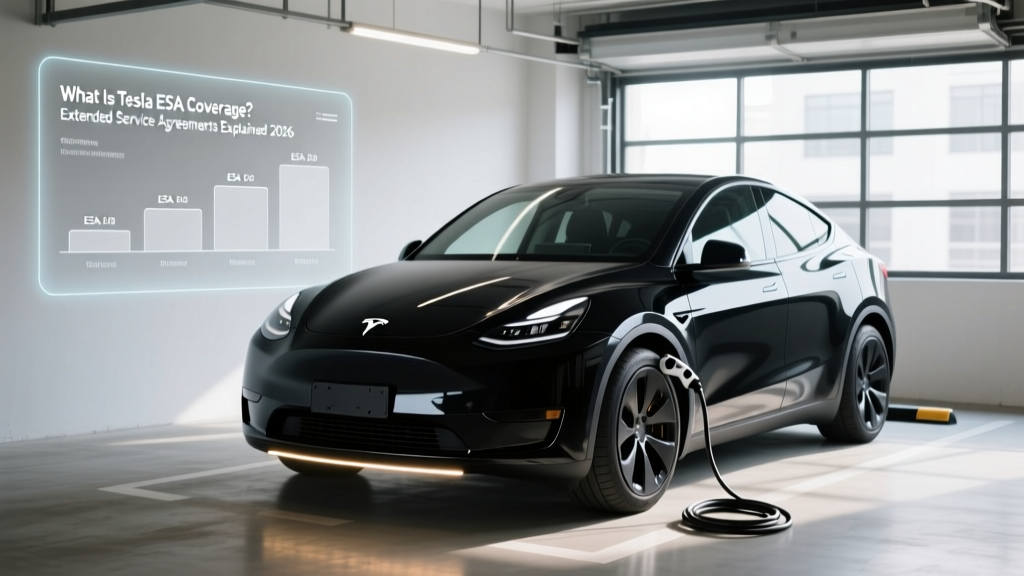
If you own a Tesla nearing the end of its factory warranty—or you're buying a used Model 3, Model Y, Model S, or Model X on the secondary market—you've probably encountered the term "ESA" in owner forums and service centers. But what is Tesla ESA coverage, exactly, and does it make financial sense in 2026? This guide dissects the Extended Service Agreement program, maps it against the standard New Vehicle Limited Warranty and Battery & Drive Unit Warranty, and tells you which Tesla models and use cases justify the extra spend.
Tesla's Factory Warranty Baseline: What You Already Have
Before evaluating an ESA, understand the coverage Tesla includes at purchase. Every new Tesla sold in the U.S. carries two distinct warranty layers:
| Component | Coverage Period | What It Includes |
|---|---|---|
| Basic Vehicle Limited Warranty | 4 years / 50,000 miles | Touchscreen, suspension, HVAC, interior trim, 12V system, body hardware |
| Battery & Drive Unit Warranty (Model 3/Y RWD) | 8 years / 100,000 miles | Traction battery, drive motor(s), inverter — 70% minimum capacity retention |
| Battery & Drive Unit Warranty (Model 3/Y LR/Perf, S/X) | 8 years / 120,000 miles (S/X: 150,000) | Same powertrain components, 70% retention threshold |
The critical takeaway: Tesla's battery and drive unit are already covered for 8 years. The ESA does not extend battery coverage. It extends the Basic Vehicle coverage—the components most likely to fail outside the powertrain as Teslas age: the central touchscreen, window regulators, seat motors, heat pump, and air suspension (Model S/X).
What Is Tesla ESA Coverage? The Extended Service Agreement Defined
A Tesla Extended Service Agreement (ESA) is a post-warranty repair contract you purchase directly from Tesla (or an authorized third-party provider) that continues coverage on non-powertrain components after the 4-year/50,000-mile Basic Vehicle Limited Warranty expires. Think of it as Tesla's version of an extended warranty, but with important structural differences from traditional automotive service contracts.
ESA Plan Tiers (2026)
Tesla historically offers ESA contracts in two duration tiers, purchasable before the Basic Vehicle Limited Warranty expires:
- 2-Year Extension: Covers years 5–6 (up to 70,000 or 100,000 total miles, depending on plan)
- 4-Year Extension: Covers years 5–8 (up to 100,000 or 150,000 total miles)
Both tiers are mileage-capped. Once you hit the mileage limit, coverage terminates regardless of time remaining. Plans are typically tied to specific model configurations and transfer to a new owner if you sell the vehicle privately—adding resale value.
What the ESA Covers (and What It Excludes)
Understanding the boundary between covered and excluded components is where most buyers get tripped up. Here's the breakdown based on Tesla's ESA terms:
Covered Components
- Infotainment & Electronics: Central touchscreen (MCU), instrument cluster (Model S/X), media control unit, audio amplifiers, cameras, sensors
- Climate System: Heat pump assembly, compressor, cabin blower, HVAC control modules
- Body & Interior Hardware: Power-folding mirrors, window regulators, door handles (including Model S/X auto-presenting handles), seat adjustment motors, panoramic roof mechanisms
- Suspension & Steering: Air suspension components (Model S/X), adaptive dampers, electric power steering rack
- Charging Hardware: Onboard charger, charge port assembly, charging ECU
- Restraint Systems: Seatbelt pretensioners, airbag control modules
Excluded Components
- Traction Battery & Drive Unit: Already covered under the separate 8-year warranty; ESA does not stack or extend this
- Wear Items: Tires, wiper blades, cabin air filters, brake pads/rotors (though regen braking extends pad life significantly)
- Cosmetic Damage: Paint chips, interior stains, glass cracks (unless from a covered defect)
- 12V Auxiliary Battery: Treated as a wear item; the newer 16V lithium-ion LiFePO4 auxiliary battery in 2023+ models lasts longer but remains excluded
- Aftermarket Modifications: Any non-OEM wrap, suspension lift, or electrical accessory voids ESA coverage on affected systems
- Damage from Neglect or Abuse: Flood, collision, racing, or failure to perform recommended maintenance
ESA Pricing: What You'll Pay in 2026
Tesla does not publish a universal ESA price list—quotes are VIN-specific and depend on model, trim, current mileage, and purchase timing. Based on owner-reported data from Tesla Motors Club forums and service center quotes gathered in early 2026, here are representative ranges:
| Model | 2-Year ESA | 4-Year ESA | Notable Cost Drivers |
|---|---|---|---|
| Model 3 (RWD/LR) | $2,500 – $3,500 | $4,000 – $5,500 | Heat pump, MCU, charge port |
| Model Y (LR/Perf) | $2,800 – $3,800 | $4,500 – $6,000 | Same as Model 3 plus rear HVAC |
| Model S (LR/Plaid) | $4,000 – $5,500 | $6,500 – $8,500 | Air suspension, MCU, auto door handles |
| Model X (LR/Plaid) | $4,500 – $6,000 | $7,000 – $9,500 | Falcon-wing hinges, air suspension, PTC heater |
Purchase timing matters. Tesla typically requires ESA purchase before the Basic Vehicle Limited Warranty expires (4 years or 50,000 miles, whichever comes first). Some service centers allow purchase up to 30 days past expiration with a vehicle inspection, but this is not guaranteed. Buying earlier—around year 3 or 30,000 miles—sometimes yields a lower quote.
ESA vs. Third-Party Extended Warranties: Which Protects Better?
The alternative to a Tesla ESA is a third-party vehicle service contract from providers like XCare, Endurance, or CARCHEX. Here's how they compare on the dimensions that matter for Tesla ownership:
- OEM parts guaranteed at Tesla Service Centers
- No third-party claim adjudication delays
- Transfers to new private-party owner
- Covers proprietary electronics (MCU, Autopilot hardware) that third parties often exclude
- No aftermarket diagnostic fees
- Often 20–40% cheaper than Tesla ESA
- May cover wear items Tesla excludes (12V battery, wipers)
- Some plans offer roadside assistance and rental car reimbursement
- Can be purchased after Tesla's ESA window closes
- Available for salvage-title vehicles (Tesla ESA is not)
The honest assessment: for Teslas still within the ESA purchase window, the OEM plan is worth the premium. Tesla's vertical integration means proprietary components like the MCU, Autopilot cameras, and heat pump are difficult for third-party administrators to source and approve. For vehicles past the ESA eligibility window, XCare has emerged as a credible Tesla-specific alternative with owner-reported claim success.
Is the ESA Worth It? A Cost-Benefit Framework
Whether the ESA pays for itself depends on your model, driving patterns, and risk tolerance. Here's a decision framework based on real repair costs reported by Tesla owners and service centers:
- You own a Model S or Model X with air suspension — a single corner air strut replacement costs $1,500–$2,500; a full set exceeds $6,000
- Your Model 3/Y is a 2021–2022 build with the early heat pump design
- You plan to keep the vehicle past year 6 or 75,000 miles
- You drive in extreme climates (sub-zero winters or desert heat) that stress HVAC and electronics
- You want predictable ownership costs without surprise $3,000 repair bills
- You lease or plan to sell/trade before the Basic Warranty expires
- You own a 2023+ Model 3 Highland or Model Y Juniper with revised hardware — early data shows improved reliability
- You're comfortable self-insuring: setting aside $150/month in a repair fund covers most out-of-warranty failures
- You have access to a trusted independent EV shop (rare but growing in major metros)
How to Purchase and Maximize Your Tesla ESA
If you've decided an ESA makes sense, follow these steps to get the best terms:
- Request a quote through your Tesla app — navigate to your vehicle, then Service → Warranty → Extended Service Agreement. The quote is VIN-bound.
- Call your local Service Center directly — some owners report lower quotes when speaking to a service advisor versus the app-generated price.
- Purchase before 50,000 miles — once you cross this threshold, eligibility may lapse.
- Keep all maintenance records — while Teslas have minimal scheduled maintenance, documented cabin filter replacements, tire rotations, and brake fluid checks prevent claim disputes.
- Transfer on sale — if you sell privately, the ESA transfers at no cost, adding $1,500–$3,000 in perceived resale value.
ESA Coverage and the Federal EV Tax Credit Interaction
A common question: does purchasing an ESA affect your §30D federal EV tax credit? No. The ESA is a service contract, not a vehicle modification, and has no bearing on the $7,500 new-vehicle credit or the $4,000 used-EV credit. However, keep these current-year rules in mind:
- Income caps: $150K single / $225K head of household / $300K joint (modified AGI)
- MSRP caps: $55,000 for sedans (Model 3), $80,000 for SUVs and trucks (Model Y, Model X, Cybertruck)
- Battery sourcing: Critical minerals and battery component percentages must meet annually increasing thresholds — verify eligibility at fueleconomy.gov before purchase
- Point-of-sale transfer: As of 2024, eligible buyers can transfer the credit to the dealer for an immediate price reduction; this applies to the vehicle, not the ESA
Frequently Asked Questions
Can I buy a Tesla ESA for a used Tesla I didn't buy new?
Generally, no. Tesla's ESA must be purchased by the original owner before the Basic Vehicle Limited Warranty expires. If you buy a used Tesla that already has an active ESA, it transfers to you. But you cannot add an ESA to a used Tesla that never had one, unless Tesla opens a secondary purchase window (which they occasionally do for Certified Pre-Owned vehicles sold through Tesla).
Does the ESA cover Autopilot and FSD hardware?
Yes, partially. The ESA covers the Autopilot hardware suite—cameras, radar (where equipped), and the FSD computer—if they fail due to defect. It does not cover FSD software subscription costs, nor does it cover damage to cameras from rock chips or collisions (that falls under insurance).
What happens if Tesla discontinues my model's parts?
Tesla's ESA terms obligate them to provide "functionally equivalent" replacement parts. In practice, this has meant retrofitting newer MCU hardware when older units fail—e.g., replacing an MCU1 in an early Model S with an MCU2 (Intel Atom) or newer AMD Ryzen-based unit. You won't be stranded, but the replacement may differ from original spec.
Does the ESA cover the 12V or 16V auxiliary battery?
No. Both the legacy 12V lead-acid and the newer 16V lithium iron phosphate (LiFePO4) auxiliary batteries are classified as wear items. The 16V LiFePO4 unit introduced in 2023+ models has a significantly longer lifespan, but replacement (roughly $400–$600) remains owner-responsible.
Can I cancel the ESA for a prorated refund?
Yes. Tesla allows ESA cancellation within the coverage period. You receive a prorated refund based on time or mileage elapsed, minus a small administrative fee (typically $50–$100). If you've filed claims, the refund may be reduced by the value of repairs performed.
Is the ESA worth it for a Model 3 RWD with the LFP battery?
The Model 3 RWD uses a lithium iron phosphate (LFP) traction battery known for exceptional longevity and a simpler thermal profile. Since the battery isn't covered by the ESA anyway, the value proposition hinges on non-powertrain components. For a Model 3 RWD driven in moderate climates and sold before year 6, the ESA is a marginal buy. For high-mileage commuters in extreme temperatures, the heat pump and electronics coverage justifies the cost.