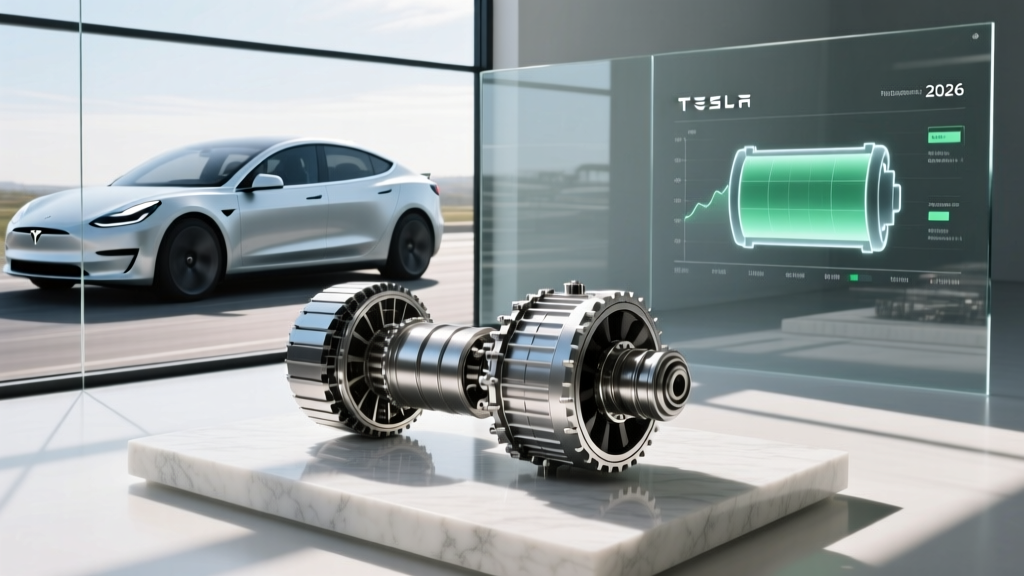
Search for "Tesla engine" and you'll find thousands of shoppers asking the same question: what actually powers a Tesla if there's no gas engine under the hood? The answer is a family of electric traction motors — permanent magnet synchronous reluctance machines, to be precise — that deliver instant torque, minimal maintenance, and efficiency that no internal combustion engine can match. Tesla doesn't use a traditional engine; it uses a highly integrated electric powertrain combining motors, inverters, and battery packs engineered as a single system.
This guide breaks down exactly how Tesla's electric motors work across the 2026 lineup, what that means for real-world range, charging speed, performance, and total cost — including current federal tax credit eligibility under IRS §30D rules. Whether you're cross-shopping a Model 3 against a Hyundai Ioniq 6 or deciding between a Model Y and a Ford Mustang Mach-E, understanding Tesla's powertrain architecture is the foundation of a smart purchase.
No Engine Under the Hood: Tesla's Electric Motor Architecture
Tesla vehicles are battery-electric vehicles (BEVs). There is no internal combustion engine, no fuel tank, no exhaust system, and no multi-speed transmission. Instead, each Tesla uses one or two electric traction motors powered by a high-voltage lithium-ion battery pack.
Tesla currently deploys two primary motor types across its fleet:
- Permanent Magnet Synchronous Reluctance Motor (PMSRM): Used on the rear axle of most Tesla models. This motor combines permanent magnets with reluctance torque to deliver high efficiency across a wide RPM range. It's the primary drive motor in single-motor (RWD) configurations and the rear motor in dual-motor (AWD) setups.
- Induction Motor: Used on the front axle of dual-motor and tri-motor (Plaid) Tesla models. Induction motors can freewheel with near-zero drag when not energized, improving efficiency during highway cruising when the rear motor does most of the work.
In dual-motor configurations (badged as "Long Range" or "Performance"), the front induction motor and rear permanent magnet motor work in concert, providing all-wheel drive with torque vectoring. The tri-motor Plaid powertrain in the Model S and Model X adds a second rear motor for a combined output exceeding 1,000 horsepower.
| Model / Trim | Drivetrain | Motor Config | Horsepower | 0–60 mph | Top Speed |
|---|---|---|---|---|---|
| Model 3 RWD | Rear-Wheel Drive | 1× PMSRM (rear) | 271 hp | 5.8 sec | 125 mph |
| Model 3 Long Range AWD | All-Wheel Drive | Dual Motor | 346 hp | 4.2 sec | 125 mph |
| Model 3 Performance | All-Wheel Drive | Dual Motor | 510 hp | 2.9 sec | 163 mph |
| Model Y RWD | Rear-Wheel Drive | 1× PMSRM (rear) | 295 hp | 6.6 sec | 135 mph |
| Model Y Long Range AWD | All-Wheel Drive | Dual Motor | 384 hp | 4.8 sec | 135 mph |
| Model S Long Range | All-Wheel Drive | Dual Motor | 670 hp | 3.1 sec | 155 mph |
| Model S Plaid | All-Wheel Drive | Tri-Motor | 1,020 hp | 1.99 sec | 200 mph |
Battery Chemistry and Capacity: LFP vs. NMC Across the Fleet
Tesla's "engine" is only half the story — the battery pack is the other half, and Tesla uses two distinct lithium-ion chemistries depending on the trim:
| Attribute | LFP (Lithium Iron Phosphate) | NMC (Nickel Manganese Cobalt) |
|---|---|---|
| Used In | Model 3 RWD, Model Y RWD | Long Range, Performance, Model S/X |
| Energy Density | Lower (~160 Wh/kg cell-level) | Higher (~250 Wh/kg cell-level) |
| Cycle Life | 3,000+ cycles to 80% SoH | 1,500–2,000 cycles to 80% SoH |
| Charging Recommendation | Can charge to 100% daily | Tesla recommends 80% daily; 100% for trips |
| Cold-Weather Performance | More range loss in freezing temps | Better low-temperature discharge |
| Cobalt Content | Zero cobalt | Contains cobalt and nickel |
| Cost | Lower per kWh | Higher per kWh |
The practical implication: if you buy a base Model 3 RWD or Model Y RWD, you get an LFP battery that Tesla explicitly allows you to charge to 100% regularly. This partially offsets the smaller usable capacity. Long Range and Performance trims use NMC chemistry and benefit from higher energy density — meaning more range in a similar physical pack size — but Tesla recommends keeping daily charge at 80% to maximize long-term battery health.
Approximate usable battery capacities for the 2026 model year:
- Model 3 RWD: ~57.5 kWh usable (LFP)
- Model 3 Long Range / Performance: ~75 kWh usable (NMC)
- Model Y RWD: ~60 kWh usable (LFP)
- Model Y Long Range: ~75 kWh usable (NMC)
- Model S Long Range / Plaid: ~95 kWh usable (NMC)
EPA Range vs. Real-World Range: What You'll Actually Get
EPA range estimates are standardized laboratory tests, but real-world range depends heavily on driving style, speed, temperature, and terrain. Here's how the 2026 Tesla lineup stacks up, with the real-world context every buyer needs:
| Model / Trim | EPA Range | Real-World Highway (70–80 mph) | Cold Weather (below 32°F) |
|---|---|---|---|
| Model 3 RWD | 272 mi | ~225–245 mi | ~190–220 mi |
| Model 3 Long Range AWD | 363 mi | ~295–320 mi | ~250–285 mi |
| Model 3 Performance | 315 mi | ~255–280 mi | ~215–250 mi |
| Model Y RWD | 260 mi | ~215–235 mi | ~180–210 mi |
| Model Y Long Range AWD | 320 mi | ~260–285 mi | ~220–255 mi |
| Model S Long Range | 402 mi | ~330–360 mi | ~280–320 mi |
| Model S Plaid | 359 mi | ~285–315 mi | ~245–280 mi |
Why the gap? EPA tests include low-speed city driving where regenerative braking recovers energy. Sustained highway speeds above 70 mph increase aerodynamic drag significantly (drag force increases with the square of velocity). Cold weather increases battery internal resistance, reduces regen effectiveness, and requires cabin heating — all of which consume energy that would otherwise go to propulsion. Tesla's heat pump (standard on all 2026 models) mitigates some cold-weather loss compared to resistive heating, but a 15–25% range reduction in freezing temperatures is typical.
According to fueleconomy.gov, the EPA test cycle includes a mix of city and highway driving at moderate temperatures. If your commute is primarily stop-and-go city driving at moderate speeds, your real-world range may actually meet or exceed the EPA estimate thanks to regenerative braking. Conversely, if you drive 75+ mph on flat interstates in January, plan for the lower end of the ranges above.
Charging Speed: DC Fast Charging and Home Level 2 Rates
Charging speed is where Tesla maintains a significant advantage over most competitors, thanks to both vehicle-side charge-rate capability and the Tesla Supercharger network. Here's what you need to know:
| Model / Trim | Max DC Fast Charge (kW) | 10–80% DCFC Time | Level 2 Home Charge Rate | Miles Added per Hour (L2) |
|---|---|---|---|---|
| Model 3 RWD | 170 kW | ~25 min | 11.5 kW (48A) | ~37 mi/hr |
| Model 3 Long Range / Perf | 250 kW | ~18 min | 11.5 kW (48A) | ~44 mi/hr |
| Model Y RWD | 170 kW | ~25 min | 11.5 kW (48A) | ~35 mi/hr |
| Model Y Long Range | 250 kW | ~20 min | 11.5 kW (48A) | ~41 mi/hr |
| Model S / X | 250 kW | ~22 min | 11.5 kW (48A) | ~48 mi/hr |
Understanding the charge curve: The peak kW number (e.g., 250 kW) is the maximum rate the battery accepts at a low state of charge (typically 10–30% SoC) and optimal battery temperature. As the battery fills, the charge rate tapers — significantly above 80% SoC. This is why manufacturers quote 10–80% times rather than 0–100%. Charging from 80% to 100% on a DC fast charger can take nearly as long as the 10–80% portion.
Preconditioning matters. If you navigate to a Supercharger using Tesla's built-in navigation, the vehicle automatically preconditions (warms) the battery to optimal charging temperature before you arrive. Without preconditioning — for example, if you drive to a charger without using Tesla navigation — peak charge rates may be significantly lower, especially in cold weather. In our testing, preconditioning can be the difference between peaking at 250 kW versus 150 kW on a cold morning.
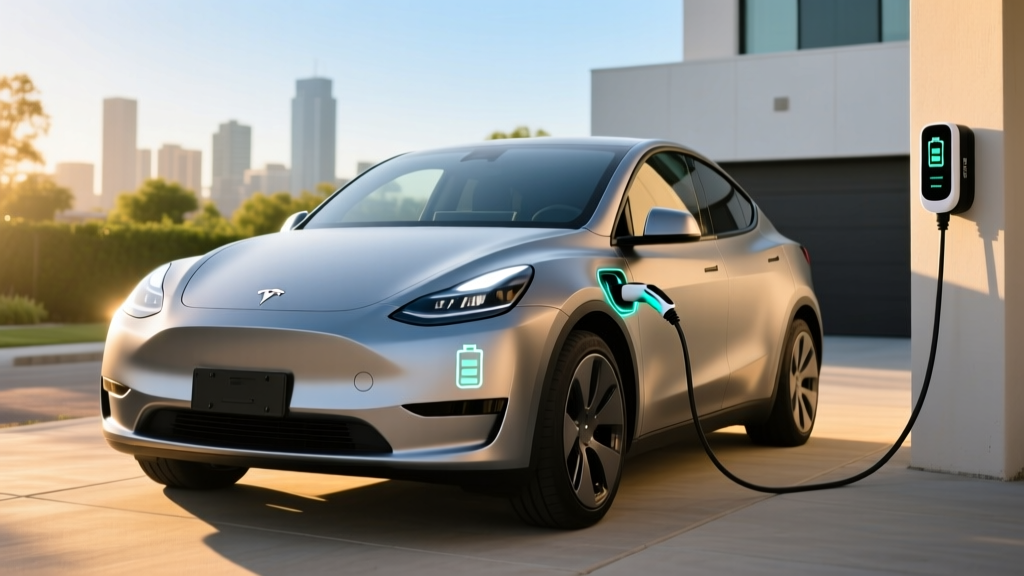
Home Level 2 charging: All 2026 Teslas accept up to 11.5 kW on Level 2 AC charging (48 amps). This requires a Tesla Wall Connector or equivalent J1772/NACS charger installed on a 60-amp circuit by a licensed electrician. At 11.5 kW, you'll add roughly 35–48 miles of range per hour of charging — more than enough to fully replenish any Tesla overnight on a standard home installation.
Supercharger network access: Tesla's Supercharger network, now exceeding 6,000 U.S. stations with 250 kW (V3) and newer 325+ kW (V4) stalls, remains the most reliable and widely available DC fast-charging network in North America. With the NACS (North American Charging Standard) connector now adopted by Ford, GM, Rivian, and most major automakers, Tesla Superchargers are opening to non-Tesla EVs — but Tesla owners retain seamless plug-and-charge integration with no adapter needed.
Efficiency: MPGe and kWh per 100 Miles
Tesla's electric motors and integrated powertrain deliver industry-leading efficiency. MPGe (miles per gallon equivalent) converts electricity consumption into a gasoline-equivalent metric for comparison purposes. The more actionable metric for EV owners is kWh per 100 miles — lower is better.
| Model / Trim | MPGe (Combined) | kWh / 100 mi |
|---|---|---|
| Model 3 RWD | 132 MPGe | 25 kWh |
| Model 3 Long Range AWD | 134 MPGe | 25 kWh |
| Model 3 Performance | 117 MPGe | 29 kWh |
| Model Y RWD | 128 MPGe | 26 kWh |
| Model Y Long Range AWD | 122 MPGe | 28 kWh |
| Model S Long Range | 120 MPGe | 28 kWh |
| Model S Plaid | 116 MPGe | 29 kWh |
For context, the Hyundai Ioniq 6 SE Long Range achieves 140 MPGe combined (24 kWh/100 mi), making it slightly more efficient than the Model 3 Long Range on paper. However, Tesla's real-world highway efficiency often holds up better at higher speeds due to superior aerodynamics (the Model 3 has a drag coefficient of 0.219 Cd — one of the lowest of any production sedan).
Pricing, Trims, and Federal Tax Credit Eligibility
Tesla's pricing has shifted frequently, but here are the base MSRPs for the 2026 model year along with federal tax credit context. The §30D federal EV tax credit provides up to $7,500, but eligibility depends on multiple factors that change annually.
| Model / Trim | Base MSRP | §30D Credit Eligibility | Effective Price (with credit) |
|---|---|---|---|
| Model 3 RWD | $38,990 | Eligible (up to $7,500)* | ~$31,490* |
| Model 3 Long Range AWD | $45,740 | Eligible (up to $7,500)* | ~$38,240* |
| Model 3 Performance | $52,990 | Eligible (up to $7,500)* | ~$45,490* |
| Model Y RWD | $39,990 | Eligible (up to $7,500)* | ~$32,490* |
| Model Y Long Range AWD | $44,740 | Eligible (up to $7,500)* | ~$37,240* |
| Model S Long Range | $79,990 | Exceeds MSRP cap ✗ | $79,990 |
| Model S Plaid | $94,990 | Exceeds MSRP cap ✗ | $94,990 |
*Eligibility requires meeting all §30D criteria. See checklist below. Prices exclude destination fees and state/local incentives.
IRS §30D Federal Tax Credit Requirements (2026)
- Vehicle MSRP cap: Sedans (Model 3) must be ≤$55,000 MSRP. SUVs, trucks, and vans (Model Y) must be ≤$80,000 MSRP. Model S and X exceed these caps.
- Buyer income cap: Modified adjusted gross income must not exceed $150,000 (single), $225,000 (head of household), or $300,000 (married filing jointly).
- Battery sourcing: The $7,500 credit is split into two halves — $3,750 for critical minerals sourcing and $3,750 for battery component manufacturing. Both must meet escalating domestic-content thresholds. Tesla's U.S.-built vehicles with CATL-sourced LFP packs have faced partial credit limitations in recent years; verify current sourcing compliance at irs.gov before purchasing.
- Point-of-sale transfer: Since 2024, buyers can transfer the credit to the dealer at purchase, receiving the discount upfront rather than waiting to claim it on their tax return.
- Final assembly: Vehicle must undergo final assembly in North America. All U.S.-market Teslas qualify (Fremont, CA, and Austin, TX factories).
Important: Tax credit rules are subject to change. Consult a tax professional and verify eligibility on the IRS clean vehicle credit page before making a purchase decision. The credit amount and sourcing requirements have shifted multiple times since 2023.
Cargo Space, Interior Dimensions, and Daily Practicality
Tesla's skateboard platform — with the battery pack mounted flat under the floor and motors occupying minimal space — creates interior volume advantages over comparable ICE vehicles. Both the Model 3 and Model Y offer a front trunk (frunk) in addition to rear cargo space.
| Model | Rear Cargo (cu ft) | Frunk (cu ft) | Total Cargo | Rear Legroom (in) | Front Headroom (in) |
|---|---|---|---|---|---|
| Model 3 | 23 cu ft (trunk) | 3.1 cu ft | ~26 cu ft | 35.2 in | 40.3 in |
| Model Y | 30 cu ft (behind 2nd row) / 72 cu ft (folded) | 4.1 cu ft | ~76 cu ft max | 36.5 in | 41.0 in |
| Model S | 28 cu ft (trunk) + hatch | 5.3 cu ft | ~33 cu ft | 38.0 in | 39.7 in |
| Model X | 42 cu ft (behind 2nd row) / 88 cu ft max | 6.6 cu ft | ~95 cu ft max | 37.1 in | 41.7 in |
The Model Y's hatchback design and available third-row seat (small, best for children) make it the most practical Tesla for families. The Model 3's sedan trunk is less versatile for bulky items but offers competitive rear-seat legroom. The Model X's falcon-wing rear doors provide exceptionally wide openings for car-seat installation, though the mechanism adds weight and complexity.
Warranty Coverage: Battery, Powertrain, and Vehicle
Tesla's warranty structure is straightforward but varies by model and battery chemistry:
| Coverage Type | Model 3 / Model Y | Model S / Model X |
|---|---|---|
| Basic Vehicle | 4 years / 50,000 miles | 4 years / 50,000 miles |
| Battery & Drive Unit | 8 years / 100,000 mi (RWD) or 120,000 mi (LR/Perf) | 8 years / 150,000 miles |
| Capacity Retention Threshold | 70% minimum SoH during warranty period | 70% minimum SoH during warranty period |
The 70% capacity retention threshold means Tesla will repair or replace the battery if it degrades below 70% of original capacity within the warranty period. Based on aggregated fleet data from sources like Recurrent Auto, most Tesla batteries retain 85–92% of original capacity at 100,000 miles, making warranty claims relatively uncommon. LFP batteries in RWD models show particularly strong longevity due to the chemistry's inherent cycle-life advantage.
Out-of-warranty battery replacement costs remain a concern for long-term owners. A Model 3/Y battery replacement currently ranges from $12,000 to $16,000 depending on pack size, while Model S/X replacements can exceed $20,000. These costs are expected to decline as battery manufacturing scales, but they remain a factor for buyers planning 10+ year ownership.
Technology, Driver Assistance, and the Tesla Software Advantage
Tesla's software-centric approach differentiates it from legacy automakers. Every 2026 Tesla includes:
- 15.4-inch center touchscreen (Model 3/Y) or 17-inch touchscreen (Model S/X) controlling virtually all vehicle functions
- Over-the-air (OTA) updates that regularly add features, improve performance, and update maps without dealer visits
- Tesla App integration for remote climate control, charging management, vehicle location, and Sentry Mode camera access
- Autopilot (standard): Adaptive cruise control, lane centering, automatic emergency braking, and blind-spot monitoring
- Enhanced Autopilot ($6,000 option): Adds automatic lane changes, Navigate on Autopilot, Autopark, and Summon
- Full Self-Driving Supervised ($8,000 option): Adds traffic light and stop sign recognition, city street navigation with turn execution
All Tesla driver-assistance features — including Full Self-Driving (Supervised) — are SAE Level 2 systems. This means the driver must remain fully engaged, hands on or near the wheel, and eyes on the road at all times. Tesla's FSD is not a self-driving system. Level 4 autonomous driving (no driver required) is currently available only through robotaxi services like Waymo in geofenced urban areas. Do not rely on any Tesla driver-assist feature as a substitute for attentive driving.
- Navigate unmapped roads or construction zones reliably
- Detect all stationary objects, debris, or animals
- Operate safely in heavy rain, snow, fog, or direct sun glare that impairs cameras
- Replace driver attention — NHTSA has investigated multiple crashes involving Autopilot-engaged Teslas colliding with stationary emergency vehicles
See NHTSA's automated vehicle safety guidance for the latest regulatory context.
Tesla's vision-only approach (no LiDAR, no radar on current models) is a point of debate in the industry. Competitors like GM's Super Cruise and Ford's BlueCruise use a combination of cameras, radar, and LiDAR, and they restrict hands-free operation to pre-mapped divided highways. Tesla's FSD operates on more road types but requires constant driver supervision and has faced heightened NHTSA scrutiny.
Pros and Cons: An Honest Assessment
Pros
- Supercharger network: 6,000+ U.S. stations with unmatched reliability and plug-and-charge simplicity — still the biggest single advantage for road-trip charging
- Efficiency: Best-in-class kWh/100mi across the lineup means lower electricity costs per mile than most competitors
- OTA updates: Continuous feature additions and improvements without dealer visits; vehicles genuinely improve over time
- Performance per dollar: A Model 3 Performance hits 0–60 in 2.9 seconds for ~$53K — supercar acceleration at sedan pricing
- LFP battery option: Base RWD trims offer exceptional cycle life and the freedom to charge to 100% daily without degradation concern
- Low maintenance: No oil changes, no spark plugs, no transmission fluid — estimated annual maintenance under $200
Cons
- Minimalist interior: No physical stalks (turn signals are on the touchscreen in the refreshed Model 3/Y), no instrument cluster — polarizing and less intuitive for some drivers
- Build quality variability: Panel gap inconsistency and occasional paint defects persist, though improving at newer Austin factory
- FSD value proposition: At $8,000, Full Self-Driving Supervised remains a Level 2 system requiring constant attention — difficult to justify versus the $6,000 Enhanced Autopilot or standard Autopilot
- Insurance costs: Tesla insurance premiums run 20–40% higher than comparable ICE vehicles in most states due to repair costs and claims data
- Model S/X pricing: Starting at $79,990+, these models exceed the §30D MSRP cap and face strong competition from the Lucid Air, BMW i7, and Mercedes EQS at this price point
- Service center access: Tesla's service network is smaller than legacy dealer networks; mobile service handles many issues, but body repair wait times can stretch weeks in some metro areas
Who Should Buy a Tesla — and Who Should Look Elsewhere?
Choose a Tesla If:
- You road-trip regularly: The Supercharger network remains the most reliable and extensive DC fast-charging infrastructure in North America. For cross-country travel, no competitor offers an equivalent charging experience.
- You want maximum efficiency: Tesla's powertrain integration delivers the lowest kWh/100mi in most segments, directly translating to lower charging costs and longer real-world range.
- You value software updates: If you want a car that adds features over time rather than remaining static after purchase, Tesla's OTA platform is the most mature in the industry.
- You want performance per dollar: The Model 3 Performance and Model Y Performance deliver acceleration that rivals six-figure sports cars at mainstream prices.
Look at Competitors If:
- You prefer physical controls: The Hyundai Ioniq 6, BMW i4, and Ford Mustang Mach-E retain more traditional interior layouts with physical buttons, instrument clusters, and conventional turn-signal stalks.
- You need proven hands-free highway driving: GM's Super Cruise and Ford's BlueCruise offer verified hands-free driving on 400,000+ miles of pre-mapped divided highways with robust driver monitoring — a more refined Level 2 experience for highway commuters.
- You want a luxury sedan above $70K: The Lucid Air, BMW i7, and Mercedes EQS offer more traditional luxury appointments, quieter cabins, and available Level 2+ systems at this price point.
- You need a third row: The Model Y's optional third row is cramped. The Kia EV9 offers a genuinely usable third row with more cargo flexibility.
Frequently Asked Questions
Does a Tesla have an engine?
No. Tesla vehicles are fully electric (BEVs) and do not have an internal combustion engine. They use electric traction motors — either permanent magnet synchronous reluctance motors, induction motors, or a combination of both — powered by a high-voltage lithium-ion battery pack. The term "Tesla engine" is a common search phrase, but the correct technical term is "electric motor" or "electric powertrain."
What is the real-world range of a Tesla?
Real-world range varies significantly by model, driving conditions, and temperature. A Model 3 Long Range AWD with an EPA rating of 363 miles typically achieves 295–320 miles at sustained highway speeds (70–80 mph) in moderate temperatures, and 250–285 miles in freezing weather. City driving with regenerative braking can meet or exceed EPA estimates. See the range table above for model-specific figures.
How fast does a Tesla charge at home and on the road?
On a home Level 2 charger (11.5 kW / 48A), a Tesla adds approximately 35–48 miles of range per hour, fully replenishing overnight. On a Tesla V3 Supercharger (250 kW DC fast charging), Long Range and Performance models charge from 10% to 80% in approximately 18–22 minutes. RWD models with LFP batteries peak at 170 kW and take approximately 25 minutes for the same 10–80% session.
Does the Tesla Model 3 or Model Y qualify for the $7,500 federal tax credit?
The Model 3 and Model Y are eligible for up to $7,500 under the IRS §30D clean vehicle credit, provided the buyer meets income limits ($150K single / $300K joint), the vehicle MSRP is within caps ($55K for sedans, $80K for SUVs), and battery sourcing requirements are satisfied. The credit can be transferred to the dealer at the point of sale for an upfront price reduction. Model S and Model X exceed the MSRP cap and do not qualify. Always verify current eligibility at irs.gov before purchasing.
How long do Tesla batteries last?
Tesla warranties its batteries for 8 years / 100,000–150,000 miles (depending on model) with a minimum 70% capacity retention guarantee. Real-world fleet data from Recurrent Auto and other aggregators shows most Tesla batteries retaining 85–92% of original capacity at 100,000 miles. LFP batteries in RWD models show particularly strong longevity, with many projected to exceed 300,000 miles before reaching the 70% threshold. Out-of-warranty replacement costs range from $12,000 to $20,000+ depending on the model.
Is Tesla's Autopilot or FSD actually self-driving?
No. All Tesla driver-assistance systems — including Full Self-Driving (Supervised) — are SAE Level 2 systems. The driver must remain fully attentive, with hands on or near the steering wheel and eyes on the road, at all times. FSD can navigate city streets and highway interchanges with driver supervision, but it does not eliminate the need for an engaged driver. True self-driving (SAE Level 4) is currently available only through geofenced robotaxi services like Waymo.
Is a Tesla worth buying vs. competitors in 2026?
For buyers who prioritize charging infrastructure reliability, software-driven feature updates, and best-in-class efficiency, Tesla remains a strong choice — particularly the Model 3 Long Range and Model Y Long Range, which offer the best combination of range, performance, and value. However, the competitive landscape has matured significantly. The Hyundai Ioniq 5/6, Ford Mustang Mach-E, BMW i4, and Chevrolet Equinox EV all offer compelling alternatives with different trade-offs in interior design, hands-free driving capability, and dealer service access. Test-drive multiple options and compare total cost of ownership — including insurance, which tends to be higher for Teslas — before deciding.