Why Tesla's Headcount Matters to EV Shoppers
When you're researching your next electric vehicle, most buyers focus on EPA range, charging speed, and price. But one overlooked data point reveals a lot about a company's ability to deliver quality, service, and long-term support: workforce size. The Tesla number of employees 2025 figure is more than a corporate statistic — it reflects the company's manufacturing scale, service network depth, and engineering capacity at a time when competition from Hyundai, Ford, and Rivian has never been fiercer.
As of early 2025, Tesla reported approximately 140,000 full-time employees globally, according to its 2024 Impact Report and subsequent SEC filings. That's a shift from the roughly 127,000 employees Tesla reported at the end of 2023, reflecting both expansion at Gigafactories (Texas, Berlin, Shanghai) and strategic hiring in AI, autonomy, and energy. However, Tesla also underwent targeted layoffs in 2024 — particularly in its Supercharger and sales divisions — meaning the net headcount tells a story of restructuring, not just growth.
For EV buyers in 2026, the practical question isn't the raw number. It's what that workforce translates into: Can Tesla service your car quickly? Are build quality and software improving? Is the Supercharger network expanding fast enough to support road trips? To answer those, we need to look at the vehicles this workforce is building — starting with Tesla's best-selling model, the 2026 Model Y.
2026 Tesla Model Y: The Benchmark Compact Electric SUV
The refreshed Model Y (internally dubbed "Juniper") entered production in early 2025 and carries into the 2026 model year with meaningful updates to range, interior materials, and ride quality. It remains Tesla's volume leader and the lens through which most buyers evaluate the company.
| Spec | Long Range AWD | Performance |
|---|---|---|
| EPA Range | 320 miles | 295 miles |
| Battery (usable) | ~75 kWh, NMC | ~75 kWh, NMC |
| Drivetrain | Dual-Motor AWD | Dual-Motor AWD |
| 0–60 mph | 4.8 seconds | 3.5 seconds |
| Horsepower | 384 hp | 456 hp |
| MPGe (combined) | 122 MPGe | 111 MPGe |
| Efficiency | 28 kWh/100 mi | 30 kWh/100 mi |
| Max DC Charge Rate | 250 kW | 250 kW |
| 10–80% DCFC Time | ~25 minutes | ~25 minutes |
| Level 2 Home Rate | 11.5 kW (~44 mi/hr) | 11.5 kW (~44 mi/hr) |
| Base MSRP | $44,990 | $51,490 |
| Cargo (rear seats up) | 30.2 cu ft | 30.2 cu ft |
| Cargo (rear seats folded) | 72.1 cu ft | 72.1 cu ft |
| Battery Warranty | 8 yr / 120,000 mi | 8 yr / 120,000 mi |
Charging: Supercharger Network Advantage
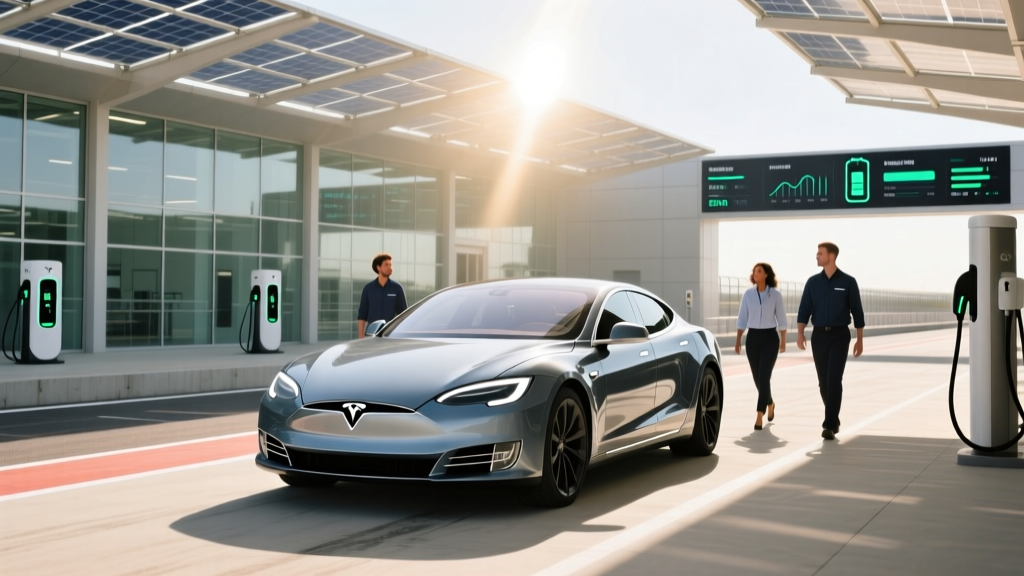
One area where Tesla's workforce investment pays dividends is charging infrastructure. The Supercharger network — now open to non-Tesla EVs via the NACS standard — remains the most reliable DC fast-charging ecosystem in North America. With Tesla employing thousands in its energy division, the network continues to expand, adding V4 stalls with 350 kW capability at select corridors.
| Level | Power | Miles Added per Hour | Typical Use Case |
|---|---|---|---|
| Level 1 (120V) | ~1.4 kW | ~5 mi/hr | Overnight trickle, emergencies |
| Level 2 (240V, 48A) | 11.5 kW | ~44 mi/hr | Home daily charging |
| DC Fast (V3 Supercharger) | 250 kW peak | ~1,000 mi/hr (peak) | Road trips; 10–80% in ~25 min |
| DC Fast (V4 Supercharger) | Up to 350 kW | Faster taper curve | Limited corridors; future-proofing |
Charging curve reality: The 250 kW peak rate only holds between roughly 10–45% State of Charge. Above 60%, the curve tapers significantly — you'll see ~100 kW at 70% and ~50 kW above 85%. This is why Tesla's navigation system typically routes you through multiple shorter stops rather than one long charge to 100%.
Interior, Tech, and Driver Assistance
The 2026 Model Y's Juniper refresh brought a ventilated front seat row, acoustic glass all around, ambient lighting, and a rear touchscreen for passengers. The minimalist interior still divides opinion — no turn signal stalk (signals are on the steering wheel), no instrument cluster — but build quality has measurably improved over 2022–2023 models, with tighter panel gaps and better material consistency.
The 15.4-inch center touchscreen runs Tesla's proprietary infotainment, which remains best-in-class for responsiveness and over-the-air updates. Navigation, streaming, and trip planning are seamless. However, Apple CarPlay and Android Auto are still not supported — a dealbreaker for some buyers switching from legacy brands.
Pricing, Trims, and Federal Tax Credit Eligibility
Tesla's pricing has stabilized after years of volatile cuts and increases. The 2026 Model Y lineup starts at $44,990 for the Long Range AWD and $51,490 for the Performance trim. A base Rear-Wheel-Drive model (with an LFP battery and ~260-mile range) has been intermittently available at ~$39,990 — check Tesla's configurator for current availability, as this trim is produced in limited batches.
| Trim | MSRP | Est. §30D Credit* | Effective Price |
|---|---|---|---|
| Long Range AWD | $44,990 | Up to $7,500 | ~$37,490 |
| Performance | $51,490 | Up to $7,500 | ~$43,990 |
*Federal tax credit eligibility under IRS §30D depends on buyer income caps ($150K single / $300K joint MAGI), vehicle MSRP caps ($80,000 for SUVs), battery critical-mineral sourcing, and North American final assembly. The Model Y is assembled in Fremont, CA and Austin, TX. Credit may be applied at point of sale as of 2024+ rules. Always verify current eligibility at IRS.gov and consult a tax professional.
How Tesla's 2025 Workforce Affects You as a Buyer
The Tesla number of employees in 2025 (~140,000 globally) is large by EV-startup standards but lean compared to legacy automakers. For context, Ford employs roughly 170,000 and Toyota over 370,000. Tesla achieves its output with fewer workers per vehicle produced — a reflection of heavy automation in its factories.
What does this mean for buyers?
- Service capacity: Tesla has expanded mobile service and remote diagnostics, reducing the need for physical service centers. However, wait times for body repair and collision work remain a common complaint in high-population metros.
- Build quality: The Juniper refresh shows measurable improvement, but variance between Fremont and Austin builds still exists. Early-2025 production vehicles occasionally showed trim alignment issues that later builds corrected.
- Software pace: Tesla's engineering-heavy workforce means OTA updates arrive frequently — adding features, refining regen profiles, and improving efficiency post-purchase. No legacy automaker matches this cadence.
- Supercharger reliability: With dedicated infrastructure teams, Tesla's charger uptime exceeds 99% — a figure industry analysts consistently confirm. This remains Tesla's strongest competitive moat.
Model Y vs. Key Competitors: 2026 Snapshot
The compact electric SUV segment is crowded. Here's how the Model Y Long Range AWD stacks up against its top rivals:
| Spec | Tesla Model Y LR | Hyundai Ioniq 5 AWD | Ford Mustang Mach-E ER AWD |
|---|---|---|---|
| EPA Range | 320 mi | 290 mi | 312 mi |
| Battery | 75 kWh NMC | 77.4 kWh NMC | 91 kWh NMC |
| Peak DC Charge | 250 kW | 240 kW | 150 kW |
| 10–80% DCFC | ~25 min | ~18 min | ~38 min |
| 0–60 mph | 4.8 sec | 5.0 sec | 5.1 sec |
| MPGe (combined) | 122 | 110 | 101 |
| Base MSRP | $44,990 | $49,850 | $48,995 |
| NACS Native? | Yes | Yes (2025+) | Yes (2025+) |
The Ioniq 5 charges faster (its 800V architecture sustains peak kW longer), while the Mach-E offers a more traditional interior layout. But the Model Y leads in efficiency (kWh/100 mi), cargo space, and — critically — access to the most mature Supercharger network. For road-trippers, that network advantage remains decisive.
Pros and Cons at a Glance
Pros
- Class-leading efficiency (122 MPGe combined)
- Access to Supercharger network with 99%+ uptime
- Spacious cargo area (72.1 cu ft with seats folded)
- Excellent OTA update cadence adds post-purchase value
- Strong real-world range with heat pump for cold climates
- Qualifies for up to $7,500 federal tax credit (verify eligibility)
Cons
- No Apple CarPlay or Android Auto
- Stalkless steering wheel takes significant adaptation
- Service center wait times in some metros remain long
- FSD Supervised is expensive and still Level 2 — not autonomous
- Ride quality improved but still firm over rough pavement
- Panel gap variance between factories
Who Should Buy the 2026 Model Y?
The Model Y remains the default recommendation for tech-forward commuters and small families who want a single-vehicle solution for daily driving and road trips. If you have home Level 2 charging access, drive 30–80 miles daily, and take 2–4 road trips per year, the Model Y Long Range AWD is difficult to beat on total cost of ownership.
It's less ideal for buyers who prioritize traditional controls (stalks, buttons, instrument clusters), need third-row seating, or live in areas with limited Tesla service infrastructure. If you tow frequently, note the Model Y's 3,500-pound tow rating — adequate for a small trailer, but less than the Ford F-150 Lightning or Rivian R1S.
Frequently Asked Questions
What is the real-world range of the 2026 Tesla Model Y?
The EPA rates the Long Range AWD at 320 miles. Real-world highway driving at 70 mph yields approximately 270–290 miles. In freezing weather, expect 220–250 miles. Preconditioning the battery (automatic when navigating to a Supercharger) helps recover some efficiency.
How fast does the Model Y charge at home and on the road?
At home on a 240V Level 2 charger (48A), the Model Y adds approximately 44 miles of range per hour — a full overnight charge from 20% to 80% takes about 5–6 hours. On a V3 Supercharger, 10–80% takes approximately 25 minutes, though the charging curve tapers above 60% SoC.
Does the 2026 Model Y qualify for the $7,500 federal tax credit?
The Model Y is assembled in the US and generally qualifies, but eligibility depends on your income (MAGI caps: $150K single, $300K joint), the vehicle's MSRP (under the $80K SUV cap), and battery mineral sourcing requirements that change periodically. Check IRS §30D guidance and confirm with a tax professional before purchasing.
How many employees does Tesla have, and why does it matter?
Tesla reported approximately 140,000 employees globally as of early 2025. This lean but automation-heavy workforce supports industry-leading production efficiency, rapid software updates, and the Supercharger network — though service-center capacity in some regions remains a constraint compared to legacy dealer networks.
Is the Model Y worth buying over the Hyundai Ioniq 5 or Ford Mach-E?
Choose the Model Y if you prioritize efficiency, cargo space, Supercharger access, and software innovation. Choose the Ioniq 5 if faster DC charging (18-min 10–80%) and a more conventional interior matter to you. The Mach-E suits buyers who prefer a car-like driving feel and traditional dealership service. All three are strong — your decision should hinge on charging access, interior preference, and which service network covers your area best.
What is the battery warranty on the 2026 Model Y?
Tesla covers the Model Y's battery and drive unit for 8 years or 120,000 miles (whichever comes first), with a minimum 70% capacity retention threshold over that period. Real-world degradation data from Tesla's fleet shows most NMC packs retain 85–90% capacity at 100,000 miles.