The Tesla employee lease program periodically surfaces in EV forums and deal-hunting communities as one of the most aggressive ways to get into a new Tesla. When active, it typically offers Tesla employees — and sometimes their families — deeply discounted lease terms on the Model 3 and Model Y. But what does the deal actually look like in 2026, and how does the underlying vehicle stack up for anyone evaluating the Model 3 regardless of how they acquire it?
This review breaks down the current Tesla employee lease program structure, then delivers a full spec-driven profile of the 2026 Tesla Model 3 Long Range AWD — the trim most commonly featured in these lease offers — so you can evaluate the car on its merits.
What Is the Tesla Employee Lease Program?
The Tesla employee lease program is an internal benefit that allows Tesla employees to lease new Tesla vehicles at significantly reduced monthly payments compared to public lease offers. Historically, the program has featured:
- Monthly payments 30–50% below public lease rates on equivalent trims
- Reduced or waived acquisition fees
- Standard 36-month/30,000-mile lease terms (with options to extend)
- Employee-purchase options at lease end based on residual value
- Access to new trims before public availability in some cases
The program availability fluctuates. Tesla does not publish its employee benefits publicly, and details change quarterly based on inventory levels, demand targets, and corporate policy. Family-member extensions have been offered intermittently but are never guaranteed. If you are a Tesla employee, check your internal benefits portal for current terms; if you are not, the public lease and purchase pricing discussed below applies to you.
2026 Tesla Model 3 Long Range AWD: Spec Table
| Specification | Value |
|---|---|
| EPA Estimated Range | 341 miles |
| Battery Capacity (usable) | 75 kWh (est.), NMC chemistry |
| Drivetrain | Dual-Motor AWD |
| Horsepower | 346 hp (combined) |
| 0–60 mph | 4.2 seconds |
| Top Speed | 125 mph |
| Max DC Fast-Charge Rate | 250 kW (peak) |
| 10–80% DC Fast Charge | ~25 minutes |
| Level 2 Home Charge Rate | 11.5 kW (~44 mi/hr) |
| Efficiency | 132 MPGe combined / 25 kWh/100 mi |
| Cargo Volume | 23 cu ft (rear trunk) + 3.1 cu ft (frunk) |
| Rear Legroom | 35.2 inches |
| Base MSRP | $47,740 (incl. destination) |
| Battery Warranty | 8 years / 120,000 miles (min 70% retention) |
| Basic Vehicle Warranty | 4 years / 50,000 miles |
Sources: fueleconomy.gov, Tesla Model 3 design page.
Real-World Range: What the EPA Number Doesn't Tell You
EPA estimate: 341 miles. Real-world expectation: 280–310 miles on mixed highway driving at 70–75 mph. In cold weather (below 32°F), expect 240–270 miles due to battery resistance and cabin heating loads. City driving with regenerative braking can match or slightly exceed the EPA figure.
The Model 3 Long Range's 341-mile EPA rating places it among the top sedans in its class. However, the EPA test cycle includes substantial low-speed and stop-and-go driving where regenerative braking recovers energy. On a sustained 70 mph highway run in moderate temperatures (60–75°F), real-world consumption typically lands around 27–29 kWh/100 mi, yielding roughly 290–310 miles before the battery buffer engages.
Cold weather is the bigger variable. At 20°F, the NMC battery's internal resistance increases and the heat pump — standard on the refreshed Model 3 — must work harder. Owners in northern climates consistently report 20–25% range reduction in deep winter. Tesla's preconditioning feature, which warms the battery when a Supercharger is set as your navigation destination, mitigates charging-speed loss in cold weather but does not restore lost range.
Charging Speed: DC Fast, Level 2, and the Charge Curve
| Charging Level | Power | Miles Added per Hour | Notes |
|---|---|---|---|
| Level 1 (120V outlet) | ~1.4 kW | ~5 mi/hr | Emergency/trickle only |
| Level 2 (240V, 48A) | 11.5 kW | ~44 mi/hr | Full overnight charge in ~7 hrs |
| DC Fast (Tesla Supercharger V3/V4) | 250 kW peak | — | 10–80% in ~25 min |
| DC Fast (CCS via adapter) | Up to 250 kW | — | Depends on station capability |
The Model 3 Long Range peaks at 250 kW on Tesla Superchargers, but — as with all EVs — that peak is not sustained across the full session. The charge curve is aggressive from roughly 10–45% State of Charge (SoC), where the car can pull above 200 kW. From 45–65%, the rate tapers to approximately 120–150 kW. Above 80%, it drops further to protect battery longevity, making the final 20% significantly slower.
A typical 10–80% session takes about 25 minutes at a V3 or V4 Supercharger. For context, that adds roughly 200 miles of real-world range — enough for most road-trip legs. The Model 3 uses the NACS (North American Charging Standard) connector natively. With Tesla's CCS adapter (included with newer deliveries), you can also access Electrify America, EVgo, and other CCS networks, though charge speeds on non-Tesla hardware may vary.
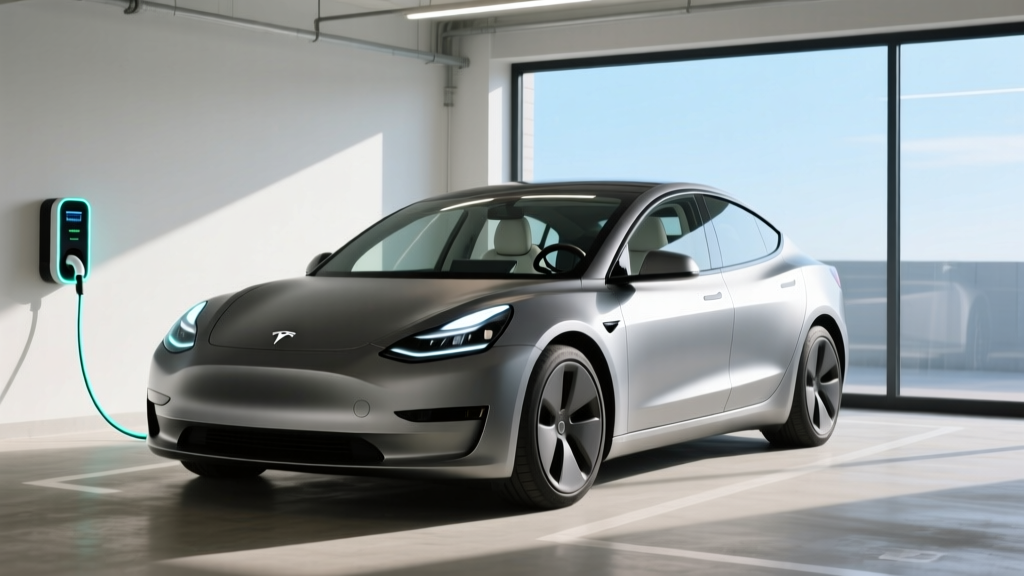
At home on a 48-amp Level 2 circuit (requiring a 60-amp breaker), the onboard charger accepts up to 11.5 kW. That translates to roughly 44 miles of range per hour of charging, or a full 0–100% charge in about 7 hours. Most owners who charge nightly from 30–80% need only 3–4 hours on Level 2.
Performance and Driving Dynamics
The dual-motor AWD powertrain delivers 346 combined horsepower and a 4.2-second 0–60 mph time. That is genuinely quick for a daily-driver sedan and sufficient for confident highway merging and passing. The instant torque delivery from the electric motors means the car feels faster than the stopwatch number suggests in real-world driving.
Ride quality on the refreshed Model 3 (internally codenamed "Highland" and carried forward) is noticeably improved over the pre-2024 models. Tesla retuned the suspension, added acoustic glass, and improved sound deadening. Highway noise is substantially reduced, though the ride remains firm by luxury-sedan standards — you will feel sharp pavement imperfections more than in a Genesis Electrified G80 or BMW i4.
One-pedal driving via regenerative braking remains a Tesla hallmark, though Tesla removed the user-adjustable regen setting in favor of a fixed, strong regen calibration. Most EV-adapted drivers prefer this, but new EV buyers may need a week to acclimate.
Interior, Tech, and Cargo
The Model 3 cabin is minimalist by design — some say starkly so. All vehicle controls, climate settings, and media run through the 15.4-inch center touchscreen. There is no instrument cluster; speed and navigation info appear in the upper-left corner of the main display. A rear 8-inch touchscreen for passengers was added in the refresh, handling climate and media for back-seat riders.
Standout tech features:
- Tesla Autopilot (SAE Level 2 driver-assist) standard — includes adaptive cruise, lane centering, and automatic emergency braking
- Full Self-Driving (Supervised) available as a $8,000 option or $99/month subscription — still SAE Level 2, requires active driver supervision
- Over-the-air updates that add features post-purchase
- Sentry Mode dashcam surveillance while parked
- Native Tesla Supercharger network integration with automatic routing
Tesla Autopilot and FSD (Supervised) are SAE Level 2 systems. The driver must keep hands on the wheel and eyes on the road at all times. These are not self-driving systems. Only Level 4 services like Waymo operate without a human driver, and those are limited to specific geofenced areas.
Notable drawbacks:
- No physical buttons for climate, turn signals (stalkless design), or wipers — all screen-controlled or steering-wheel-button-controlled
- Rear seat is snug for tall adults (35.2 inches of legroom vs. 38+ in midsize sedans)
- No Apple CarPlay or Android Auto — Tesla's proprietary infotainment only
- Panel gaps and paint quality, while improved, still draw owner complaints relative to legacy luxury brands
Cargo space totals 26.1 cubic feet (23.0 cu ft rear trunk + 3.1 cu ft frunk). The trunk opening is a conventional sedan lid, not a hatchback, which limits loading bulky items. The frunk is useful for charging cables and small bags.
Pricing, Tax Credits, and Total Cost
| Item | Amount |
|---|---|
| Model 3 RWD (base) | $40,240 MSRP |
| Model 3 Long Range AWD | $47,740 MSRP |
| Model 3 Performance | $54,990 MSRP |
| FSD (Supervised) option | +$8,000 |
| Federal §30D Tax Credit (if eligible) | Up to $7,500 |
| Long Range AWD after max credit | ~$40,240 effective |
The federal EV tax credit under IRS §30D offers up to $7,500 for qualifying new EVs. However, eligibility depends on several factors that change periodically:
- MSRP cap: Sedans must be priced at or below $55,000. The Model 3 Long Range AWD ($47,740) qualifies; the Performance trim ($54,990) also qualifies. Adding FSD can push you over the cap.
- Buyer income cap: Modified adjusted gross income must not exceed $150,000 (single), $225,000 (head of household), or $300,000 (joint filing).
- Battery sourcing: The $7,500 credit splits into two halves — $3,750 for critical-minerals sourcing and $3,750 for battery-component manufacturing. Tesla has historically met both requirements for US-built Model 3 vehicles, but sourcing rules tighten annually. Verify current-year eligibility on the IRS clean vehicle credit page before purchasing.
- Point-of-sale transfer: As of 2024, buyers can transfer the credit to the dealer at purchase, reducing the upfront price rather than waiting for a tax refund. Tesla participates in this program.
Employee lease pricing context: When the Tesla employee lease program is active, employees have reported monthly payments on the Model 3 Long Range in the $299–$449 range (36 months, 10,000–12,000 miles/year, with varying money-down structures). Public leases on the same vehicle typically run $499–$649/month under comparable terms. The savings of $150–$350/month add up to $5,400–$12,600 over the lease term — a substantial benefit. However, lease vehicles may not qualify for the §30D new-vehicle credit; instead, the leasing company claims it and may (or may not) pass the savings through as a capitalized-cost reduction. Tesla has historically passed the credit through on employee leases, but confirm this with the internal lease offer details.
Pros and Cons
- Class-leading 341-mile EPA range
- Access to Tesla Supercharger network (most reliable DC fast-charging infrastructure)
- Strong 0–60 performance (4.2 sec) with AWD traction
- Continuous OTA updates add features over time
- Low running costs: ~$0.04–$0.06/mile on home electricity
- Employee lease program offers significant savings when available
- Minimalist interior polarizes — no physical buttons, no CarPlay
- Turn signals via steering-wheel buttons (no stalk) frustrates some drivers
- Rear seat legroom is tight for a car in this price range
- FSD (Supervised) remains Level 2 despite the name and $8,000 price
- Service center wait times can be long in some metro areas
- Employee lease program is not available to the general public
Who Is the Model 3 Long Range Best For?
Ideal buyer: Tech-comfortable commuters and road-trippers who prioritize range, charging infrastructure access, and performance. The 341-mile EPA range and Supercharger network make this one of the most practical EVs for drivers who regularly cover 200+ miles in a day. The AWD powertrain adds confidence in rain and light snow.
Less ideal for: Families needing spacious rear seating (consider the Model Y instead), buyers who prefer traditional controls and Apple CarPlay, and those without reliable home charging access — the Model 3's value proposition depends heavily on cheap overnight Level 2 charging.
Employee lease decision: If you are a Tesla employee with access to the lease program, the Model 3 Long Range at the discounted lease rate is one of the best value-per-mile propositions in the EV market. For the general public, the Model 3 Long Range competes with the Hyundai Ioniq 6 (361-mile EPA, lower MSRP), the BMW i4 xDrive40 (more luxurious, less range), and the Polestar 2 (similar price, less range). The Tesla's Supercharger access and software ecosystem remain its strongest differentiators.
Frequently Asked Questions
What is the real-world range of the 2026 Tesla Model 3 Long Range?
The EPA rates it at 341 miles. In mixed highway driving at 70 mph, expect 280–310 miles. In cold weather below freezing, plan for 240–270 miles. City driving with regenerative braking can match or slightly exceed the EPA figure.
How fast does the Model 3 Long Range charge?
On a Tesla Supercharger (V3/V4), it peaks at 250 kW and charges from 10–80% in approximately 25 minutes. At home on a 48-amp Level 2 charger, it accepts 11.5 kW, adding about 44 miles of range per hour.
How much does the Model 3 cost after tax credits?
The Long Range AWD starts at $47,740. If you qualify for the full $7,500 federal §30D credit (meeting income, MSRP, and battery-sourcing requirements), the effective price drops to approximately $40,240. State incentives may reduce this further — check your local DMV or energy office.
Does the Model 3 qualify for the federal EV tax credit?
The Model 3 Long Range AWD ($47,740 MSRP) falls under the $55,000 sedan MSRP cap and has historically met battery-sourcing requirements for the full $7,500 credit. However, buyer income limits apply ($150K single / $300K joint), and sourcing rules tighten annually. Always verify on IRS.gov before purchasing.
Is the Tesla employee lease program available to the public?
No. The employee lease program is an internal Tesla benefit available only to current Tesla employees and, in some periods, their immediate family members. It is not accessible to the general public. Public lease and purchase pricing is available on Tesla's website.
Is the Model 3 worth buying over key competitors?
For range and charging infrastructure, the Model 3 Long Range is hard to beat. The Hyundai Ioniq 6 offers slightly more EPA range (361 miles) at a lower price but lacks Supercharger access (though it now supports NACS via adapter). The BMW i4 is more refined but offers less range and costs more. If Supercharger reliability and Tesla's software ecosystem matter to you, the Model 3 remains the benchmark.