Why the Tesla Emergency Door Release Matters More Than You Think
If you've ever sat in a Tesla with a dead 12V battery, you already know the feeling: the screens are black, the electronic door buttons do nothing, and you're locked inside a $45,000 piece of glass and aluminum. Every Tesla sold in the United States has a mechanical Tesla emergency door release — but its location varies significantly by model and model year, and in some cases, it's far from obvious.
This guide shows you exactly where to find the emergency release in each current Tesla model, how to use it, and — because you're likely researching a purchase — we've paired it with a full spec breakdown for the 2025–2026 lineup. Range, charging speed, battery chemistry, pricing, and federal tax credit eligibility are all below.
Locating the Emergency Door Release by Model
Tesla uses electronic push-button door latches across its lineup. When the vehicle's 12V electrical system loses power — whether from a depleted auxiliary battery, a crash event, or a software fault — those buttons stop working. The mechanical override is your only way out from the inside (and, in some cases, your only way in from the outside without a key card).
Model 3 (2024–2026 Highland Refresh)
Front doors: Pull up the mechanical release lever located at the top of the door's interior armrest, just forward of the window switch cluster. On the refreshed Highland Model 3, this lever is partially concealed behind a small trim panel. Pull firmly upward to unlatch the door.
Rear doors: The rear emergency release is located beneath a small removable cover at the bottom of the rear door pocket. Pull the tab outward. This is less intuitive than the front and worth showing to any rear-seat passengers — especially children's caregivers.
Model Y (2025–2026 Juniper Refresh)
Front doors: Similar to the Model 3 Highland, a mechanical pull lever sits above the armrest on each front door. It is clearly labeled with a door-open icon on 2025+ models.
Rear doors: Behind a small snap-in panel in the lower door card. Pull the T-shaped handle to release the latch. On pre-refresh Model Y (2020–2024), the rear release is a cable pull hidden under the door pocket liner — noticeably harder to find in an emergency.
Model S (2021–2026 Plaid/Long Range)
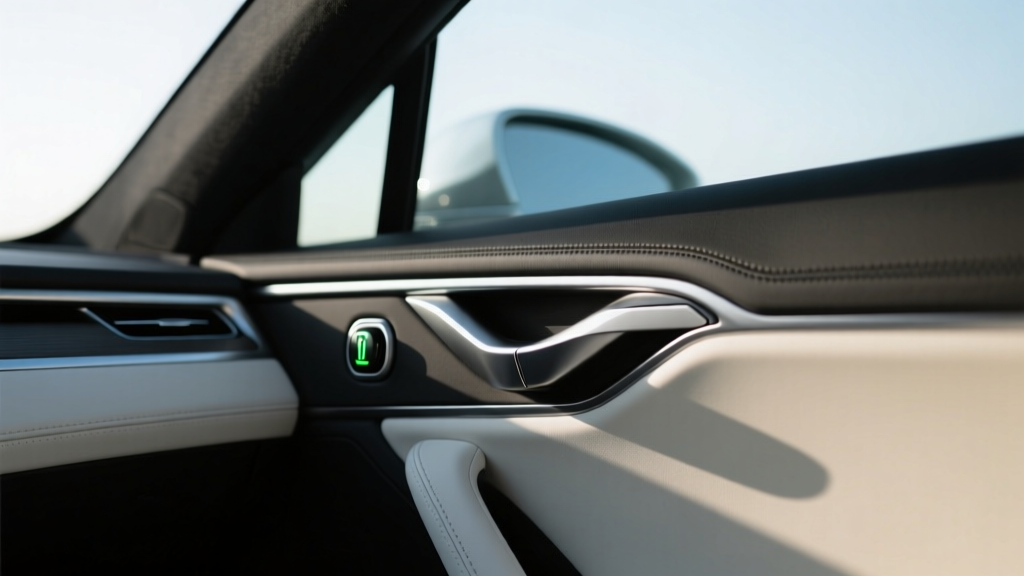
Front doors: A pull-up lever is integrated into the interior door handle assembly itself. Pull the handle past its normal electronic actuation point — a second, firmer detent mechanically releases the latch.
Rear doors: Standard manual pull handles with a mechanical linkage. These operate normally even with zero electrical power, making the Model S the most straightforward Tesla for rear-passenger egress.
Model X (2021–2026 Refresh)
Front doors: Same dual-detent handle as Model S — pull past the electronic stop for mechanical release.
Rear doors (falcon wing): A manual release cable is located behind a trim panel near the rear C-pillar on the inside. This is the most difficult emergency release in the Tesla lineup to locate without prior knowledge. Consult your owner's manual for the exact panel location, as it differs between 5-seat and 6/7-seat configurations.
2025–2026 Tesla Lineup: Full Spec Breakdown
Knowing how to exit your Tesla is essential. Knowing whether to buy one in the first place requires hard numbers. Here's the complete specification matrix for every current model.
| Spec | Model 3 LR AWD | Model Y LR AWD | Model S LR | Model X LR |
|---|---|---|---|---|
| EPA Range | 341 mi | 320 mi | 402 mi | 335 mi |
| Battery (usable) | ~75 kWh (NMC) | ~75 kWh (NMC) | ~95 kWh (NMC) | ~95 kWh (NMC) |
| Efficiency | 132 MPGe / 25 kWh/100mi | 122 MPGe / 28 kWh/100mi | 124 MPGe / 27 kWh/100mi | 109 MPGe / 31 kWh/100mi |
| Max DC Fast Charge | 250 kW | 250 kW | 250 kW | 250 kW |
| 10–80% DCFC Time | ~27 min | ~28 min | ~33 min | ~35 min |
| Level 2 Home Rate | 11.5 kW (~44 mi/hr) | 11.5 kW (~44 mi/hr) | 11.5 kW (~34 mi/hr) | 11.5 kW (~30 mi/hr) |
| 0–60 mph | 4.2 sec | 4.8 sec | 3.1 sec | 3.8 sec |
| Horsepower | ~346 hp | ~384 hp | ~670 hp | ~670 hp |
| Drivetrain | Dual-Motor AWD | Dual-Motor AWD | Dual-Motor AWD | Dual-Motor AWD |
| Cargo Volume | 23 cu ft (rear + frunk) | 76 cu ft (rear seats folded) | 28 cu ft (rear + frunk) | 88 cu ft (seats folded) |
| Base MSRP | $47,740 | $49,990 | $79,990 | $84,990 |
| Battery Warranty | 8 yr / 120,000 mi | 8 yr / 120,000 mi | 8 yr / 150,000 mi | 8 yr / 150,000 mi |
Source: fueleconomy.gov and Tesla.com specifications for 2025 model year. Pricing excludes destination fee. Verify current MSRP before purchase.
Real-World Range: What the EPA Sticker Doesn't Tell You
Model 3 LR AWD: EPA 341 mi → Expect ~285–310 mi on highway road trips (70–80 mph). In freezing temperatures (below 32°F), plan for 220–260 mi.
Model Y LR AWD: EPA 320 mi → Expect ~265–290 mi highway. Cold weather: ~210–240 mi.
Model S LR: EPA 402 mi → Expect ~340–370 mi highway. Cold weather: ~280–320 mi.
Model X LR: EPA 335 mi → Expect ~275–300 mi highway. Cold weather: ~220–260 mi.
Tesla's heat pump (standard on all current models) significantly reduces cold-weather cabin energy draw compared to older resistive heaters, but battery chemistry still loses efficiency below freezing. Preconditioning while plugged in recovers 5–10% of range.
Tesla's efficiency remains among the best in the EV segment. The Model 3 Highland's 25 kWh/100mi is class-leading for an AWD sedan. However, the 10–80% DC fast-charge times of 27–35 minutes, while competitive, trail the Hyundai Ioniq 5 and Kia EV6 (which hit 10–80% in roughly 18 minutes on 800V architecture at 350 kW chargers). If DC fast-charge speed is your top priority, this is a meaningful gap.
Charging Speed Deep Dive: Home, Supercharger, and Third-Party
| Charging Level | Power (kW) | Miles Added per Hour | Typical Use Case |
|---|---|---|---|
| Level 1 (120V outlet) | 1.4 kW | 3–5 mi/hr | Emergency / overnight trickle |
| Level 2 (240V, Tesla Wall Connector) | 11.5 kW | 30–44 mi/hr | Primary home charging |
| DC Fast Charge (Supercharger V3) | Up to 250 kW | ~1,000 mi/hr (peak) | Road trips, 10–80% in ~27–35 min |
| DC Fast Charge (CCS adapter, third-party) | Up to 250 kW | ~1,000 mi/hr (peak) | Electrify America, EVgo, etc. |
kW vs. kWh refresher: kW (kilowatts) measures the rate of charging — like water pressure from a hose. kWh (kilowatt-hours) measures the total energy stored in the battery — like the size of the bucket. A 250 kW charger fills your 75 kWh battery fast, but only during the peak portion of the charge curve. Above 80% State of Charge, Tesla tapers the rate significantly to protect battery longevity, dropping to ~50 kW or less.
All 2025–2026 Teslas ship with a NACS (North American Charging Standard) port natively. Tesla has opened its Supercharger network to other brands (Ford, GM, Rivian, etc.), which means more vehicles competing for stalls at popular corridors — plan road-trip charging stops accordingly.
Pricing, Trims, and Federal Tax Credit Eligibility
| Model / Trim | Base MSRP | §30D Credit Eligible? | Effective Price (if eligible) |
|---|---|---|---|
| Model 3 RWD (LFP battery) | $42,490 | Varies — see below | ~$34,990 |
| Model 3 Long Range AWD | $47,740 | Varies — see below | ~$40,240 |
| Model 3 Performance | $54,990 | Varies — see below | ~$47,490 |
| Model Y Long Range AWD | $49,990 | Varies — see below | ~$42,490 |
| Model S Long Range | $79,990 | No — exceeds $55K sedan cap | $79,990 |
| Model X Long Range | $84,990 | No — exceeds $80K SUV cap | $84,990 |
Pricing reflects Tesla.com MSRP as of early 2025, excluding $1,390 destination fee. Tax credit amounts are estimates based on IRS §30D rules. Always confirm eligibility with a tax professional.
Federal Tax Credit Eligibility Checklist (IRS §30D)
- MSRP Cap: Sedans (Model 3) must be ≤ $55,000. SUVs/trucks/vans (Model Y) must be ≤ $80,000. Model S and Model X exceed their respective caps.
- Buyer Income Cap: Modified AGI must not exceed $150,000 (single), $225,000 (head of household), or $300,000 (married filing jointly).
- Battery Sourcing: The credit is split into two halves ($3,750 each) — one for critical minerals sourcing and one for battery component manufacturing. Tesla's sourcing has shifted over time; check the current fueleconomy.gov eligibility list for the exact credit amount available for your purchase date.
- Point-of-Sale Transfer: As of 2024, you can transfer the credit to the dealer at purchase, reducing your out-of-pocket cost immediately rather than waiting for a tax refund.
- Final Assembly: Must occur in North America. All US-market Teslas are assembled in Fremont, CA, or Austin, TX — this requirement is met.
Technology, Driver Assistance, and Notable Drawbacks
Infotainment: All Teslas run Tesla's proprietary OS on a 15.4-inch center touchscreen (Model 3/Y) or 17-inch screen (Model S/X). There is no Apple CarPlay or Android Auto — a persistent dealbreaker for some buyers. Navigation, streaming (Netflix/YouTube while parked), and a built-in web browser are standard.
Autopilot & FSD (Supervised): Every Tesla ships with basic Autopilot (Traffic-Aware Cruise Control + Autosteer). Full Self-Driving (Supervised) is an optional $8,000 upgrade or $99/month subscription.
Despite the "Full Self-Driving" name, Tesla's FSD (Supervised) is an SAE Level 2 driver-assistance system. You must keep your hands on the wheel and eyes on the road at all times. The system does not make the vehicle autonomous. True driverless operation (SAE Level 4) currently exists only in geofenced robotaxi services like Waymo — not in any consumer vehicle you can buy.
Standout features: Over-the-air software updates that add functionality post-purchase, the Supercharger network (the most reliable DC fast-charging network in North America based on uptime data), Sentry Mode dashcam recording, and Dog Mode climate control for pets left briefly in the vehicle.
Notable drawbacks:
- No Apple CarPlay/Android Auto — ever, as of Tesla's current product roadmap.
- Panel gaps and paint quality remain inconsistent, though improved on the Highland/Juniper refreshes.
- No physical instrument cluster in Model 3/Y — all information (including speedometer) is on the center screen.
- Insurance costs are 20–40% higher than comparable gas vehicles in most US states, per industry data.
- Turn-signal stalks have been removed on the refreshed Model 3 Highland — signals are now on the steering wheel, a polarizing ergonomic change.
- Class-leading efficiency (Model 3: 25 kWh/100mi)
- Supercharger network access — best-in-class reliability
- Strong OTA update cadence adds real features over time
- Excellent performance per dollar (Model 3 Perf: 3.1s 0–60)
- Low center of gravity = confident handling
- Comprehensive active safety (standard AEB, blind-spot, lane-keep)
- No Apple CarPlay or Android Auto
- DC fast charge speed (250 kW peak) trails 800V competitors
- Insurance premiums significantly above segment average
- Rear emergency door releases are hard to locate in Model 3/Y
- FSD (Supervised) remains Level 2 despite the name and price
- Turn signals on steering wheel (Model 3 Highland) take adjustment
Who Should Buy a Tesla in 2025–2026?
- Commuter / daily driver: Model 3 RWD or LR. Home Level 2 charging makes daily use effortless. 272–341 mi EPA range covers virtually any commute with margin.
- Family hauler: Model Y. 76 cu ft of cargo with seats folded, available 7-seat config, and strong crash-test ratings from NHTSA (5-star overall).
- Road-trip warrior: Model S LR (402 mi EPA) or Model 3 LR. The Supercharger network removes charging-anxiety on long hauls — plan stops around V3/V4 stalls.
- Performance seeker: Model 3 Performance or Model S Plaid. Sub-3-second 0–60 times at a fraction of the cost of comparable ICE sports sedans.
- You need Apple CarPlay or Android Auto — consider Hyundai Ioniq 5/6, Ford Mustang Mach-E, or BMW i4.
- DC fast-charge speed is your #1 priority — Hyundai/Kia's 800V E-GMP platform charges 10–80% in ~18 minutes at 350 kW stations.
- You want a traditional instrument cluster and physical buttons — virtually every legacy-brand EV offers this.
- You need a truck bed — Tesla's Cybertruck is a separate category with its own trade-offs.
Frequently Asked Questions
Can you open a Tesla door if the battery is completely dead?
Yes. Every Tesla has a mechanical emergency door release that operates independently of the 12V and high-voltage battery systems. The location varies by model and seating position — see the detailed breakdown above. The front-door releases are generally easier to locate than the rear-door releases, which are sometimes hidden behind trim panels.
What is the real-world range of the Tesla Model 3 and Model Y?
The Model 3 Long Range AWD carries an EPA rating of 341 miles, but expect 285–310 miles on sustained highway driving at 70–80 mph, and 220–260 miles in sub-freezing temperatures. The Model Y Long Range AWD is EPA-rated at 320 miles, with real-world highway figures of 265–290 miles and cold-weather range of roughly 210–240 miles. Preconditioning the battery while plugged in can recover 5–10% of cold-weather range.
How fast does a Tesla charge at home and on the road?
At home on a Level 2 Tesla Wall Connector (240V, 48A), all current models charge at up to 11.5 kW, adding roughly 30–44 miles of range per hour depending on the model's efficiency. A full overnight charge (8 hours) adds 240–350 miles — more than enough for daily use. On DC fast chargers (Tesla Supercharger V3), peak rate is 250 kW with a 10–80% charge taking approximately 27–35 minutes depending on battery size. Above 80% SoC, the charge rate tapers significantly.
Do Tesla Model 3 and Model Y qualify for the $7,500 federal tax credit?
It depends on the trim, your income, and current battery-sourcing rules. The Model 3 (sedan MSRP cap: $55,000) and Model Y (SUV MSRP cap: $80,000) are under their respective price caps. However, the buyer must also meet income limits ($150K single / $300K joint), and the battery must meet critical-minerals and component-manufacturing thresholds per IRS §30D. The exact credit amount ($3,750 or $7,500) changes as Tesla's supply chain evolves. Check fueleconomy.gov for the latest eligibility before purchasing.
Is Tesla's Autopilot or FSD actually self-driving?
No. Both Autopilot and Full Self-Driving (Supervised) are SAE Level 2 driver-assistance systems. They can steer, accelerate, and brake within certain parameters, but the driver must remain fully engaged with hands on the wheel and eyes on the road. These systems do not make the car autonomous. True driverless capability (SAE Level 4) is currently limited to geofenced commercial services like Waymo, not consumer vehicles.
Is a Tesla worth buying over competitors like the Hyundai Ioniq 5 or Ford Mustang Mach-E?
It depends on your priorities. Tesla wins on charging-network reliability (Supercharger uptime), software/OTA updates, and efficiency (kWh/100mi). Competitors like the Ioniq 5 win on DC fast-charge speed (800V, ~18 min 10–80%), Apple CarPlay/Android Auto availability, and in some cases interior material quality. The Model 3 and Model Y remain strong all-around choices — particularly if you road-trip frequently and value the Supercharger network — but they are no longer the only compelling EVs in their segments.
What is the battery warranty on a Tesla?
Model 3 and Model Y: 8 years or 120,000 miles, whichever comes first, with at least 70% battery capacity retention. Model S and Model X: 8 years or 150,000 miles with the same 70% retention threshold. If the battery degrades beyond 30% within the warranty period, Tesla will repair or replace it. Real-world degradation data from fleet studies suggests most Tesla batteries retain 85–90% capacity at 100,000 miles under normal use.