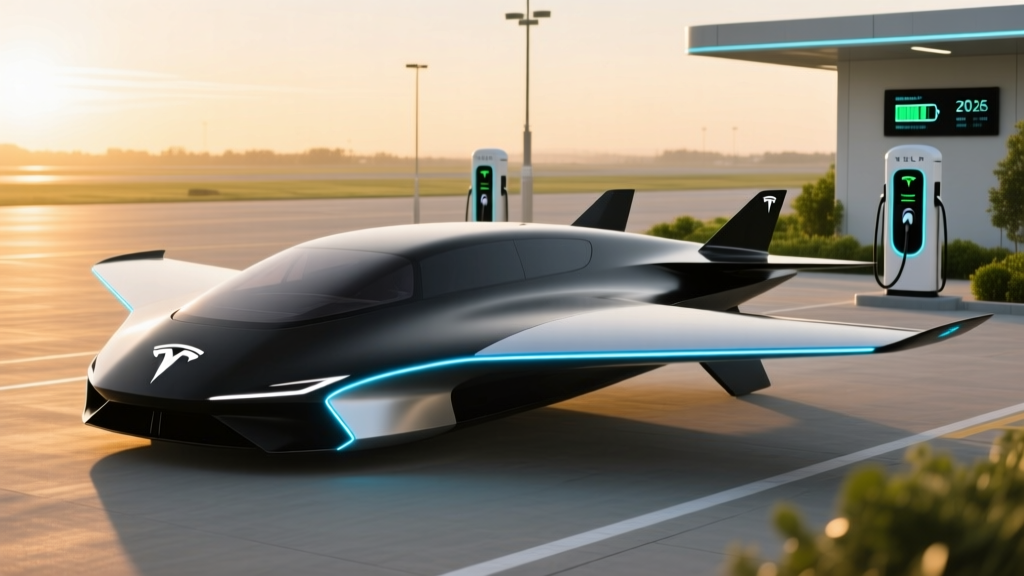
If you have been searching for a Tesla electric plane, you are not alone. The concept of a battery-powered aircraft wearing the Tesla badge has circulated on social media, YouTube concept channels, and speculative tech blogs for years. Elon Musk himself has mused about electric aviation in interviews and on X (formerly Twitter), floating ideas about a vertical-takeoff electric jet concept powered by high-density battery packs.
Here is the reality check for 2026: Tesla does not manufacture, sell, or have any announced electric aircraft. The company's product lineup remains firmly on the ground — the Model 3, Model Y, Model S, Model X, Cybertruck, and the Tesla Semi. No Tesla aircraft has been unveiled, priced, or certified by the FAA. Period.
But the search volume for "Tesla electric plane" tells us something important: readers are fascinated by where Tesla's battery and motor technology could go next, and many people landing on this query are actually Tesla-curious buyers trying to understand the brand's full technology portfolio before committing to a vehicle purchase. So let's do two things: explain why a Tesla electric plane doesn't exist (and what would need to change in battery physics for it to), and then give you the most useful thing we can — a complete, spec-driven profile of the Tesla vehicle that best represents the cutting edge of what Tesla actually sells today: the 2026 Tesla Model 3 Long Range AWD.
Why a Tesla Electric Plane Doesn't Exist Yet — The Battery Physics Problem
Electric aviation is not science fiction — companies like Eviation (with its Alice aircraft) and Heart Aerospace are developing electric planes. But they face a fundamental constraint that Tesla's ground vehicles do not: energy density.
Jet-A fuel contains roughly 12,000 watt-hours per kilogram (Wh/kg) of usable energy. Tesla's current best battery cells — the 4680-format NMC (nickel manganese cobalt) cells used in the Model Y and Cybertruck — deliver approximately 250–270 Wh/kg at the cell level. That means aviation fuel packs about 45 times more energy per unit of weight than the best lithium-ion cells Tesla can produce today.
For a ground vehicle, this gap is manageable. A Tesla Model 3 Long Range carries roughly 79 kWh of usable battery capacity in a pack weighing approximately 480 kg — heavy, but the car's total curb weight of ~4,000 lbs handles it fine. For an aircraft, that same 79 kWh would need to lift not just the battery but the fuselage, passengers, and avionics, with enough reserve for safe landing margins. Current battery chemistry simply cannot close that gap for anything beyond short-hop, small-passenger aircraft.
Elon Musk has acknowledged this directly. In a 2022 interview, he stated that a Tesla electric jet concept would require battery energy density of at least 400 Wh/kg — roughly 50% better than current cells — and ideally closer to 500 Wh/kg. Solid-state battery technology, which several labs are pursuing, could eventually reach those numbers, but no production-ready solid-state cells exist at scale as of 2026.
The Real Tesla Technology Showcase: 2026 Model 3 Long Range AWD
While Tesla's aviation dreams remain theoretical, the 2026 Model 3 Long Range AWD is a concrete, purchasable vehicle that demonstrates everything Tesla does well: class-leading efficiency, a robust Supercharger network, and continuous over-the-air improvements. Below is the full spec breakdown.
| Specification | 2026 Tesla Model 3 Long Range AWD |
|---|---|
| EPA Estimated Range | 341 miles |
| Battery Capacity (Usable) | 79 kWh |
| Battery Chemistry | NMC (Nickel Manganese Cobalt), 4680-format cells |
| Drivetrain | Dual-Motor AWD |
| Horsepower | 346 hp (combined) |
| 0–60 mph | 4.2 seconds |
| Top Speed | 125 mph |
| Max DC Fast Charge Rate | 250 kW (peak) |
| 10–80% DC Fast Charge Time | ~27 minutes |
| Level 2 Home Charge Rate | 11.5 kW (44 miles/hr added) |
| EPA Efficiency | 134 MPGe combined / 25 kWh/100 mi |
| Cargo Volume | 23 cu ft (rear trunk) + 3.1 cu ft (frunk) = 26.1 cu ft total |
| Rear Legroom | 35.3 inches |
| Base MSRP | $47,740 (before destination) |
| Destination Fee | $1,390 |
| Battery Warranty | 8 years / 120,000 miles (minimum 70% retention) |
| Basic Vehicle Warranty | 4 years / 50,000 miles |
Real-World Range Reality Check
EPA Sticker: 341 miles
Expect in real-world highway driving (70–75 mph): ~280–300 miles
Cold weather (below 32°F) with cabin heat: ~230–260 miles
Optimal conditions (city, mild weather, moderate speeds): 330–350 miles
The Model 3's heat pump (standard since the Highland refresh) significantly reduces cold-weather HVAC energy draw compared to resistive heaters, but battery chemistry itself loses efficiency in freezing temps. Plan road trips using ~280 miles of usable range as your baseline buffer, and precondition the battery via the Tesla app before DC fast charging in cold conditions.
Charging Speed and Network Access: The Tesla Advantage
Charging speed is where the Model 3 Long Range continues to justify its price premium over the base Rear-Wheel-Drive variant. Here is the full charging profile:
| Charging Level | Power (kW) | Miles Added Per Hour | Notes |
|---|---|---|---|
| Level 1 (120V household outlet) | ~1.4 kW | ~5 mi/hr | Emergency/trickle only |
| Level 2 (240V home Wall Connector) | 11.5 kW | ~44 mi/hr | Full charge in ~7 hours |
| Level 2 (public AC charger) | 7.2–11.5 kW | 28–44 mi/hr | Varies by station |
| DC Fast Charge (Tesla Supercharger V3) | 250 kW (peak) | ~175 mi in 15 min | 10–80% in ~27 min |
| DC Fast Charge (CCS adapter, Electrify America) | ~150–200 kW | ~120–150 mi in 15 min | Depends on station output |
Charge curve reality: The 250 kW peak only holds between roughly 10–30% state of charge. From 30–60%, the rate tapers to approximately 150–170 kW. Above 80%, charging slows dramatically to protect battery longevity — expect 20–40 kW in the 80–100% zone. This is why Tesla (and every EV maker) quotes 10–80% times rather than 0–100%.
The Model 3 uses the NACS (North American Charging Standard) connector natively — the same connector Tesla designed and which has now been adopted by Ford, GM, Rivian, Volvo, and most major automakers. This means the Model 3 has seamless access to Tesla's Supercharger network, which as of early 2026 includes over 6,500 V3 and V4 stalls across the United States, consistently rated the most reliable public charging network in third-party surveys.
Performance, Tech, and Daily Livability
The dual-motor AWD powertrain delivers 346 hp and a 4.2-second 0–60 mph time — quick enough to merge onto any highway with confidence, though not in the same league as the Model 3 Performance (3.1 seconds). The trade-off is efficiency: the Long Range achieves 134 MPGe combined (25 kWh per 100 miles), which translates to roughly $0.04–$0.06 per mile at the national average residential electricity rate of $0.16/kWh. Compare that to a 30 MPG gas sedan at $3.40/gallon: $0.11/mile. The per-mile fuel savings are substantial.
Infotainment and tech: The refreshed Model 3 (post-Highland update) features a 15.4-inch center touchscreen, ventilated front seats, ambient lighting, rear-seat ventilation controls on an 8-inch rear display, and acoustic glass all around for improved cabin quietness. The navigation system integrates Supercharger routing with automatic battery preconditioning — when you navigate to a Supercharger, the car warms the battery pack to optimal charging temperature before you arrive, shaving 5–10 minutes off your charge session in cold weather.
Driver assistance: Tesla's Basic Autopilot (traffic-aware cruise control and lane centering) is standard. Full Self-Driving (Supervised) remains a $8,000 add-on or $99/month subscription. It is critical to understand that FSD is an SAE Level 2 system — the driver must remain fully engaged, hands on or near the wheel, and eyes on the road at all times. It is not autonomous driving. Tesla's FSD has improved substantially in city-street navigation, but it still requires active supervision and will not handle every scenario without intervention.
Pricing, Trims, and Federal Tax Credit Eligibility
| Trim | Base MSRP | With Destination | Est. After §30D Credit |
|---|---|---|---|
| Model 3 Long Range AWD | $47,740 | $49,130 | $41,630 (if eligible) |
| Model 3 Long Range AWD + FSD | $55,740 | $57,130 | $49,630 (if eligible) |
| Model 3 Performance | $54,990 | $56,380 | $48,880 (if eligible) |
Federal tax credit (§30D) — key rules for 2026:
- Maximum credit: Up to $7,500 for new EVs, split into two $3,750 halves (critical minerals + battery component sourcing requirements).
- MSRP cap: Sedans must be priced at or below $55,000 (SUVs/trucks: $80,000). The Model 3 Long Range at $47,740 qualifies; adding FSD pushes it over the cap.
- Buyer income cap: Modified AGI must not exceed $150,000 (single), $225,000 (head of household), or $300,000 (joint filers).
- Battery sourcing: The vehicle must meet escalating percentages of critical minerals and battery components sourced from the US or FTA-partner nations. Tesla has made significant progress in domestic sourcing via its Nevada and Texas battery plants, but eligibility for the full $7,500 vs. $3,750 can change quarter to quarter.
- Point-of-sale transfer: As of 2024, the credit can be transferred to the dealer at purchase, reducing your out-of-pocket cost immediately rather than waiting for tax filing.
Always verify current eligibility on the official fueleconomy.gov database and consult a tax professional. Rules under IRS §30D are subject to change.
Who Should Buy the Model 3 Long Range — And Who Should Look Elsewhere
Pros
- Class-leading efficiency at 134 MPGe combined
- Native NACS access to the most reliable US DC fast-charging network
- 341-mile EPA range handles most road trips with a single 20–25 minute charge stop
- Over-the-air updates continuously add features and refine performance
- Strong resale value relative to most EV competitors
- Heat pump standard — better cold-weather range retention
Cons
- No physical stalks — turn signals and wipers are steering-wheel buttons (learning curve)
- Rear-seat headroom is tight for passengers over 6'2"
- No Apple CarPlay or Android Auto — Tesla's proprietary interface only
- FSD (Supervised) remains a Level 2 system despite the "self-driving" branding
- Insurance costs tend to run 15–30% higher than comparable gas sedans
- Adding FSD pushes MSRP above the $55,000 §30D sedan cap
Best for: Tech-forward commuters and couples who want a daily-driver EV with road-trip capability, access to the best charging network, and the lowest per-mile operating cost in the premium sedan segment.
Consider alternatives if: You need a spacious rear seat for car seats or tall passengers (look at the Hyundai Ioniq 6 or BMW i4), you require Apple CarPlay integration, or you want a traditional dealership service experience rather than Tesla's mobile-ranger-and-service-center model.
Tesla Electric Plane vs. Reality: The Bottom Line
The Tesla electric plane remains a thought experiment — an appealing idea that current battery energy density cannot support at any meaningful scale. Solid-state batteries, lithium-sulfur chemistry, or hydrogen fuel cells may eventually close the gap, but none of these technologies are production-ready for aviation in 2026. Companies like Eviation, Heart Aerospace, and Joby Aviation are pursuing electric and hybrid-electric aircraft with near-term technology, but these are small, short-range aircraft — not the transcontinental Tesla jet that concept art depicts.
What Tesla does offer is a ground-vehicle ecosystem that is arguably the most mature in the EV industry. The Model 3 Long Range AWD delivers 341 miles of EPA range, 250 kW DC fast charging, access to over 6,500 Superchargers, and a per-mile energy cost that undercuts gasoline by more than half. If you came here looking for a Tesla electric plane, the best Tesla product you can actually buy is parked on a lot near you — and it gets the equivalent of 134 miles per gallon.
Frequently Asked Questions
Does Tesla make an electric plane or aircraft in 2026?
No. Tesla has no announced, certified, or available electric aircraft. Elon Musk has discussed an electric jet concept in interviews, but it would require battery energy density of 400+ Wh/kg — well beyond current production cells at ~250–270 Wh/kg. Tesla's product lineup consists of the Model 3, Model Y, Model S, Model X, Cybertruck, and Tesla Semi.
What is the real-world range of the 2026 Tesla Model 3 Long Range?
The EPA rates it at 341 miles. In real-world highway driving at 70–75 mph, expect approximately 280–300 miles. In freezing temperatures with cabin heating, plan for 230–260 miles. The onboard heat pump helps mitigate cold-weather losses compared to older EVs with resistive heaters.
How fast does the Model 3 Long Range charge at home and on the road?
At home on a 240V Level 2 Tesla Wall Connector (11.5 kW), the car adds about 44 miles of range per hour — a full charge takes roughly 7 hours. On a Tesla V3 Supercharger, it peaks at 250 kW and charges from 10–80% in approximately 27 minutes, though peak speed only holds in the lower state-of-charge range.
Does the Tesla Model 3 Long Range qualify for the $7,500 federal EV tax credit?
It can, but eligibility depends on several factors. The base MSRP of $47,740 is under the $55,000 sedan cap. The buyer must meet income limits ($150K single / $300K joint). Battery sourcing requirements under IRS §30D determine whether the full $7,500 or a partial $3,750 credit applies — and this can change by quarter. Verify on fueleconomy.gov before purchasing. Adding the $8,000 FSD option pushes the MSRP above the cap, disqualifying the vehicle.
Is the Tesla Model 3 Long Range worth buying vs. competitors like the Hyundai Ioniq 6 or BMW i4?
The Model 3 Long Range wins on charging network access (Supercharger exclusivity), efficiency (134 MPGe is best-in-class), and software integration. The Hyundai Ioniq 6 offers more rear headroom, physical controls, and Apple CarPlay at a slightly lower price. The BMW i4 provides a more traditional luxury interior and dealership service experience. If charging convenience and per-mile cost are your top priorities, the Model 3 remains the benchmark.
What are the biggest drawbacks of the Model 3 Long Range?
The removal of physical turn-signal stalks and wiper stalks frustrates some drivers. The rear seat is snug for tall passengers. There is no Apple CarPlay or Android Auto. Insurance premiums tend to be higher than gas equivalents. And Tesla's service model (mobile rangers, limited service centers) is less convenient than a traditional dealer network for buyers in rural areas.
Will Tesla ever build an electric plane?
Elon Musk has said it is theoretically possible with next-generation battery technology, but he has also stated that Tesla's priorities remain ground transportation, energy storage, and AI/robotics. There is no timeline, patent filing, or corporate announcement pointing to a Tesla aircraft in development. For now, electric aviation is being pursued by specialized aerospace startups, not automakers.