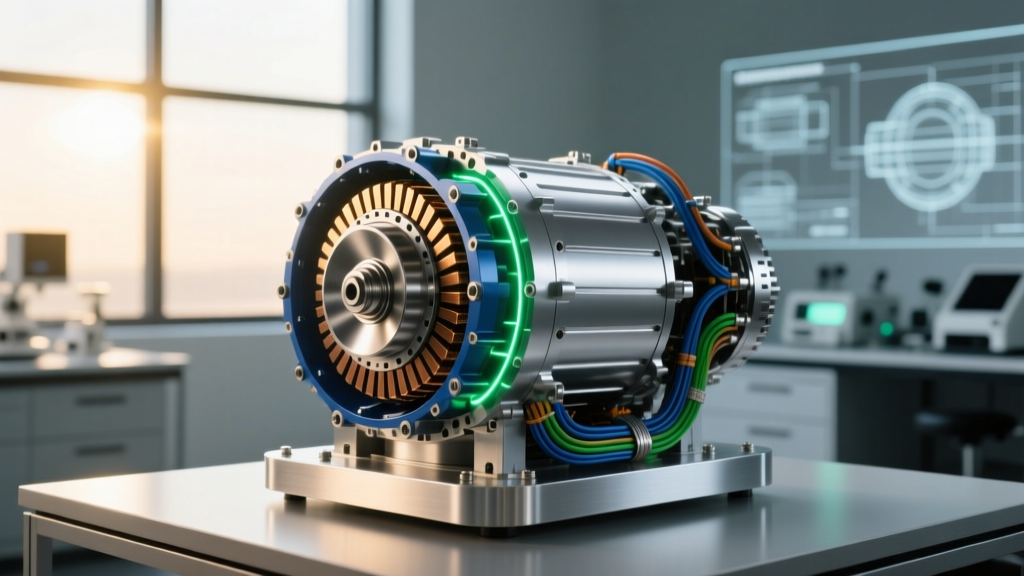
When shoppers search for a "Tesla electric engine," they're usually asking about the electric motor—the heart of every Tesla's powertrain. Unlike a gas engine with hundreds of moving parts, Tesla's motors convert electrical energy from the battery into mechanical rotation with remarkable simplicity. But not all Tesla motors are created equal. The difference between a permanent magnet synchronous reluctance motor (PMSRM) on the rear axle and an induction motor on the front axle directly shapes range, efficiency, and performance across the lineup.
This guide breaks down the motor technology powering Tesla's 2026 Model 3 and Model Y—the two highest-volume vehicles in the fleet—along with real-world range, charging speeds, pricing after federal tax credits, and how the powertrain stacks up against competitors like the Hyundai Ioniq 5 and Ford Mustang Mach-E.
Tesla's Electric Motor Architecture: How It Actually Works
Tesla uses a dual-motor strategy in its all-wheel-drive vehicles that pairs two fundamentally different motor types:
- Rear axle: Permanent Magnet Synchronous Reluctance Motor (PMSRM). This design embeds rare-earth magnets in the rotor, producing high torque at low speeds and excellent efficiency at cruising RPMs. It's the primary drive motor in most driving conditions.
- Front axle: AC Induction Motor. This motor has no permanent magnets—it induces a magnetic field in the rotor using stator current. The advantage? When not needed (like steady highway cruising), the front motor can be completely de-energized with zero drag, improving efficiency. It also handles torque-vectoring and traction control duties in slippery conditions.
In the single-motor, rear-wheel-drive Model 3, only the PMSRM is used. This simpler setup sacrifices some acceleration grip but maximizes efficiency—making it the range champion of the lineup.
The result of this architecture is a powertrain that dynamically manages which motor does what, millisecond by millisecond. Under hard acceleration, both motors engage for maximum thrust. During light-load cruising, the front induction motor freewheels while the rear PMSRM handles propulsion. This is why Tesla's dual-motor AWD vehicles lose surprisingly little range compared to their RWD counterparts—a trade-off that historically penalized gas-powered AWD systems with 2-4 MPG penalties.
Model 3 and Model Y Powertrain Specifications
| Spec | Model 3 RWD | Model 3 Long Range AWD | Model Y Long Range AWD | Model Y Performance |
|---|---|---|---|---|
| EPA Range | 363 mi | 346 mi | 320 mi | 295 mi |
| Battery (usable) | ~60 kWh (LFP) | ~75 kWh (NMC) | ~75 kWh (NMC) | ~75 kWh (NMC) |
| Motor Config | Single (rear PMSRM) | Dual (front induction + rear PMSRM) | Dual (front induction + rear PMSRM) | Dual (tuned PMSRM + induction) |
| Horsepower | 271 hp | 346 hp | 384 hp | 510 hp |
| 0-60 mph | 5.8 sec | 4.2 sec | 4.8 sec | 3.5 sec |
| Drivetrain | RWD | AWD | AWD | AWD |
| MPGe (combined) | 132 MPGe | 125 MPGe | 117 MPGe | 111 MPGe |
| Efficiency | 25 kWh/100mi | 27 kWh/100mi | 29 kWh/100mi | 30 kWh/100mi |
Sources: fueleconomy.gov, Tesla.com official specs. Real-world results vary with temperature, terrain, and driving style.
Real-World Range vs. EPA Estimates
EPA sticker: 346 miles (Model 3 Long Range AWD)
Real-world highway (70-75 mph, mild weather): ~290-310 miles
Real-world city/mixed driving: ~320-340 miles
Cold weather (below 32°F, highway): ~240-270 miles
The EPA test cycle includes a mix of city and highway driving at moderate speeds with climate control at a modest setting. In practice, Tesla's regenerative braking system recovers significant energy in stop-and-go traffic, meaning city range often comes close to—or occasionally exceeds—the EPA number. Highway driving is where EVs lose efficiency to aerodynamic drag, which increases with the square of speed. Sustained 75-80 mph travel will cost you roughly 10-15% versus the sticker.
Cold weather compounds this further. Lithium-ion batteries experience increased internal resistance at low temperatures, and cabin heating draws substantial power. Tesla's heat pump (standard on all 2026 models) mitigates this by scavenging waste heat from the motor and battery cooling loop, but expect 20-30% range reduction in sub-freezing conditions on longer highway trips. Preconditioning the battery while plugged in—using the Tesla app to warm the pack before departure—recovers some of that loss.
The LFP (lithium iron phosphate) battery in the Model 3 RWD is worth noting. LFP chemistry has lower energy density than NMC, which is why the RWD model has a smaller pack. However, LFP offers a longer cycle life, better thermal stability, and can be charged to 100% daily without the degradation concerns that apply to NMC packs (which Tesla recommends charging to 80% for daily use).
Charging Speeds: DC Fast Charge and Home Level 2
Tesla's Supercharger network remains the gold standard for DC fast charging reliability, and the 2026 Model 3 and Model Y take full advantage of V3 and V4 Supercharger hardware.
| Charging Level | Power | Speed (approx.) | Use Case |
|---|---|---|---|
| Level 1 (120V household) | ~1.4 kW | 3-5 mi/hr | Emergency / overnight trickle |
| Level 2 (240V home, 48A) | 11.5 kW | 35-44 mi/hr | Daily home charging (full in ~8 hrs) |
| DC Fast (V3 Supercharger) | Peak 250 kW | 10-80% in ~25 min (LR AWD) | Road trips |
| DC Fast (V4 Supercharger) | Peak 250+ kW | 10-80% in ~22 min (LR AWD) | Road trips (newer stations) |
The critical nuance here is the charge curve. Tesla's battery management system peaks at 250 kW only when the battery is warm (preconditioned) and at a low state of charge (typically below 30%). As the battery fills past 50-60%, the charge rate tapers progressively—dropping to ~100 kW around 70% and below 50 kW above 85%. This is why Tesla quotes 10-80% times rather than 0-100%. Charging from 80-100% can take as long as the 10-80% portion.
For home charging, Tesla's Wall Connector at 48 amps on a 60-amp circuit delivers 11.5 kW, adding roughly 35-44 miles of range per hour depending on the model. A full charge from 10% to 100% takes approximately 7-8 hours for the Long Range models. Most owners charge nightly and rarely deplete below 20%, making home Level 2 more than sufficient for daily needs.
With Tesla's NACS (North American Charging Standard) now adopted by Ford, GM, Rivian, and others, Model 3 and Model Y owners can also access compatible third-party networks using the native NACS port—no adapter required for Tesla Superchargers, and adapters available for legacy CCS stations.
Pricing, Trims, and Federal Tax Credit Eligibility
| Model / Trim | Base MSRP | Est. §30D Credit | Effective Price |
|---|---|---|---|
| Model 3 RWD | $38,990 | Up to $7,500 | ~$31,490 |
| Model 3 Long Range AWD | $42,990 | Up to $7,500 | ~$35,490 |
| Model 3 Performance | $52,990 | Up to $7,500 | ~$45,490 |
| Model Y Long Range AWD | $44,990 | Up to $7,500 | ~$37,490 |
| Model Y Performance | $51,490 | Up to $7,500 | ~$43,990 |
Prices exclude destination fee ($1,390). Tax credit amounts are estimates based on current IRS §30D rules and are subject to change. See irs.gov for current eligibility.
The federal EV tax credit under IRS §30D is not automatic. Eligibility depends on several factors that buyers must verify:
- Buyer income caps: Modified adjusted gross income must not exceed $150,000 (single), $225,000 (head of household), or $300,000 (joint filing).
- MSRP caps: The vehicle's MSRP must not exceed $55,000 for sedans (Model 3) or $80,000 for SUVs/trucks (Model Y). All current Model 3 and Model Y trims fall within these limits.
- Battery sourcing requirements: A percentage of critical minerals and battery components must be sourced from the U.S. or free-trade-agreement partners. Tesla has progressively shifted supply chains to meet these thresholds, but the specific credit amount ($3,750 for minerals, $3,750 for components, up to $7,500 total) can shift based on annual rule updates.
- Point-of-sale transfer: As of 2024, buyers can transfer the credit to the dealer at purchase, reducing the purchase price directly rather than waiting for a tax refund. Tesla supports this at delivery.
Consult a tax professional before relying on a specific credit amount, as individual circumstances and annual rule changes affect eligibility.
Interior Space, Tech, and Driver Assistance
The Model 3 (refreshed "Highland" platform) and Model Y ("Juniper" refresh) share Tesla's minimalist interior philosophy—virtually all controls live on the 15.4-inch center touchscreen, including climate, mirrors, and glovebox release. This polarizes buyers: some love the clean aesthetic, others find it distracting.
Cargo and passenger space:
- Model 3: 23 cu ft trunk + rear frunk; rear legroom 35.3 inches
- Model Y: 30 cu ft behind rear seats (72 cu ft with seats folded) + rear frunk; rear legroom 40.5 inches
The Model Y's hatchback design and available third-row seat (small, best for children) make it the practical family choice, while the Model 3 sedan offers a quieter cabin and slightly better efficiency.
Driver assistance: Tesla's Autopilot (standard) provides SAE Level 2 adaptive cruise control and lane centering. Full Self-Driving (Supervised), a $8,000 add-on or $99/month subscription, adds automatic lane changes, traffic light recognition, and city-street navigation—but remains Level 2, meaning the driver must remain fully engaged and hands on the wheel at all times. This is not autonomous driving. Tesla's FSD has shown improvement in intervention frequency, but it still requires active supervision and is not a substitute for an attentive driver.
Tesla Autopilot and FSD (Supervised) are SAE Level 2 driver-assist systems. The driver is always responsible for vehicle control. Only Level 4 services like Waymo operate without a human driver, and those are limited to specific geofenced areas.
Standout tech: Tesla's over-the-air update system is industry-leading, regularly adding features post-purchase. The Sentry Mode dashcam system, Dog Mode climate control, and integrated trip planner with real-time Supercharger availability set Tesla apart. The infotainment system includes Netflix, YouTube, and gaming while parked, plus a surprisingly capable navigation system that factors in elevation changes and battery temperature for range estimates.
Warranty Coverage
Tesla's warranty structure is competitive but not class-leading:
- Basic vehicle: 4 years / 50,000 miles
- Battery & drive unit (Model 3 RWD, LFP): 8 years / 100,000 miles, with minimum 70% capacity retention
- Battery & drive unit (Long Range / Performance, NMC): 8 years / 120,000 miles, with minimum 70% capacity retention
The 70% retention threshold is important context. A Model 3 Long Range with 75 kWh usable that degrades to 70% would still hold ~52.5 kWh—enough for roughly 240-260 real-world miles. Tesla's historical degradation data, aggregated from fleet telemetry, shows most packs losing 8-12% in the first 50,000 miles and then stabilizing, with very few falling below the warranty threshold within the coverage period. LFP packs in the RWD model tend to show even slower degradation, making them attractive for high-mileage drivers.
How It Compares: Model 3/Y vs. Key Competitors
- Supercharger network access is a priority for road trips
- You value OTA updates and integrated trip planning
- Efficiency (kWh/100mi) is a top buying criterion
- You want the widest DC fast-charge network with native NACS
- Software-driven features (Sentry, Dog Mode, app integration) matter
- You prefer physical buttons and traditional controls (Hyundai Ioniq 5)
- You need 800V ultra-fast charging (Ioniq 5: 10-80% in ~18 min)
- You want a longer basic warranty (Hyundai: 5yr/60k vs Tesla: 4yr/50k)
- Interior material quality and quietness are priorities (BMW i4, Genesis GV60)
- You prefer a traditional dealership service experience
Against the Hyundai Ioniq 5, Tesla wins on Supercharger reliability and efficiency but loses on charge speed (Ioniq 5's 800V architecture hits 10-80% in ~18 minutes vs Tesla's ~25 minutes) and interior ergonomics. The Ford Mustang Mach-E offers more traditional SUV styling and a BlueCruise hands-free driving system on approved highways, though its charging network access depends on Ford's NACS adapter for Supercharger use.
Who Should Buy a Tesla Model 3 or Model Y?
Best for: Daily commuters with home charging access, road-trip enthusiasts who value Supercharger coverage, tech-forward buyers who want OTA updates, and efficiency-focused drivers who prioritize low kWh/100mi consumption. The Model 3 RWD at ~$31,490 after the tax credit is one of the most affordable long-range EVs on the market. The Model Y Long Range is the default family EV for buyers who need hatchback cargo space and AWD capability.
Less ideal for: Buyers without home or workplace charging access (public charging costs 2-3x more per mile than home Level 2), those who prefer physical controls and traditional dealership service, and drivers who want the absolute fastest DC charging available (Hyundai/Kia 800V platforms currently lead here).
Frequently Asked Questions
Does Tesla use an electric engine or electric motor?
Technically, Tesla uses electric motors, not engines. "Engine" refers to internal combustion devices that burn fuel. Tesla's powertrain uses permanent magnet synchronous reluctance motors (rear) and AC induction motors (front in AWD models) to convert electrical energy from the battery into rotational force. The term "electric engine" is commonly used in consumer searches, but "electric motor" is the accurate engineering term.
What is the real-world range of the Tesla Model 3 Long Range?
The EPA rates it at 346 miles. In real-world highway driving at 70-75 mph in mild weather, expect 290-310 miles. City and mixed driving yields closer to the EPA figure thanks to regenerative braking. In freezing temperatures on highway trips, plan for 240-270 miles.
How fast does a Tesla charge at home?
Using the Tesla Wall Connector on a 240V/60A circuit (48A continuous), you'll get approximately 11.5 kW, which adds 35-44 miles of range per hour. A full overnight charge from 20% to 80% takes about 4-5 hours, which covers virtually all daily driving needs.
Does the Tesla Model 3 or Model Y qualify for the $7,500 federal tax credit?
Both models currently qualify for up to $7,500 under IRS §30D, subject to buyer income limits ($150K single / $300K joint), MSRP caps (both models are under the limits), and battery critical-mineral/component sourcing requirements that update annually. The credit can be transferred at point of sale to reduce your purchase price directly. Verify current eligibility at irs.gov or with a tax professional before purchasing.
How long will a Tesla battery last?
Tesla warranties its Long Range NMC batteries for 8 years/120,000 miles with at least 70% capacity retention. Fleet data suggests most packs degrade 8-12% in the first 50,000 miles and then stabilize. Many Tesla packs have exceeded 200,000 miles with 85-90% capacity remaining. The LFP battery in the Model 3 RWD shows even slower degradation and can be charged to 100% daily without the same longevity concerns as NMC.
Is Tesla's FSD actually self-driving?
No. Tesla's Full Self-Driving (Supervised) is an SAE Level 2 driver-assistance system. It can navigate city streets, handle traffic lights, and change lanes automatically, but the driver must remain fully engaged, monitor the road, and keep hands on the steering wheel at all times. It is not an autonomous driving system.