The Tesla Electric Airplane: Separating Internet Rumor from Reality
If you've spent any time in EV forums or tech comment sections, you've likely encountered breathless speculation about a Tesla electric airplane — an all-electric aircraft that would disrupt aviation the way the Model S disrupted sedans. Elon Musk himself floated the idea of an electric vertical takeoff and landing (eVTOL) jet as far back as 2019, calling it a concept he'd "like to do." As of 2026, that aircraft does not exist, is not in development at Tesla, and cannot be purchased, pre-ordered, or reserved.
This article exists because search engines show real demand for information about a Tesla electric airplane. Rather than feed speculation, we'll explain exactly where the concept stands, why battery physics makes electric aviation extraordinarily difficult, what Tesla's actual current lineup looks like for buyers who want Tesla's best range and technology, and which companies are building electric aircraft worth watching.
Where Did the Tesla Electric Airplane Idea Come From?
The seed of the rumor traces to a July 2019 tweet from Elon Musk responding to a question about whether Tesla would ever build an electric airplane. Musk replied that he had a concept for an electric VTOL jet with supersonic capability, but emphasized that Tesla's priority was "solving autonomy" and scaling ground-vehicle production. He has reiterated variations of this stance several times since, always framing electric aviation as a personal interest rather than a Tesla product roadmap item.
The concept Musk described would require energy-density levels that current lithium-ion batteries simply cannot deliver. Aviation demands roughly 400–500 Wh/kg at the cell level for any practical short-haul electric aircraft. As of 2026, the best production lithium-ion cells — including Tesla's own 4680 NMC cells — deliver approximately 260–300 Wh/kg at the cell level and significantly less at the pack level once structural components, cooling, and safety systems are included.
This isn't a minor gap. It's a fundamental physics constraint that no amount of software optimization or manufacturing efficiency can bridge in the near term. Solid-state batteries, which theoretically could reach 400+ Wh/kg, remain in limited production for niche applications and are not yet viable for aviation-scale deployment. Companies like QuantumScape and Toyota are targeting automotive solid-state cells for the late 2020s, but aviation certification adds years of additional validation.
Why Electric Aviation Is Fundamentally Harder Than Electric Cars
To understand why Tesla hasn't pursued an electric airplane, it helps to compare the engineering constraints of ground vehicles versus aircraft:
| Factor | Ground EV (e.g., Tesla Model Y) | Electric Aircraft (Conceptual) |
|---|---|---|
| Energy density required | ~150–180 Wh/kg at pack level (adequate) | ~350–500 Wh/kg at pack level (not yet achievable) |
| Weight penalty tolerance | High — heavier cars still drive, just use more energy | Near zero — every extra kg requires proportionally more lift energy |
| Regenerative braking | Recovers 15–30% of energy in city driving | Negligible — aircraft can't regen during cruise |
| Thermal management | Liquid cooling, ample airflow at ground level | Extreme — thin air at altitude reduces cooling capacity |
| Safety redundancy | Pull over if battery fails | Must maintain flight — requires multiple independent systems |
| Regulatory pathway | NHTSA / FMVSS — years of process | FAA Part 23/25/21.17 — a decade or more for novel propulsion |
These constraints explain why Tesla's engineering talent has remained focused on problems where battery technology is already sufficient: cars, trucks, and grid-scale storage. Aviation requires a generational leap in energy density that the industry hasn't achieved.
What Tesla Actually Offers in 2026: The Closest Thing to "Flight"
While there is no Tesla electric airplane, Tesla's 2026 vehicle lineup does represent the pinnacle of what current lithium-ion battery technology can achieve on the ground. For buyers drawn to the Tesla brand and its engineering ambition, here are the models that deliver the most range, performance, and technology — the closest analog to what a "Tesla aircraft" might feel like in spirit.
2026 Tesla Model S Long Range
The Model S remains Tesla's flagship sedan and the vehicle that most closely embodies the company's engineering-maximalist philosophy. For 2026, it continues to offer the longest EPA-estimated range in Tesla's lineup.
| Spec | Value |
|---|---|
| EPA Range | 402 miles |
| Battery (usable) | ~95 kWh, NMC (2170 cells) |
| Drivetrain | Dual-motor AWD |
| Horsepower | 670 hp |
| 0–60 mph | 3.1 seconds |
| Peak DC Fast Charge | 250 kW (CCS via adapter or native NACS on newer builds) |
| 10–80% DC Charge | ~28 minutes |
| Level 2 Home Charging | 11.5 kW / ~34 mi/hr |
| Efficiency | 124 MPGe combined (28 kWh/100 mi) |
| Cargo Volume | 28 cu ft (rear seats up), 63 cu ft (folded) |
| Base MSRP | $79,990 |
| Battery Warranty | 8 years / 150,000 miles (70% capacity retention) |
2026 Tesla Model Y Long Range
The Model Y is Tesla's volume leader and the best-selling EV globally. The 2026 "Juniper" refresh brought updated styling, improved suspension tuning, and a slightly larger battery pack.
| Spec | Value |
|---|---|
| EPA Range | 335 miles |
| Battery (usable) | ~78 kWh, NMC |
| Drivetrain | Dual-motor AWD |
| Horsepower | 384 hp |
| 0–60 mph | 4.8 seconds |
| Peak DC Fast Charge | 250 kW (NACS native) |
| 10–80% DC Charge | ~25 minutes |
| Level 2 Home Charging | 11.5 kW / ~37 mi/hr |
| Efficiency | 122 MPGe combined (28 kWh/100 mi) |
| Cargo Volume | 34 cu ft (rear up), 76 cu ft (folded) |
| Base MSRP | $48,990 |
| Battery Warranty | 8 years / 120,000 miles (70% capacity retention) |
Federal Tax Credit Eligibility for Tesla Vehicles in 2026
One of the most common buyer questions is whether Tesla vehicles qualify for the IRS §30D federal clean vehicle tax credit. The answer depends on several factors that change periodically:
- MSRP Cap: Sedans (Model S) must have an MSRP at or below $55,000. SUVs, vans, and trucks (Model Y, Model X, Cybertruck) must be at or below $80,000. The Model S at $79,990 exceeds the sedan cap and does not qualify. The Model Y at $48,990 falls under the $80,000 SUV cap and may qualify.
- Buyer Income Cap: Modified adjusted gross income (MAGI) must not exceed $150,000 (single), $225,000 (head of household), or $300,000 (joint filing).
- Battery Sourcing Requirements: The full $7,500 credit requires meeting both critical-mineral and battery-component sourcing thresholds, which tighten annually through 2029. Tesla has worked to North American-source components, but specific eligibility varies by build date and supply-chain batch.
- Point-of-Sale Transfer: As of 2024, buyers can transfer the credit to the dealer at point of sale, reducing the purchase price directly rather than waiting for a tax refund.
| Model | MSRP | Vehicle Class Cap | Eligible? |
|---|---|---|---|
| Model S Long Range | $79,990 | $55,000 (sedan) | ❌ No — exceeds MSRP cap |
| Model 3 Long Range | $47,740 | $55,000 (sedan) | ✅ Potentially — subject to sourcing + income |
| Model Y Long Range | $48,990 | $80,000 (SUV) | ✅ Potentially — subject to sourcing + income |
| Cybertruck AWD | $79,990 | $80,000 (truck) | ✅ Potentially — subject to sourcing + income |
Important: Tax credit eligibility is buyer-specific and changes with IRS guidance. Always confirm current eligibility on fueleconomy.gov and consult a tax professional before relying on the credit for purchase decisions.
Who Is Actually Building Electric Aircraft?
While Tesla has stayed on the ground, several companies are actively developing electric and hybrid-electric aircraft. None are Tesla competitors in the automotive sense, but they represent the real state of electric aviation in 2026:
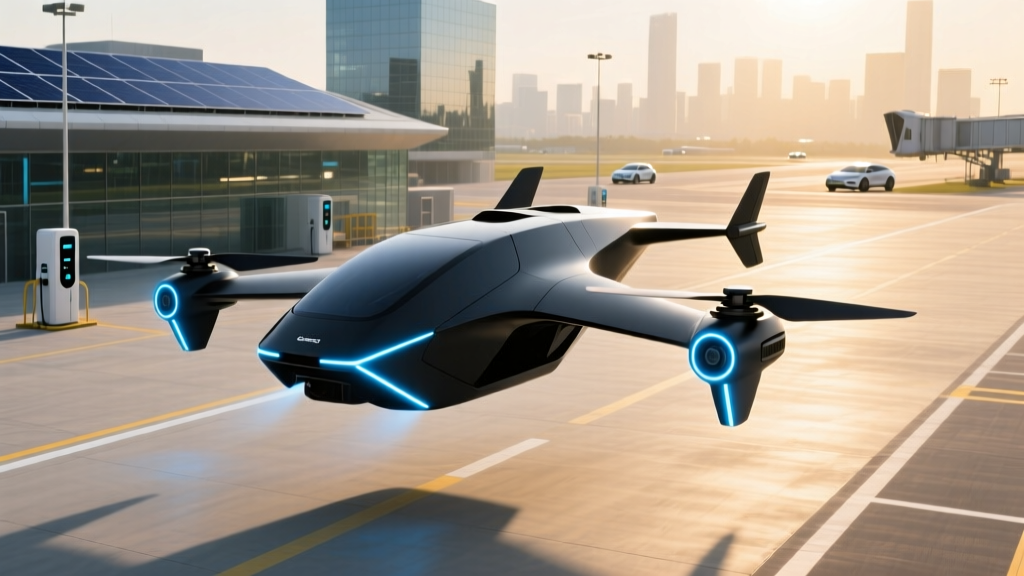
eVTOL / Air Taxi Companies
- Joby Aviation — Backed by Toyota, Joby's S4 eVTOL has completed FAA certification testing milestones and targets limited commercial air-taxi service. Range: ~100 miles. Seats: 4 passengers + pilot.
- Archer Aviation — The Midnight aircraft targets 20-mile urban hops with rapid turnaround. United Airlines has placed conditional orders.
- Beta Technologies — The ALIA-250 is an eVTOL cargo and passenger aircraft with ~250 nautical miles of range in conventional takeoff mode. UPS has ordered units.
Regional Electric / Hybrid-Electric
- Heart Aerospace (ES-30) — A 30-seat hybrid-electric regional airliner targeting 200 km electric range with reserve fuel turbines. Expected entry into service: late 2020s.
- Eviation (Alice) — A 9-passenger all-electric commuter aircraft with ~250 nautical mile range. First flight completed; certification ongoing.
Notice a pattern: every production or near-production electric aircraft targets short-range, low-passenger missions. None approach the range or payload of a jet airliner. This reinforces why Tesla — a company built on high-volume consumer vehicles — has not entered this space.
Tesla's Actual Technology Edge: What an "Electric Airplane" Search Might Really Mean
Some searchers looking for a "Tesla electric airplane" may actually be interested in Tesla-adjacent technologies that feel futuristic or aviation-adjacent. Here's what Tesla actually offers in 2026 that pushes boundaries:
Full Self-Driving (Supervised)
Tesla's FSD system remains a SAE Level 2 driver-assistance feature, meaning the driver must remain fully attentive and is responsible for all driving decisions at all times. It is not autonomous driving and should not be confused with Waymo's Level 4 robotaxi service, which operates without a human driver in geofenced urban areas. FSD (Supervised) costs $8,000 as a one-time purchase or $99/month as of 2026.
4680 Battery Cells and Structural Battery Pack
Tesla's 4680 cell format — 46mm diameter, 80mm height — delivers higher energy density and lower manufacturing cost per kWh than the older 2170 format. The structural battery pack, used in Cybertruck and some Model Y builds, integrates cells into the vehicle chassis, reducing weight and increasing torsional rigidity. This is Tesla's most significant hardware innovation since the original Model S skateboard platform.
Optimus Humanoid Robot
Tesla's Optimus robot program has progressed from concept demonstrations to limited internal factory deployment. While not an airplane, it represents Tesla's ambition to apply its AI and motor-control expertise beyond vehicles. No consumer product is available as of 2026.
Should You Wait for a Tesla Airplane, or Buy a Tesla Now?
This is the practical question behind the search. The answer is straightforward:
- Wait if: You're looking for an electric aircraft to purchase or invest in. Tesla is not building one. Look at Joby, Archer, or Heart Aerospace for industry developments.
- Buy now if: You want a Tesla vehicle with the best range and tech currently available. The Model S Long Range (402 mi EPA) and Model Y Long Range (335 mi EPA) represent the current ceiling of Tesla's ground-vehicle engineering.
- Reconsider if: You were drawn to Tesla purely by the "electric airplane" hype cycle. Tesla's value proposition is real but terrestrial: Supercharger network access, industry-leading efficiency, over-the-air updates, and strong resale value.
Frequently Asked Questions
Is Tesla building an electric airplane?
No. As of 2026, Tesla has no announced, in-development, or in-testing electric aircraft. Elon Musk has mentioned the concept of an electric VTOL jet as a personal interest, but it is not on Tesla's product roadmap.
Has Elon Musk confirmed a Tesla airplane release date?
No. Musk has never provided a timeline, prototype reveal date, or production target for any Tesla aircraft. All "release date" claims online are speculative and unsourced.
What battery technology would a Tesla electric airplane need?
Practical electric aviation requires cell-level energy density of 400–500 Wh/kg. Current production lithium-ion cells (including Tesla's 4680 NMC) deliver approximately 260–300 Wh/kg. Solid-state batteries may eventually close this gap, but are not yet production-ready for aviation.
Which Tesla vehicle has the longest range in 2026?
The 2026 Tesla Model S Long Range offers the highest EPA-estimated range at 402 miles, followed by the Model 3 Long Range at approximately 363 miles and the Model Y Long Range at 335 miles.
Does the Tesla Model Y qualify for the $7,500 federal tax credit?
The Model Y Long Range ($48,990 MSRP) falls under the $80,000 SUV cap for §30D eligibility. However, full credit depends on buyer income limits ($300,000 joint MAGI cap), battery critical-mineral sourcing compliance, and current IRS guidance. Always verify on fueleconomy.gov before purchasing.
Are there any electric airplanes I can buy today?
Not as a consumer. The Pipistrel Velis Electro is a two-seat electric trainer aircraft certified by EASA (Europe) and available to flight schools, but it has a range of roughly 50 minutes and is not a practical personal transport aircraft. Consumer-viable electric aircraft do not yet exist.
What companies are closest to launching electric air taxis?
Joby Aviation and Archer Aviation are the furthest along in FAA certification for eVTOL air-taxi service, with limited commercial operations targeted for the late 2020s in select metro areas.