The Tesla drive unit is the core propulsion system behind every Model Y, Model 3, and Cybertruck on the road — yet most buyers never look past the badge to understand what's actually pushing them forward. In this review, we examine the 2026 Tesla Model Y Long Range AWD through the lens of its drive unit architecture: the permanent-magnet synchronous reluctance motors, the inverter design, the thermal management that sustains peak output, and how all of it translates into real-world range, charging speed, and long-term reliability.
If you're researching a Tesla purchase and have encountered the term "Tesla drive unit" in forums, service bulletins, or spec sheets, this article connects the engineering to the ownership experience — with exact numbers, not marketing gloss.
2026 Tesla Model Y Long Range AWD: Spec Sheet at a Glance
| Specification | 2026 Model Y Long Range AWD |
|---|---|
| EPA Estimated Range | 320 miles |
| Battery Capacity (usable) | ~78.1 kWh (NMC chemistry) |
| Drivetrain | Dual-motor AWD (permanent-magnet rear + induction front) |
| Horsepower (combined peak) | 384 hp |
| 0–60 mph | 4.8 seconds |
| Max DC Fast-Charge Rate | 250 kW (peak) |
| 10–80% DC Fast Charge | ~27 minutes |
| Level 2 Home Charge Rate | 11.5 kW (~44 mi/hr) |
| MPGe (combined) | 111 MPGe |
| Energy Consumption | 28 kWh/100 mi |
| Cargo Volume (rear seats up / folded) | 30.2 / 72.1 cu ft |
| Base MSRP | $44,990 |
| As-Tested (w/ FSD, Pearl White, 19" wheels) | $53,490 |
| Battery & Drive Unit Warranty | 8 years / 120,000 miles |
What Is the Tesla Drive Unit, Exactly?
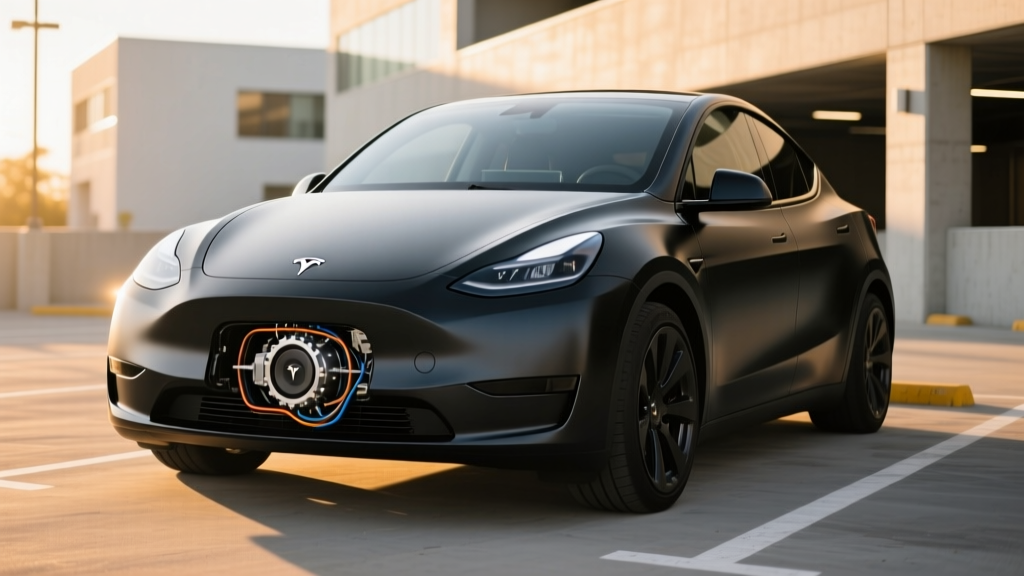
The Tesla drive unit is an integrated electric propulsion module that combines the electric motor, the power inverter, and the reduction gearbox into a single sealed assembly. In the 2026 Model Y Long Range AWD, there are two drive units — one on each axle.
The rear drive unit uses a permanent-magnet synchronous reluctance motor (PMSRM). This design delivers high torque density and efficiency at cruise speeds, making it the primary propulsion source under normal driving conditions. The front drive unit uses an induction (asynchronous) motor that can be completely decoupled — meaning it spins down to zero drag when AWD traction isn't needed, preserving range.
The inverter in each drive unit converts DC from the battery pack into precisely timed AC waveforms. Tesla has moved to silicon carbide (SiC) MOSFETs in its inverters, which reduce switching losses and improve efficiency under partial-load conditions — the scenario that dominates real-world driving. This is one reason Tesla vehicles consistently achieve strong real-world efficiency figures relative to their battery size.
Thermal management is handled by Tesla's integrated heat pump and liquid-cooling loop, which conditions the battery, drive units, and cabin from a single system. During sustained high-speed driving or DC fast charging, the system can route waste heat from the drive unit inverters into the battery for preconditioning — or shed it to ambient air via the front-end heat exchangers.
Real-World Range: Beyond the EPA Sticker
Real-World Expectations:
- City / mixed driving (65–75°F): ~290–310 miles — regen braking recovers energy in stop-and-go traffic
- Highway (70–80 mph, 65–75°F): ~255–275 miles — aerodynamic drag dominates at speed
- Cold weather (30°F, highway): ~215–240 miles — battery resistance increases, cabin heating draws power even with the heat pump
- Cold weather (30°F, city): ~245–265 miles — lower speeds reduce aero penalty
Source: EPA data at fueleconomy.gov; real-world estimates based on aggregated owner data and independent testing.
The 320-mile EPA figure is achieved under the EPA's multi-cycle test procedure, which includes moderate-speed urban and highway segments. In practice, sustained 75–80 mph interstate driving pushes energy consumption closer to 30–32 kWh/100 mi, reducing effective range to the mid-250s. This is physics, not a Tesla-specific limitation — all EVs lose range at highway speed due to the cubic relationship between velocity and aerodynamic drag.
The Model Y's heat pump (standard on all trims) significantly reduces cold-weather range loss compared to vehicles using resistive PTC heaters. Owners in northern climates typically report 15–25% range reduction in winter, versus 30–40% for EVs without heat pumps.
Charging Speed: DC Fast, Level 2, and the Charge Curve
The 2026 Model Y Long Range supports Tesla's V3 and V4 Supercharger architecture at a peak rate of 250 kW. However, peak rate is not sustained rate — understanding the charge curve is essential for trip planning.
| Charging Level | Power (kW) | Speed (mi/hr added) | Typical Use Case |
|---|---|---|---|
| Level 1 (120V, 12A) | ~1.4 kW | ~4–5 mi/hr | Emergency / overnight trickle |
| Level 2 (240V, 48A) | 11.5 kW | ~44 mi/hr | Home daily charging (Wall Connector) |
| Level 2 (240V, 32A mobile) | 7.7 kW | ~30 mi/hr | Portable / outlet-based home charging |
| DC Fast (V3 Supercharger) | 250 kW peak | Up to ~1,000 mi/hr (peak) | Road trips; 10–80% in ~27 min |
| DC Fast (CCS adapter, 3rd-party) | Up to 150–250 kW | Variable by station | Electrify America, EVgo, etc. |
The charge curve reality: The Model Y hits 250 kW only between roughly 10–20% state of charge (SoC). From 20–50%, power tapers to ~175–200 kW. From 50–80%, it drops further to ~90–120 kW. Above 80%, charging slows dramatically to protect the NMC cells — typically 40–50 kW, then lower still. This is why Tesla's navigation system recommends charging to 80% on road trips: the time from 80–100% can exceed the time from 10–80%.
For home charging, Tesla's Wall Connector at 48 amps (requiring a 60A circuit) adds roughly 44 miles of range per hour. A full overnight charge from 20% to 80% takes about 4–5 hours — more than sufficient for daily driving. Installation costs vary widely; expect $500–$2,000 depending on panel proximity and whether a service upgrade is needed. Always consult a licensed electrician for final specifications.
Preconditioning matters: When you navigate to a Supercharger, the Model Y automatically warms or cools the battery to the optimal temperature for fast charging. Skipping preconditioning (e.g., arriving at a charger without using navigation) can reduce peak charge rates by 30–50%, especially in cold weather.
Performance and Drivetrain: How the Drive Unit Delivers
The dual-motor setup produces 384 combined peak horsepower and launches the Model Y Long Range to 60 mph in 4.8 seconds. That's genuinely quick for a 4,400-lb crossover — and it's available instantly, with no turbo lag or transmission shift delay.
The rear PMSRM drive unit provides the bulk of propulsion torque, while the front induction unit engages in milliseconds when the traction control system detects slip, during hard acceleration, or in low-grip conditions. Because the front motor can freewheel with near-zero drag, the Model Y Long Range operates effectively as a rear-wheel-drive vehicle during steady-state cruising — maximizing efficiency.
For buyers prioritizing acceleration, the Model Y Performance trim drops the 0–60 time to 3.5 seconds via higher-output drive unit tuning and a sport-oriented suspension. The trade-off is a modest range reduction (EPA 293 miles) and a higher MSRP ($51,490 base).
Pricing, Trims, and Federal Tax Credit Eligibility
| Trim | Base MSRP | Est. Price After §30D Credit* |
|---|---|---|
| Long Range AWD | $44,990 | $37,490 |
| Performance AWD | $51,490 | $43,990 |
*Assumes full $7,500 federal tax credit under IRS §30D. Eligibility requires:
- Buyer income caps: Modified AGI ≤ $150,000 (single), $225,000 (head of household), $300,000 (joint)
- MSRP cap: SUVs/vans ≤ $80,000; sedans ≤ $55,000 (Model Y qualifies as SUV per IRS classification)
- Battery sourcing: Critical minerals and battery components must meet phased annual thresholds for North American or FTA-partner sourcing — verify current-year compliance on the IRS qualified vehicles list
- Point-of-sale transfer: As of 2024, buyers can transfer the credit to the dealer for an immediate price reduction at purchase
Important: Battery-sourcing requirements tighten each year. A model that qualifies in January may not qualify by December if supply chains shift. Always verify eligibility at fueleconomy.gov and consult a tax professional before relying on the credit.
Interior, Cargo, and Daily Usability
The Model Y's cabin follows Tesla's minimalist approach: a single 15.4-inch touchscreen handles infotainment, climate, vehicle settings, and the camera-based instrument cluster. Physical controls are limited to steering-wheel buttons and stalk-mounted turn signals (restored in the 2025 refresh after significant owner feedback).
Cargo volume: 30.2 cu ft behind the second row, expanding to 72.1 cu ft with seats folded. The front trunk (frunk) adds 4.1 cu ft — useful for charging cables, a laptop bag, or groceries you want separated from the main cargo area.
Passenger space: Front legroom is 41.8 inches; rear legroom is 41.6 inches — competitive with the Hyundai Ioniq 5 and Ford Mustang Mach-E, and more generous than the BMW iX3. The panoramic glass roof creates an airy feel but reduces rear headroom for passengers over 6'2".
Notable tech:
- Over-the-air (OTA) software updates that add features post-purchase
- Sentry Mode dashcam recording with USB storage
- Camp Mode for overnight climate control during car camping
- HEPA cabin air filtration (Bioweapon Defense Mode)
Notable drawbacks:
- No Apple CarPlay or Android Auto — Tesla's native interface only
- Rear visibility is limited; relies heavily on backup camera
- Panel gap quality has improved but still trails legacy OEMs at this price point
- Phantom braking incidents reported with Autopilot; driver must remain attentive
Driver Assistance: Autopilot and FSD Supervised
Tesla Autopilot and Full Self-Driving (Supervised) require continuous driver supervision. The driver must keep hands on the wheel and eyes on the road at all times. These are not self-driving systems — they are advanced driver-assistance features. Only Level 4 services (e.g., Waymo in designated geofenced areas) operate without a human driver.
Autopilot (standard) includes Traffic-Aware Cruise Control and Autosteer for lane-centering on highways. FSD (Supervised), a $8,000 option, adds automatic lane changes, traffic light and stop sign recognition, and navigation-guided on/off-ramp handling. In practice, FSD performs well on well-marked highways but requires frequent interventions in construction zones, complex intersections, and adverse weather.
- It does not make the vehicle autonomous — you are legally responsible for all driving actions
- It does not reliably handle unmapped construction zones or faded lane markings
- It does not eliminate the need for insurance, attention, or a valid driver's license
- Performance degrades in heavy rain, snow, or fog due to camera-only sensor suite (no lidar or radar on current models)
Warranty, Reliability, and Drive Unit Longevity
Tesla covers the battery and drive unit for 8 years or 120,000 miles (whichever comes first) on the Long Range AWD, with a minimum 70% capacity retention threshold. The basic vehicle limited warranty is 4 years / 50,000 miles.
Drive unit reliability has been a strong point for Tesla. The permanent-magnet rear motor and induction front motor have fewer moving parts than an internal-combustion powertrain — no timing belts, no oil changes, no transmission fluid (the single-speed reduction gear uses a sealed lubricant designed for the vehicle's life). Reported drive unit failures in the Model Y are rare relative to production volume, and Tesla's warranty covers replacement if a unit fails within the coverage period.
The NMC battery chemistry in the Long Range offers higher energy density than LFP (used in the RWD trim), but is more sensitive to sustained high-SoC storage. Best practice: charge to 80% daily, 100% only before long trips, and avoid leaving the vehicle at very low SoC for extended periods.
For safety, the Model Y holds a 5-star overall rating from NHTSA and a Top Safety Pick+ designation from IIHS (when equipped with acceptable headlights).
Pros and Cons: The Honest Verdict
Pros
- Class-leading Supercharger network access — still the most reliable DC fast-charging ecosystem
- Strong real-world efficiency (28 kWh/100 mi) translates to lower charging costs
- Dual-motor AWD with instant torque and confident traction in rain/snow
- Excellent cargo versatility with frunk + fold-flat rear seats
- OTA updates continuously improve the vehicle post-purchase
- Strong resale value relative to EV market average
Cons
- No Apple CarPlay/Android Auto — dealbreaker for some buyers
- FSD (Supervised) is expensive ($8,000) and still requires full driver attention
- Insurance premiums run 15–30% higher than comparable gas crossovers
- Ride quality on 20" wheels can be firm over broken pavement
- NMC battery requires more careful SoC management than LFP
- Service center wait times remain long in some metro areas
Who Should Buy the 2026 Model Y Long Range AWD?
- You take regular road trips and want the most reliable DC fast-charging network
- You need AWD for snow/rain but don't want a truck-based SUV
- You can install Level 2 charging at home and want a daily-driver EV with 300+ mile range
- You value cargo space and versatility over luxury interior materials
- You require Apple CarPlay or a traditional instrument cluster (consider Hyundai Ioniq 5 or Kia EV6)
- You want true hands-free highway driving (consider GM Super Cruise or Ford BlueCruise on compatible models)
- You primarily drive short city commutes and want lower upfront cost (the RWD trim with LFP battery starts at ~$36,490)
- You need 3-row seating for larger families (consider the Kia EV9 or Tesla Model X)
Frequently Asked Questions
What is the real-world range of the 2026 Tesla Model Y Long Range?
The EPA rates it at 320 miles. In real-world mixed driving at moderate temperatures, expect 290–310 miles. Sustained highway driving at 75–80 mph reduces this to roughly 255–275 miles, and cold weather (below freezing) can drop range to 215–265 miles depending on conditions and cabin heating demand.
How fast does the Model Y charge at home and on the road?
At home on a 240V/48A Tesla Wall Connector, it charges at 11.5 kW — adding about 44 miles of range per hour, or a full 20–80% charge overnight in roughly 4–5 hours. On a V3 Supercharger, it peaks at 250 kW and charges from 10–80% in approximately 27 minutes, though the rate tapers significantly above 50% SoC.
How much does the Model Y cost after the federal tax credit?
The Long Range AWD starts at $44,990 MSRP. If you qualify for the full $7,500 §30D credit (meeting income caps, MSRP limits, and current-year battery sourcing requirements), the effective price drops to approximately $37,490. The credit can be applied as a point-of-sale reduction at the dealer. Always verify current eligibility on the IRS qualified vehicle list before purchasing.
Is the Model Y worth buying vs. the Hyundai Ioniq 5 or Ford Mustang Mach-E?
The Model Y wins on Supercharger network access, cargo space, and efficiency. The Ioniq 5 offers faster 10–80% charging (18 minutes on a 350 kW charger via its 800V architecture), Apple CarPlay, and a more distinctive design. The Mach-E provides a more traditional driving feel and available BlueCruise for hands-free highway driving on mapped roads. Your priority — charging ecosystem vs. charging speed vs. interface preference — should drive the decision.
Does the 2026 Model Y qualify for the $7,500 federal EV tax credit?
It can, but eligibility depends on your income (≤$150K single / $300K joint), the vehicle's MSRP (under the $80K SUV cap — both trims qualify), and whether the battery meets current-year critical-mineral and component sourcing thresholds. These thresholds increase annually. Check fueleconomy.gov for the latest qualified vehicle list and consult a tax professional.
What is the Tesla drive unit warranty?
Tesla covers the battery and drive unit for 8 years or 120,000 miles (whichever comes first) on the Long Range and Performance trims, guaranteeing a minimum of 70% battery capacity retention. The drive unit itself is covered against defects and failure for the full warranty period, with Tesla replacing or refurbishing the unit at no cost if a covered failure occurs.
How long do Tesla drive units last?
Electric drive units have far fewer wear components than internal-combustion engines. Tesla's PMSRM and induction motors are designed for the life of the vehicle. Real-world data from high-mileage Model 3 and Model Y owners (150,000+ miles) shows that drive unit failures are uncommon, and when they do occur, they are typically covered under warranty. The reduction gear uses a sealed lubricant that does not require scheduled replacement.