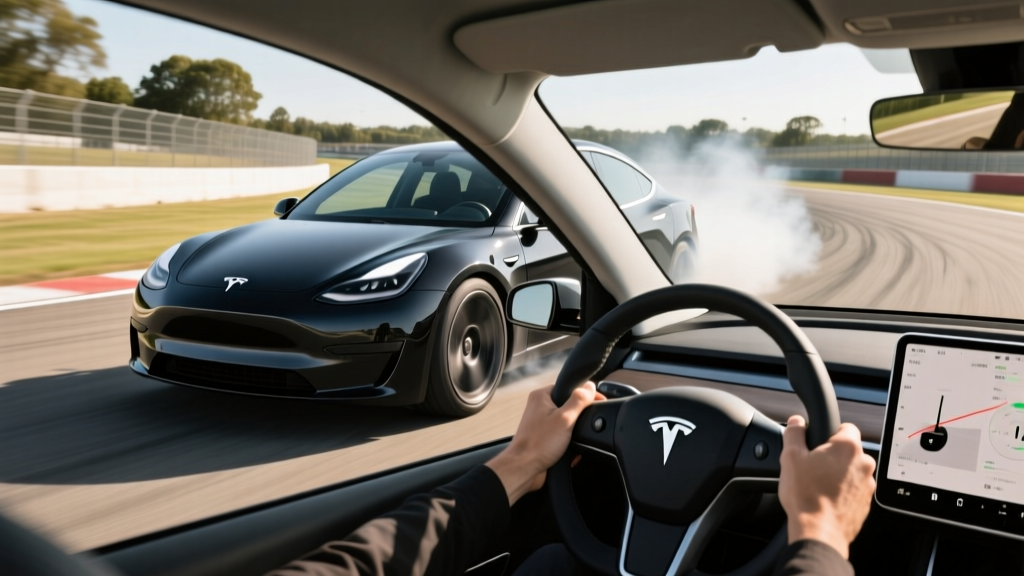
Tesla's Drift Mode arrived as a software-defined torque-vectoring trick that captured headlines and YouTube thumbnails alike. But behind the viral appeal of a factory sedan sliding around a skid pad lies a genuinely capable performance EV that also serves as a daily commuter. The 2026 Tesla Model 3 Performance — the vehicle that put Tesla drift capability into a production sedan — is far more than a party trick. This review breaks down its real-world range, charging behavior, pricing after federal incentives, and whether its dual personality justifies the premium over the standard Long Range trim.
Quick Verdict: Is the Model 3 Performance More Than a Drift Machine?
The 2026 Model 3 Performance pairs a 346-mile EPA range with a 2.9-second 0-60 time and Tesla's adaptive damping suspension. Drift Mode, accessible only on closed courses through Track Mode settings, biases torque to the rear axle and relaxes stability control to enable controlled oversteer. For daily driving, you get a refined, quiet cabin, access to the Supercharger network, and efficiency that undercuts most performance sedans on cost-per-mile. The trade-off is a firmer ride than the Long Range trim, a minimalist interior that polarizes, and a price that crests $55,000 before incentives.
Spec Sheet: 2026 Tesla Model 3 Performance at a Glance
| Spec | Value |
|---|---|
| EPA Range | 346 miles |
| Battery (usable) | ~79 kWh, NMC (nickel manganese cobalt) |
| Drivetrain | Dual-motor AWD (permanent magnet rear, induction front) |
| Horsepower | 510 hp (combined) |
| 0-60 mph | 2.9 seconds |
| Top Speed | 163 mph |
| Max DC Fast Charge | 265 kW (peak) |
| 10-80% DC Charge | ~18 minutes (preconditioned) |
| Level 2 Home Charge | 11.5 kW (~44 mi/hr on 48A circuit) |
| Efficiency | 121 MPGe combined / 28 kWh/100 mi |
| Cargo Volume | 23 cu ft (trunk) + 3.1 cu ft (frunk) |
| Base MSRP | $54,990 (incl. destination) |
| Battery Warranty | 8 years / 120,000 miles (≥70% retention) |
| Basic Warranty | 4 years / 50,000 miles |
Real-World Range: What 346 EPA Miles Actually Means
Real-World Highway (70-75 mph, 70°F): ~285-305 miles
Real-World City / Mixed (moderate temps): ~310-330 miles
Cold Weather (below 30°F, highway): ~230-260 miles
The Model 3 Performance's NMC battery holds roughly 79 kWh of usable energy. Tesla's heat pump and octovalve thermal management system are among the best in the industry at preserving range in cold weather — expect roughly a 20-25% reduction in freezing temperatures, which is better than the 30-40% loss many competitors suffer. At sustained highway speeds above 75 mph, aerodynamic drag dominates and efficiency drops to roughly 3.5-3.8 miles per kWh, yielding 280-300 miles of practical range on a full charge.
For context, the EPA's fueleconomy.gov listing confirms the 346-mile combined figure, which blends city and highway driving. In everyday commuting with regenerative braking set to high, many owners report matching or slightly exceeding the EPA number on suburban routes. The performance-oriented tires (Pirelli P Zero or Michelin Pilot Sport) do carry a slight efficiency penalty versus the Long Range's all-season rubber — expect 5-10 fewer miles per charge under identical conditions.
Charging Speed and Infrastructure: Supercharger Advantage
| Level | Power | Miles Added per Hour | Typical Use Case |
|---|---|---|---|
| Level 1 (120V) | ~1.4 kW | ~5 mi/hr | Emergency / overnight trickle |
| Level 2 (240V, 48A) | 11.5 kW | ~44 mi/hr | Home daily charging |
| DC Fast Charge | 265 kW (peak) | ~1,000+ mi/hr (peak) | Road trips, Superchargers |
The Model 3 Performance peaks at 265 kW on a V4 Supercharger or compatible CCS/NACS DC fast charger, but — and this is critical — that peak is only sustained from roughly 10-30% state of charge. The charge curve tapers significantly above 50%, dropping to ~100 kW by 70% and ~50 kW by 90%. This is why Tesla quotes a 10-80% time of approximately 18 minutes; the final 20% can add another 20-25 minutes, so plan accordingly on road trips.
At home on a Tesla Wall Connector with a 60-amp circuit (48A continuous), you'll add about 44 miles of range per hour, meaning a full overnight charge from 20% to 100% takes roughly 7-8 hours. Most owners charge to 80% daily (a best practice for NMC chemistry longevity) and reserve 100% charges for road trips. Tesla's native NACS connector means seamless plug-and-charge at every Supercharger — no adapter needed. For third-party CCS networks like Electrify America, a NACS-to-CCS adapter is required; Tesla sells one for ~$250.
According to Tesla's home charging guide, a typical Wall Connector installation runs $500-$1,500 depending on electrical panel proximity and whether a 200-amp service upgrade is needed.
Drift Mode and Track Mode: How Tesla Drift Actually Works
Tesla Drift Mode is not a standalone button — it's a sub-setting within Track Mode, which itself is only available when the vehicle detects it is on a closed course (via GPS geofencing at known tracks or manual override in designated areas). Here's how the system functions:
- Torque Bias: In normal driving, the dual-motor system distributes torque roughly 50/50 or slightly front-biased for stability. Drift Mode shifts up to 100% of available torque to the rear axle.
- Stability Control: Traction control and electronic stability program (ESP) are significantly relaxed, allowing the rear tires to break loose without the car immediately correcting.
- Simulated Limited-Slip: The rear motor's instant torque response acts as a virtual limited-slip differential, modulating power to sustain a drift angle.
- Thermal Management: Track Mode preconditions the battery and activates aggressive cooling for the drive units and brakes, which is essential for sustained track use.
In practice, the Model 3 Performance is surprisingly capable on a skid pad or drift circuit. The instant torque delivery makes initiating a slide easier than in many ICE performance sedans, and the low center of gravity keeps the car composed mid-drift. However, the car's ~4,065-lb curb weight means tire wear is aggressive — budget for replacement rubber after a few track days.
Interior, Tech, and Cargo: Daily-Driving a Track Sedan
The 2026 Model 3 Performance carries over the "Highland" refresh interior introduced in late 2023, with incremental updates for the 2026 model year:
- Display: 15.4-inch center touchscreen (no instrument cluster; speed and range are displayed on the main screen's driver-side zone)
- Rear Screen: 8-inch rear passenger touchscreen for climate and media controls
- Audio: 17-speaker premium audio with immersive sound
- Seats: Sport seats with enhanced bolstering, ventilated front seats, heated front and rear
- Materials: Vegan leather upholstery, aluminum and textile trim
- Ambient Lighting: Customizable RGB ambient light strip across dashboard and doors
Cargo space remains practical: 23 cubic feet in the trunk (with a wide hatch opening) and 3.1 cubic feet in the front trunk (frunk), suitable for a charging cable kit or small bag. Rear legroom measures 35.3 inches — adequate for adults on shorter trips but tighter than a midsize sedan like the Hyundai Ioniq 6.
Notable drawback: The absence of physical stalks for turn signals (replaced by steering-wheel buttons) and the lack of a traditional instrument cluster continue to draw criticism from new Tesla owners. Most adapt within a week, but it's a genuine friction point for test-drive evaluations.
Pricing, Tax Credits, and Total Cost of Ownership
| Item | Cost |
|---|---|
| Base MSRP (incl. destination) | $54,990 |
| Typical As-Tested (with red paint, FSD) | $58,490 |
| Federal §30D Tax Credit (if eligible) | Up to $7,500 (point-of-sale transfer available) |
| Effective Price (with max credit) | ~$47,490 |
The IRS §30D clean vehicle credit offers up to $7,500 for qualifying new EVs, but eligibility depends on three moving targets:
- MSRP Cap: Sedans must have an MSRP ≤ $55,000. The Model 3 Performance's $54,990 base price clears this threshold, but adding options that push the sticker above $55,000 disqualifies the vehicle.
- Income Cap: Modified adjusted gross income must not exceed $150,000 (single), $225,000 (head of household), or $300,000 (joint filers).
- Battery Sourcing: A percentage of critical minerals and battery components must be sourced from the US or free-trade-agreement countries. These thresholds increase annually. Check Tesla's current eligibility status at purchase, as supply chain changes can shift qualification mid-year.
As of 2026, the credit can be transferred to the dealer at point of sale, reducing the purchase price directly rather than waiting for a tax refund. Confirm eligibility with your tax professional and verify the VIN on the IRS qualification tool before signing.
5-year ownership cost considerations:
- Electricity cost: ~$0.14/kWh national average × 28 kWh/100 mi = ~$0.039/mile (vs. ~$0.12/mile for a 30-MPG gas sedan at $3.50/gal)
- Insurance: Expect $2,200-$3,000/year for the Performance trim (higher than the Long Range due to repair costs and performance classification)
- Maintenance: Minimal — no oil changes, cabin air filter every 2 years, brake fluid check, tire rotation. Budget $300-$500/year.
- Tire replacement: Performance tires wear faster, especially with Track Mode use. Budget $1,200-$1,800 for a set every 20,000-30,000 miles.
Pros and Cons
- 2.9-second 0-60 with daily-driver comfort
- 346-mile EPA range is exceptional for a performance sedan
- 265 kW DC fast charging with Supercharger network access
- Drift Mode / Track Mode adds genuine track capability
- Industry-leading efficiency (121 MPGe combined)
- OTA updates continuously add features
- Strong resale value relative to EV segment average
- Firmer ride than Long Range; noticeable on rough pavement
- No turn signal stalks — steering-wheel buttons require adaptation
- Performance tires wear quickly with track use
- $54,990 base price is close to the $55,000 §30D sedan cap — option carefully
- Rear seat space is tighter than midsize competitors
- FSD (Supervised) remains Level 2, not autonomous — $8,000 add-on with limited capability
- Insurance premiums higher than Long Range trim
Who Should Buy the Model 3 Performance?
Choose the Model 3 Performance if:
- You want sub-3-second acceleration and track-day capability in a daily driver
- You have access to home Level 2 charging and want Supercharger road-trip convenience
- You value efficiency and low per-mile fuel cost even in a performance vehicle
- Drift Mode and Track Mode appeal to you as a driving enthusiast
- Your household income and the vehicle's configured MSRP qualify for the §30D credit
Consider the Model 3 Long Range or a competitor if:
- Ride comfort is a higher priority than track capability (the Long Range is noticeably softer)
- You need more rear-seat room for adult passengers (look at the Hyundai Ioniq 6 or BMW i4)
- You prefer physical controls and a traditional instrument cluster
- Track use isn't in your plans — the Long Range offers 363 miles of range for ~$7,000 less
Frequently Asked Questions
What is the real-world range of the Tesla Model 3 Performance?
The EPA rates it at 346 miles combined. In real-world highway driving at 70-75 mph in moderate temperatures, expect 285-305 miles. City driving with regen braking can match or slightly exceed the EPA figure. In cold weather below 30°F, plan for 230-260 miles on the highway.
How fast does it charge at home and on the road?
On a 48-amp Level 2 home charger, you'll add roughly 44 miles of range per hour (11.5 kW). At a DC fast charger, the Model 3 Performance peaks at 265 kW and charges from 10-80% in about 18 minutes when the battery is preconditioned. Charging slows significantly above 80% — avoid DC fast charging past 80% on road trips unless necessary.
Does the Model 3 Performance qualify for the federal EV tax credit?
It can, but eligibility depends on your income, the configured MSRP (must stay ≤ $55,000 for sedans), and current battery-sourcing requirements under IRS §30D rules. The base MSRP of $54,990 qualifies, but adding certain options may push it over the cap. Verify your eligibility on the IRS website and with a tax professional before purchasing.
Is Tesla Drift Mode available on all Model 3 trims?
No. Drift Mode is exclusive to the Model 3 Performance and is only accessible through Track Mode, which requires the vehicle to be on a recognized closed course. The Long Range and base Rear-Wheel Drive trims do not include Track Mode or Drift Mode.
Is it worth buying the Performance over the Long Range?
If you value the adaptive suspension, 510 hp, 2.9-second 0-60, and Track Mode capability, the ~$7,000 premium is justified. If you prioritize range (363 vs. 346 miles), ride comfort, and lower insurance costs, the Long Range is the more rational daily driver. For most buyers who won't use Track Mode, the Long Range is the better value.
What's the battery warranty coverage?
Tesla covers the Model 3 Performance's battery and drive unit for 8 years or 120,000 miles, whichever comes first, with a guaranteed minimum 70% capacity retention. This is competitive with the industry standard, though some rivals like Hyundai offer 10-year/100,000-mile coverage.