Why the Tesla Draper Office Matters for Utah EV Buyers
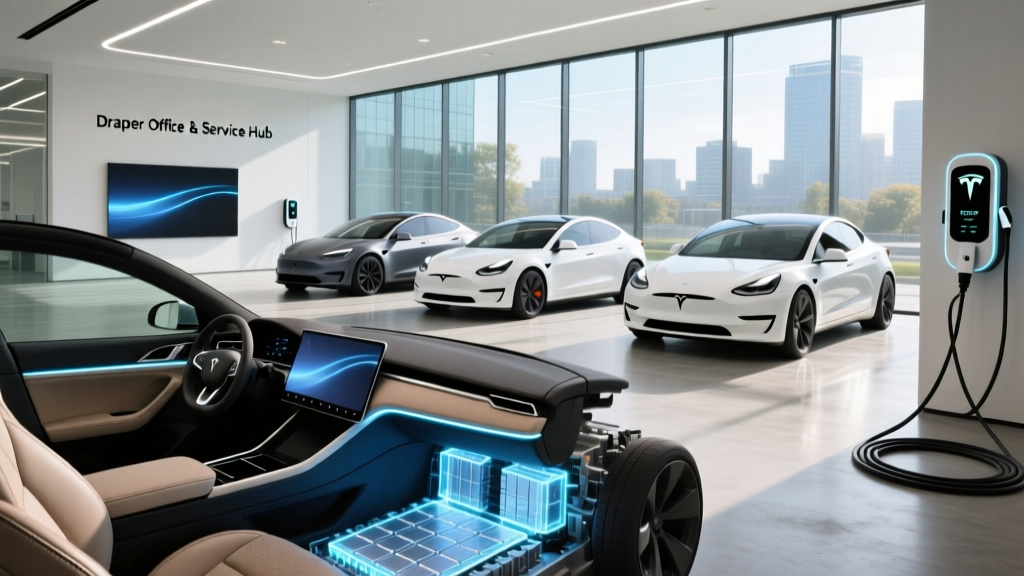
If you're researching electric vehicles in the Salt Lake City metro, you've likely encountered the Tesla Draper office — the company's combined sales, delivery, and service campus in Draper, Utah. Located near the I-15 corridor at roughly 1300 E. 12800 S., this facility serves as Tesla's primary Utah touchpoint for vehicle delivery, warranty service, Supercharging, and test drives across the full 2026 lineup: Model 3, Model Y, Model S, Model X, and the Cybertruck.
But a dealership visit only matters if you already know which vehicle fits your driving needs. Below, we break down every current Tesla model you can experience at the Draper location — with the exact EPA range, battery chemistry, charging speeds, pricing, and federal tax-credit eligibility that actually drive ownership satisfaction long after you leave the lot.
2026 Tesla Model Lineup at a Glance
| Spec | Model 3 RWD | Model 3 Long Range AWD | Model Y Long Range AWD | Model Y Performance | Model S Plaid | Cybertruck AWD |
|---|---|---|---|---|---|---|
| EPA Range | 363 mi | 363 mi | 320 mi | 295 mi | 402 mi | 340 mi |
| Battery (usable kWh) | ~60 kWh (LFP) | ~79 kWh (NMC) | ~79 kWh (NMC) | ~79 kWh (NMC) | ~100 kWh (NMC) | ~123 kWh (NMC) |
| 0-60 mph | 5.8 s | 4.2 s | 4.8 s | 3.5 s | 1.99 s | 3.9 s |
| Horsepower | 283 hp | 384 hp | 384 hp | 510 hp | 1,020 hp | 600 hp |
| Drivetrain | RWD | AWD dual-motor | AWD dual-motor | AWD dual-motor | AWD tri-motor | AWD dual-motor |
| MPGe (combined) | 132 MPGe | 132 MPGe | 122 MPGe | 111 MPGe | 120 MPGe | 68 MPGe |
| Base MSRP | $38,990 | $45,990 | $44,990 | $51,490 | $89,990 | $79,990 |
Charging Speeds: DC Fast, Supercharger Network, and Home Level 2
Charging infrastructure is Tesla's strongest ownership advantage, and the Draper Supercharger campus — co-located with the service center — gives local owners a reliable daily option if home charging isn't feasible.
| Model | Peak DC kW | 10-80% Time | Level 2 (48A / 11.5 kW) |
|---|---|---|---|
| Model 3 RWD (LFP) | 170 kW | ~25 min | ~30 mi/hr |
| Model 3 LR / Model Y LR | 250 kW | ~22 min | ~37 mi/hr |
| Model Y Performance | 250 kW | ~23 min | |
| Model S / X | 250 kW | ~27 min | ~34 mi/hr |
| Cybertruck | 250 kW (V3); 350 kW+ (V4) | ~25 min | ~30 mi/hr |
Charge-curve reality check: Peak kW is only sustained between roughly 10-30% State of Charge. Above 50%, the curve tapers significantly, and the final 80-100% can take as long as the first 80%. For road trips along I-15 toward Idaho or I-70 toward Colorado, plan stops at 20-80% to minimize total charging time. Preconditioning the battery via the Tesla navigation system is essential for achieving peak rates — skipping it can add 5-10 minutes per stop in cold weather.
For home charging, Tesla's Wall Connector at 48 amps on a 240V/60A circuit delivers roughly 11.5 kW — enough to refill any Model 3 or Model Y overnight. Budget $500-$1,500 for a licensed electrician to install a NEMA 14-50 outlet or hardwired Wall Connector, plus potential panel-upgrade costs if your home's service is under 150A.
Federal Tax Credit Eligibility (§30D) for 2026 Tesla Models
The IRS §30D Clean Vehicle Credit remains a top buyer question at the Draper office. As of 2026, the credit is available as a point-of-sale transfer — meaning you can apply up to $7,500 directly to your purchase price at delivery rather than waiting for tax-season filing.
| Model | Base MSRP | MSRP Cap Met? | Est. Credit | Effective Price |
|---|---|---|---|---|
| Model 3 RWD | $38,990 | Yes (under $55k sedan cap) | Up to $7,500 | ~$31,490 |
| Model 3 Long Range | $45,990 | Yes | Up to $7,500 | ~$38,490 |
| Model Y Long Range | $44,990 | Yes (under $80k SUV cap) | Up to $7,500 | ~$37,490 |
| Model Y Performance | $51,490 | Yes | Up to $7,500 | ~$43,990 |
| Model S Plaid | $89,990 | No (exceeds $80k cap) | $0 | $89,990 |
| Cybertruck AWD | $79,990 | Borderline (pickup/SUV cap $80k) | Varies by trim | Varies |
- Buyer income caps: AGI ≤ $150,000 (single), $225,000 (head of household), $300,000 (married filing jointly).
- MSRP caps: $55,000 for sedans; $80,000 for SUVs, vans, and pickups.
- Battery sourcing: Increasing percentages of critical minerals and battery components must be sourced from the U.S. or FTA partners — Tesla's U.S.-built vehicles generally qualify, but verify via the IRS's official list at irs.gov.
- Point-of-sale transfer: You assign the credit to Tesla at delivery; the dealer remits it to the IRS. Confirm eligibility with a tax professional before signing.
Interior, Cargo Space, and Daily Practicality
The Model Y remains Tesla's volume leader at the Draper office for good reason. Behind its crossover footprint sits 30.2 cu ft of cargo space (76.2 cu ft with rear seats folded), making it competitive with the Hyundai Ioniq 5 and Ford Mustang Mach-E for family duty. The Model 3 sedan offers 23 cu ft of trunk space — adequate for commuter use but tight for bulky gear.
Cybertruck's 6.5-foot bed and 3,500-lb payload target the truck buyer, though its angular stainless-steel exoskeleton limits rear-seat headroom compared to a Ford F-150 Lightning. The Model S and Model X continue to offer the most premium cabin materials and a frunk (front trunk) for additional storage, with the Model X's falcon-wing doors easing third-row access in tight parking spots.
All 2026 Teslas ship with a minimalist 15.4-inch (Model 3/Y) or 17-inch (Model S/X/Cybertruck) center touchscreen running Tesla's latest infotainment software, which integrates navigation, streaming, Sentry Mode dashcam recording, and over-the-air updates. Wireless phone charging, heated seats front and rear, and a HEPA air filtration system (Bioweapon Defense Mode on S/X) are standard.
Driver-Assist Technology: Autopilot and FSD (Supervised)
Every 2026 Tesla includes Basic Autopilot (adaptive cruise control and lane centering) as standard. The $8,000 FSD (Supervised) upgrade adds automatic lane changes, traffic-light recognition, Navigate on Autopilot for highway interchanges, and city-street turning — impressive technology that still requires active supervision. In our experience on I-15 and I-215 around Salt Lake City, FSD handles well-marked highways confidently but can hesitate at complex unprotected left turns and construction zones.
Warranty Coverage and Long-Term Battery Durability
Tesla's warranty structure is straightforward and competitive with legacy automakers:
- Basic Vehicle: 4 years / 50,000 miles
- Battery & Drive Unit: 8 years / 100,000 miles (Model 3 RWD); 8 years / 120,000 miles (Long Range, Model Y, Model S/X, Cybertruck)
- Capacity retention threshold: Tesla warrants at least 70% retention over the warranty period
Real-world degradation data from Tesla's 2025 Impact Report indicates Model 3/Y batteries retain approximately 88% capacity after 150,000 miles. LFP batteries in the Model 3 RWD can be charged to 100% daily without accelerated degradation — a meaningful ownership advantage for commuters who want maximum daily range. NMC packs (Long Range, Performance) are best kept between 20-80% for daily use, charging to 100% only before long trips.
Pros, Cons, and Who the Draper-Bought Tesla Suits Best
Pros
- Access to the Supercharger network — the most reliable DC fast-charging ecosystem in the U.S.
- Class-leading efficiency (kWh/100mi) across Model 3 and Model Y
- Continuous OTA software updates add features years after purchase
- Strong resale value relative to non-Tesla EVs
- Point-of-sale §30D credit reduces effective price at delivery
Cons
- Minimalist interior lacks physical controls; everything routes through the touchscreen
- Build-quality variance still surfaces — panel gaps, paint imperfections
- No Apple CarPlay or Android Auto integration
- FSD (Supervised) is an expensive add-on that still requires full driver attention
- Insurance premiums in Utah run 15-25% higher than comparable gas sedans/SUVs
Look elsewhere if: You prefer physical buttons, need Apple CarPlay, want a traditional dealer service experience, or prioritize NHTSA 5-star ratings across every subcategory (IIHS has rated the Model 3 a Top Safety Pick+, but the Model Y has not earned the highest IIHS honor as of early 2026).
Frequently Asked Questions
What is the real-world range of a Tesla bought at the Draper office?
Expect 85-90% of EPA range in temperate city/highway driving, and 70-80% in Utah winter highway conditions. The Model Y Long Range's 320-mile EPA rating translates to roughly 250-270 real-world miles in January along I-80.
How fast does a Tesla charge at the Draper Supercharger?
The Draper V3 Superchargers deliver up to 250 kW. A Model 3 Long Range or Model Y Long Range can add 10-80% in roughly 22 minutes when the battery is preconditioned via navigation routing.
Does the Tesla Model Y qualify for the $7,500 federal tax credit in 2026?
Yes, if your AGI falls under the IRS income caps and the specific VIN meets battery-sourcing requirements. Verify the exact model on the IRS qualified-vehicles list before purchase, and confirm point-of-sale transfer with the Draper delivery team.
Is buying from the Tesla Draper office better than ordering online?
All Tesla orders begin online. The Draper office handles test drives, trade-in appraisal, delivery, and post-sale service. Visiting before ordering lets you experience cabin ergonomics, visibility, and one-pedal driving feel before committing.
How does Tesla's service model work in Utah?
Tesla prioritizes mobile service (a technician comes to your home or office) for minor repairs and recalls. The Draper service center handles major warranty work, collision repair, and battery/drive-unit replacements. Appointment scheduling via the Tesla app typically yields 1-3 week wait times for non-urgent service in the Salt Lake metro.
Should I get the Model 3 or Model Y from Draper?
Choose the Model 3 if you're a commuter prioritizing efficiency and price (132 MPGe combined, ~$31,490 after credit). Choose the Model Y if you need cargo versatility, all-wheel drive for snow, and family seating. The $6,000 price gap is justified by the SUV's utility.