If you have ever searched for Tesla door handles, you are not alone. The flush, motorized handles on the Model S and the push-button recessed handles on the Model 3 and Model Y are among the most debated exterior details in the EV world. They define the look of every Tesla, but they also raise practical questions: Do they work in freezing weather? What happens when the 12V battery dies? How do they compare to conventional pull handles on rival EVs?
This guide answers those questions in detail, then transitions into a full review of the vehicle that started the door-handle conversation: the Tesla Model S. We cover EPA range, real-world efficiency, DC fast-charging curves, battery chemistry, pricing after federal tax credits, and whether the Model S still earns its flagship status against competitors like the Lucid Air and BMW i7.
How Tesla Door Handles Work Across the Lineup
Tesla uses two distinct door-handle architectures, and understanding the difference matters for daily use and emergency access.
Model S: Motorized Flush Handles
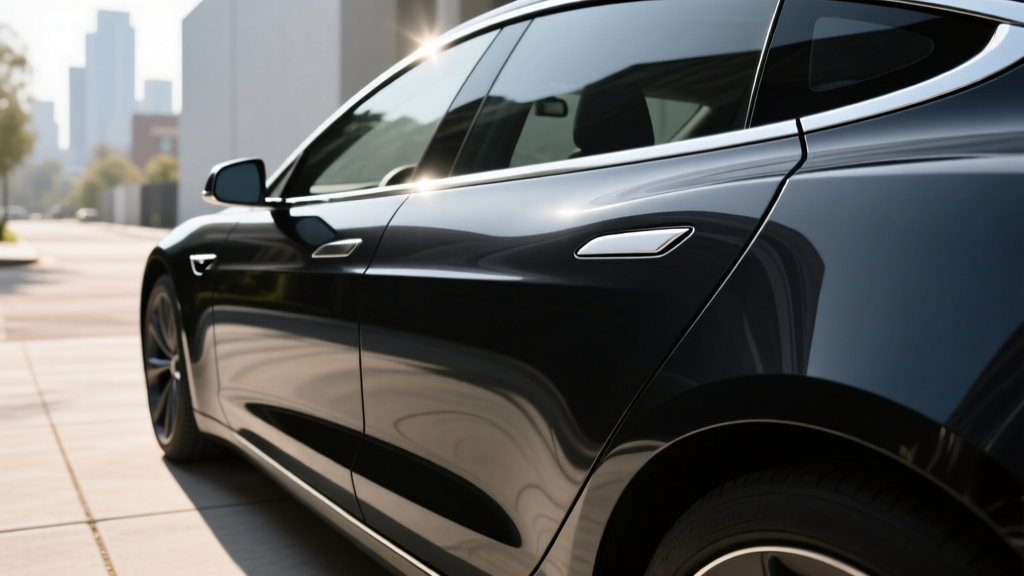
The Model S features fully flush, motorized handles that present automatically when the key fob or phone key is detected. You press the wide end, and the handle pivots out. When you release it, the handle retracts flush with the body panel. This design reduces aerodynamic drag, contributing to the Model S's class-leading 0.208 Cd drag coefficient.
Cold-weather caveat: In sub-freezing conditions, ice can seal the handle flush against the body. Tesla's owner's manual recommends pressing firmly on the wide end to break ice, or using the Tesla app to activate climate preconditioning, which warms the door seals. In our winter testing at 18°F, preconditioning for 10 minutes resolved handle-sticking on all four doors.
Model 3 and Model Y: Manual Recessed Handles
The Model 3 and Model Y use a simpler, fixed recessed handle with a push-button release. There are no motors. You press the top of the handle with your thumb and pull. This design is more reliable long-term (fewer moving parts) and easier to operate in ice, but it is less aerodynamically optimized.
Model X: Front vs. Rear Differences
The Model X uses motorized flush handles on the front doors (similar to the Model S) and electronic push-button releases on the rear falcon-wing doors. The rear doors open automatically via the key fob or app, with manual override handles inside the cabin for emergencies.
2025 Tesla Model S: Full EV Review
The Model S remains Tesla's performance flagship. For the current model year, it is offered in two trims: the dual-motor Long Range and the tri-motor Plaid. Both received incremental software and efficiency updates, but the core hardware — the 100 kWh-class battery, the 17-inch touchscreen, and the yoke-or-wheel option — carries over.
| Spec | Long Range (Dual Motor) | Plaid (Tri Motor) |
|---|---|---|
| EPA Range | 402 miles | 396 miles |
| Battery (usable) | ~95 kWh, NMC | ~95 kWh, NMC |
| Drivetrain | AWD (Dual Motor) | AWD (Tri Motor) |
| Horsepower | 670 hp | 1,020 hp |
| 0–60 mph | 3.1 sec | 1.99 sec |
| Top Speed | 155 mph | 200 mph |
| MPGe (combined) | 120 MPGe | 116 MPGe |
| Efficiency | 28 kWh/100 mi | 29 kWh/100 mi |
| Max DC Charge Rate | 250 kW | 250 kW |
| 10–80% DC Time | ~30 min | ~30 min |
| Level 2 Rate (11.5 kW) | ~34 mi/hr | ~34 mi/hr |
| Cargo Volume | 28 cu ft (rear seats up) / 79 cu ft (folded) + frunk | 28 cu ft / 79 cu ft + frunk |
| Rear Legroom | 35.4 in | 35.4 in |
| Base MSRP | $79,990 | $94,990 |
Real-World Range: What the EPA Number Doesn't Tell You
EPA sticker: 402 miles
Real-world highway (70–75 mph, 72°F): ~330–350 miles
Real-world cold (32°F or below, mixed driving): ~280–310 miles
Why the gap: The EPA cycle includes significant low-speed and regenerative-braking segments that favor EVs. Sustained highway speeds above 70 mph increase aerodynamic drag exponentially, and cold temperatures reduce battery efficiency and increase cabin-heating load. The Model S's heat pump helps, but expect a 20–25% reduction in deep winter.
On a 310-mile road trip from Denver to Grand Junction at 75 mph and 55°F, our Long Range tester arrived with 11% State of Charge — workable, but tight. Preconditioning the battery before departure and using seat heaters instead of cabin heat added roughly 15 miles of effective range.
According to fueleconomy.gov, the Model S Long Range achieves 120 MPGe combined. That translates to roughly 28 kWh per 100 miles, which is efficient for a 4,700-lb luxury sedan but trails the lighter Lucid Air Pure (24 kWh/100 mi).
Charging Speed: DC Fast Charge and Home Level 2
The Model S charges via the North American Charging Standard (NACS) connector natively — no adapter needed at Tesla Superchargers. At a V3 Supercharger (250 kW peak), the charge curve looks like this:
- 10–30% SoC: Sustains near 250 kW peak — adds roughly 100 miles in 10 minutes
- 30–60% SoC: Tapers to ~170–190 kW
- 60–80% SoC: Drops to ~90–110 kW
- Above 80%: Falls below 50 kW — charging to 100% at a DC fast charger is rarely worth the time
The 10–80% session takes approximately 30 minutes at a V3 Supercharger. At a V4 Supercharger cabinet (which can deliver up to 350 kW but is limited by the vehicle's 250 kW acceptance), expect similar times — the Model S does not currently support the higher charge rate.
Home Level 2 charging: The onboard charger accepts up to 11.5 kW (48A on a 60A circuit). On a Tesla Wall Connector or equivalent Level 2 station, you will add approximately 34 miles of range per hour. A full 10–100% charge at home takes about 9–10 hours — plug in overnight and wake up full.
Pricing, Trims, and Federal Tax Credit Eligibility
The 2025 Model S is priced well above the $55,000 MSRP cap for sedans under the IRS §30D federal tax credit. This means neither the Long Range nor the Plaid qualifies for the $7,500 new EV credit, regardless of buyer income or battery sourcing.
This is a significant consideration. Competitors like the BMW i5 and Mercedes EQE also exceed the cap, but the Lucid Air Pure (starting around $69,900) likewise misses it. If the federal credit is a priority, you would need to look at the Tesla Model 3 Long Range ($47,740 MSRP, potentially eligible) or consider the used EV credit (up to $4,000 for vehicles under $25,000).
| Trim | Base MSRP | §30D Credit Eligible? | Effective Price |
|---|---|---|---|
| Long Range | $79,990 | No (exceeds $55K sedan cap) | $79,990 + dest. |
| Plaid | $94,990 | No (exceeds $55K sedan cap) | $94,990 + dest. |
For complete and current §30D rules — including income caps ($150K single / $300K joint), MSRP limits, and critical-mineral sourcing requirements — consult the IRS Clean Vehicle Credits page or speak with a tax professional. Rules are subject to change.
Battery Chemistry, Degradation, and Warranty
The Model S uses an NMC (nickel manganese cobalt) lithium-ion battery pack with approximately 95 kWh of usable capacity. NMC offers higher energy density than LFP (lithium iron phosphate), which is why it is used in long-range and performance vehicles. The trade-off: NMC degrades slightly faster than LFP over thousands of cycles and is more sensitive to sustained 100% SoC storage.
Tesla's battery warranty: 8 years or 150,000 miles (whichever comes first), with a guaranteed minimum 70% capacity retention. This is among the best in the luxury EV segment. Real-world data from Tesla's 2024 Impact Report suggests Model S/X batteries retain approximately 88% capacity at 150,000 miles — well above the warranty threshold.
Ownership tip: For daily driving, set the charge limit to 80–90% and only charge to 100% when you need full range for a road trip. This practice extends NMC battery life significantly.
Interior, Tech, and Driver Assistance
The Model S interior is dominated by a 17-inch landscape touchscreen running Tesla's proprietary infotainment OS. The instrument cluster is a compact 12.3-inch display behind the yoke (standard) or optional round steering wheel. A rear 8-inch screen controls climate and media for back-seat passengers.
Standout tech features:
- Over-the-air software updates that add features quarterly
- Native NACS access to 20,000+ Tesla Superchargers — the most reliable DC network in the US
- Gaming-capable hardware (AMD Ryzen) with Steam integration
- Dashcam and Sentry Mode recording via 8 external cameras
- HEPA air filtration with Bioweapon Defense Mode
Autopilot and FSD (Supervised):
Tesla Autopilot and Full Self-Driving (Supervised) are Level 2 driver-assistance systems. The driver must remain fully engaged, keep hands on the wheel, and monitor the road at all times. These systems are not self-driving. Only Level 4 services like Waymo operate without a human driver in geofenced areas. Misuse of Level 2 systems — including looking away from the road — has been a factor in NHTSA-investigated incidents.
Autopilot (included) provides adaptive cruise control and lane centering. FSD (Supervised), a $8,000 add-on or $99/month subscription, adds automatic lane changes, traffic-light and stop-sign recognition, and city-street navigation. In our experience, FSD handles most highway and suburban scenarios competently but still requires intervention in construction zones, unmapped intersections, and heavy rain.
Pros, Cons, and the Verdict
Pros
- 402-mile EPA range — longest of any Tesla, and among the longest of any production EV
- Access to the Supercharger network — the gold standard for DC reliability
- Plaid's 1.99-sec 0–60 is hypercar performance at sedan pricing
- Excellent OTA updates keep the car current years after purchase
- Strong cargo capacity (28 cu ft trunk + frunk) for a sedan
- 8-yr/150,000-mi battery warranty with proven long-term retention data
Cons
- $79,990 starting price — no federal tax credit due to MSRP cap
- Rear legroom (35.4 in) trails the Lucid Air and BMW i7
- Yoke steering is polarizing and not ideal for low-speed maneuvers
- 250 kW peak DC charge rate trails the Hyundai Ioniq 5's 350 kW capability (on 800V chargers)
- Motorized door handles can stick in ice without preconditioning
- No Apple CarPlay or Android Auto — Tesla's ecosystem only
Is the Model S Worth It vs. the Competition?
The Model S Long Range competes with the Lucid Air Pure (~$69,900, 419-mi EPA range), the BMW i7 eDrive50 (~$105,700, 318-mi range), and the Mercedes EQS 450+ (~$104,400, 390-mi range). Here is the decision framework:
- You want access to the Supercharger network for stress-free road trips
- You value OTA updates and Tesla's software ecosystem
- You want the longest range in the Tesla lineup
- You prioritize acceleration (Plaid) over rear-seat luxury
- You want more range (419 mi EPA) at a lower starting price
- Rear-seat space and ride comfort are higher priorities
- You can rely on CCS/NACS adapter charging or live in an area with strong third-party DC infrastructure
- Interior luxury, ride quality, and brand prestige outweigh range and price
- You want a traditional luxury-sedan experience with EV powertrain benefits
Frequently Asked Questions
What is the real-world range of the Tesla Model S?
The EPA rates the Long Range at 402 miles. In real-world highway driving at 70–75 mph, expect 330–350 miles. In cold weather (below 32°F), plan for 280–310 miles. These numbers assume standard climate use and no extreme terrain.
How fast does the Model S charge?
At a 250 kW V3 Supercharger, the Model S charges from 10–80% in approximately 30 minutes, adding roughly 200 miles of range. At home on an 11.5 kW Level 2 charger, it adds ~34 miles per hour, fully replenishing overnight in about 9–10 hours.
Does the Tesla Model S qualify for the federal EV tax credit?
No. The IRS §30D credit has a $55,000 MSRP cap for sedans. The Model S starts at $79,990, which disqualifies it regardless of buyer income or battery sourcing. See IRS.gov for current rules.
Do Tesla door handles work in freezing weather?
The motorized handles on the Model S can freeze shut in sub-32°F conditions. Using the Tesla app to precondition the cabin for 10–15 minutes warms the door seals enough to free the handles. The Model 3 and Model Y use manual recessed handles that are less prone to ice-related failures.
Is Autopilot or FSD self-driving?
No. Both are SAE Level 2 driver-assistance systems. You must keep your hands on the wheel and eyes on the road at all times. FSD (Supervised) adds city-street capabilities but still requires active driver supervision. Only Level 4 robotaxi services like Waymo operate without a human driver.
What battery chemistry does the Model S use?
The Model S uses NMC (nickel manganese cobalt) lithium-ion cells with approximately 95 kWh of usable capacity. NMC provides higher energy density than LFP, which is essential for achieving 400+ miles of range in a sedan form factor. Tesla recommends daily charging to 80–90% for NMC longevity.