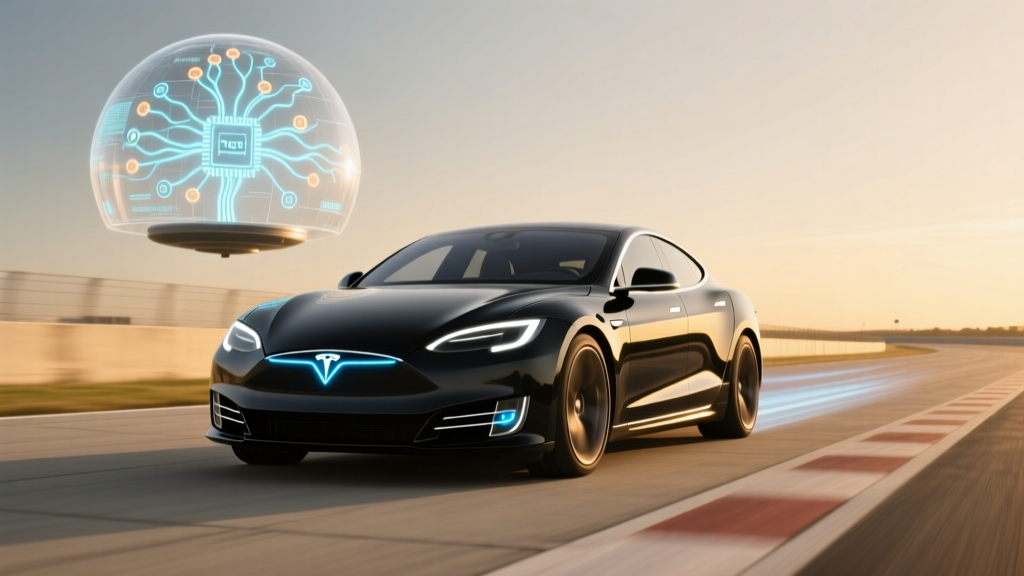
Tesla's decision to shut down its Dojo supercomputer project sent shockwaves through the EV and AI communities in early 2026. Originally unveiled as Tesla's custom-built, in-house neural network training powerhouse, Dojo was supposed to give Tesla an insurmountable advantage in developing Full Self-Driving (FSD) technology. Now that it's offline, buyers and owners are asking a practical question: does this change anything about the Tesla you'd drive today?
This analysis examines the Dojo shutdown through the lens of what matters to EV buyers — FSD capability, vehicle value, and whether Tesla's AI pivot affects the ownership equation. We'll also ground the discussion with current specs on the 2026 Tesla Model Y, the vehicle most directly tied to Tesla's autonomy ambitions.
What Was Tesla Dojo and Why Did It Shut Down?
Dojo was Tesla's purpose-built supercomputer designed to train neural networks on the massive volume of video data collected from Tesla's fleet. Announced in 2021 and brought online in phases through 2023-2024, Dojo used Tesla's custom D1 chip architecture to process driving data at scale. The goal was to accelerate FSD training without relying on third-party GPU clusters.
By early 2026, Tesla confirmed it was winding down Dojo operations. The reasons are multifaceted:
- Cost vs. return: Dojo's development and operational costs reportedly exceeded $2 billion, while commercially available NVIDIA H100 and B200 GPU clusters offered competitive or superior training throughput at lower marginal cost.
- Engineering talent shift: Key Dojo engineers departed for other AI ventures throughout 2025, weakening the project's momentum.
- Strategic pivot to inference: Tesla's FSD stack shifted from training-heavy approaches to inference optimization — making the vehicle's onboard Hardware 4 (and now Hardware 5) chips more critical than cloud-side training hardware.
- NVIDIA partnership deepening: Tesla expanded its use of NVIDIA's Cortex GPU clusters, which offered better performance-per-dollar for the specific workloads FSD required by 2026.
The shutdown does not mean Tesla has abandoned FSD development. It means Tesla is training its neural networks on different hardware — a behind-the-scenes infrastructure change, not a product cancellation.
What This Means for FSD (Supervised) in 2026
For current Tesla owners and prospective buyers, the Dojo shutdown has minimal near-term impact on the FSD experience you'll actually use. Here's why:
FSD v13 and beyond were already being trained primarily on NVIDIA clusters by late 2025. The transition was gradual, and Tesla's software team had been running parallel training pipelines for over a year before Dojo's official shutdown. The FSD (Supervised) system available on 2026 Tesla vehicles reflects this continuity — it handles city streets, highways, and parking maneuvers with the same vision-only architecture.
The real question is pace of improvement. Dojo's theoretical advantage was faster iteration cycles. Without it, Tesla relies on the same GPU supply chain as every other AI company. Whether this slows FSD's march toward unsupervised Level 4 capability remains an open question — but no automaker has achieved consumer-available Level 4 autonomy outside of robotaxi geofences as of 2026.
2026 Tesla Model Y: Current Specs at a Glance
Since the Model Y is Tesla's best-selling vehicle and the primary platform for FSD deployment, here's a detailed spec breakdown for the current 2026 model year:
| Specification | Long Range AWD | Performance |
|---|---|---|
| EPA Range | 320 miles | 295 miles |
| Battery (usable) | 75 kWh (NMC) | 75 kWh (NMC) |
| Drivetrain | Dual-Motor AWD | Dual-Motor AWD |
| Horsepower | 384 hp | 456 hp |
| 0-60 mph | 4.8 sec | 3.5 sec |
| Max DC Fast Charge | 250 kW (peak) | 250 kW (peak) |
| 10-80% DC Time | ~25 min | ~25 min |
| Level 2 Home Charge | 11.5 kW (~44 mi/hr) | 11.5 kW (~44 mi/hr) |
| Efficiency | 122 MPGe / 28 kWh/100mi | 111 MPGe / 30 kWh/100mi |
| Cargo Volume | 30.2 cu ft (rear up) / 72.1 cu ft (rear down) | 30.2 cu ft / 72.1 cu ft |
| Base MSRP | $46,630 | $52,130 |
Source: EPA Fueleconomy.gov and Tesla.com Model Y specs. Prices exclude destination fee.
Charging Speed and Infrastructure
| Charging Level | Power (kW) | Speed (miles added/hr) | Notes |
|---|---|---|---|
| Level 1 (120V) | 1.4 kW | ~5 mi/hr | Emergency/trickle only |
| Level 2 (240V, 48A) | 11.5 kW | ~44 mi/hr | Home Wall Connector; full charge in ~7 hrs |
| DC Fast (V3 Supercharger) | 250 kW (peak) | ~200+ mi in 15 min | Tapers significantly above 60% SoC |
| DC Fast (V4 Supercharger) | Up to 325 kW | Model Y limited to ~250 kW intake | V4 stalls available at newer corridors |
Charging curve reality check: The 250 kW peak rate is only sustained between roughly 10-30% State of Charge (SoC). Above 50%, the rate drops to ~120 kW, and above 80% it falls to ~40-50 kW. The advertised "10-80% in 25 minutes" assumes battery preconditioning is active (the car navigates to a Supercharger, triggering automatic thermal prep). Cold-soaking the battery without preconditioning can add 10+ minutes to a fast-charge session.
Tesla's NACS (North American Charging Standard) connector is now the industry standard, with Ford, GM, Rivian, and most major automakers adopting it for 2025+ models. Tesla owners retain the broadest fast-charging network access — over 6,500 Supercharger stations in North America as of 2026 — though non-Tesla EVs now share many of these stalls.
Pricing, Tax Credits, and Total Cost
| Trim | MSRP | Est. §30D Credit | Effective Price |
|---|---|---|---|
| Long Range AWD | $46,630 | $3,750-$7,500* | ~$39,130-$42,880 |
| Performance | $52,130 | $3,750-$7,500* | ~$44,630-$48,380 |
*Credit amount depends on battery component and critical mineral sourcing requirements under IRS §30D rules. As of 2026, Tesla's battery sourcing qualifies for a partial or full credit depending on the specific battery batch and mineral supply chain. Income caps apply: $150K single / $300K joint modified AGI. MSRP must be ≤$55,000 for SUVs. Point-of-sale transfer is available through registered dealers.
- ✅ Buyer MAGI ≤ $150K (single) or ≤ $300K (joint)
- ✅ Vehicle MSRP ≤ $55,000 (SUV classification — Model Y qualifies)
- ⚠️ Battery components: ≥60% manufactured in North America (2026 threshold)
- ⚠️ Critical minerals: ≥50% sourced from US or FTA partners (2026 threshold)
- ✅ Vehicle assembled in North America (Fremont, CA or Austin, TX)
- ✅ Point-of-sale transfer available — apply credit at purchase, not at tax filing
Tesla's exact credit amount fluctuates as supply chains shift. Check fueleconomy.gov for the current verified credit before purchasing.
Warranty and Long-Term Ownership
Tesla's warranty structure for the 2026 Model Y:
- Basic Vehicle: 4 years / 50,000 miles
- Battery & Drive Unit: 8 years / 120,000 miles (Long Range & Performance) with minimum 70% capacity retention guaranteed
- Rust-Through: 12 years, unlimited miles
The 70% retention threshold is the trigger for a warranty battery replacement. In practice, Tesla's NMC packs in the Model Y have shown degradation curves that plateau around 8-12% loss after 100,000 miles based on fleet data aggregated by third-party sources. LFP chemistry (used in the Standard Range/RWD Model 3 and some Model Y variants) offers slower degradation and a higher cycle life, though at the cost of lower energy density and reduced cold-weather range.
Battery replacement cost (out of warranty): $12,000-$16,000 for a Model Y pack as of 2026, including labor. This figure has declined from ~$20,000 in 2022 as refurbishment programs expand.
How the Dojo Shutdown Affects Your Buying Decision
Let's separate signal from noise:
What changes:
- Tesla's FSD training now relies on NVIDIA infrastructure like its competitors. The proprietary compute advantage Dojo was meant to provide did not materialize at the scale promised.
- Long-term, Tesla's path to unsupervised Level 4 autonomy may take longer than the most bullish timelines suggested. This affects resale value projections for buyers who paid for FSD capability.
- The FSD purchase ($8,000 one-time or $99/month subscription in 2026) carries more uncertainty about future payoff than it did when Dojo was operational.
What doesn't change:
- The Model Y you buy today drives, charges, and performs identically regardless of what hardware trains the neural network.
- Supercharger network access remains the most reliable public charging ecosystem in North America.
- Over-the-air updates continue to improve FSD (Supervised) incrementally, regardless of training infrastructure.
- The vehicle's range, efficiency, and charging speed are hardware-determined and unaffected by cloud compute decisions.
- Choose Tesla if: You prioritize Supercharger network reliability, want the most mature Level 2 driver-assist system available (even if Level 4 remains distant), and value OTA update cadence.
- Consider competitors if: You want a more traditional dealer/service experience (Hyundai Ioniq 5, Kia EV6), prefer a more premium interior (BMW iX, Genesis GV60), or need proven long-term build quality data that Tesla's rapid iteration cycles make harder to predict.
- Defer FSD purchase if: The Dojo shutdown makes you skeptical about Tesla achieving unsupervised autonomy on a timeline that justifies the $8,000 cost. The $99/month subscription lets you test it without long-term commitment.
Pros and Cons: 2026 Tesla Model Y
✅ Pros
- Best-in-class Supercharger access (6,500+ stations)
- Strong efficiency: 122 MPGe / 28 kWh/100mi
- Spacious cargo area: 72.1 cu ft with seats folded
- Quick DC charging: 10-80% in ~25 min with preconditioning
- Continuous OTA improvements
- NACS connector = future-proof charging standard
❌ Cons
- FSD (Supervised) remains Level 2 — Dojo shutdown adds uncertainty to autonomy timeline
- Minimalist interior lacks physical controls (no turn signal stalk in 2026 refresh)
- Service center wait times remain long in many metro areas
- Insurance premiums 15-25% higher than comparable ICE SUVs
- No Apple CarPlay / Android Auto
- Cold-weather range loss more pronounced than some competitors with heat pump standard
Competitor Comparison
| Metric | Tesla Model Y LR | Hyundai Ioniq 5 Limited | Ford Mustang Mach-E ER AWD |
|---|---|---|---|
| EPA Range | 320 mi | 305 mi | 290 mi |
| Max DC Charge | 250 kW | 350 kW | 150 kW |
| 10-80% Time | ~25 min | ~18 min | ~38 min |
| 0-60 mph | 4.8 sec | 5.1 sec | 5.1 sec |
| Base MSRP (equiv. trim) | $46,630 | $52,200 | $48,995 |
| ADAS | Autopilot/FSD (L2) | Highway Driving Assist 2 (L2) | BlueCruise (L2, hands-free) |
The Ioniq 5 charges faster on 350 kW-capable stations but has fewer miles of range. The Mach-E offers Ford's BlueCruise with genuine hands-free highway driving on mapped routes — a tangible Level 2 convenience advantage over Autopilot's hands-on-wheel requirement. The Model Y wins on range, Supercharger ecosystem, and cargo space.
Frequently Asked Questions
Does the Tesla Dojo shutdown mean FSD is dead?
No. FSD (Supervised) continues to receive over-the-air updates and is actively trained on NVIDIA GPU clusters. Dojo was one training infrastructure among several; its shutdown means Tesla chose a more cost-effective compute path, not that it stopped developing autonomous driving software.
Should I still buy FSD for $8,000?
Only if you value the current Level 2 capabilities (city street navigation, automatic parking, Smart Summon) and want lifetime access. The Dojo shutdown adds uncertainty to whether Tesla will achieve unsupervised Level 4 autonomy on an aggressive timeline. The $99/month subscription is a lower-risk way to evaluate the system before committing.
What is the real-world range of the 2026 Tesla Model Y?
EPA-rated at 320 miles (Long Range AWD). Expect 265-285 miles in real-world highway driving at moderate temperatures, and 220-250 miles in sub-freezing conditions. City driving with regenerative braking can match or slightly exceed the EPA estimate.
How fast does the Model Y charge at home and on the road?
At home on a Level 2 Tesla Wall Connector (11.5 kW / 48A), you gain ~44 miles of range per hour — a full charge takes about 7 hours. On a V3 Supercharger (250 kW peak), 10-80% takes approximately 25 minutes with battery preconditioning active. Actual speed varies with battery temperature, SoC, and station load.
Does the 2026 Model Y qualify for the federal EV tax credit?
Yes, partially or fully depending on battery sourcing. Under IRS §30D, the Model Y (classified as an SUV, MSRP under $55,000 cap) qualifies for between $3,750 and $7,500 depending on whether its battery meets the critical mineral and component sourcing thresholds at time of delivery. Buyer income caps apply ($150K single / $300K joint). Verify current eligibility on fueleconomy.gov before purchasing.
Is the Model Y still worth buying vs. competitors after the Dojo news?
If your priorities are range, charging network access, and cargo practicality, the Model Y remains the segment benchmark. If hands-free highway driving (BlueCruise on Mach-E), faster peak charging (Ioniq 5 at 350 kW), or traditional dealer service matter more, competitors are compelling. The Dojo shutdown primarily affects buyers who were banking on Tesla achieving full autonomy soon — a proposition that was always speculative.