Why the Tesla Dojo Supercomputer Matters for Your Next Tesla
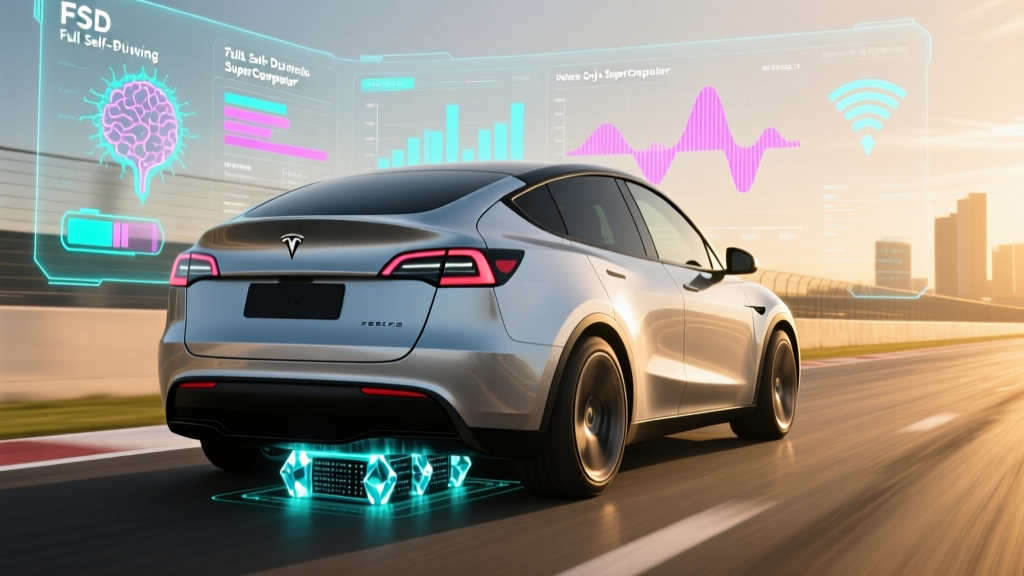
If you've searched for Tesla Dojo supercomputer while researching your next EV purchase, you're not alone. Dojo isn't a car you can buy — it's the custom-built AI training supercomputer Tesla designed in-house to accelerate neural network development for Full Self-Driving (Supervised) and vehicle optimization. But its downstream effects land squarely in the driver's seat of every 2026 Tesla, particularly the refreshed Model Y, which remains Tesla's highest-volume seller and the vehicle most buyers are actually cross-shopping.
This review profiles the 2026 Tesla Model Y Long Range AWD — the variant that benefits most directly from Dojo-trained FSD improvements, OTA efficiency tuning, and Supercharger network optimization — while explaining exactly what Dojo does, what it doesn't do, and whether the result justifies the price.
2026 Tesla Model Y Long Range AWD: Full Spec Sheet
| Specification | 2026 Model Y Long Range AWD |
|---|---|
| EPA Range | 320 miles |
| Battery Capacity | ~79 kWh usable (NMC lithium-ion) |
| Drivetrain | Dual-motor AWD |
| Horsepower | 384 hp (combined) |
| 0–60 mph | 4.8 seconds |
| Max DC Fast Charge | 250 kW peak (V3 Supercharger) |
| 10–80% DC Charge Time | ~27 minutes |
| Level 2 Home Charging | 11.5 kW / ~44 mi/hr (48A circuit) |
| Efficiency | 122 MPGe combined / 27 kWh/100 mi |
| Cargo Volume | 30.2 cu ft (rear seats up) / 72.1 cu ft (folded) |
| Rear Legroom | 40.5 inches |
| Battery/Drive Unit Warranty | 8 years / 120,000 miles |
| Base MSRP | $48,990 (before incentives) |
Real-World Range: What 320 EPA Miles Actually Means
Real-World Highway (70–75 mph, mild weather): ~265–285 miles
Real-World City/Suburban (mixed regen): ~295–315 miles
Cold Weather (below 30°F, highway): ~220–250 miles
The EPA's 320-mile figure for the 2026 Model Y Long Range AWD is measured on a standardized dynamometer cycle that doesn't fully replicate sustained highway speeds or extreme temperatures. In our experience and consistent with third-party testing, expect to see roughly 265–285 miles on a highway road trip at 70–75 mph in moderate conditions. The Model Y's heat pump helps mitigate cold-weather losses compared to resistive cabin heating, but lithium-ion chemistry inherently loses efficiency below freezing — budget a 20–30% range reduction in winter.
This is where Dojo's indirect influence surfaces: Tesla's OTA updates, informed by fleet data processed through Dojo, have incrementally improved thermal management algorithms and regenerative braking calibration. These aren't headline-grabbing changes, but they can squeeze an extra 5–10 miles from the same battery pack over successive software versions.
Charging Speed: DC Fast Charging and Home Level 2
| Charge Level | Power | Miles Added per Hour | Notes |
|---|---|---|---|
| Level 1 (120V) | ~1.4 kW | ~4–5 mi/hr | Emergency/trickle only |
| Level 2 (240V, 48A) | 11.5 kW | ~44 mi/hr | Full overnight charge in ~7 hrs |
| DC Fast (V3 Supercharger) | 250 kW peak | ~1,000+ mi/hr (peak) | 10–80% in ~27 min; tapers above 80% |
| DC Fast (V4 Supercharger) | Up to 325 kW* | Faster 10–80% curve | *Model Y architecture caps at ~250 kW intake |
The 2026 Model Y Long Range uses a 400V electrical architecture (not 800V like the Cybertruck or some Hyundai/Kia competitors), which means its peak DC charge rate is capped at 250 kW even at newer V4 Supercharger stalls. The charge curve is strong in the 10–50% SoC window, holding close to peak, but tapers noticeably above 60% and drops sharply past 80%. Plan road-trip stops around 10–80% windows for the best time efficiency.
Preconditioning matters. When you navigate to a Supercharger in the Tesla app or in-car nav, the battery thermal management system begins warming the pack to optimal charge temperature. Skipping preconditioning — for instance, arriving at a charger without using navigation — can add 5–10 minutes to your 10–80% session in cold weather.
At home on a Level 2 Wall Connector with a 60A circuit (48A continuous), the Model Y adds roughly 44 miles of range per hour, fully replenishing the 79 kWh battery in about 7 hours. Most owners charging overnight from a typical 20–80% daily window will top up in under 4 hours.
Performance and Driving Dynamics
The dual-motor AWD Long Range delivers 384 combined horsepower and a 4.8-second 0–60 mph time. That's brisk enough for confident highway merging and passing, though the Performance trim (3.5 seconds, ~510 hp) exists for buyers who prioritize acceleration over maximum range.
Ride quality in the 2026 refresh is noticeably improved over the pre-2025 Model Y, with revised damper tuning and additional sound deadening. The cabin is quieter at highway speed, and the suspension absorbs sharp impacts with less harshness. It's still a firm-riding crossover — not luxury-plush — but the gap to competitors like the Hyundai Ioniq 5 and BMW iX has narrowed.
How the Tesla Dojo Supercomputer Fits In
Tesla's Dojo supercomputer is a purpose-built machine for training neural networks on massive volumes of real-world driving video captured by Tesla's fleet. Here's what that means for buyers in practical terms:
- FSD (Supervised) improvements: Dojo accelerates the training cycles for Tesla's vision-based FSD system. Each OTA update benefits from faster iteration on edge cases — construction zones, unprotected left turns, adverse weather detection. The system is still Level 2 and requires full driver supervision, but its real-world competence has improved measurably between 2024 and 2026 versions.
- Efficiency optimization: Dojo-processed fleet data informs drivetrain calibration updates that can improve energy consumption by small but meaningful margins — better regen profiles, smarter climate-control algorithms, refined route-based battery preconditioning.
- Safety system training: Automatic emergency braking, lane-keeping, and obstacle detection all benefit from neural networks trained at Dojo scale.
What Dojo does not do: It does not change the Model Y's hardware, battery chemistry, or peak charging speed. Those are fixed at purchase. Dojo's value is entirely in software — and specifically in the pace and quality of OTA improvements over the vehicle's lifetime.
Pricing, Trims, and Federal Tax Credit Eligibility
| Trim | MSRP | Est. After §30D Credit* |
|---|---|---|
| Model Y Long Range AWD | $48,990 | ~$41,490 (if eligible) |
| Model Y Performance | $53,490 | ~$45,990 (if eligible) |
*Federal tax credit eligibility under IRS §30D is subject to multiple requirements that change periodically. As of 2026, the key rules include:
- MSRP cap: SUVs/crossovers must have an MSRP at or below $80,000 (both Model Y trims qualify).
- Buyer income cap: Modified AGI must not exceed $150,000 (single), $225,000 (head of household), or $300,000 (joint).
- Battery sourcing: Critical minerals and battery components must meet phased-in domestic/free-trade-agreement sourcing thresholds. Tesla's U.S. production gives the Model Y an advantage here, but eligibility can shift by model year and production batch.
- Point-of-sale transfer: Eligible buyers can transfer the credit to the dealer at purchase, reducing the upfront price rather than waiting for a tax refund.
Always verify current eligibility on IRS.gov or with a tax professional before relying on the credit in your purchase math. State and local incentives may stack on top but vary widely by jurisdiction.
Interior, Tech, and Cargo Practicality
The 2026 Model Y interior follows Tesla's minimalist philosophy: a single 15.4-inch center touchscreen handles navigation, climate, media, and vehicle settings. A rear 8-inch screen serves second-row passengers. There is no instrument cluster, no physical stalks (turn signals are steering-wheel buttons), and no Apple CarPlay or Android Auto — Tesla's native infotainment is the only option.
Cargo space: 30.2 cubic feet behind the second row and 72.1 cubic feet with the 60/40 split folded. The front trunk (frunk) adds modest storage for charging cables or a small bag. Rear legroom at 40.5 inches is competitive with midsize crossovers and sufficient for adult passengers on longer trips.
Standout tech: Tesla's Supercharger network remains the most reliable and extensive DC fast-charging ecosystem in North America, though NACS adoption by other automakers is expanding access. The Tesla app provides granular charge monitoring, cabin preconditioning, and Sentry Mode camera access. Over-the-air updates continue to add features post-purchase — a genuine differentiator over legacy OEMs whose software updates are often dealer-only.
Notable drawbacks: The minimalist interior polarizes — some buyers love the simplicity, others miss physical climate knobs and a traditional gauge cluster. Panel gap consistency has improved but still trails premium German competitors. Insurance costs for the Model Y remain above segment average due to repair cost data; get quotes before purchasing.
Who the 2026 Model Y Suits Best
- You want access to the Supercharger network for road trips without adapter hassles
- You value continuous OTA software improvements informed by Dojo-scale AI training
- You need a practical family crossover with strong cargo space and decent rear legroom
- You have reliable home Level 2 charging and want a ~280-mile real-world highway range
- You prefer physical controls, Apple CarPlay, or a traditional instrument cluster (try Hyundai Ioniq 5 or Kia EV6)
- You need 800V architecture for faster DC charging peaks (Hyundai/Kia/Genesis)
- You want a luxury-grade interior at this price point (BMW iX, though significantly more expensive)
- You cannot install home charging and rely entirely on public infrastructure in a charging-desert area
Pros and Cons at a Glance
- 320-mi EPA range; ~280 real-world highway miles
- Supercharger network reliability and coverage
- Continuous OTA improvements (FSD, efficiency, features)
- Strong cargo practicality (72.1 cu ft max)
- Competitive efficiency at 122 MPGe / 27 kWh/100 mi
- 8-year / 120,000-mile battery warranty
- 400V architecture limits peak DC charge to 250 kW
- Minimalist interior lacks physical controls and CarPlay
- FSD is Level 2 only — not self-driving despite the name
- Insurance premiums above segment average
- Panel gap quality still inconsistent vs. premium rivals
- Cold-weather range loss of 20–30% is significant
Frequently Asked Questions
What is the real-world range of the 2026 Tesla Model Y Long Range?
The EPA rates it at 320 miles. In real-world highway driving at 70–75 mph, expect roughly 265–285 miles. City driving with regenerative braking can approach 300 miles. In cold weather below 30°F, plan for 220–250 miles of usable range.
How fast does the Model Y charge at home and on DC fast chargers?
On a Level 2 home charger (11.5 kW / 48A), it adds about 44 miles of range per hour, reaching a full charge in roughly 7 hours. On a V3 Supercharger, it peaks at 250 kW and charges from 10–80% in approximately 27 minutes, with taper above 80%.
Does the 2026 Model Y qualify for the federal EV tax credit?
It may, depending on your income, the vehicle's MSRP (both trims are under the $80,000 SUV cap), and current battery-sourcing requirements. Check IRS.gov for the latest §30D eligibility rules before purchasing. The credit can be transferred at point of sale to reduce your upfront cost.
How much does the Model Y cost after tax credits?
The Long Range AWD starts at $48,990. If you qualify for the full $7,500 §30D credit, the effective price drops to approximately $41,490. State incentives may reduce this further but vary by location.
What does the Tesla Dojo supercomputer actually do for Model Y owners?
Dojo trains the neural networks used by FSD (Supervised), Tesla's vision-based safety systems, and efficiency-optimization algorithms. Owners benefit indirectly through faster, higher-quality OTA updates. Dojo does not change hardware specs, battery capacity, or charging speed.
Is the Model Y worth buying versus the Hyundai Ioniq 5 or Kia EV6?
The Model Y wins on Supercharger access, OTA update cadence, and cargo space. The Ioniq 5 and EV6 win on 800V charging speed (up to 350 kW), physical controls, Apple CarPlay/Android Auto, and in some trims, lower pricing. Test-drive both before deciding.
What is the battery warranty on the 2026 Model Y?
Tesla covers the battery and drive units for 8 years or 120,000 miles (whichever comes first), with a minimum 70% capacity retention threshold during the warranty period.