In late 2025, Tesla confirmed what industry insiders had suspected for months: the company effectively disbanded its Dojo supercomputer training team, culminating in the departure of project lead Pete Bannon. For EV shoppers evaluating Tesla's Full Self-Driving (FSD) technology — and current owners wondering about the future of their vehicle's most expensive software add-on — this organizational shift raises urgent questions about Tesla's AI ambitions and the real-world capabilities you can expect from a 2026 Model 3, Model Y, Model S, or Model X.
This article breaks down the Dojo disbandment, what it means for Tesla's FSD roadmap, and — critically — whether Tesla's current lineup still delivers the range, charging speed, and driver-assistance performance that justify its premium pricing in an increasingly competitive EV market.
What Happened: Tesla Disbands Dojo Supercomputer Team Led by Pete Bannon
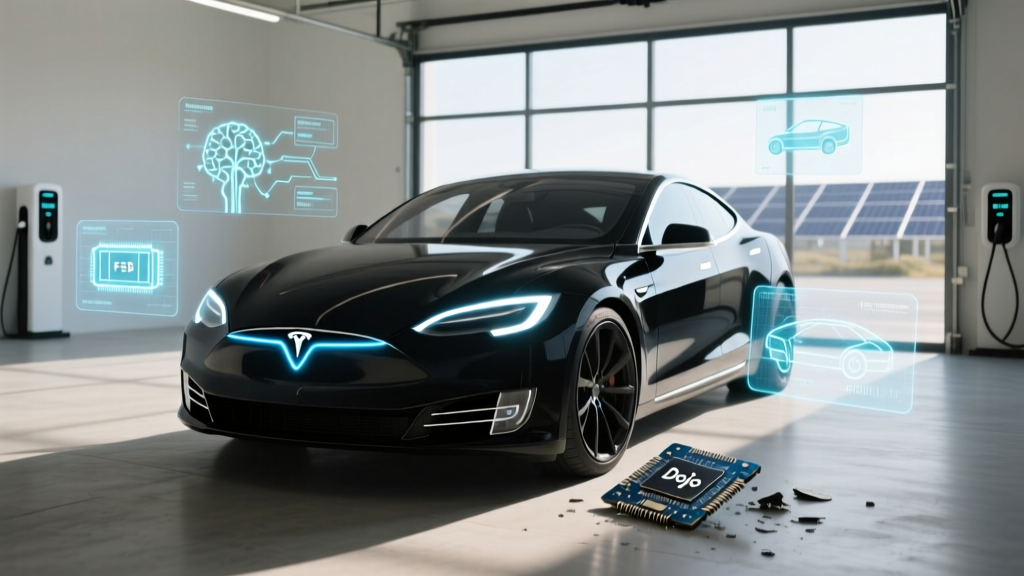
Pete Bannon, who led Tesla's Dojo supercomputer project since its inception and previously oversaw the development of Tesla's in-house FSD chips, departed the company as Tesla restructured its AI training infrastructure. According to Reuters reporting and internal communications reviewed by multiple outlets, Tesla shifted its neural network training away from the custom Dojo D1 architecture toward clusters built on NVIDIA H100 GPUs — the same hardware its competitors use for autonomous driving development.
The Dojo project, announced with significant fanfare in 2021, was supposed to give Tesla a proprietary advantage in training the massive neural networks that power FSD. The system used Tesla's custom D1 chips arranged into "training tiles" to process the billions of video frames collected from Tesla's fleet. By mid-2025, however, Tesla had reportedly encountered persistent yield and reliability issues with the D1 architecture at scale, while NVIDIA's rapidly improving GPU ecosystem offered a more proven — if less differentiated — path forward.
Regardless of the Dojo situation, Tesla's FSD (Supervised) remains an SAE Level 2 driver-assistance system. The driver must remain fully engaged, hands on or near the wheel, and eyes on the road at all times. Tesla's FSD does not make the vehicle autonomous. Only Level 4 services like Waymo operate without a human driver in geofenced areas. Never treat any Tesla system as self-driving.
Tesla's 2026 Lineup: Range, Charging, and Specs That Still Matter
While the Dojo news dominates AI headlines, the vehicles Tesla actually sells to consumers remain defined by their hardware specs — range, charging speed, battery chemistry, and efficiency. Here's where Tesla's 2026 core lineup stands against the numbers that matter to buyers.
| Spec | Model 3 Long Range AWD | Model Y Long Range AWD | Model S Long Range |
|---|---|---|---|
| EPA Range | 363 mi | 330 mi | 402 mi |
| Battery (usable) | ~75 kWh, NMC | ~75 kWh, NMC | ~95 kWh, NMC |
| Max DC Fast Charge | 250 kW peak | 250 kW peak | 250 kW peak |
| 10–80% DC Time | ~25 min | ~27 min | ~30 min |
| Level 2 Home Rate | 11.5 kW (~44 mi/hr) | 11.5 kW (~44 mi/hr) | 11.5 kW (~34 mi/hr) |
| 0–60 mph | 4.2 sec | 4.8 sec | 3.1 sec |
| Horsepower | 346 hp | 384 hp | 670 hp |
| Drivetrain | Dual-Motor AWD | Dual-Motor AWD | Dual-Motor AWD |
| MPGe (combined) | 132 MPGe | 122 MPGe | 120 MPGe |
| Efficiency | 25 kWh/100 mi | 28 kWh/100 mi | 29 kWh/100 mi |
| Cargo Volume | 23 cu ft (trunk) + frunk | 34 cu ft (rear up) + frunk | 28 cu ft (trunk) + frunk |
| Base MSRP | $47,740 | $48,990 | $79,990 |
Source: fueleconomy.gov (EPA) and Tesla.com. Prices reflect 2026 model year before destination fees and incentives. Specs subject to change by production batch.
Real-World Range vs. EPA Sticker: What Owners Actually Experience
Model 3 Long Range: EPA 363 mi → Expect ~290–310 mi on highway trips at 70+ mph; ~250–270 mi in sub-30°F cold weather with cabin heating.
Model Y Long Range: EPA 330 mi → Expect ~265–285 mi highway; ~225–245 mi in cold weather.
Model S Long Range: EPA 402 mi → Expect ~330–355 mi highway; ~280–310 mi in cold weather.
Cold-weather losses of 20–30% are typical for all EVs due to battery chemistry and cabin heating demands. Tesla's heat pump (standard on all 2026 models) mitigates this somewhat compared to older resistance-heater EVs, but the physics of lithium-ion cells in cold temperatures cannot be fully engineered away.
Tesla's efficiency remains class-leading. The Model 3 Long Range's 25 kWh/100 mi figure means you're extracting more miles from each kilowatt-hour than nearly any competing EV. This translates directly to lower charging costs and more usable range from a given battery size — a meaningful advantage whether you're charging at home on Level 2 or paying per kWh at public DC fast chargers.
Charging Speed and Infrastructure: Still a Tesla Advantage
The Dojo restructuring doesn't affect Tesla's hardware charging capabilities, which remain among the best in the industry — particularly when using the Tesla Supercharger network.
| Level | Power (kW) | Miles Added per Hour | Best Use Case |
|---|---|---|---|
| Level 1 (120V) | ~1.4 kW | ~3–5 mi/hr | Overnight trickle, emergencies |
| Level 2 (240V, 48A) | 11.5 kW | ~34–44 mi/hr | Daily home charging |
| DC Fast (Supercharger V3) | Up to 250 kW peak | ~170 mi in 15 min | Road trips |
Charging curve reality: Tesla's 250 kW peak rate applies only between approximately 10–30% state of charge. Above 50%, the charge rate tapers significantly — typically to 100 kW by 60% SoC and below 50 kW above 80%. This is normal lithium-ion charge-curve behavior, not a Tesla deficiency, but it means the advertised "170 miles in 15 minutes" applies only when starting from a low state of charge. A 10–80% session takes 25–30 minutes depending on battery temperature and starting SoC.
NACS connector advantage: All 2026 Teslas use the North American Charging Standard (NACS) connector natively. With Ford, GM, Rivian, and most major automakers adopting NACS for 2025–2026 models, Tesla's connector has become the de facto industry standard. Tesla Superchargers now serve non-Tesla EVs at many locations, which increases utilization (and potentially wait times at popular stations), but also validates Tesla's infrastructure investment.
Pricing, Tax Credits, and Total Cost of Ownership
| Model / Trim | Base MSRP | §30D Credit Eligible? | Effective Price (with credit) |
|---|---|---|---|
| Model 3 RWD | $38,990 | Yes — up to $7,500* | ~$31,490 |
| Model 3 Long Range AWD | $47,740 | Yes — up to $7,500* | ~$40,240 |
| Model Y Long Range AWD | $48,990 | Yes — up to $7,500* | ~$41,490 |
| Model S Long Range | $79,990 | No — exceeds $55,000 sedan cap | $79,990 |
| Model X Long Range | $84,990 | No — exceeds $80,000 SUV cap | $84,990 |
*Under IRS §30D rules, eligibility requires: (1) buyer AGI ≤ $150K single / $300K joint, (2) MSRP within caps ($55K sedans, $80K SUVs/trucks), (3) battery components and critical minerals sourcing thresholds met. Credit can be transferred to the dealer at point of sale as a purchase-price reduction. Verify current eligibility on IRS.gov before purchasing — sourcing requirements tighten annually.
FSD cost context: Tesla's FSD (Supervised) software adds $8,000 to the purchase price or is available as a $99/month subscription. Given that FSD remains a Level 2 system requiring constant driver supervision — and that the Dojo disbandment raises questions about Tesla's long-term AI training differentiation — buyers should carefully weigh whether the premium is justified for their use case. The monthly subscription may be the more prudent choice for those who want to evaluate FSD capabilities without a large upfront commitment.
What the Dojo Disbandment Means for FSD Development
The dissolution of the Dojo team under Pete Bannon does not mean Tesla has stopped developing FSD. Tesla continues to train its neural networks — it has simply shifted from custom silicon to commercially available NVIDIA hardware. The practical implications break down as follows:
Short-term (2026): Minimal direct impact on FSD capabilities available to consumers. Tesla's current FSD (Supervised) v13.x continues to receive over-the-air updates, and the training compute is being handled by NVIDIA H100 clusters. Tesla has publicly stated it operates one of the largest H100 clusters in the world.
Medium-term (2027–2028): The strategic risk is differentiation. If Tesla trains on the same NVIDIA hardware as Waymo, Cruise, and every ADAS startup, its competitive moat narrows to its fleet data advantage (billions of real-world driving miles from customer vehicles) rather than proprietary compute. Whether fleet data volume alone sustains a meaningful lead in neural network quality is an open question.
For current owners: Your vehicle's hardware (HW4/AI4 computer) is unaffected. OTA updates will continue. The question is whether the pace of FSD improvement accelerates, plateaus, or decelerates relative to competitors like GM's Super Cruise and Ford's BlueCruise — both of which are also Level 2 systems but take different technical approaches to hands-free highway driving.
- FSD (Supervised) is SAE Level 2 — you are the driver and are legally responsible for the vehicle at all times
- Does not reliably handle construction zones, unmapped roads, severe weather, or complex intersections without intervention
- Tesla's camera-only approach (no LiDAR or radar on 2026 models) can struggle with depth perception in low-contrast conditions (fog, direct sun glare, heavy rain)
- FSD does NOT make your Tesla a robotaxi — Tesla's announced "unsupervised" FSD timelines have repeatedly slipped
- Insurance liability in an FSD-involved collision falls on the driver, not Tesla
How Tesla Stacks Up Against Key Competitors
The Dojo news arrives at a time when Tesla faces its strongest competitive pressure in years. Here's how the Model 3 and Model Y compare against rivals on the metrics that matter most to buyers:
| Metric | Tesla Model 3 LR | Hyundai Ioniq 6 SEL | BMW i4 eDrive40 |
|---|---|---|---|
| EPA Range | 363 mi | 361 mi | 307 mi |
| Max DC Charge | 250 kW | 240 kW | 205 kW |
| 10–80% Time | ~25 min | ~18 min | ~31 min |
| Base MSRP | $47,740 | $46,500 | $57,900 |
| Efficiency | 25 kWh/100 mi | 26 kWh/100 mi | 30 kWh/100 mi |
The Hyundai Ioniq 6 matches Tesla on range and actually charges faster (18 minutes 10–80% vs. Tesla's 25 minutes) thanks to its 800V architecture. The BMW i4 commands a premium but delivers superior build quality and a more conventional interior layout. Tesla's advantages remain its Supercharger network access, over-the-air update cadence, and class-leading efficiency.
Warranty, Reliability, and Long-Term Ownership
Tesla's warranty coverage for 2026:
- Basic Vehicle: 4 years / 50,000 miles
- Battery & Drive Unit: 8 years / 120,000 miles (Model 3/Y Long Range); 8 years / 150,000 miles (Model S/X)
- Battery capacity retention threshold: Tesla warrants that the battery will retain at least 70% of its original capacity during the warranty period
The 70% retention threshold is standard for the industry but worth noting: if your 363-mile Model 3 degrades to 254 miles of range within 8 years, Tesla does not consider that a warranty claim. Real-world degradation data from Tesla's fleet suggests most NMC packs lose approximately 10–12% capacity in the first 100,000 miles, then the curve flattens — meaning most owners will retain 85–90% capacity well beyond the warranty period.
Tesla's service model remains a pain point for some owners. Unlike legacy automakers with dealer networks, Tesla relies on its own service centers and mobile service vans. In high-density EV markets (California, Florida, Texas), wait times for service appointments can stretch to 2–3 weeks for non-critical issues. Mobile service handles many software and minor hardware repairs but cannot address structural or high-voltage issues.
Pros, Cons, and Who Should Buy a Tesla in 2026
- Class-leading efficiency (lowest kWh/100 mi in segment)
- Access to Supercharger network — still the most reliable DC fast-charging ecosystem
- Strong real-world range (290–363 mi EPA depending on model)
- Over-the-air updates continuously add features
- Excellent regenerative braking and one-pedal driving experience
- NACS connector is now the industry standard
- Competitive pricing after §30D tax credit (Model 3 from ~$31,490)
- Dojo disbandment raises questions about long-term FSD differentiation
- FSD remains Level 2 despite $8,000 price tag — supervision always required
- Camera-only vision system has known limitations in adverse weather
- Service center availability and wait times in some markets
- Minimalist interior not for everyone (no instrument cluster, limited physical controls)
- Model S/X ineligible for federal tax credit (MSRP cap)
- Charge rate tapers significantly above 50% SoC (not unique to Tesla)
Choose Tesla if: You prioritize charging-network reliability (Superchargers), want best-in-class efficiency, value OTA feature updates, and are comfortable with a screen-centric interior. The Model 3 RWD at ~$31,490 after the federal credit is one of the most affordable ways into a 300+ mile EV.
Look elsewhere if: You want the fastest DC charging speeds (Hyundai/Kia's 800V platform charges 10–80% in 18 min vs. Tesla's 25 min), prefer a traditional interior with physical gauges and buttons, need guaranteed hands-free highway driving (GM Super Cruise on mapped highways), or are buying primarily for FSD and are uncomfortable with Level 2 limitations.
Frequently Asked Questions
What is the real-world range of a 2026 Tesla Model 3 Long Range?
The EPA rates the Model 3 Long Range AWD at 363 miles. In real-world highway driving at 70–75 mph, expect 290–310 miles. In cold weather (below 30°F), range drops to approximately 250–270 miles due to battery chemistry limitations and cabin heating energy demands. Tesla's heat pump helps mitigate cold-weather losses compared to older EVs, but physics dictates some reduction.
How fast does a 2026 Tesla charge at home and on the road?
At home on a 240V Level 2 charger (48A), Teslas charge at up to 11.5 kW, adding approximately 34–44 miles of range per hour — enough to fully replenish overnight. On DC fast charging (Tesla Supercharger V3), the peak rate is 250 kW, but this is sustained only from roughly 10–30% SoC. A 10–80% session takes 25–30 minutes. Above 80%, charging slows dramatically to protect battery health — plan to charge to 80% on road trips and move on rather than waiting for a full charge.
How much does a 2026 Tesla cost after federal tax credits?
The Model 3 RWD starts at $38,990 MSRP and qualifies for up to $7,500 under IRS §30D (subject to buyer income limits of $150K single/$300K joint, and battery sourcing requirements), bringing the effective price to approximately $31,490. The Model 3 Long Range drops from $47,740 to ~$40,240. The Model Y Long Range falls from $48,990 to ~$41,490. The Model S ($79,990) and Model X ($84,990) exceed the §30D MSRP caps for sedans ($55,000) and SUVs ($80,000) and do not qualify. Credit can be applied as a point-of-sale reduction. Always verify current eligibility at IRS.gov.
Is Tesla still worth buying after the Dojo supercomputer team disbandment?
For buyers choosing a Tesla based on its core vehicle attributes — range, efficiency, charging network, performance — the Dojo disbandment has no impact on the hardware you're purchasing. For buyers paying $8,000 for FSD with the expectation that it will become a Level 4 autonomous system, the Dojo shift introduces uncertainty about Tesla's long-term AI differentiation. Tesla is still training FSD neural networks using NVIDIA H100 clusters, but it no longer has a proprietary compute advantage. Consider the FSD subscription ($99/month) instead of the upfront purchase if autonomous capability is your primary motivation.
Does the 2026 Tesla Model Y qualify for the federal EV tax credit?
Yes. The Model Y Long Range AWD at $48,990 MSRP falls under the $80,000 SUV/truck MSRP cap for §30D eligibility. Buyers must meet income requirements (AGI ≤ $300,000 joint / $150,000 single) and the vehicle must meet battery component and critical mineral sourcing thresholds, which tighten each year. The credit can be transferred to Tesla at the point of sale, reducing your purchase price by up to $7,500. Confirm current-year sourcing compliance with your Tesla advisor and consult a tax professional for your specific situation.
What are the biggest pros and cons of buying a Tesla in 2026?
The biggest pros are class-leading efficiency (25 kWh/100 mi on Model 3), the Supercharger network's reliability, strong EPA range (up to 402 mi on Model S), and competitive post-credit pricing. The biggest cons are FSD's persistent Level 2 limitations despite the premium price, the camera-only sensor suite's weather vulnerabilities, service center wait times in some areas, and the strategic uncertainty introduced by the Dojo team disbandment for those banking on Tesla's AI leadership.
Data sources: EPA fueleconomy.gov, IRS §30D Clean Vehicle Credits, Tesla.com official specifications. All prices and specs reflect 2026 model year as of publication. Tax credit eligibility rules are subject to change — verify with IRS.gov and a qualified tax professional before purchasing.