If you've ever searched for Tesla Dog Mode while shopping for an EV, you're not alone. The feature — which keeps your Tesla's climate system running while you step away, displaying a cabin-temperature message on the center screen for passersby — has become one of the brand's most talked-about quality-of-life tools. But Dog Mode isn't a standalone product; it's a software feature embedded in Tesla's climate and vehicle-management systems. That means understanding Dog Mode really means understanding the vehicles that carry it, how much battery it consumes, and whether the underlying EV is the right fit for your life.
This guide breaks down Tesla Dog Mode as a feature, then profiles the 2026 Tesla lineup that supports it — with the exact range, charging, pricing, and tax-credit data you need to make a purchase decision.
What Is Tesla Dog Mode and How Does It Work?
Dog Mode is a climate-control setting available on all current-production Tesla vehicles (Model 3, Model Y, Model S, Model X, and the Cybertruck). When activated from the touchscreen or the Tesla mobile app, it:
- Maintains your set cabin temperature indefinitely while the vehicle is parked.
- Displays the current cabin temperature and a "My driver will be back soon" message on the center screen, visible through the windshield.
- Disables the walk-up door handles and prevents the vehicle from being shifted into drive without the key fob or phone key present.
- Sends a push notification to your phone if the battery State of Charge (SoC) drops below 20%, warning you that climate maintenance may soon be curtailed.
Tesla introduced Dog Mode via an over-the-air (OTA) update in early 2019, and it has been standard on every vehicle delivered since. There is no extra charge, no subscription tier, and no hardware prerequisite beyond the standard heat-pump-based thermal management system Tesla has installed on all vehicles built since late 2020 (the "Octovalve" architecture on Model 3/Y, and equivalent systems on Model S/X and Cybertruck).
Battery Drain and Range Impact: The Numbers
The most common question about Tesla Dog Mode is how much energy it consumes. The answer depends on the ambient-to-target temperature delta, but Tesla's heat pump system is remarkably efficient compared to resistive heating.
| Condition | Approx. Power Draw | Battery Use per Hour (82 kWh pack) |
|---|---|---|
| Mild weather (65-75°F), cooling | 0.5–1.0 kW | ~0.6–1.2% |
| Hot weather (90°F+), active cooling | 1.5–3.0 kW | ~1.8–3.7% |
| Cold weather (30°F), heating via heat pump | 1.5–2.5 kW | ~1.8–3.0% |
| Extreme cold (below 10°F), supplemental resistive | 3.0–5.0 kW | ~3.7–6.1% |
For a typical 30-minute grocery run in moderate weather, you'll use roughly 0.5% of battery on a Long Range Model Y — effectively negligible. Even a two-hour stop in 95°F heat might cost you 6-7% SoC on a Long Range pack, which translates to roughly 20-25 miles of EPA range. The vehicle's 20% SoC notification provides a generous safety buffer.
2026 Tesla Lineup: Specs for Every Dog Mode-Equipped Model
Since Dog Mode is standard across the fleet, the real purchase decision is which Tesla vehicle best fits your needs. Below is the full 2026 spec comparison.
| Spec | Model 3 LR AWD | Model Y LR AWD | Model S LR | Model X LR | Cybertruck AWD |
|---|---|---|---|---|---|
| EPA Range | 341 mi | 320 mi | 402 mi | 335 mi | 340 mi |
| Battery (usable) | ~75 kWh NMC | ~75 kWh NMC | ~95 kWh NMC | ~95 kWh NMC | ~123 kWh NMC |
| Max DC Fast Charge | 250 kW | 250 kW | 250 kW | 250 kW | 350 kW |
| 10-80% DCFC Time | ~25 min | ~25 min | ~30 min | ~31 min | ~20 min |
| Level 2 (240V/48A) | 11.5 kW / ~44 mi/hr | 11.5 kW / ~44 mi/hr | 11.5 kW / ~34 mi/hr | 11.5 kW / ~30 mi/hr | 11.5 kW / ~37 mi/hr |
| 0-60 mph | 4.2 sec | 4.8 sec | 3.1 sec | 3.8 sec | 4.1 sec |
| Horsepower | 346 hp | 384 hp | 670 hp | 670 hp | 600 hp |
| Drivetrain | Dual Motor AWD | Dual Motor AWD | Dual Motor AWD | Dual Motor AWD | Dual Motor AWD |
| Efficiency (MPGe) | 132 MPGe | 122 MPGe | 124 MPGe | 109 MPGe | ~110 MPGe |
| Cargo Volume | 23 cu ft (rear) + 3.1 cu ft (frunk) | 30 cu ft (rear) + 4.1 cu ft (frunk) | 28 cu ft (rear) + 3.1 cu ft (frunk) | 88 cu ft (rear seats folded) + 3.1 cu ft (frunk) | ~67 cu ft (vault) + 7 cu ft (frunk) |
| Rear Legroom | 35.2 in | 41.6 in | 35.4 in | 41.1 in | ~36 in |
| Base MSRP | $47,740 | $49,630 | $79,990 | $84,990 | $79,990 |
Source: fueleconomy.gov and Tesla.com specifications. Prices reflect 2026 model year MSRP before destination fees and incentives. Specs subject to change by production batch.
Charging Infrastructure and the Dog Mode Lifestyle
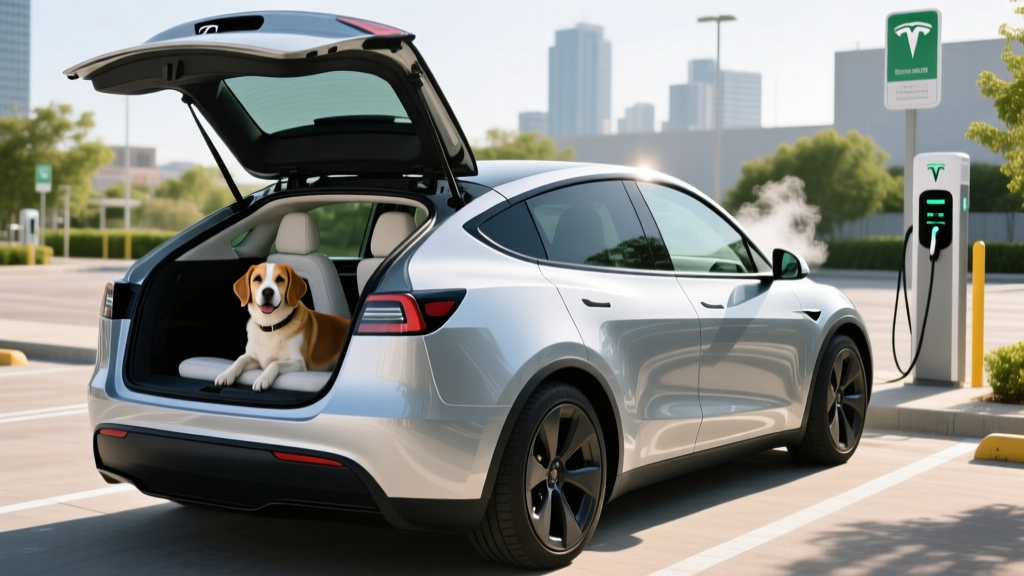
Dog Mode's practicality is amplified by Tesla's Supercharger network — the most reliable DC fast-charging ecosystem in North America. When you pull into a Supercharger stall, you can plug in, activate Dog Mode, and walk to a nearby restaurant or shop while your pet stays comfortable and your car charges.
| Level | Power (kW) | Miles of Range Added per Hour | Typical Use Case |
|---|---|---|---|
| Level 1 (120V) | ~1.4 kW | ~3-5 mi/hr | Emergency / overnight trickle |
| Level 2 (240V, 48A) | 11.5 kW | ~44 mi/hr | Home daily charging |
| DC Fast (V3 Supercharger) | 250 kW peak | ~1,000+ mi/hr (peak) | Road trips, 10-80% in ~25 min |
A critical detail: Dog Mode works while the car is plugged in and charging. This means your pet stays cool or warm, the car charges simultaneously, and there's no net battery drain from climate maintenance — the charger supplies the energy. This is a significant advantage for road-trippers who travel with pets and want to maximize charging-stop efficiency.
Regarding connectors: all 2026 Teslas use the NACS (North American Charging Standard) connector natively. Tesla opened its Supercharger network to non-Tesla EVs (via the NACS standard adopted by Ford, GM, Rivian, and others), meaning the network is growing in utilization but also gaining revenue from non-Tesla vehicles. For Tesla owners, this means continued network investment and expansion.
Pricing, Trims, and Federal Tax Credit Eligibility
Tesla's pricing shifts periodically, but as of early 2026, here is where the lineup stands for Dog Mode-equipped models:
| Model / Trim | MSRP (incl. dest.) | Under §30D MSRP Cap? | Potential Credit |
|---|---|---|---|
| Model 3 RWD | $38,990 | Yes (sedan cap: $55,000) | Up to $7,500* |
| Model 3 Long Range AWD | $47,740 | Yes (sedan cap: $55,000) | Up to $7,500* |
| Model Y Long Range AWD | $49,630 | Yes (SUV/truck cap: $80,000) | Up to $7,500* |
| Model Y Performance | $54,630 | Yes (SUV/truck cap: $80,000) | Up to $7,500* |
| Model S Long Range | $79,990 | Yes (sedan cap: $55,000) — NO, exceeds | Not eligible (exceeds MSRP cap) |
| Model X Long Range | $84,990 | No (exceeds $80,000 SUV cap) | Not eligible |
| Cybertruck AWD | $79,990 | Yes (truck cap: $80,000) | Up to $7,500* |
*Eligibility for the full $7,500 under IRS §30D depends on: (1) buyer adjusted gross income not exceeding $150,000 single / $300,000 joint; (2) critical mineral and battery component sourcing requirements, which change annually; (3) the vehicle being assembled in North America. The credit can be transferred to the dealer at point of sale as an instant discount. Always verify current-year sourcing rules on fueleconomy.gov before purchasing.
Standout Tech, Safety, and Dog Mode-Specific Features
Beyond Dog Mode itself, Tesla's 2026 vehicles share a tech stack that remains industry-leading in several dimensions:
- 15.4-inch center touchscreen (Model 3/Y) or 17-inch (Model S/X/Cybertruck) with Netflix, YouTube, and gaming while parked.
- HEPA air filtration (Bioweapon Defense Mode, standard on Model Y/S/X) — a genuine differentiator for pet owners concerned about air quality during wildfire season.
- Autopilot (SAE Level 2 driver assistance) standard, with optional Full Self-Driving (Supervised) at $8,000 or $99/month. Note: FSD is Level 2 — the driver must remain attentive and is legally responsible at all times. This is not autonomous driving.
- Sentry Mode pairs well with Dog Mode: external cameras record activity around the vehicle, giving you peace of mind that your pet (and car) are secure.
- Over-the-air updates continue to add features; Tesla has historically refined Dog Mode with OTA tweaks (such as adjustable temperature presets via the app).
Warranty Coverage
Tesla's warranty structure is straightforward and applies uniformly to all Dog Mode-equipped models:
- Basic Vehicle Limited Warranty: 4 years / 50,000 miles, whichever comes first.
- Battery and Drive Unit Warranty: 8 years / 100,000 miles (Model 3 RWD with LFP battery) or 8 years / 120,000 miles (Long Range and Performance models with NMC batteries), with a minimum 70% capacity retention guarantee during the warranty period.
- Dog Mode itself is a software feature covered under the basic warranty; there is no separate hardware component that could fail independently of the climate system.
The battery warranty is relevant to Dog Mode users because frequent climate-maintenance usage does count toward total cycle life. However, the energy consumed by Dog Mode (typically 1-5% per use) is trivial compared to driving cycles, and Tesla's thermal management system is designed for sustained HVAC operation.
Who Should Buy a Tesla for Dog Mode?
Choose the Model Y Long Range if: You want the best balance of cargo space for pet gear, rear-seat room for larger dogs, 320 miles of EPA range, and §30D tax credit eligibility. This is the most popular Tesla for pet-owning families for good reason.
Choose the Model 3 Long Range if: You prioritize efficiency (132 MPGe combined), a lower price point, and don't need SUV-level cargo space. Great for single professionals or couples with smaller dogs.
Choose the Cybertruck AWD if: You need truck utility, 11,000-lb towing capacity, and the 800V architecture that enables 350 kW peak DC charging. The Cybertruck's stainless-steel exoskeleton also resists pet claw scratches better than painted surfaces.
Choose the Model X if: You need three-row seating, falcon-wing doors for easy pet loading in tight spaces, and maximum cargo volume — and you accept that it does not qualify for the federal tax credit due to its $84,990 MSRP exceeding the $80,000 SUV cap.
Pros and Cons
Pros
- Dog Mode is free, standard, and works while charging — no net battery cost at Superchargers
- Heat-pump HVAC makes Dog Mode highly energy-efficient vs. resistive systems
- External screen message prevents well-meaning (or hostile) bystander interventions
- Supercharger network reliability means you can confidently leave your pet while charging
- HEPA filtration (Model Y/S/X) protects pets from poor outdoor air quality
- App-based activation lets you pre-condition before you even reach the car
- Sentry Mode integration adds security while your pet is inside
Cons
- 20% SoC cutoff means Dog Mode will eventually shut off — risky for all-day use
- No interior camera monitoring (unless you add an aftermarket pet cam)
- Model S and Model X exceed §30D MSRP caps — no federal tax credit
- Tesla service center wait times can be long in some markets
- Insurance premiums tend to run 15-25% higher than comparable non-Tesla EVs
- No physical buttons for climate — touchscreen-only adjustment can frustrate some users
- FSD (Supervised) remains Level 2 and is not hands-free autonomous driving
Frequently Asked Questions
Does Tesla Dog Mode drain the battery significantly?
In moderate weather (65-75°F), Dog Mode draws roughly 0.5-1.0 kW, consuming about 0.6-1.2% of an 82 kWh battery per hour. That's approximately 2-4 miles of EPA range lost per hour. In extreme heat (95°F+), expect 1.5-3.0 kW draw and roughly 20-25 miles of range consumed over two hours. The car sends a phone alert at 20% SoC.
Can I use Dog Mode while the car is charging at a Supercharger?
Yes. Dog Mode operates normally while plugged into any charger. In fact, this is the ideal use case — the charger supplies the energy for climate maintenance, so your battery SoC actually increases while your pet stays comfortable.
Which Tesla models have Dog Mode in 2026?
All current-production Tesla vehicles — Model 3, Model Y, Model S, Model X, and Cybertruck — include Dog Mode as standard software. There is no trim-level restriction or additional cost.
Does Dog Mode work without an internet connection?
Dog Mode functions without cellular connectivity; the climate system and screen message operate locally. However, you will not receive the 20% SoC push notification on your phone without a data connection, and you cannot activate or adjust Dog Mode remotely via the app without connectivity.
Do any non-Tesla EVs offer a Dog Mode equivalent?
Several competitors offer similar features: Hyundai/Kia's "Utility Mode" and Ford's "Frunk and Cabin Comfort" mode both maintain climate while parked. However, Tesla's implementation remains the most recognized due to its external screen message, which serves a public-communication function that competitors' versions lack.
Is Dog Mode safe for overnight use?
Tesla's owner manual advises against leaving pets unattended for extended periods. Dog Mode will shut off when SoC reaches 20%. For overnight scenarios, Camp Mode is a better choice (it doesn't display the external message, which could attract unwanted attention at night), but neither feature replaces proper pet supervision.
How do I activate Tesla Dog Mode?
From the vehicle: tap the fan icon on the bottom bar of the touchscreen, then select "Dog" from the climate mode options. From the app: open the Tesla app, tap Climate, and select Dog Mode. You can set the target temperature before leaving the vehicle.