Rumors about Tesla discontinuing Model X surface every few quarters, and the 2026 model year has amplified the speculation. With the refreshed Model X now sharing its platform with the Cybertruck's 48-volt architecture and facing stiff competition from three-row electric SUVs like the Rivian R1S, Kia EV9, and Mercedes EQS SUV, buyers are asking a fair question: Is this the last chance to own Tesla's flagship family hauler?
Whether you're tracking the discontinuation chatter or simply evaluating the 2026 Model X on its merits, this review gives you the exact numbers you need — EPA range, real-world highway expectations, DC fast-charge curves, battery chemistry, tax-credit eligibility, and a clear-eyed look at where this SUV still wins and where it falls short.
2026 Tesla Model X: Quick Verdict
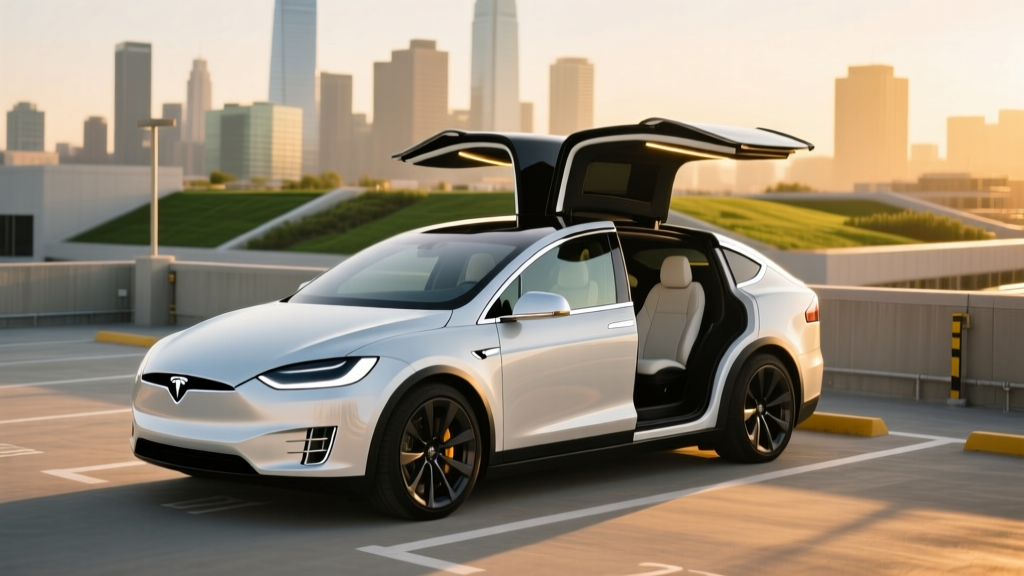
The 2026 Tesla Model X remains one of the fastest, most spacious, and most technologically loaded electric SUVs on the market. The Long Range trim delivers an EPA-estimated 348 miles of range, while the Plaid variant trades some efficiency for a 2.5-second 0-60 mph time that embarrasses supercars. Falcon Wing rear doors, a standard yoke or round steering wheel, and Tesla's Supercharger network access continue to differentiate it.
But the discontinuation rumors aren't baseless. Tesla has shifted significant engineering resources toward its next-generation platform, Optimus robotics, and the Cybercab robotaxi program. Model X sales volume has always been a fraction of Model Y, and competitors have closed the gap in interior quality and third-row usability. If Tesla does sunset the Model X after 2026, current buyers may be looking at a future collector's item — or a depreciating orphan. Here's the data to help you decide.
Range, Battery, and Efficiency: The Real Numbers
| Spec | Model X Long Range | Model X Plaid |
|---|---|---|
| EPA Range | 348 miles | 320 miles |
| Battery Capacity (usable) | ~100 kWh | ~100 kWh |
| Battery Chemistry | NMC (Nickel Manganese Cobalt) | NMC |
| EPA Efficiency | 100 MPGe (34 kWh/100mi) | 96 MPGe (35 kWh/100mi) |
| Drivetrain | Dual-Motor AWD | Tri-Motor AWD |
| Horsepower | 670 hp | 1,020 hp |
| 0-60 mph | 3.8 seconds | 2.5 seconds |
The EPA sticker says 348 miles for the Long Range, but plan for ~280-310 miles on highway road trips at 70-80 mph. Sustained high-speed driving pushes energy consumption to 38-42 kWh/100mi, well above the EPA test cycle. In cold weather (below 30°F), expect a further 15-25% reduction — meaning a winter highway trip could yield 220-260 miles before you need to plug in. The Model X's heat pump helps mitigate cabin heating losses, but battery chemistry limits still apply. Tesla's NMC pack delivers strong energy density but is more sensitive to cold than LFP chemistry.
The Model X has stuck with NMC chemistry rather than the LFP (lithium iron phosphate) packs Tesla uses in the base Model 3 and Model Y. The trade-off: NMC offers higher energy density — critical for a 5,100+ lb SUV — but it degrades slightly faster over time and requires more careful charge management. Tesla recommends daily charging to 80-90% for NMC packs, reserving 100% for road trips. Source: fueleconomy.gov.
Charging Speed: DC Fast, Level 2, and the Supercharger Advantage
| Charging Method | Max Power | Speed (Miles Added) | 10-80% Time |
|---|---|---|---|
| DC Fast Charge (V4 Supercharger) | 250 kW peak | ~200 mi in 15 min | ~30 minutes |
| DC Fast Charge (3rd-party CCS/NACS) | 250 kW peak (adapter req.) | ~200 mi in 15 min | ~30 minutes |
| Level 2 (Tesla Wall Connector, 48A) | 11.5 kW | ~34 mi/hr | ~10 hours (0-100%) |
| Level 2 (Standard 240V/32A outlet) | 7.7 kW | ~23 mi/hr | ~14 hours (0-100%) |
| Level 1 (120V household) | ~1.4 kW | ~3-4 mi/hr | N/A (trickle only) |
The Model X peaks at 250 kW on DC fast chargers, which is competitive but no longer class-leading — the Hyundai Ioniq 5 and Porsche Macan EV accept 270-350 kW on 800V architectures. The practical impact: the Model X charge curve tapers noticeably above 60% State of Charge (SoC). You'll see 250 kW only between roughly 10-30% SoC, after which it steps down to ~150 kW, then ~80 kW past 80%. This is why the 10-80% time sits at around 30 minutes rather than the ~18 minutes some competitors achieve.
Preconditioning is essential. Navigate to a Supercharger using the built-in navigation, and the Model X will warm the battery to optimal charging temperature before you arrive. Skip this step — or use a third-party charger without preconditioning — and your peak charge rate may drop to 120-150 kW, especially in cold weather.
At home, the Tesla Wall Connector at 48 amps delivers roughly 34 miles of range per hour of charging. For most owners who plug in overnight, this means a full recharge while you sleep. Installation typically costs $500-$2,000 depending on whether your electrical panel needs an upgrade. Note: kW (kilowatts) measures charging power — how fast energy flows — while kWh (kilowatt-hours) measures battery capacity, the total energy stored. Don't confuse the two.
Interior, Cargo, and Family Practicality
The Model X seats five standard (two rows) or up to seven with the optional third row. Here are the dimensions that matter for family duty:
- Cargo (behind 3rd row): ~15.3 cu ft — enough for a few grocery bags or two carry-ons
- Cargo (3rd row folded): ~41.1 cu ft — competitive with midsize SUVs
- Cargo (all rear seats folded): ~81.5 cu ft — cavernous, van-like space
- Frunk (front trunk): ~6.7 cu ft — useful for charging cables or a small bag
- 3rd-row legroom: ~32.7 inches — tight for adults on long trips; best for kids
- 2nd-row legroom: ~40.9 inches — generous, especially with captain's chairs
The Falcon Wing rear doors are the Model X's party trick. They open upward with dual-hinged articulation, making car-seat loading dramatically easier than in a conventional SUV. They also detect overhead obstacles and adjust their opening arc accordingly. However, they add mechanical complexity, and long-term owners report occasional sensor glitches and slower opening in freezing rain.
Interior quality has improved with recent refreshes — ventilated front seats, a 17-inch center touchscreen, a rear-seat entertainment display, and available HEPA air filtration (Bioweapon Defense Mode). But compared to the Mercedes EQS SUV or BMW iX, the Model X cabin still leans minimalist over luxurious. Panel gap consistency remains a Tesla talking point.
Pricing, Trims, and Federal Tax Credit Eligibility
| Trim | Base MSRP | Est. As-Tested | §30D Credit Eligible? |
|---|---|---|---|
| Model X Long Range | $79,990 | $85,000-$95,000 | No (MSRP exceeds $80,000 SUV cap) |
| Model X Plaid | $94,990 | $100,000-$110,000 | No (MSRP exceeds $80,000 SUV cap) |
Here's the hard truth for tax-credit shoppers: the 2026 Model X does not qualify for the $7,500 federal EV tax credit under IRS §30D. The law caps eligible SUVs at an $80,000 MSRP, and even the base Long Range trim starts at $79,990 — before destination fees and options push it well above the threshold. Additionally, the buyer income cap ($300,000 joint / $150,000 single) and critical-mineral/battery-sourcing requirements further limit eligibility for any vehicle that might squeak under the cap. Source: IRS §30D guidelines.
Tesla occasionally adjusts pricing, and a future price cut could theoretically bring the Long Range under the cap — but as of the current 2026 model year, plan your budget without assuming the credit. Some states offer additional rebates (California's CVRP, for instance, has its own income and MSRP rules), so check your local DMV or energy office. Consult a tax professional for your specific situation.
Technology, Autopilot, and Driver Assistance
The Model X comes standard with Tesla's Basic Autopilot, which includes Traffic-Aware Cruise Control and Autosteer (lane-centering). This is an SAE Level 2 driver-assistance system — meaning you must keep your hands on the wheel and eyes on the road at all times. It is not self-driving.
Both Autopilot and the optional Full Self-Driving (Supervised) package are Level 2 systems. The driver is responsible for all vehicle operation and must continuously supervise. True driverless operation (Level 4) is currently only available in limited robotaxi services like Waymo, not in any consumer vehicle. Source: NHTSA.
The optional Full Self-Driving (Supervised) package ($8,000 or $99/month as of 2026) adds automatic lane changes, Navigate on Autopilot, Autopark, Summon, and traffic-light/stop-sign recognition. FSD has improved substantially on highway interchanges and urban navigation, but it still requires active supervision. Expect occasional phantom braking, missed construction-zone cones, and hesitation at complex unprotected left turns.
The 17-inch center touchscreen runs Tesla's latest infotainment software, which remains one of the most responsive in the industry. Wireless phone mirroring is absent — Tesla relies on its native apps for Spotify, YouTube, Netflix (while parked), and a built-in browser. A 22-speaker audio system, wireless charging pads, and four USB-C ports round out the tech suite.
Is the Model X Worth It vs. Key Competitors?
| Spec | Tesla Model X LR | Rivian R1S (Dual) | Kia EV9 GT-Line | Mercedes EQS 450 SUV |
|---|---|---|---|---|
| EPA Range | 348 mi | 352 mi (Max Pack) | 279 mi | 305 mi |
| Starting MSRP | $79,990 | $75,900 | $73,900 | $104,400 |
| 0-60 mph | 3.8 sec | 4.5 sec | 8.2 sec | 5.9 sec |
| 3rd Row | Yes (tight) | Yes (usable) | Yes (spacious) | Yes (moderate) |
| Max DC Charge | 250 kW | 200 kW | 236 kW (800V) | 200 kW |
| §30D Credit | No | No (MSRP/income varies) | Yes (if income eligible) | No |
- Choose Model X if: You prioritize performance (3.8s 0-60 in a 3-row SUV is remarkable), live near Superchargers, want Falcon Wing doors for car-seat loading, and value Tesla's software ecosystem and over-the-air updates.
- Choose Rivian R1S if: You need genuine off-road capability, a more usable third row, and better build-quality consistency — and can accept a slightly lower charge rate.
- Choose Kia EV9 if: You want the best value, a spacious third row, 800V fast-charging architecture, and potential §30D tax-credit eligibility — and don't need supercar acceleration.
- Choose Mercedes EQS SUV if: Interior luxury, ride comfort, and dealer service experience matter more than range or performance per dollar.
Warranty and Long-Term Ownership
Tesla covers the Model X with:
- Basic Vehicle Warranty: 4 years / 50,000 miles
- Battery & Drive Unit Warranty: 8 years / 150,000 miles (Long Range & Plaid), with a minimum 70% capacity retention threshold
The 150,000-mile battery warranty is among the longest in the segment. Real-world degradation data from Tesla's fleet suggests the Model X's NMC pack retains approximately 88-92% of its original capacity after 100,000 miles — well within the warranty threshold. However, battery replacement out of warranty remains expensive: estimates range from $12,000 to $20,000 depending on pack configuration and labor.
Insurance costs are a real consideration. The Model X consistently ranks among the most expensive EVs to insure, with average annual premiums of $2,800-$4,200 depending on your state, driving record, and coverage level. Get quotes before committing.
Biggest Pros and Cons
✓ Pros
- Class-leading performance (3.8s / 2.5s 0-60)
- 348-mile EPA range is competitive in the 3-row SUV class
- Supercharger network access remains a real-world advantage
- Falcon Wing doors genuinely ease car-seat loading
- OTA updates continuously add features
- Massive cargo space with seats folded (81.5 cu ft)
- Standard HEPA air filtration
✗ Cons
- Does NOT qualify for $7,500 federal tax credit (MSRP cap)
- Third row is tight for adults — rivals do it better
- Interior quality still lags Mercedes, BMW at this price
- Falcon Wing doors add complexity and potential repair cost
- DC fast-charge speed (250 kW peak) falling behind 800V rivals
- High insurance premiums ($2,800-$4,200/yr avg.)
- Discontinuation risk may affect resale value
Frequently Asked Questions
Is Tesla actually discontinuing the Model X?
As of the 2026 model year, Tesla has not issued an official discontinuation announcement. The Model X remains available for order on Tesla's website. However, industry analysts note that Tesla's Fremont factory is increasingly prioritizing other product lines, and Model X sales volume has remained low relative to Model Y and Cybertruck. A phase-out after the 2026 or 2027 model year is plausible but unconfirmed.
What is the real-world highway range of the Model X?
Expect approximately 280-310 miles at sustained highway speeds (70-80 mph) in moderate temperatures. In cold weather (below 30°F), that drops to roughly 220-260 miles. The EPA's 348-mile combined estimate includes city driving with regenerative braking, which recovers energy that highway driving cannot.
Does the 2026 Model X qualify for the federal EV tax credit?
No. The Model X Long Range starts at $79,990, and with destination fees and typical options, it exceeds the IRS §30D $80,000 MSRP cap for SUVs. The Plaid trim ($94,990) is well above the cap. Always verify current rules at IRS.gov and consult a tax professional.
How fast does the Model X charge at home?
Using a Tesla Wall Connector at 48 amps (11.5 kW), the Model X adds approximately 34 miles of range per hour — a full charge from empty takes about 10 hours overnight. On a standard 240V/32A dryer-style outlet, expect ~23 miles per hour.
Should I buy a Model X now or wait?
If the Model X's unique combination of performance, Falcon Wing doors, Supercharger access, and range fits your needs, buying now ensures you get the current generation. If discontinuation happens, parts and service support typically continue for 10+ years under federal warranty requirements, though resale value is harder to predict. If you want a safer bet with better third-row space and tax-credit eligibility, the Kia EV9 or Rivian R1S are strong alternatives.
What's the battery warranty on the Model X?
Tesla covers the battery and drive unit for 8 years or 150,000 miles, whichever comes first, with a guaranteed minimum of 70% capacity retention. Real-world fleet data suggests most packs retain 88-92% at 100,000 miles.
Sources: EPA fuel economy data via fueleconomy.gov, Tesla official specifications, IRS §30D Clean Vehicle Credits, NHTSA Automated Vehicle Safety. Pricing and credit rules reflect the 2026 model year and are subject to change. Verify all figures with the manufacturer and a qualified tax professional before purchasing.