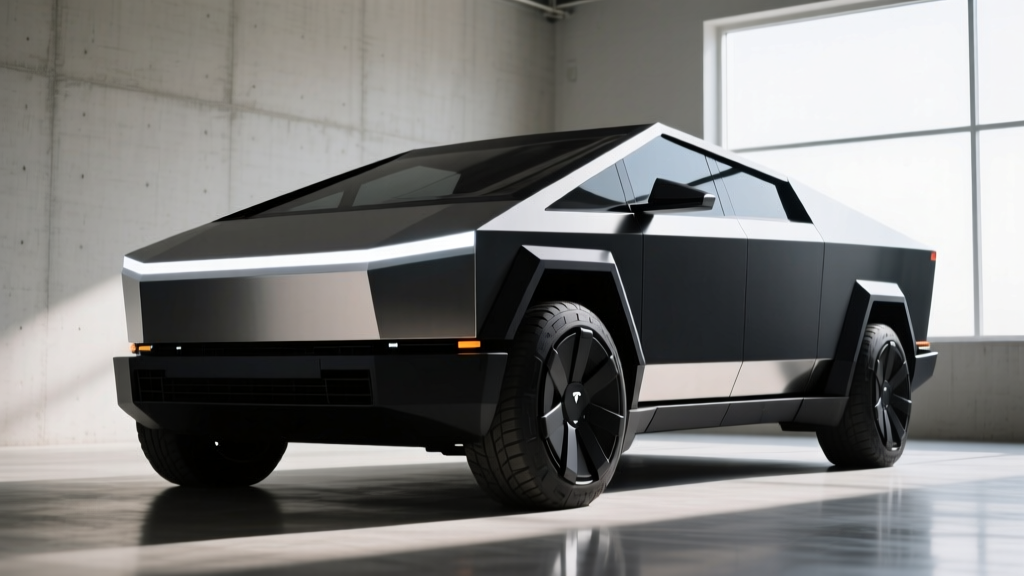
In late 2024, Tesla quietly listed a single-motor, rear-wheel-drive (RWD) Cybertruck at a $60,990 base price — positioned as the most affordable entry into the stainless-steel pickup's lineup. By early 2026, that variant is gone from Tesla's configurator. The decision to drop the RWD model reflects a straightforward reality: a heavy, angular, single-motor truck couldn't deliver the range, towing, or performance buyers expected at that price point. For 2026, Tesla is consolidating the Cybertruck around its dual-motor and tri-motor AWD configurations, which better match the vehicle's weight and capability promises.
This review covers what the discontinuation means for current shoppers, the specs of the remaining 2026 Cybertruck trims, and whether the all-wheel-drive lineup justifies its premium over key competitors like the Ford F-150 Lightning and Rivian R1T.
Why Tesla Dropped the Rear-Wheel-Drive Cybertruck
The RWD Cybertruck was announced with a targeted EPA range of roughly 250 miles and a base MSRP under $61,000. In practice, the single-motor setup struggled against the truck's 6,600+ lb curb weight and polarizing angular aerodynamics. Real-world highway efficiency hovered around 2.2–2.4 kWh/mile, meaning that 250-mile EPA estimate would compress to roughly 190–210 miles at sustained 70 mph speeds — a tough sell for a pickup marketed on capability.
Towing made the picture worse. With a single rear motor, the RWD variant's max towing capacity was limited to approximately 7,500 lbs (compared to 11,000 lbs on the dual-motor AWD). Cold-weather range loss — typically 20–30% for LFP-equipped vehicles without a heat pump running constantly — could push real-world winter range below 170 miles.
Tesla's decision simplifies production and steers buyers toward trims that actually deliver on the Cybertruck's value proposition: AWD traction, higher towing, and meaningful performance.
2026 Cybertruck Lineup: Remaining Trims and Specs
For 2026, the Cybertruck is offered in two primary configurations: the Dual Motor AWD and the Cyberbeast (tri-motor AWD). Both use a ~123 kWh usable battery pack with NMC (nickel manganese cobalt) chemistry, chosen for its higher energy density — essential given the truck's mass.
| Spec | Dual Motor AWD | Cyberbeast (Tri-Motor) |
|---|---|---|
| Drivetrain | Dual Motor AWD | Tri-Motor AWD |
| Horsepower | 600 hp | 845 hp |
| 0-60 mph | 3.9 sec | 2.6 sec |
| Battery (usable) | ~123 kWh (NMC) | ~123 kWh (NMC) |
| EPA Range | 340 mi | 320 mi |
| Max Towing | 11,000 lbs | 11,000 lbs |
| Payload | 2,500 lbs | 2,500 lbs |
| Bed Length | 6 ft (72 in) | 6 ft (72 in) |
| Cargo Volume (bed) | ~67 cu ft | ~67 cu ft |
| Base MSRP | $79,990 | $99,990 |
Charging Speed: DC Fast Charge and Home Level 2
The Cybertruck's 800V-class electrical architecture supports peak DC fast-charging rates up to 350 kW at compatible V4 Superchargers. However, as with all EVs, peak rate is not sustained rate. The charge curve tapers significantly above 50% state of charge (SoC), and thermal management throttles input as the pack warms.
| Charging Level | Power / Rate | Estimated Time / Gain |
|---|---|---|
| DC Fast Charge (V4 Supercharger) | Peak 350 kW | 10-80% in ~22 minutes |
| DC Fast Charge (150 kW station) | Sustained ~120 kW avg | 10-80% in ~48 minutes |
| Level 2 (Tesla Wall Connector, 48A) | 11.5 kW | ~30 miles of range per hour; full charge in ~11 hours |
| Level 1 (120V standard outlet) | ~1.4 kW | ~3-4 miles per hour (emergency use only) |
Charging-curve insight: You'll see the highest charge rates between 10–40% SoC, where the pack can accept close to peak kW. From 50–80%, the rate drops to roughly 100–150 kW. This is normal for NMC packs of this size — Tesla's thermal management is effective, but physics limits how fast you can push electrons into a 123 kWh battery without degrading it. For road trips, plan stops around the 20–80% window for the fastest turnaround.
Efficiency and Running Costs
The Dual Motor AWD achieves an EPA-rated 67 MPGe combined (approximately 2.0 kWh/mile or 50 kWh/100mi). The Cyberbeast drops to roughly 59 MPGe combined due to its third motor and higher performance tuning. For a 6,600+ lb truck, these figures are competitive — the Ford F-150 Lightning Extended Range posts 70 MPGe combined, while the Rivian R1T Dual-Motor Large Pack lands at 73 MPGe.
At the national average electricity rate of $0.17/kWh (EIA, 2025 data), charging the Dual Motor from 0–100% at home costs approximately $20.91, or about $0.06 per mile. Compare that to a gas-powered F-150 averaging 20 MPG at $3.30/gallon: $0.165 per mile. The per-mile fuel savings are substantial, especially for high-mileage drivers.
Pricing, Tax Credits, and Total Cost
With the RWD variant discontinued, the 2026 Cybertruck's entry point is the Dual Motor AWD at $79,990 (before destination and options). The Cyberbeast starts at $99,990. Both trims exceed the IRS §30D MSRP cap of $80,000 for pickup trucks, which creates a narrow credit window:
| Trim | Base MSRP | §30D Credit Eligible? | Effective Price (if eligible) |
|---|---|---|---|
| Dual Motor AWD (base) | $79,990 | Yes — at base MSRP only (under $80K cap) | ~$72,490 (with full $7,500) |
| Dual Motor AWD (with options) | $82,000+ | No — exceeds $80K truck cap | $82,000+ |
| Cyberbeast | $99,990 | No — exceeds $80K truck cap | $99,990 |
Critical §30D caveats for 2026: Even the base Dual Motor only qualifies if configured at or below the $80,000 MSRP cap for trucks. Additionally, the buyer must meet income limits ($150K single / $300K joint AGI), and the vehicle must satisfy critical-mineral and battery-component sourcing requirements that have tightened annually since 2023. Tesla's supply chain has adapted significantly, but eligibility can change. Always verify current rules at irs.gov and consult a tax professional. The credit can now be transferred to the dealer at point of sale, reducing your purchase price directly.
Tech, Interior, and Driver Assistance
The Cybertruck's cabin is minimalist even by Tesla standards: a single 18.5-inch center touchscreen handles infotainment, climate, and vehicle controls. There is no traditional instrument cluster; a smaller secondary screen serves rear passengers. The stainless-steel exoskeleton and angular glass create a distinctive interior volume, though rear headroom is compromised by the sloping roofline.
Dimensions: Front legroom measures 41.4 inches; rear legroom is 38.2 inches. The 6-foot bed offers approximately 67 cu ft of cargo space with the tonneau cover closed. The front trunk (frunk) provides roughly 7 cu ft of additional sealed storage — enough for charging cables and a soft cooler.
Driver assistance: All Cybertrucks ship with Tesla's Basic Autopilot (adaptive cruise control + lane centering). Full Self-Driving (Supervised) remains a $8,000 add-on (or $99/month subscription as of early 2026).
Standout features: 48-volt electrical architecture (a first for a production vehicle at this scale), steer-by-wire with variable ratio (no mechanical linkage between wheel and rack), four-wheel steering for a remarkably tight 35-foot turning circle, and adaptive air suspension with up to 16 inches of ground clearance in Off-Road mode.
Warranty Coverage
Tesla provides the following warranty structure for the 2026 Cybertruck:
- Basic Vehicle Limited Warranty: 4 years / 50,000 miles
- Battery & Drive Unit Warranty: 8 years / 120,000 miles (whichever comes first), with a minimum 70% battery capacity retention threshold
- Restraint System: 5 years / 60,000 miles
- Corrosion Perforation: 12 years / unlimited miles
The 8-year/120,000-mile battery warranty is competitive within the full-size truck segment. Ford matches it on the F-150 Lightning; Rivian offers 8 years/175,000 miles on the R1T battery, which is notably more generous on mileage. The 70% retention threshold is industry-standard — if your pack drops below 70% of original capacity within the warranty window, Tesla will repair or replace it.
- 340-mile EPA range (Dual Motor) is best-in-class for electric pickups
- 350 kW peak DC fast charging; 10-80% in ~22 min at V4 Superchargers
- 11,000-lb towing capacity with integrated trailer brake controller
- Steer-by-wire and 4-wheel steering yield a 35-ft turning circle
- Stainless-steel exoskeleton eliminates paint and dent concerns
- Access to Tesla's Supercharger network (17,000+ stalls in North America)
- RWD variant discontinued — no sub-$70K entry point
- Base Dual Motor only qualifies for §30D credit at exact base MSRP (options push it over $80K cap)
- Cyberbeast at $99,990 has no federal credit path
- Angular design limits rear visibility and headroom
- Steer-by-wire learning curve; no mechanical fallback linkage
- Insurance premiums run 20-35% higher than F-150 Lightning average
- Panel gaps and build-quality concerns persist in early production units
How It Stacks Up Against Competitors
With the RWD Cybertruck gone, the relevant comparisons are against the 2026 Ford F-150 Lightning (Extended Range, dual-motor AWD) and the Rivian R1T (Dual-Motor, Large Pack). Here's how they compare on the metrics that matter:
| Spec | Cybertruck Dual Motor AWD | F-150 Lightning Ext. Range | Rivian R1T Dual-Motor Large |
|---|---|---|---|
| EPA Range | 340 mi | 320 mi | 352 mi |
| Battery | ~123 kWh (NMC) | ~131 kWh (NMC) | ~129 kWh (NMC) |
| Peak DC Charge | 350 kW | 150 kW | 200 kW |
| 0-60 mph | 3.9 sec | 5.0 sec | 4.5 sec |
| Max Towing | 11,000 lbs | 10,000 lbs | 11,000 lbs |
| Base MSRP | $79,990 | $69,995 | $75,900 |
| §30D Credit Eligible | Base only (at $80K cap) | Yes (most trims) | Yes (under cap) |
Verdict: The Cybertruck Dual Motor leads on charging speed and performance, but the F-150 Lightning offers a lower entry price with broader tax-credit eligibility, and the Rivian R1T edges ahead on EPA range with a more conventional (and some would say more practical) pickup design. If you need the fastest DC charging and value Tesla's Supercharger network, the Cybertruck wins. If you want the lowest out-of-pocket cost after credits, the Lightning is the smarter buy.
Who Should Buy the 2026 Cybertruck (and Who Shouldn't)
- You regularly tow heavy loads (boats, horse trailers, campers) and need 11,000-lb capacity with electric range
- DC fast-charging speed is a priority — 350 kW peak is best-in-class and shaves real time off road trips
- You want access to the Tesla Supercharger network for reliable long-distance travel
- The angular, armored aesthetic appeals to you and you don't mind the attention it draws
- Budget is a primary concern — the F-150 Lightning starts ~$10K lower and qualifies for the full §30D credit on most trims
- You need a true work-truck fleet vehicle — the Lightning and Silverado EV have more conventional upfitting paths
- Rear passenger comfort is critical — the R1T and Lightning offer more traditional rear-seat ergonomics
- You're uncomfortable with steer-by-wire technology and its lack of a mechanical backup linkage
Frequently Asked Questions
Why did Tesla discontinue the rear-wheel-drive Cybertruck variant?
The single-motor RWD Cybertruck underperformed on real-world range (estimated 190–210 highway miles vs. the 250-mile EPA target), offered lower towing capacity (~7,500 lbs), and couldn't justify its $60,990 price for buyers expecting full truck capability. Tesla streamlined the lineup to AWD-only configurations that better match the vehicle's weight and mission.
What is the real-world range of the 2026 Cybertruck?
The Dual Motor AWD carries a 340-mile EPA estimate. Expect 280–300 miles in real-world highway driving, and 230–260 miles in cold weather (below 30°F). The Cyberbeast delivers roughly 260–285 highway miles from its 320-mile EPA rating.
How fast does the Cybertruck charge?
At a Tesla V4 Supercharger, the Cybertruck peaks at 350 kW and charges from 10–80% in approximately 22 minutes. On a 150 kW third-party DC fast charger, expect 10–80% in about 48 minutes. Home Level 2 charging at 11.5 kW (48A) adds roughly 30 miles per hour.
Does the 2026 Cybertruck qualify for the federal EV tax credit?
Only the base Dual Motor AWD at its exact $79,990 MSRP qualifies, as it sits just under the $80,000 truck cap. Adding any options that push MSRP above $80,000 disqualifies it. The Cyberbeast at $99,990 does not qualify. All buyers must also meet IRS income caps ($150K single / $300K joint) and the vehicle must satisfy critical-mineral and battery-component sourcing requirements. Verify at irs.gov before purchasing.
Is the Cybertruck worth buying over the F-150 Lightning or Rivian R1T?
It depends on priorities. The Cybertruck leads in DC charging speed (350 kW vs. 150–200 kW for competitors) and Supercharger network access. The F-150 Lightning is more affordable and has broader tax-credit eligibility. The Rivian R1T offers slightly more EPA range and a more conventional truck layout. If fast charging and Tesla's ecosystem are paramount, the Cybertruck is the pick. For budget-conscious buyers, the Lightning is hard to beat.
What battery chemistry does the Cybertruck use?
The 2026 Cybertruck uses NMC (nickel manganese cobalt) chemistry in its ~123 kWh usable battery pack. NMC offers higher energy density than LFP, which is necessary given the truck's 6,600+ lb curb weight. The trade-off is that Tesla recommends daily charging to 80% (not 100%) to preserve long-term battery health, unlike LFP packs which tolerate regular 100% charges.
What is the Cybertruck's warranty?
Tesla covers the battery and drive units for 8 years or 120,000 miles (whichever comes first) with a 70% minimum capacity retention guarantee. The basic vehicle warranty is 4 years / 50,000 miles.