The Short Answer: How Many Tesla Diners Are There?
If you've been searching for how many Tesla Diners are there, the answer as of early 2026 is: one fully operational Tesla Supercharger Diner, located at 7001 W. Santa Monica Blvd in Hollywood, California. A second location in the greater Los Angeles area has been confirmed by Tesla, with additional sites rumored but not officially announced.
This isn't a traditional car model review — it's a review of Tesla's most ambitious infrastructure play yet: combining DC fast charging, a sit-down restaurant, a drive-in movie screen, and a full Supercharger station into a single destination. For EV owners and road-trippers, it represents a potential blueprint for how charging stops could evolve beyond the gas-station-convenience-store model.
- Location: 7001 W. Santa Monica Blvd, Los Angeles, CA 90046
- Status: Open (opened July 2025)
- Stalls: 80 V4 Supercharger stalls
- Max Charge Rate: Up to 500 kW (V4 architecture, CCS/NACS compatible)
- Restaurant: Full-service 1950s-themed diner, ~250 seats
- Entertainment: Two outdoor drive-in-style LED movie screens
- Hours: 24/7 charging; diner operates extended hours
Charging Infrastructure: What's Actually Under the Hood
The Tesla Supercharger Diner isn't just a restaurant with a charger in the parking lot. It's a purpose-built charging hub with serious infrastructure. Here's what EV owners need to know about the hardware.
| Spec | Detail |
|---|---|
| Total Stalls | 80 V4 Supercharger stalls |
| Peak DC Fast Charge Rate | Up to 500 kW (V4 cabinet) |
| Connector Types | NACS (native Tesla) + CCS1 (via integrated adapter) |
| Typical 10–80% Time (Model 3/Y) | ~15–20 minutes (battery preconditioned) |
| Typical 10–80% Time (Cybertruck) | ~18–22 minutes (800V architecture) |
| On-Site Power | Megapack battery buffer + solar canopy |
| Wait Time (Observed) | Minimal — 80 stalls absorb peak demand |
Real-world charging context: While V4 Superchargers can deliver up to 500 kW, your actual charge rate depends on your vehicle's onboard architecture. A 2026 Tesla Model 3 Long Range (NMC battery, ~79 kWh usable) will peak around 250–270 kW, reaching 10–80% State of Charge (SoC) in roughly 18 minutes when preconditioned. A Cybertruck with its 800V+ architecture can sustain higher rates longer. Non-Tesla EVs with CCS1 connectors (Ford Mustang Mach-E, Hyundai Ioniq 5, etc.) are welcome and can access comparable speeds if the vehicle supports them.
The on-site Megapack battery buffer is a critical detail. It stores energy during off-peak hours and supplements grid power during high-demand periods, which means charge speeds remain consistent even when all 80 stalls are occupied — a common pain point at smaller Supercharger stations.
The Diner Experience: Menu, Seating, and the Retro Vibe
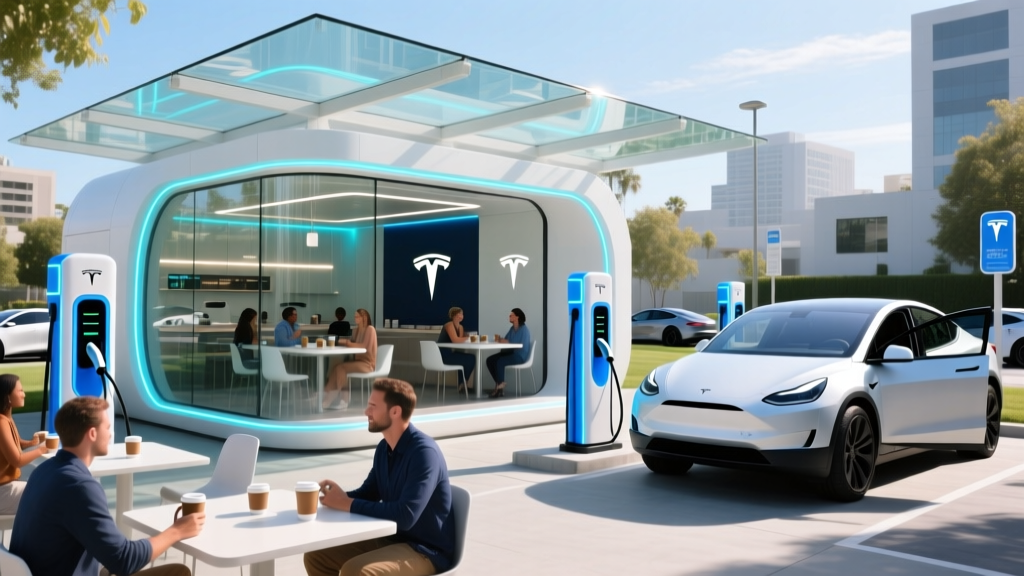
Tesla's Hollywood Supercharger Diner leans heavily into 1950s Americana aesthetics — chrome accents, neon signage, booth seating, and a jukebox-era atmosphere — but with a modern, tech-forward operational layer. The menu features classic American diner fare: burgers, shakes, fries, all-day breakfast, and coffee. Tesla has stated that the food concept is designed for the 20–30 minute window most EV owners spend charging.
Seating accommodates approximately 250 guests across indoor booths, a counter bar, and an outdoor patio area. The two large LED screens facing the parking lot play curated content — short films, Tesla-produced media, and classic movies — visible from both the diner interior and from your vehicle if you prefer to eat inside your car.
For EV owners accustomed to hovering near a charging kiosk in a strip-mall parking lot with nothing but a vending machine, this is a fundamentally different experience. It's also a direct answer to the "what do I do while I charge?" problem that remains a friction point for apartment dwellers and road-trippers without home charging.
Who Is the Tesla Diner For? Use-Case Breakdown
Best For
- LA-area Tesla owners without home Level 2 charging — a comfortable place to charge weekly
- Road-trippers passing through LA who want a real meal during a 20-minute charge stop
- Non-Tesla EV drivers (CCS1) seeking a reliable, well-lit, amenity-rich fast-charging hub
- Families — kids can watch the movie screen while parents charge and eat
- Rideshare drivers needing a predictable, high-speed charge with food access during shifts
Not Ideal For
- Quick top-ups — the diner experience adds time if you only need 5 minutes of charge
- Budget-focused chargers — expect premium Supercharger per-kWh pricing, plus food costs
- Non-LA residents — with only one location, this isn't a national network yet
- CHAdeMO vehicles (older Nissan Leaf, Mitsubishi) — no CHAdeMO connector available
How the Tesla Diner Compares to Typical Supercharger Stops
| Feature | Typical Supercharger | Tesla Supercharger Diner |
|---|---|---|
| Stall Count | 8–20 stalls | 80 stalls |
| Peak Charge Rate | 150–250 kW (V2/V3) | Up to 500 kW (V4) |
| Food Options | Nearby fast food (variable) | On-site full-service diner |
| Restrooms | Depends on host business | Dedicated, maintained |
| Entertainment | None | Dual LED movie screens |
| Wait at Peak Hours | Common at popular stops | Rare (80 stalls + buffer) |
| CCS1 Compatibility | Select stations (Magic Dock) | All stalls (native CCS1 + NACS) |
What This Means for Tesla's Broader Charging Network
The Hollywood Supercharger Diner is widely interpreted as a proof-of-concept. Tesla CEO Elon Musk first teased the concept in 2018, describing a "retro diner, drive-in movie, and Supercharger" destination. The seven-year gap between announcement and opening reflects the complexity of permitting, construction, and utility coordination in Los Angeles — not a lack of ambition.
Tesla has confirmed that at least one additional Diner location is in development in the Los Angeles metropolitan area. Industry analysts expect that if the Hollywood location demonstrates strong utilization rates and customer satisfaction, Tesla could expand the concept to other high-traffic corridors — potentially along I-5 in California, I-95 on the East Coast, or I-10 across the Sun Belt.
The strategic implication is significant. As Tesla opens its Supercharger network to non-Tesla EVs (a requirement under the NEVI federal charging program), high-amenity stations like the Diner make the Tesla network more attractive to Ford, GM, Rivian, and Hyundai owners who are transitioning to NACS connectors.
Practical Details: Cost, Access, and Tips for Visiting
Charging cost: Supercharger pricing at the Diner follows Tesla's standard per-kWh rate for the Los Angeles area, which as of early 2026 ranges from approximately $0.36–$0.48/kWh depending on time of day (off-peak vs. peak). A typical 10–80% charge on a Model 3 Long Range (~55 kWh added) costs roughly $20–$26. Non-Tesla EVs using the station may pay a slightly higher per-kWh rate unless they have an active Tesla charging membership.
Federal tax credit note: Charging at a Supercharger Diner does not qualify for the Alternative Fuel Vehicle Refueling Property Credit (IRS §30C), as that credit applies to home or business-installed charging equipment, not public charging sessions. However, if you're purchasing a Tesla or any qualifying EV, the §30D New Clean Vehicle Credit may apply — subject to MSRP caps ($55,000 for sedans, $80,000 for SUVs/trucks), buyer income limits ($150K single / $300K joint), and battery critical-mineral sourcing requirements. Always verify current-year eligibility on IRS.gov or with a tax professional.
Tips for visiting:
- Navigate to the station using your Tesla's built-in navigation — the car will automatically precondition the battery for optimal charge speed on arrival.
- If you drive a non-Tesla EV with NACS or CCS1, use the Tesla app to locate the station and initiate a charging session.
- Peak diner hours (6–9 PM on weekends) can mean a wait for a table, though charging stalls remain available.
- The solar canopy and Megapack system mean the station draws less grid power during peak hours — a genuine sustainability advantage over conventional gas stations.
Frequently Asked Questions
How many Tesla Diners are currently open?
As of early 2026, exactly one Tesla Supercharger Diner is open to the public: the Hollywood location at 7001 W. Santa Monica Blvd, Los Angeles, CA. A second LA-area location has been confirmed but has no announced opening date.
Can non-Tesla EVs charge at the Tesla Diner?
Yes. All 80 V4 Supercharger stalls at the Diner support both NACS (Tesla's connector, now the North American standard) and CCS1 via integrated adapters. Any EV with a CCS1 or NACS port can charge here. CHAdeMO-equipped vehicles (older Nissan Leaf, Mitsubishi Outlander PHEV) are not supported.
How fast can my EV charge at the Tesla Diner?
Charge speed depends on your vehicle. A 2026 Tesla Model 3 Long Range peaks at roughly 250–270 kW, completing a 10–80% charge in about 18 minutes. A Hyundai Ioniq 5 (with 800V architecture) can peak near 240 kW and achieve 10–80% in approximately 18 minutes. The Cybertruck can sustain higher rates, reaching 10–80% in roughly 18–22 minutes. Actual speeds depend on battery temperature, SoC, and the vehicle's maximum acceptance rate.
Is the Tesla Diner open 24 hours?
The Supercharger stalls operate 24/7. The diner restaurant has extended operating hours but is not 24 hours — check the Tesla app or on-site signage for current restaurant hours before planning a late-night meal.
Will Tesla open more Diner locations?
Tesla has confirmed at least one additional LA-area Diner is in development. Broader national expansion has not been officially announced, but the concept is widely expected to scale to other major metropolitan corridors if the Hollywood location proves commercially successful. Tesla's filings and Supercharger network updates are the best sources for confirmed new locations.
Does the Tesla Diner have Wi-Fi and work-friendly seating?
Yes. The diner offers complimentary Wi-Fi, and the indoor seating includes booth-style tables suitable for working on a laptop during a charging session. Power outlets are available at select seating areas.
Bottom Line
If you've been asking "how many Tesla Diners are there?" — the answer is one, and it's in Hollywood. But that single location represents a meaningful shift in what EV charging infrastructure can look like: 80 high-speed V4 stalls, a real restaurant, drive-in entertainment, and a solar-plus-storage system that reduces grid strain. For LA-area EV owners, it's a genuine upgrade over the typical parking-lot Supercharger experience. For the rest of the country, it's a signal of where destination charging may be headed — if Tesla decides to scale the concept.