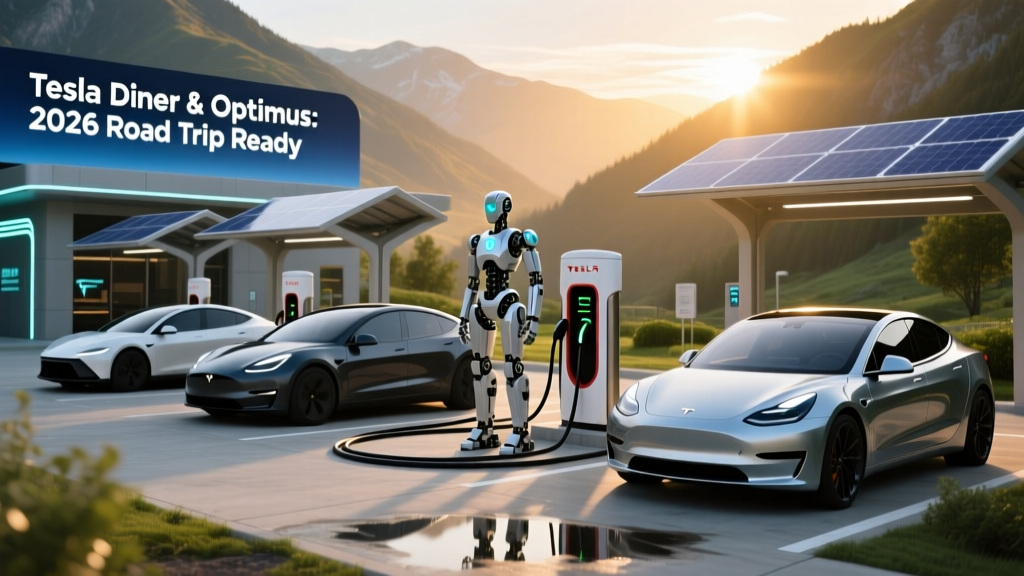
Tesla's first-of-its-kind Supercharger Diner in Hollywood, Los Angeles, represents a pivot in how the company thinks about the EV charging experience. Announced in 2024 and opened to the public in mid-2025, the retro-futuristic hub pairs a full-service diner with 32 V4 Supercharger stalls and two outdoor movie screens. But the feature generating the most discussion among EV owners is the deployment of Tesla Optimus humanoid robots handling select operational tasks on-site. This profile examines what the Tesla Diner and Optimus integration actually delivers for EV road-trippers, how V4 Supercharger specs translate to real-world charging times, and whether this model will reshape the public charging landscape by 2026.
Tesla Diner and Optimus: Concept Meets Reality
The Hollywood Supercharger Diner occupies a former car dealership lot on Santa Monica Boulevard. The facility includes a 5,000-square-foot diner with indoor seating for roughly 120 guests, a rooftop terrace, two 45-foot LED movie screens visible from charging stalls, and 32 V4 Supercharger posts. Tesla has deployed several Optimus Gen 2 humanoid robots to perform tasks including bussing trays, basic food prep assistance, and directional guidance for drivers navigating the charging lot.
This is not a vehicle review — the Tesla Diner is a charging and hospitality venue, and Optimus is a general-purpose humanoid robot. Neither is a car you can drive off a lot. But for EV owners planning road trips through Southern California (and potentially other markets as Tesla expands the concept), understanding the charging hardware, wait-time dynamics, and practical value of the Optimus deployment is essential.
Tesla Optimus is a general-purpose bipedal humanoid robot (height: 5'8", weight: ~125 lbs, payload: ~45 lbs). At the Diner, Optimus units perform logistics and customer-service tasks. They are not autonomous vehicles and do not hold an SAE automation level classification. Tesla's vehicles equipped with FSD (Supervised) remain SAE Level 2 driver-assist systems requiring continuous driver engagement.
V4 Supercharger Specs: Charging Speed and Real-World Performance
The Hollywood Diner is equipped exclusively with V4 Supercharger cabinets, which represent Tesla's latest public DC fast-charging architecture. Unlike the V3 cabinets (which peaked at 250 kW per stall), V4 cabinets support higher power delivery and feature a redesigned charge cable with a lighter, more ergonomic CCS/NACS connector.
| Spec | Value |
|---|---|
| Cabinet Max Output | ~500 kW per cabinet (shared across 4 stalls) |
| Per-Stall Peak (CCS/NACS) | Up to 325 kW (vehicles supporting ≥350V architecture) |
| Per-Stall Peak (Legacy Tesla 400V) | Up to 250 kW |
| Typical 10–80% (Model 3 LR / Model Y LR) | ~18–22 minutes |
| Typical 10–80% (Cybertruck, 800V-class) | ~15–18 minutes |
| Connector | NACS (native), CCS1 via adapter |
| Cable Length | ~11.5 ft (improved reach for non-Tesla EVs) |
| Idle Fees | $1.00/min (if station ≥50% occupied) |
Peak kW is not sustained kW. A Model 3 Long Range (75 kWh usable, LFP or NMC depending on build) may peak at ~250 kW between 10–30% State of Charge, then taper progressively. Expect an average of ~130–150 kW across the full 10–80% session. Cold batteries (below 50°F) without preconditioning can reduce peak rates by 30–50%. Always enable battery preconditioning via the Tesla nav routing to a Supercharger for optimal charge-curve performance.
Optimus at the Diner: What the Robot Actually Does
Tesla has positioned Optimus as a labor-augmentation tool rather than a full replacement for human staff. At the Hollywood Diner, Optimus Gen 2 units handle the following confirmed tasks:
- Tray bussing and table clearing: Optimus navigates the dining floor, collects used trays, and deposits them at the dishwashing station.
- Basic food-prep assistance: Portioning, plating simple items, and ferrying ingredients between prep stations under human kitchen supervision.
- Wayfinding and queue management: Directing arriving drivers to available V4 stalls and providing real-time wait estimates during peak hours.
- Light janitorial tasks: Sweeping outdoor walkways and collecting trash from charging-stall areas.
Optimus does not take orders, process payments, cook food, or interact with children unsupervised. Human staff remain the primary workforce at the Diner. The robot deployment is best understood as a live pilot program — Tesla is collecting operational data to refine Optimus for potential deployment at future Supercharger Diner locations and Tesla Gigafactories.
- Optimus cannot operate in heavy rain or extreme heat (>110°F) outdoors without performance degradation.
- Navigation is limited to pre-mapped environments; the robot cannot improvise routes around unexpected obstacles beyond basic path replanning.
- Payload is limited to ~45 lbs — Optimus cannot carry heavy supply crates or large catering orders.
- Optimus is not available for consumer purchase as of 2026. Tesla has indicated a potential external sale timeline of 2027–2028 at an estimated price of $20,000–$30,000, but this remains unconfirmed.
Charging Cost and Diner Pricing: What You Will Actually Spend
Public DC fast-charging costs vary by time of day, utility demand charges, and Tesla's dynamic pricing model. At the Hollywood Diner, rates reflect Los Angeles commercial electricity pricing and Tesla's premium-location surcharge.
| Time Window | Rate per kWh | Cost for 60 kWh Session (~200 mi) |
|---|---|---|
| Off-Peak (10 PM – 6 AM) | $0.33/kWh | ~$19.80 |
| Mid-Peak (6 AM – 4 PM) | $0.43/kWh | ~$25.80 |
| On-Peak (4 PM – 10 PM) | $0.56/kWh | ~$33.60 |
For comparison, a gasoline vehicle averaging 28 MPG at $4.40/gallon (California average, early 2026 per EIA) would spend ~$9.43 for the equivalent 200-mile trip. Public DC fast-charging remains more expensive than home Level 2 charging (typically $0.12–$0.18/kWh depending on utility), reinforcing the economic advantage of home charging for daily use.
The Diner itself offers a full menu with breakfast, lunch, and dinner service. Entrees range from $14–$24, with classic American diner fare (burgers, shakes, all-day breakfast). Pricing is at the premium end for casual dining, consistent with the Hollywood location.
Who Should Plan a Stop at the Tesla Diner?
The Hollywood Supercharger Diner is best suited for specific use cases rather than as a daily charging solution:
- You're on a Southern California road trip and need a 20–30 minute DC fast-charge stop with quality food and entertainment.
- You own a Tesla or NACS-equipped EV (Rivian, Ford F-150 Lightning, Cadillac Lyriq, etc.) and want a premium Supercharger experience.
- You're interested in seeing Optimus robots in a live commercial deployment.
- You value a safe, well-lit charging environment with amenities during evening or overnight travel.
Look Elsewhere If:
- You need a quick charge-and-go stop — the Diner's appeal is lingering, not speed alone.
- You drive a CHAdeMO-equipped vehicle (Nissan Leaf, older Mitsubishi) — no CHAdeMO connectors are available.
- You're budget-conscious and can charge at home or at lower-cost Electrify America or EVgo stations nearby.
How the Diner Fits Into Tesla's Broader Charging Strategy
Tesla opened the Supercharger network to non-Tesla EVs via the NACS standard (now adopted by Ford, GM, Rivian, Hyundai, and most major automakers as of 2025–2026). The Diner concept is Tesla's answer to a persistent complaint among EV road-trippers: public charging stations are often located in isolated parking lots with no amenities, poor lighting, or unreliable equipment.
By pairing V4 Superchargers with a full-service restaurant, outdoor cinema, and Optimus-powered operational efficiency, Tesla is testing a model that could expand to high-traffic corridors (I-5, I-10, I-80) if the Hollywood location proves economically viable. As of early 2026, Tesla has not announced additional Diner locations, but job postings and permitting records suggest scouting in Austin, TX, and Orlando, FL.
For context, the average Supercharger session at a standard Tesla station takes 20–35 minutes. The Diner transforms that idle time into a revenue-generating hospitality experience — a strategy that could improve per-stall economics and justify further network expansion.
Pros and Cons: Tesla Diner and Optimus Hub
Pros
- V4 Superchargers deliver up to 325 kW — among the fastest public DC chargers in the US
- Full-service diner eliminates the "charging desert" amenity problem
- Optimus deployment offers a live demonstration of humanoid robot utility
- Outdoor movie screens provide entertainment during 20–30 min charge sessions
- Well-lit, staffed location improves safety for evening/overnight charging
- NACS-native with CCS adapter support — compatible with most 2025+ EVs
Cons
- On-peak charging rates ($0.56/kWh) are expensive vs. home Level 2
- Hollywood location only — limited utility unless you're in the LA area
- Optimus robots are a pilot, not a fully autonomous service — human staff still essential
- No CHAdeMO support for legacy Nissan/Mitsubishi EVs
- Diner food pricing is premium ($14–$24 entrees)
- 32 stalls can still fill during holiday travel peaks — wait times possible
Frequently Asked Questions
Is the Tesla Diner open to non-Tesla EVs?
Yes. The V4 Superchargers at the Hollywood Diner support NACS-native vehicles and CCS1-equipped EVs using Tesla's Magic Dock adapter or the vehicle's built-in NACS port (Ford, GM, Rivian, Hyundai, and others as of 2025–2026). Non-Tesla drivers access charging via the Tesla app or Plug&Charge if their vehicle supports it.
Can I buy a Tesla Optimus robot for my home?
No. As of 2026, Optimus is deployed only in Tesla-controlled environments (Gigafactories, the Hollywood Diner). Tesla CEO Elon Musk has projected a potential consumer sale price of $20,000–$30,000 with availability in 2027–2028, but this timeline has shifted multiple times and remains unconfirmed.
How does the V4 Supercharger compare to Electrify America or EVgo?
V4 stalls peak at ~325 kW for compatible vehicles, which is competitive with Electrify America's 350 kW CCS stalls and EVgo's 350 kW chargers. However, Tesla's reliability and uptime rates consistently rank higher in owner surveys (per PlugShare data), and the NACS connector is lighter and more ergonomic than CCS1.
Does the Tesla Diner offer free charging?
No. All charging sessions are paid at standard Tesla Supercharger rates (dynamic pricing by time of day). There are no complimentary charging programs tied to diner purchases as of 2026.
Will Tesla build more Supercharger Diners?
Tesla has not officially announced additional Diner locations beyond Hollywood. However, the company's 2025 Q4 earnings call referenced "hospitality-integrated charging hubs" as a growth vector, and permitting activity suggests future sites in Texas and Florida. We will update this profile if and when new locations are confirmed.
What is the real-world range impact of charging at V4 vs. V3 Superchargers?
Range is a function of your vehicle's battery, not the charger — but charging speed is not. A V4 stall can deliver ~200 miles of range in ~15 minutes to a compatible vehicle (e.g., Cybertruck, Model 3 Highland with NMC pack), while a V3 stall (250 kW peak) would deliver the same in ~22–25 minutes. For vehicles limited to 250 kW acceptance (older Model S/X, Model 3 RWD), the V4 advantage is minimal.