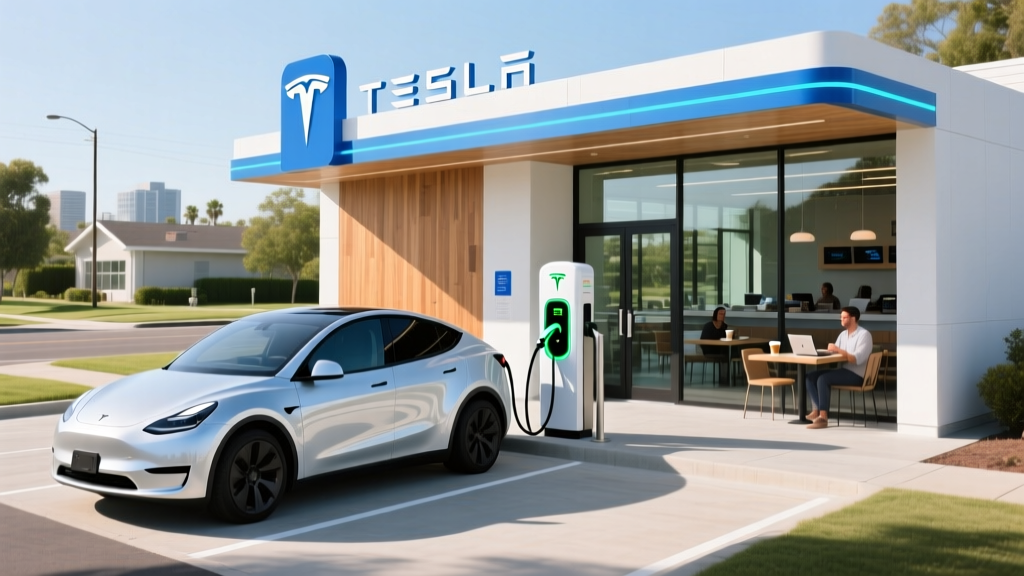
The Tesla Diner — a retro-futuristic eatery attached to a Los Angeles Supercharger station — has been one of the most talked-about EV lifestyle projects since Elon Musk first announced it in 2021. After years of permitting delays, redesigns, and construction, the project at 7001 Sunset Boulevard in Hollywood has moved into its final build-out phase. For EV owners planning a pilgrimage (or just curious whether Tesla can actually execute a hospitality concept), here is everything we know about the Tesla diner opening date and what the facility will deliver.
Why the Tesla Diner Opening Date Has Shifted Repeatedly
Understanding the timeline context matters before we discuss what the facility offers. The project was first announced in July 2021, with Musk tweeting that Tesla would build a "classic drive-in diner, roller-skate & rock-n-roll" at a Hollywood Supercharger site. What followed was a multi-year saga of:
- Permitting and zoning challenges — The Sunset Boulevard location required extensive negotiations with the City of Los Angeles regarding traffic flow, alcohol licensing (for the rooftop bar), and historic-district considerations.
- Design revisions — Original plans called for a two-story structure; later revisions added the rooftop element and expanded the charger count from an initial 29 stalls to approximately 80.
- Construction phasing — Site preparation, utility upgrades (critical for a station pulling this much power), and the building shell have proceeded in stages through 2024 and 2025.
As of early 2026, construction is substantially complete on the charging infrastructure, with the restaurant build-out in its final phase. Tesla has not announced an official opening day, but industry sources and local reporting point to a summer 2026 launch window, likely between June and August. Tesla tends to avoid pre-announcing exact dates for non-vehicle projects, so expect a relatively short runway between the formal announcement and doors opening.
Charging Infrastructure: V4 Supercharger Stalls and What They Deliver
The headline feature for EV owners isn't the milkshakes — it's the charging hardware. The Tesla Diner location will be one of the largest urban Supercharger installations in the United States, and it will serve as a showcase for Tesla's latest V4 charging architecture.
| Specification | Details |
|---|---|
| Total Stalls | ~80 (V4 architecture) |
| Max Charge Rate | Up to 250 kW per stall (V4 cabinet dependent) |
| Connector | NACS (native Tesla); CCS adapter-compatible vehicles supported |
| Cable Length | Extended (~9.8 ft) for non-Tesla EVs with varying port locations |
| Payment | Tesla app, plug-and-charge for Teslas; RFID/app for non-Tesla EVs |
| On-site Amenities | Full-service restaurant, rooftop bar, restrooms, Wi-Fi, movie screens |
The V4 Supercharger represents a meaningful upgrade over earlier V3 stalls. Key improvements include a redesigned cabinet that separates the power electronics from the charging post (allowing easier maintenance and future power upgrades), longer cables to accommodate non-Tesla EVs with charge ports in various locations, and credit-card readers built into the post for non-Tesla users who don't want to download the Tesla app.
For context on what 250 kW means in practice: a Tesla Model Y Long Range (with a ~75 kWh usable battery) charging from 10% to 80% at a sustained V3/V4 rate will add roughly 200+ miles of range in about 20–25 minutes, depending on battery temperature and preconditioning. The charge curve tapers significantly above 80% — expect the final 20% to take nearly as long as the first 70%. Always plan your stops around the 10–80% window for maximum efficiency.
The Dining Experience: What's on the Menu and at What Price
Tesla has kept specific menu details under wraps, but the concept borrows heavily from 1950s American drive-in culture — think classic burgers, shakes, and fries, elevated to a premium fast-casual tier. Key details from filings and reporting:
- Drive-in service: Patrons can order from their parked EV (while charging) via the Tesla app or walk in for traditional counter service.
- Rooftop bar: A full-service bar with alcohol licensing, offering cocktails and craft beverages with views of the Hollywood Hills.
- Outdoor movie screens: Two large-format screens visible from the charging stalls — designed so you can watch a film while your car charges. Audio will likely be piped through your car's speakers via the Tesla app or a dedicated frequency.
- Roller-skate service: In keeping with the retro theme, carhop-style service on roller skates is planned for drive-in patrons.
Pricing is expected to land in the premium fast-casual range — think Shake Shack or In-N-Out pricing rather than fine dining. The rooftop bar will command higher prices consistent with Los Angeles cocktail bars. For a typical 25-minute charging session, budget roughly $15–$25 per person for food, plus $10–$18 per cocktail at the bar.
What This Means for Tesla Vehicle Owners: A Practical Charging Stop
The Tesla Diner isn't a vehicle, but it directly impacts the ownership experience for Tesla drivers in the Los Angeles area and visitors. Here's how it fits into real-world EV ownership:
For Tesla Model 3 and Model Y Owners
If you own a current-generation Tesla Model Y Long Range (EPA range 320 miles, 75 kWh usable battery, NMC chemistry) or a Model 3 Long Range (EPA range 341 miles), the Diner's V4 stalls will deliver peak charging performance. Tesla vehicles automatically precondition their batteries when you navigate to a Supercharger, so you'll hit peak charge rates (up to 250 kW) within minutes of plugging in.
For Tesla Model S and Model X Owners
The Model S Long Range (EPA 402 miles, ~95 kWh usable battery) and Model X (EPA 348 miles) will also benefit from V4 stalls, though their larger batteries mean longer absolute charge times. Expect a 10–80% session in roughly 30–35 minutes at peak rates — enough time for a full meal and an episode on the movie screen.
For Cybertruck Owners
The Cybertruck (EPA range 340 miles for the AWD tri-motor variant, ~123 kWh usable battery, NMC chemistry) has the largest battery in Tesla's lineup. At 250 kW, a 10–80% charge will take approximately 35–40 minutes. The Diner's amenities make this a far more pleasant wait than sitting in a strip-mall parking lot.
Tesla Supercharger Network in 2026: Broader Context
The Diner arrives at a pivotal moment for the Supercharger network. As of early 2026, Tesla operates over 7,500 Supercharger stalls in North America and more than 65,000 globally, according to Tesla's Supercharger page. The network is now the de facto standard for DC fast charging in the U.S., with virtually every major automaker having adopted the NACS connector or committed to providing adapters.
Reliability remains the Supercharger network's strongest advantage. Independent testing by J.D. Power and user surveys consistently rank Tesla Superchargers significantly above Electrify America, EVgo, and other networks in uptime and successful charge initiation. The Diner location, with its high stall count and on-site staff (a rarity for Supercharger stations), should push reliability even higher.
| Feature | Tesla Diner (Hollywood) | Typical Urban Supercharger |
|---|---|---|
| Stall Count | ~80 | 8–20 |
| Max Charge Rate | 250 kW (V4) | 150–250 kW (V3/V4) |
| On-site Staff | Yes (restaurant employees) | No |
| Restrooms | Yes (full restaurant) | Rarely (dependent on host business) |
| Food/Beverage | Full-service restaurant + bar | Nearby businesses (varies) |
| Wait Time at Peak | Low (high stall count) | Moderate to high in urban areas |
Charging Costs at the Diner: What to Budget
Tesla Supercharger pricing varies by location, time of day, and whether you're a Tesla owner or using the Non-Tesla Supercharger program. For the Hollywood area in 2026, expect the following approximate rates:
- Tesla vehicles (on-peak): $0.48–$0.58 per kWh
- Tesla vehicles (off-peak): $0.33–$0.42 per kWh
- Non-Tesla EVs: $0.54–$0.68 per kWh (higher tier unless subscribed to Tesla's charging membership)
For a typical session adding 45 kWh (roughly 10–80% on a Model Y), expect to pay $22–$26 on-peak or $15–$19 off-peak. Non-Tesla EV owners should budget $25–$31 for the same session. The Tesla membership program ($4.99/month) reduces non-Tesla rates closer to Tesla-owner pricing and pays for itself after roughly two sessions per month.
Compare this to home Level 2 charging at the Los Angeles average residential rate of ~$0.28/kWh: the same 45 kWh session at home costs about $12.60. Supercharging remains more expensive than home charging — the Diner is best viewed as a convenient destination stop, not a replacement for your overnight Level 2 routine.
How to Plan Your Visit: Access, Parking, and Practical Tips
The Tesla Diner is located at 7001 Sunset Boulevard, Hollywood, CA 90028. Key logistics to plan around:
- Access: The charging stalls will be accessible 24/7 (standard Supercharger access). The restaurant and bar will have posted operating hours — expect roughly 7 AM to midnight for the restaurant and later for the bar.
- Parking: Charging stalls double as parking while you eat. Expect time limits or idle fees if you remain plugged in well past a full charge.
- Peak times: Weekend evenings will be the busiest — both for the restaurant and the chargers. Weekday midday visits will offer the shortest waits.
- Navigation: Tesla vehicles will list the Diner as a Supercharger destination in the nav system, with real-time stall availability shown before you arrive.
Is the Tesla Diner Worth the Visit for EV Owners?
Pros
- 80 V4 Supercharger stalls — one of the largest urban installations in the U.S.
- Full restaurant and bar eliminates the "parking lot boredom" problem of typical charging stops
- On-site staff means someone can help if a stall malfunctions
- Outdoor movie screens add genuine entertainment value during 25–35 minute charge sessions
- High stall count reduces wait times even at peak hours
- Drive-in ordering from your car is a clever integration of EV + dining
Cons
- Hollywood location means heavy traffic and premium-area pricing
- Alcohol service raises questions about responsible use adjacent to a charging station
- Destination draw may attract non-charging visitors who occupy stall parking
- Premium food pricing adds cost on top of already-higher Supercharger rates vs. home charging
- Only one location — not a replicable model for most EV owners' daily routines
- Opening date has slipped multiple times; delays remain possible
Frequently Asked Questions
What is the confirmed Tesla diner opening date?
Tesla has not announced an official opening date. Based on construction progress and local reporting, the most likely window is summer 2026 (June–August). Tesla typically announces openings with a short lead time, so monitor Tesla's official channels and local Los Angeles news for the formal date.
Can non-Tesla EVs charge at the Tesla Diner Supercharger?
Yes. The V4 stalls support NACS natively, and any EV with a NACS charge port or a CCS-to-NACS adapter (approved by Tesla) can use the station through the Non-Tesla Supercharger program. Payment is handled via the Tesla app or the built-in credit-card reader on V4 posts.
How fast will my EV charge at the Tesla Diner?
V4 stalls deliver up to 250 kW DC fast charging. Real-world charge speed depends on your vehicle's battery architecture, state of charge, and temperature. A Tesla Model Y (NMC battery, preconditioned) will charge from 10–80% in approximately 22–25 minutes. Vehicles with lower max charge rates (e.g., some LFP-equipped models capped at ~170 kW) will take longer.
Will the Tesla Diner have Wi-Fi and work-friendly spaces?
Yes, Wi-Fi is planned for the facility. The restaurant interior and rooftop area will provide seating suitable for working during a charge session, though it is primarily designed as a casual dining and entertainment venue rather than a co-working space.
How much will a meal at the Tesla Diner cost?
Expect premium fast-casual pricing: approximately $12–$18 for a burger-and-fries combo, $8–$12 for shakes, and $12–$18 for cocktails at the rooftop bar. A typical meal during a 25-minute charge session will run $15–$30 per person.
Is the Tesla Diner a sign of Tesla expanding beyond vehicles?
The Diner is currently a single-location concept, not an announced chain. It serves as a brand-experience showcase and a proof-of-concept for integrating destination amenities with high-volume charging infrastructure. Whether Tesla replicates the model at other high-traffic Supercharger locations will depend on the Hollywood location's operational success and financial performance.
Editor's note: This article reflects information available as of early 2026. The Tesla Diner has not yet opened, and specific details (menu, pricing, hours, exact stall count) are subject to change. Tesla's official announcements will supersede any projected figures cited here. For the latest Supercharger network information, visit tesla.com/supercharger.