The phrase Tesla diner interior has dominated EV enthusiast searches ever since the company opened its first retro-futuristic Supercharger station with a full-service diner and movie screens in Hollywood, California. But for buyers researching Tesla ownership in 2026, the real question isn't just what you'll experience while waiting for a charge — it's whether the vehicles pulling into those stalls still deliver the range, charging speed, and value to justify the investment. This guide covers the Tesla diner concept in detail, then pairs it with a comprehensive review of the 2026 Tesla Model Y Long Range AWD — the vehicle most likely parked in those charging bays.
What Is the Tesla Diner Interior Actually Like?
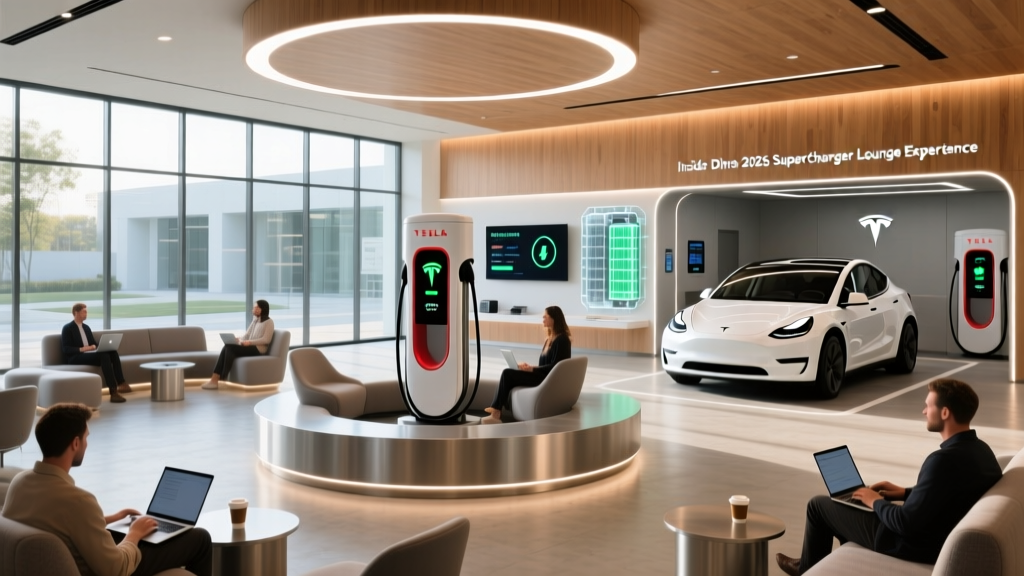
The Tesla Supercharger diner, located at 7001 W. Santa Monica Blvd in Hollywood, represents Tesla's vision for destination charging. The interior blends 1950s Americana aesthetics with Tesla's signature minimalist design language: curved booths upholstered in vegan leather, a chrome-accented soda fountain counter, ambient LED lighting synced to the station's energy flow, and overhead screens streaming short films and Tesla product content. Menu items are ordered via touchscreen kiosks or the Tesla app, and the space seats approximately 250 guests across two stories and an outdoor patio.
For EV owners, the practical value is clear: instead of sitting in a car for 20–30 minutes during a DC fast-charge session, you can grab a meal in a climate-controlled, well-designed space while your vehicle adds up to 180 miles of range. The Hollywood station features 80 V4 Supercharger stalls capable of delivering up to 250 kW to compatible Tesla vehicles (and, via the NACS open network, compatible non-Tesla EVs with adapters).
2026 Tesla Model Y Long Range AWD: Quick Verdict
The 2026 Model Y Long Range AWD remains Tesla's highest-volume seller for good reason. With an EPA-estimated 320 miles of range, peak 250 kW DC fast-charging, and a starting MSRP around $44,990 (before incentives), it occupies the sweet spot for family EV buyers. The refreshed "Juniper" update brought a quieter cabin, ventilated front seats, ambient lighting, and a rear-seat touchscreen — addressing the most common complaints from the previous generation.
EPA estimate: 320 miles. In real-world mixed driving (65–75 mph highway, moderate climate), expect approximately 270–290 miles. In cold weather (below 32°F), range can drop to 230–260 miles due to battery heating demands and cabin HVAC load. City/regenerative driving can push closer to or slightly above the EPA figure.
Range, Battery, and Efficiency Specs
The 2026 Model Y Long Range AWD uses a ~78 kWh usable lithium-ion battery pack with NMC (nickel manganese cobalt) chemistry, chosen for its higher energy density compared to LFP — critical for maximizing range in a mid-size crossover. Tesla's thermal management system, including a heat pump standard across all trims, helps mitigate cold-weather losses.
| Spec | Value |
|---|---|
| EPA Range | 320 miles |
| Battery (usable) | ~78 kWh, NMC chemistry |
| Efficiency | 122 MPGe combined / 28 kWh/100 mi |
| Drivetrain | Dual-Motor AWD |
| Horsepower | 384 hp (combined) |
| 0–60 mph | 4.8 seconds |
| DC Fast Charge (peak) | 250 kW |
| 10–80% DC Charge Time | ~27 minutes |
| Level 2 Home Charge Rate | 11.5 kW (~44 mi/hr) |
| Cargo Volume (rear seats up) | 30.2 cu ft |
| Cargo Volume (rear seats folded) | 72.0 cu ft |
| Rear Legroom | 41.6 inches |
| Battery Warranty | 8 years / 120,000 miles |
| Base MSRP | $44,990 |
Efficiency at 28 kWh per 100 miles puts the Model Y among the most efficient AWD electric crossovers in its class, translating to low per-mile charging costs whether you're at home or at a Supercharger.
Charging Speed: DC Fast and Home Level 2
The Model Y Long Range supports a peak DC fast-charge rate of 250 kW on V3 and V4 Superchargers. However, as with all EVs, that peak is not sustained across the entire session. The charge curve tapers significantly above 80% State of Charge (SoC). Here's what a typical session looks like:
| Charge Level | Power | Miles Added per Hour | Notes |
|---|---|---|---|
| Level 1 (120V) | ~1.4 kW | ~3–4 mi/hr | Emergency/trickle only |
| Level 2 (240V, 48A) | 11.5 kW | ~44 mi/hr | Full overnight charge in ~7 hr |
| DC Fast (V3/V4 Supercharger) | Peak 250 kW | ~162 mi in 15 min | 10–80% in ~27 min; tapers above 80% |
For home charging, a 48-amp Level 2 wall connector on a 60-amp circuit delivers the full 11.5 kW, adding roughly 44 miles per hour. Most owners charging overnight from 20% to 80% will wake up with ample range for daily driving. Installation costs for a Level 2 home setup typically range from $500 to $2,000 depending on panel proximity and whether a 200-amp service upgrade is needed — defer to a licensed electrician for your specific situation.
At a Tesla Supercharger (or any NACS-compatible DC fast charger), preconditioning is key. When you navigate to a Supercharger via the car's built-in navigation, the battery thermal system begins warming automatically, enabling faster charge acceptance upon arrival. Skipping preconditioning can add 5–10 minutes to your session, especially in cold weather.
Pricing, Trims, and Federal Tax Credit Eligibility
The 2026 Model Y is offered in three primary trims. Pricing below reflects MSRP before any incentives or destination fees:
| Trim | MSRP | EPA Range | §30D Credit Eligible? |
|---|---|---|---|
| Long Range RWD | $42,990 | 320 mi | Check current IRS sourcing rules |
| Long Range AWD | $44,990 | 320 mi | Check current IRS sourcing rules |
| Performance | $48,990 | 298 mi | Check current IRS sourcing rules |
The IRS §30D federal tax credit offers up to $7,500 for qualifying new EVs, but eligibility is governed by three constraints that change frequently:
- MSRP cap: SUVs must be priced at or below $80,000. All Model Y trims qualify.
- Buyer income cap: Modified AGI must not exceed $150,000 (single), $225,000 (head of household), or $300,000 (joint).
- Battery sourcing: A percentage of critical minerals and battery components must be sourced from the U.S. or free-trade-agreement countries. Tesla has been progressively shifting supply chains, but exact eligibility varies by production batch and model year.
As of early 2026, the point-of-sale transfer option allows qualified buyers to apply the credit as an immediate discount at purchase rather than waiting for tax filing. Always verify current eligibility on the IRS website or with a tax professional before relying on the credit in your budget.
Tech, Driver Assistance, and Interior Features
The Model Y's interior follows Tesla's ultra-minimalist philosophy: a single 15.4-inch center touchscreen controls virtually all vehicle functions, with no physical instrument cluster or traditional buttons. The Juniper refresh added ambient lighting strips, ventilated front seats, acoustic glass for reduced cabin noise, and an 8-inch rear touchscreen for passengers.
Autopilot and FSD (Supervised): Every Model Y includes basic Autopilot (traffic-aware cruise control and lane centering). Full Self-Driving (Supervised) is available as an $8,000 option or $99/month subscription. It adds automatic lane changes, traffic light/stop sign recognition, and Navigate on Autopilot.
Both Autopilot and FSD (Supervised) are SAE Level 2 driver-assistance systems. The driver must remain fully engaged, hands on or near the wheel, and eyes on the road at all times. These are not self-driving systems. Only Level 4 services like Waymo operate without a human driver in defined areas.
The infotainment system supports streaming (Netflix, YouTube, Spotify), gaming, and a built-in web browser — all usable while parked or charging. This is where the Tesla diner concept complements the ownership experience: streaming a show on the car's screen while eating at the diner during a 25-minute charge session is a genuinely pleasant road-trip workflow.
Pros, Cons, and Who Should Buy
- Class-leading efficiency at 28 kWh/100 mi
- Access to Tesla Supercharger network (17,000+ stalls in North America)
- Spacious cargo area (72 cu ft with seats folded)
- Over-the-air updates continuously add features
- Heat pump standard for better cold-weather range retention
- Strong resale value relative to EV segment average
- Minimalist interior polarizes — no physical buttons or gauges
- FSD (Supervised) costs extra and remains Level 2
- Ride quality firm on rough pavement vs. some competitors
- No Apple CarPlay or Android Auto
- Rear visibility limited; relies heavily on cameras
- Insurance premiums above segment average
Who it suits best: The Model Y Long Range AWD is ideal for families and commuters who need 300+ miles of real-world range, fast charging for road trips, and practical cargo space. If you frequently drive in cold climates or take highway-heavy road trips, the NMC battery and heat pump combination provides better range confidence than LFP-equipped alternatives. It's less suited for buyers who prioritize plush ride quality, traditional interiors, or Apple CarPlay integration.
How Does It Compare to Key Competitors?
The Model Y's most direct rivals in 2026 include the Hyundai Ioniq 5 (310 mi, 350 kW peak charging), Ford Mustang Mach-E Extended Range AWD (312 mi), and the Kia EV6 (310 mi, 800V architecture). The Model Y wins on Supercharger network access and cargo volume, while the Ioniq 5 and EV6 charge faster on compatible 350 kW chargers. The Mach-E offers a more traditional interior layout that some buyers prefer.
Choose the Hyundai Ioniq 5 or Kia EV6 if: You prioritize faster peak charging (on 350 kW chargers), a more conventional interior, or Apple CarPlay/Android Auto support.
Choose the Ford Mach-E if: You prefer a more car-like interior with physical controls and don't mind a slightly smaller charging network.
Frequently Asked Questions
What is the real-world range of the 2026 Tesla Model Y?
The EPA rates the Long Range AWD at 320 miles. Real-world highway driving at 70+ mph typically yields 270–290 miles. Cold weather (below freezing) can reduce range to 230–260 miles. City driving with regenerative braking often matches or slightly exceeds the EPA estimate.
How fast does the Model Y charge at home and on the road?
At home on a 48-amp Level 2 charger (11.5 kW), you'll add about 44 miles per hour, fully charging overnight. On a V3/V4 Supercharger at peak 250 kW, you'll go from 10–80% in roughly 27 minutes, adding about 162 miles in 15 minutes. Charging slows significantly above 80% SoC.
Does the 2026 Model Y qualify for the $7,500 federal EV tax credit?
It may, depending on your income, the vehicle's battery sourcing compliance, and current IRS rules. All trims fall under the $80,000 SUV MSRP cap. Buyer income must not exceed IRS thresholds ($150K single / $300K joint). Battery critical-mineral and component sourcing requirements apply and can change. Verify at IRS.gov or with a tax professional.
Is the Tesla diner open to non-Tesla owners?
Yes. The Hollywood Supercharger diner is open to the public regardless of what vehicle you drive. However, the 80 V4 Supercharger stalls at the location serve NACS-compatible vehicles (Teslas and, increasingly, other brands via adapter or native NACS ports).
What is the battery warranty on the Model Y?
Tesla covers the Model Y Long Range battery and drive unit for 8 years or 120,000 miles, whichever comes first, with a minimum 70% capacity retention guarantee during that period.
Can I charge a non-Tesla EV at the Tesla diner Supercharger station?
Yes, if your vehicle has a native NACS charge port (increasingly common for 2025–2026 models from Ford, GM, Rivian, and others) or if you use a CCS-to-NACS adapter approved by Tesla via their Magic Dock system at select stalls.