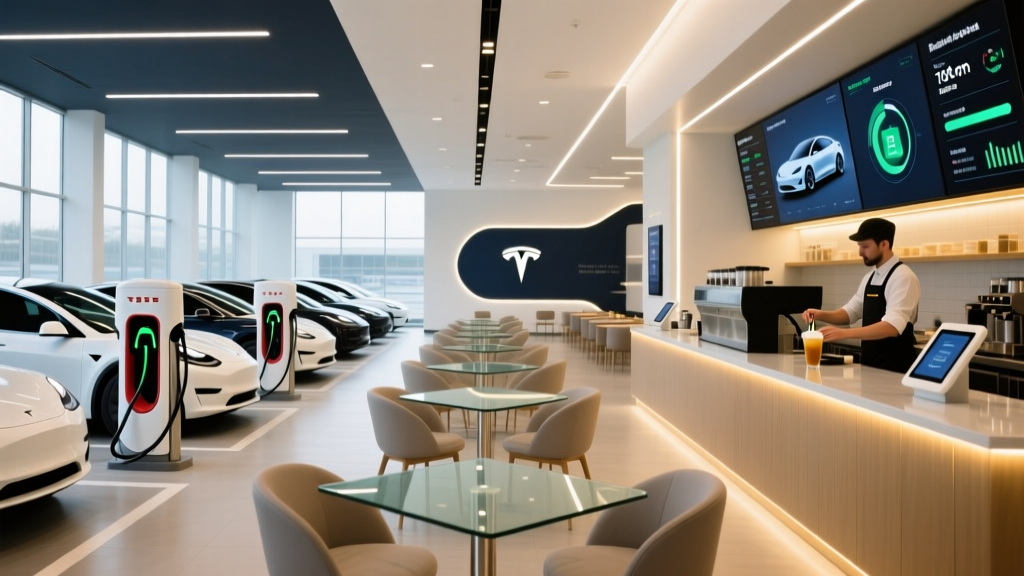
The Tesla Diner in Hollywood, California isn't just a restaurant—it's a statement about what EV charging infrastructure could become. Opened in mid-2025 at the corner of Santa Monica Boulevard and North Orange Drive, the facility pairs a full-service, retro-futuristic diner with V4 Supercharger stalls and a rooftop deck. For EV owners and prospective Tesla buyers, the real question isn't whether the burgers are good—it's whether this model changes the charging-desert equation for road trippers and urban apartment dwellers alike.
This review breaks down what the Tesla Diner app offers, the charging hardware on-site, and how the Tesla vehicles you'd drive there stack up on range, efficiency, and ownership cost in 2026.
What the Tesla Diner App Actually Does
The Tesla Diner app—accessible through the main Tesla mobile app under a dedicated "Diner" tab—serves as a reservation, ordering, and charging-status platform rolled into one. Here's what it handles:
- Table reservations: Book a booth or counter seat up to 7 days in advance. Walk-ins are accepted but subject to availability.
- Pre-ordering: Order from the menu before you arrive so food hits the table as you plug in.
- Charging stall status: Real-time availability of V4 Supercharger stalls, including current occupancy and estimated wait times.
- Session tracking: Monitor your vehicle's state of charge (SoC), charging speed in kW, and estimated time-to-full from your table.
- Payment integration: Charging session and food bill consolidate into one Tesla account charge—no separate payment terminals.
The app does not currently allow you to reserve a specific charging stall, and peak-hour wait times for both tables and chargers have been reported at 15–30 minutes on weekends. Tesla has indicated a waitlist feature is in development.
Charging Hardware: V4 Supercharger Specs On-Site
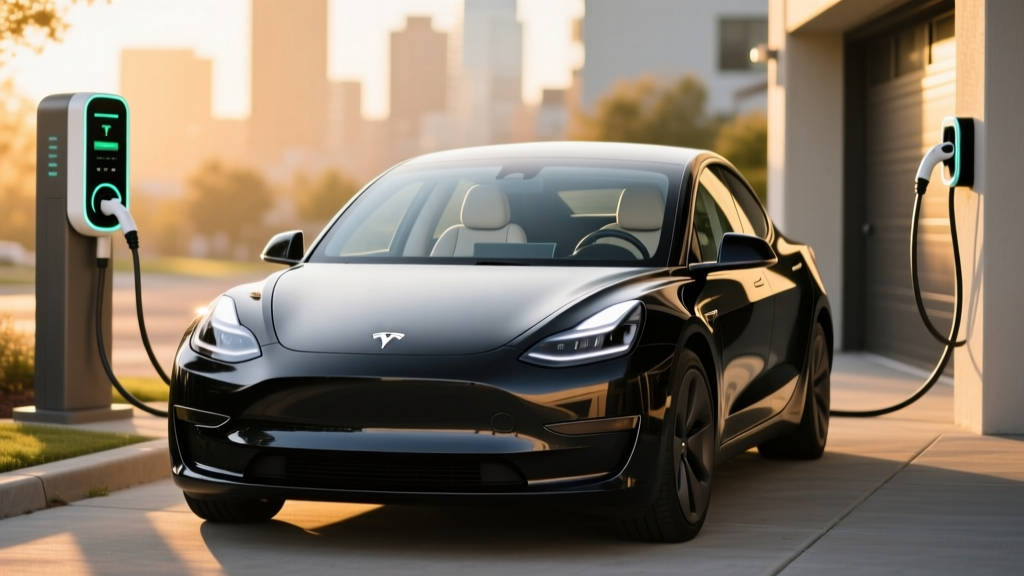
The Hollywood location is equipped with V4 Supercharger cabinets capable of delivering up to 350 kW to compatible vehicles. However, sustained charge rates depend heavily on your vehicle's battery chemistry, thermal preconditioning, and current SoC.
| Vehicle | Battery Chemistry | Peak DC Charge Rate | 10–80% Time (est.) | Level 2 (Destination) |
|---|---|---|---|---|
| Model 3 Long Range AWD | NMC | 250 kW | ~25 min | 11.5 kW (44 mi/hr) |
| Model 3 RWD | LFP | 170 kW | ~30 min | 11.5 kW (44 mi/hr) |
| Model Y Long Range AWD | NMC | 250 kW | ~27 min | 11.5 kW (37 mi/hr) |
| Cybertruck AWD | NMC | 250 kW (800V arch) | ~22 min | 11.5 kW (30 mi/hr) |
| Non-Tesla (NACS adapter) | Varies | Up to 350 kW* | Varies | 11.5 kW (varies) |
*V4 cabinet maximum. Vehicle-side acceptance rate varies. Most current non-Tesla EVs with NACS adapters peak between 150–270 kW.
The charge curve on Tesla's NMC packs typically peaks near 250 kW between 10–30% SoC, then tapers progressively—dropping to roughly 100 kW by 60% and under 50 kW above 80%. LFP packs in the base Model 3 charge more linearly but at a lower peak, making them better suited to routine 100% charges but slower on DC fast-charging road trips.
The Tesla Fleet You'll Drive to the Diner: 2026 Specs
The Tesla Diner is a destination, but the vehicles that visit it need to stand on their own merits. Here's how the core 2026 Tesla lineup shapes up for the drivers most likely to use this station.
| Spec | Model 3 LR AWD | Model 3 RWD | Model Y LR AWD | Cybertruck AWD |
|---|---|---|---|---|
| EPA Range | 363 mi | 272 mi | 320 mi | 340 mi |
| Battery (usable) | ~79 kWh (NMC) | ~60 kWh (LFP) | ~78 kWh (NMC) | ~123 kWh (NMC) |
| Efficiency | 25 kWh/100mi (132 MPGe) | 25 kWh/100mi (134 MPGe) | 28 kWh/100mi (120 MPGe) | 47 kWh/100mi (72 MPGe) |
| 0–60 mph | 4.2 sec | 5.8 sec | 4.8 sec | 3.9 sec |
| Horsepower | 384 hp | 271 hp | 384 hp | 600 hp |
| Drivetrain | Dual-Motor AWD | RWD | Dual-Motor AWD | Tri-Motor AWD |
| Cargo Volume | 23 cu ft (rear) + 3.1 cu ft (frunk) | 23 cu ft + 3.1 cu ft | 76 cu ft (rear folded) + 4.1 cu ft (frunk) | 67 cu ft (bed + vault) |
| Base MSRP | $47,740 | $38,990 | $49,630 | $79,990 |
Sources: EPA fueleconomy.gov, Tesla.com official specs.
Pricing, Tax Credits, and Total Cost to Own
Under current IRS §30D rules for 2026, the federal EV tax credit remains at up to $7,500 for qualifying new EVs—but eligibility depends on a matrix of requirements that trip up many buyers.
| Model / Trim | Base MSRP | Federal Credit | Effective Price | Credit Eligible? |
|---|---|---|---|---|
| Model 3 RWD | $38,990 | $7,500 (point-of-sale) | ~$31,490 | Yes — meets MSRP cap, sourcing rules |
| Model 3 Long Range AWD | $47,740 | $7,500 | ~$40,240 | Yes — under $55,000 sedan cap |
| Model Y Long Range AWD | $49,630 | $7,500 | ~$42,130 | Yes — under $80,000 SUV cap |
| Cybertruck AWD | $79,990 | $7,500 | ~$72,490 | Yes — classified as light truck, $80K cap |
Key §30D caveats for 2026:
- Income caps: Modified AGI must not exceed $150,000 (single), $225,000 (head of household), or $300,000 (joint). Source: IRS.gov
- MSRP caps: $55,000 for sedans; $80,000 for SUVs, vans, and trucks.
- Battery sourcing: Increasing percentages of critical minerals and battery components must be sourced from the U.S. or free-trade-agreement countries. Tesla has largely met these thresholds for Model 3 and Model Y built at Fremont and Giga Texas, but rules tighten annually.
- Point-of-sale transfer: Buyers can transfer the credit to the dealer at purchase, reducing the out-of-pocket price immediately rather than waiting for a tax refund.
Tesla's warranty coverage across the lineup includes a 4-year/50,000-mile basic vehicle warranty and an 8-year/100,000-mile (Model 3 RWD) or 8-year/120,000-mile (Long Range / Model Y / Cybertruck) battery and drive unit warranty, guaranteeing at least 70% capacity retention over the warranty period.
Tech, Driver Assistance, and the Diner Experience
The Tesla Diner itself leans heavily into the brand's tech-forward identity. Two 40-foot LED screens anchor the exterior, displaying a rotating reel of classic car-culture films and ambient visuals visible from the charging stalls. Inside, the aesthetic blends 1950s diner chrome with Tesla's minimalist design language.
On the vehicle side, every 2026 Tesla ships with:
- 15.4-inch center touchscreen (Model 3/Y) or 18.5-inch (Cybertruck) with Tesla's latest infotainment build
- Autopilot (SAE Level 2) standard—adaptive cruise, lane centering, automatic emergency braking
- Full Self-Driving (Supervised) available as a $8,000 add-on or $99/month subscription—still Level 2, requiring active driver supervision at all times
- Sentry Mode, Dashcam, and over-the-air updates continuing to add features post-purchase
At the Diner, the integration between car and venue is the draw: your car's charging progress appears in the Diner app, and the restaurant staff can notify you via the app when your session reaches 80% or your target SoC—so you can time your meal to your charge curve.
Pros and Cons: The Tesla Diner Charging Model
Pros
- V4 Supercharger hardware with up to 350 kW cabinet capacity
- Seamless app integration—order food, track charge, pay in one flow
- Urban location solves apartment-dweller charging access
- Destination charging makes 30–45 min sessions feel productive
- Non-Tesla NACS vehicles welcome (expanding access)
- Retro aesthetic and LED screens create a genuine destination feel
Cons
- Only one location as of early 2026—limited utility unless you're in LA
- Weekend wait times of 15–30 min for both tables and chargers
- Menu pricing is premium (entrées $14–$22) vs. typical fast food near chargers
- No stall reservation feature—first-come, first-served for charging
- Model 3 RWD (LFP) charges noticeably slower than Long Range trims
- Single location doesn't solve broader highway charging-desert concerns
Who Should Care About the Tesla Diner Model?
The Tesla Diner isn't a reason to buy a Tesla on its own—but it signals where Tesla is heading with charging infrastructure, and that matters for certain buyers:
Urban apartment dwellers in LA: If you live within a 10-minute drive of Santa Monica Blvd and lack home charging, this location doubles as a weekly charging routine and a decent sit-down meal. The Level 2 destination chargers also allow slower overnight-style top-ups if you're nearby for an extended evening.
Road trippers passing through Hollywood: The V4 stalls make this a viable pit stop on a coastal California route. The 25-minute 10–80% charge on a Model 3 Long Range aligns well with a sit-down meal.
Non-Tesla NACS EV owners: With Ford, Rivian, GM, and others now using NACS adapters or native NACS ports in 2025–2026, the Hollywood Supercharger is open to you. Just expect slower peak speeds than Tesla's own vehicles unless your EV supports 350 kW acceptance.
Buyers weighing Tesla vs. competitors: If you're cross-shopping the Model 3 against the Hyundai Ioniq 6 (361 mi EPA, 800V charging at up to 350 kW) or the Model Y against the Kia EV9 (304 mi, 3-row SUV), the Diner concept is a nice perk but shouldn't outweigh core vehicle specs. The Ioniq 6 charges faster in real-world 10–80% sessions (~18 min) due to its 800V architecture, and the EV9 offers family-friendly space the Model Y can't match with a third row.
Frequently Asked Questions
What is the real-world range of the Tesla vehicles most likely to visit the Diner?
The 2026 Model 3 Long Range AWD carries a 363-mile EPA rating, but expect 290–310 miles on sustained highway driving and 240–270 miles in freezing conditions. The Model Y Long Range AWD (320 mi EPA) delivers roughly 260–280 real-world highway miles. The base Model 3 RWD with its LFP battery (272 mi EPA) realistically provides 215–230 highway miles in mild weather.
How fast does charging work at the Tesla Diner station?
V4 Supercharger cabinets deliver up to 350 kW, but most Tesla vehicles peak at 250 kW. A Model 3 or Model Y Long Range charges from 10–80% in approximately 25–27 minutes. The LFP Model 3 RWD takes roughly 30 minutes due to its lower peak charge rate of ~170 kW. Non-Tesla EVs with NACS adapters will vary based on their own battery acceptance rates.
How much does a Tesla cost after the federal tax credit?
With the $7,500 §30D credit applied at point-of-sale, the 2026 Model 3 RWD drops to approximately $31,490, the Model 3 Long Range to ~$40,240, and the Model Y Long Range to ~$42,130. Eligibility requires meeting IRS income caps ($150K single / $300K joint), MSRP limits, and battery-sourcing rules. Always verify current-year rules at IRS.gov before purchasing.
Is a Tesla worth buying over key competitors in 2026?
For charging-network access and software integration, Tesla still leads—especially with Supercharger reliability and the Diner concept hinting at future destination charging. For pure charging speed, Hyundai/Kia's 800V E-GMP platform (Ioniq 5/6, EV6/EV9) charges faster at compatible stations. For family space, the Kia EV9's third row beats the Model Y. For value, the base Model 3 RWD at ~$31,500 after credit is extremely competitive. The right choice depends on your priority: network (Tesla), speed (Hyundai/Kia), or space (EV9).
Does the Tesla Diner accept non-Tesla EVs?
Yes. The Hollywood Supercharger station is open to non-Tesla EVs equipped with a NACS charge port or a CCS-to-NACS adapter. Use the Tesla app (not the Diner-specific app features, which are Tesla-vehicle-only) to initiate and monitor your charging session. Expect charge speeds to vary based on your vehicle's maximum DC acceptance rate.
Will Tesla build more Diner locations?
Tesla has confirmed the Hollywood location is a proof of concept. As of early 2026, no additional Diner locations have been formally announced with construction timelines. If the model proves profitable, expansion to high-traffic corridors (I-5, I-10, Route 66) is plausible, but Tesla has not committed to a timeline or specific markets.