The Tesla Design Studio Trade-In: What You Need Before You Configure
When you open the Tesla Design Studio to configure a new Model Y and click "Trade In," Tesla's system will generate an offer for your current vehicle within minutes. It's convenient, but the trade-in value is only one piece of the math. Before you lock in a configuration and apply your trade-in credit, you need hard data on what the 2026 Model Y actually delivers — real-world range versus the EPA sticker, how fast it truly charges on the road, and whether the federal tax credit applies to your specific financial situation.
This profile breaks down the 2026 Tesla Model Y Long Range AWD and Performance trims with the exact numbers Tesla's configurator doesn't surface: sustained charging curves, cold-weather range loss, battery chemistry, and total cost after incentives. Use this as your companion reference while working through the Design Studio.
2026 Tesla Model Y: Core Specifications
| Spec | Long Range AWD | Performance |
|---|---|---|
| EPA Range | 320 miles | 295 miles |
| Battery (usable) | ~75 kWh, NMC (nickel manganese cobalt) | ~75 kWh, NMC |
| Peak DC Fast Charge | 250 kW | 250 kW |
| 10–80% DCFC Time | ~25 minutes | ~25 minutes |
| Level 2 Home Charge (11.5 kW / 48A) | ~44 mi/hr | ~44 mi/hr |
| 0–60 mph | 4.8 seconds | 3.5 seconds |
| Horsepower | ~384 hp (dual motor) | ~456 hp (dual motor) |
| Drivetrain | AWD (dual motor) | AWD (dual motor) |
| MPGe (combined) | 122 MPGe | 111 MPGe |
| Efficiency | 28 kWh/100 mi | 30 kWh/100 mi |
| Cargo (rear seats up / folded) | 30.2 / 72.0 cu ft | 30.2 / 72.0 cu ft |
| Rear Legroom | 37.0 in | 37.0 in |
| Battery Warranty | 8 yr / 120,000 mi | 8 yr / 120,000 mi |
| Base MSRP | $48,990 | $53,990 |
Sources: fueleconomy.gov, Tesla.com order pages. Specs reflect 2026 model year as listed; minor revisions may occur mid-year.
Real-World Range: What the EPA Sticker Doesn't Tell You
EPA sticker: 320 miles (Long Range AWD)
Real-world highway (70–80 mph, moderate climate): ~260–285 miles
Real-world mixed city/highway: ~280–305 miles
Cold weather (below 32°F, highway): ~210–250 miles
Heat pump equipped: Yes — mitigates some cold-weather cabin draw, but battery chemistry still loses 15–25% at freezing temps.
The 2026 Model Y Long Range uses an NMC (nickel manganese cobalt) battery pack. NMC offers higher energy density than LFP (lithium iron phosphate) — which is why the Long Range achieves 320 miles EPA in a relatively compact crossover footprint. The trade-off: NMC batteries are more sensitive to sustained 100% state of charge. Tesla recommends daily charging to 80–90% for longevity, reserving 100% for road trips.
On a real 300-mile highway run at 75 mph in 65°F weather, expect to arrive with roughly 10–15% state of charge remaining. In winter conditions with cabin heat running, that same trip will require a mid-route Supercharger stop. Plan accordingly if your commute or typical road trip exceeds 250 miles one-way.
Charging Speed: DC Fast, Supercharger Network & Home Level 2
Charging speed is where Tesla's vertical integration still pays dividends. The Model Y peaks at 250 kW on V3 Superchargers, but peak rate is not sustained rate — the charge curve tapers significantly above 60% state of charge.
| Charging Level | Power (kW) | Miles Added per Hour | Notes |
|---|---|---|---|
| Level 1 (120V / 12A) | ~1.4 kW | ~3–4 mi/hr | Emergency/trickle only |
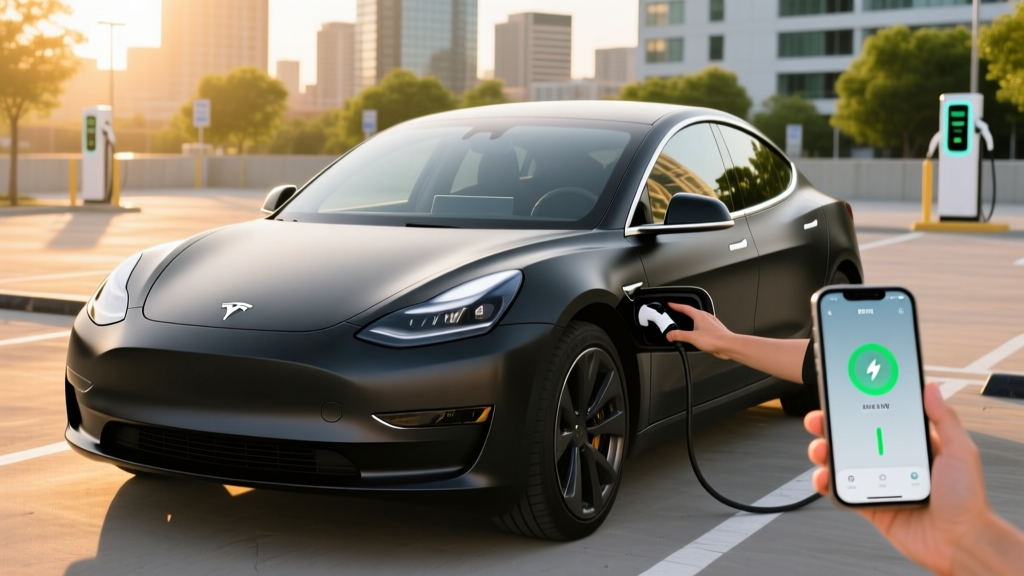
| Level 2 (240V / 48A) | 11.5 kW | ~44 mi/hr | Full charge in ~7–8 hours |
| DC Fast (V3 Supercharger) | Peak 250 kW | ~1,000 mi/hr (peak) | 10–80% in ~25 min |
| DC Fast (CCS station, with adapter) | Up to 150–250 kW | Varies | Requires NACS-to-CCS adapter for non-Tesla networks |
Charge curve reality: The Model Y holds near 250 kW from roughly 10–30% SoC, then steps down to ~175 kW through 50%, and tapers to under 80 kW past 70%. That 10–80% time of ~25 minutes assumes you arrive at a low state of charge and the battery is preconditioned (the car does this automatically when you navigate to a Supercharger). Without preconditioning — say, at a non-Tesla DCFC on a cold morning — expect 10–80% to stretch past 35 minutes.
The 2026 Model Y uses the NACS (North American Charging Standard) connector natively. With Tesla opening the Supercharger network to other EVs, station congestion at popular corridors is a growing consideration. Plan road trips using the in-car trip planner, which accounts for elevation, temperature, and speed.
Pricing, Tax Credits & the Trade-In Math
When you use the Tesla Design Studio trade-in estimator, Tesla generates a conditional offer based on your vehicle's year, mileage, condition, and market demand. That offer is applied as a credit toward your new Model Y purchase. But the trade-in value interacts with the federal §30D tax credit in ways worth understanding before you finalize.
| Item | Long Range AWD | Performance |
|---|---|---|
| Base MSRP | $48,990 | $53,990 |
| Common Add-Ons (FSD, paint, wheels) | +$6,000–$14,000 | +$6,000–$14,000 |
| Typical As-Tested Price | $52,000–$58,000 | $57,000–$64,000 |
| MSRP Cap (§30D SUV limit: $80,000) | ✅ Under cap | ✅ Under cap |
| Federal Tax Credit (max) | Up to $7,500 | Up to $7,500 |
| Point-of-Sale Transfer | Available (reduces purchase price at delivery) | Available |
Federal §30D eligibility requirements (2026 tax year):
- Income caps: Modified AGI must not exceed $150,000 (single), $225,000 (head of household), or $300,000 (joint filers).
- MSRP cap: Vehicle base MSRP must be ≤ $80,000 for SUVs/pickups/vans (Model Y qualifies as an SUV per IRS classification).
- Battery sourcing: A percentage of critical minerals and battery components must be sourced from the U.S. or free-trade-agreement countries. These thresholds increase annually. Tesla's supply chain has adapted, but confirm current-year eligibility on IRS.gov before relying on the credit.
- Point-of-sale transfer: As of 2024, buyers can transfer the credit to the dealer (Tesla) at purchase, reducing the out-of-pocket price immediately rather than waiting for a tax refund. This applies to the Design Studio trade-in flow as well.
Trade-in + credit example: If your trade-in is valued at $18,000 and you qualify for the full $7,500 credit transferred at point of sale, your effective cost on a $48,990 Long Range drops to approximately $23,490 before taxes and fees — a number the Design Studio configurator will calculate for you at checkout, but that you should verify independently.
Interior, Tech & Driver Assistance
The 2026 Model Y carries Tesla's minimalist interior philosophy: a single 15.4-inch center touchscreen controls virtually all vehicle functions, climate, and media. There is no instrument cluster — speed and navigation appear on the center screen or an optional rear-seat display. Build quality has improved noticeably since the 2023 refresh, with tighter panel gaps, acoustic glass, and ventilated front seats now standard on Long Range and Performance trims.
Driver assistance — critical clarity: Tesla's Autopilot (standard) and Full Self-Driving Supervised ($8,000 option or $99/month) are SAE Level 2 systems. This means the driver must remain fully engaged, hands on or near the wheel, and eyes on the road at all times. FSD Supervised can navigate intersections, make turns, and handle highway lane changes, but it is not autonomous driving. You are the driver, legally and practically. Only Level 4 services like Waymo operate without a human driver in geofenced areas.
• Does not operate in all weather conditions (heavy rain, snow, fog may disable)
• Requires driver supervision — camera monitoring will issue alerts and can disengage
• Construction zones, unmapped roads, and complex intersections remain challenging
• Not a substitute for attentive driving; you are liable for all vehicle operation
Notable tech features:
- Over-the-air (OTA) software updates that add features post-purchase
- Sentry Mode (360° camera recording when parked)
- Dog Mode, Camp Mode, and theater-mode streaming on the center display
- Phone-as-key with Bluetooth proximity unlock
- Trip planner with real-time Supercharger availability and battery preconditioning
Pros, Cons & Who the Model Y Suits Best
- Access to the Supercharger network — the most reliable DC fast-charging infrastructure in the U.S.
- Class-leading efficiency (28 kWh/100 mi) means lower charging costs per mile
- Strong resale value relative to non-Tesla EVs
- OTA updates keep the vehicle current years after purchase
- Practical cargo space (72 cu ft with seats folded) for a compact SUV
- Touchscreen-only controls frustrate some drivers (no physical climate or volume knobs)
- Rear-seat comfort is adequate but not class-leading vs. Hyundai Ioniq 5 or Kia EV6
- FSD Supervised is expensive and still requires full driver attention
- Insurance premiums tend to run 15–30% higher than comparable ICE SUVs
- NACS connector is standard, but CCS adapter needed for some non-Tesla DCFC stations
Who the 2026 Model Y suits best:
- Daily commuters with home Level 2 charging — the 320-mile EPA range and 122 MPGe combined make it one of the most cost-efficient electric crossovers to operate.
- Road-trip-capable families who value Supercharger reliability over maximum interior volume. Two adults and two children fit comfortably; three across the rear seat is tight.
- Tech-forward buyers who want OTA updates, app integration, and an active development roadmap rather than a static vehicle platform.
Consider alternatives if: You need maximum rear-seat space (look at the Hyundai Ioniq 5 or Kia EV9), prefer physical controls, or want an LFP battery for worry-free 100% daily charging (the standard-range Model Y uses LFP, but with ~270 miles EPA range).
Is the 2026 Model Y Worth It vs. Key Competitors?
The Model Y Long Range at ~$48,990 competes directly with the Hyundai Ioniq 5 ($46,000–$53,000), Kia EV6 ($43,000–$56,000), and Ford Mustang Mach-E ($43,000–$60,000). The Model Y wins on efficiency, Supercharger access, and cargo volume. The Ioniq 5 and EV6 counter with 800V architecture enabling faster 10–80% DCFC times (~18 minutes at 350 kW chargers), more rear-seat legroom, and physical controls. The Mach-E offers a more traditional driving feel and available hands-free BlueCruise on mapped highways.
If the Tesla Design Studio trade-in tool gives you a strong offer on your current vehicle — particularly if you're trading in a Tesla already, where Tesla tends to offer above-market values — the effective price advantage can tip the scales. Cross-check the trade-in offer against Carvana, CarMax, and private-party values before committing.
Frequently Asked Questions
What is the real-world range of the 2026 Tesla Model Y Long Range?
The EPA rates it at 320 miles. In real-world highway driving at 70–80 mph in moderate temperatures, expect 260–285 miles. In mixed city/highway use, 280–305 miles is typical. Below freezing, highway range drops to roughly 210–250 miles despite the heat pump.
How fast does the Model Y charge at home and on the road?
On a 48-amp Level 2 home charger (11.5 kW), the Model Y adds approximately 44 miles of range per hour, fully charging overnight in 7–8 hours. On a V3 Supercharger at 250 kW peak, it charges from 10–80% in about 25 minutes with battery preconditioning active.
How much does the Model Y cost after federal tax credits?
The Long Range AWD starts at $48,990 MSRP. If you qualify for the full $7,500 federal §30D credit (income under $150K single / $300K joint, vehicle under $80K MSRP, battery sourcing requirements met) and transfer it at point of sale, the effective starting price drops to ~$41,490 before state incentives, taxes, and destination fees.
Does the 2026 Model Y qualify for the federal EV tax credit?
The Model Y qualifies as an SUV under IRS rules (MSRP cap: $80,000), and both trims fall well under that limit. Eligibility depends on your income, the battery's critical-mineral and component sourcing for the specific production batch, and whether you've already reached the per-buyer credit limit. Confirm current eligibility at IRS.gov clean vehicle credits before finalizing your order.
How does the Tesla Design Studio trade-in offer compare to selling privately?
Tesla's trade-in offers are competitive for Tesla-to-Tesla trades but can run 5–15% below private-party value for non-Tesla vehicles. The convenience factor is high — the offer is applied directly to your purchase, and you drop off the old car at delivery. Always get comparison quotes from CarMax, Carvana, or a local dealer before accepting.
What's the battery warranty on the 2026 Model Y?
Tesla covers the battery and drive unit for 8 years or 120,000 miles (whichever comes first) on the Long Range and Performance trims, with a minimum 70% capacity retention threshold. If the battery degrades below 70% of original capacity within that period, Tesla will repair or replace it at no cost.
Should I get FSD Supervised with my Model Y purchase?
FSD Supervised ($8,000 one-time or $99/month) is a Level 2 driver-assist system that handles highway navigation, lane changes, and some city driving — but requires constant driver supervision. For most buyers, the included Autopilot (lane centering + adaptive cruise) is sufficient for highway commuting. The $8,000 FSD purchase only makes sense if you drive high miles on varied roads and accept that you remain the responsible driver at all times.