Massive Blaze at a Tesla Facility in Southern France
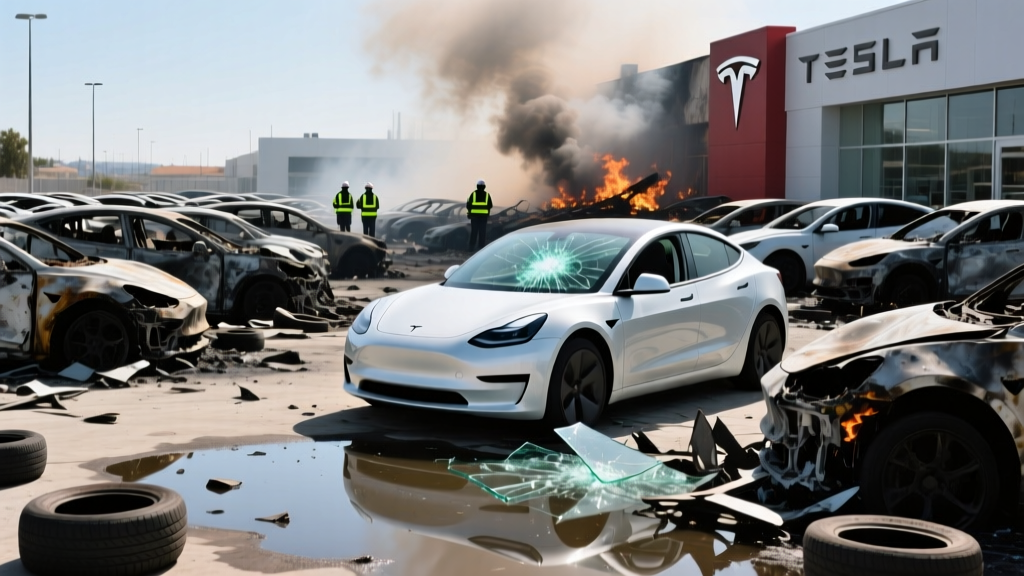
A large-scale fire broke out at a Tesla-affiliated dealership and service center near Marseille, France, destroying dozens of vehicles stored on the lot and in the service bays. The incident, which drew a significant emergency response from local fire brigades (pompiers), sent thick plumes of black smoke visible across the industrial zone surrounding the facility. While no injuries were reported, the financial toll on inventory — including new Model 3, Model Y, and potentially Model S and Model X units — is substantial.
This article breaks down what is known about the fire, the challenges of lithium-ion battery fires in EV storage facilities, and what it means for Tesla buyers and deliveries in the Provence-Alpes-Côte d'Azur region.
What Happened at the Tesla Dealership Near Marseille?
According to local French media reports and emergency dispatch records, the fire began in the vehicle storage area of the facility, which serves as both a delivery center and a service hub for Tesla customers in and around Marseille — France's second-largest city. The blaze spread rapidly across parked vehicles before firefighters could establish containment.
Key facts from the incident:
- Location: An industrial/commercial zone in the greater Marseille metropolitan area (Bouches-du-Rhône department).
- Vehicles affected: Dozens of Tesla vehicles, including customer-ready new inventory and trade-in/service vehicles.
- Emergency response: Multiple fire engines and hazmat units deployed; the fire required extended suppression efforts due to the nature of lithium-ion battery packs.
- Injuries: No casualties reported; the facility was evacuated promptly.
- Cause: Under investigation by French authorities; possible origins include an electrical fault in a vehicle, a charging station malfunction, or external factors.
Tesla has not issued a public statement at the time of this writing, and the dealership's operations were temporarily suspended while authorities assessed structural damage and environmental contamination from burned battery cells.
Why EV Fires at Dealerships Are Especially Difficult to Manage
Lithium-ion battery fires behave fundamentally differently from gasoline vehicle fires, and the Marseille incident highlights the unique challenges first responders face when dozens of EVs are involved.
Thermal Runaway and Re-Ignition Risk
When a lithium-ion cell enters thermal runaway — an uncontrollable self-heating reaction — it can reach temperatures exceeding 1,000°C (1,832°F) and release flammable gases including hydrogen fluoride. In a tightly packed dealership lot, thermal runaway in one vehicle's battery pack can propagate to adjacent vehicles, creating a cascading fire event.
According to NFPA (National Fire Protection Association) research and international fire-service data, EV battery fires require significantly more water to suppress than internal-combustion engine fires — sometimes tens of thousands of gallons — and carry a risk of re-ignition hours or even days after the initial flames are extinguished.
Environmental and Cleanup Concerns
Burned lithium-ion cells release toxic compounds. French environmental agencies typically require soil and groundwater testing after such incidents, especially in industrial zones near waterways. The cleanup process for the Marseille facility will likely take weeks and involve specialized hazmat contractors.
Storage and Spacing Protocols
Industry best practices for EV storage at dealerships and logistics hubs recommend wider spacing between vehicles than traditional car lots, along with dedicated firebreaks and enhanced detection systems. Whether the Marseille facility followed these protocols will be part of the official investigation.
Impact on Tesla Deliveries in the Marseille Region
For customers awaiting vehicle deliveries in southern France, the fire creates short-term disruption. Marseille-area Tesla buyers typically receive vehicles through the local delivery center, and with dozens of units destroyed, replacement inventory must be sourced from Tesla's European logistics hubs — primarily the Gigafactory Berlin-Brandenburg in Germany or regional distribution centers in the Netherlands and Italy.
What Affected Customers Should Know
- Delivery delays: Expect 2–6 week delays for orders that were staged at the affected facility.
- Vehicle assignments: Tesla typically reassigns VINs from other regional inventory; customers should check their Tesla account for updated delivery estimates.
- Insurance and deposits: Customer deposits are protected; no financial loss to buyers is expected for undelivered vehicles.
- Service appointments: Routine service at the affected location will be rerouted to nearby Tesla Service Centers or mobile service units.
Tesla's Vehicle Safety Record in Context
While dramatic, dealership and storage-lot fires involving EVs are statistically rare relative to the total number of vehicles on the road. It is important to contextualize the Marseille fire within broader EV safety data.
EV Fire Incidence vs. Gasoline Vehicles
Multiple studies — including data from the Swedish Civil Contingencies Agency (MSB) and U.S. NHTSA — have found that electric vehicles catch fire at a lower rate per 100,000 vehicles than internal-combustion engine vehicles. However, when EV fires do occur, they tend to be more intense, longer-lasting, and harder to extinguish due to the energy density of lithium-ion battery packs.
Tesla's Battery Architecture
Tesla's current-generation vehicles use either nickel-manganese-cobalt (NMC) or lithium iron phosphate (LFP) battery chemistries, depending on the model and trim:
| Model / Trim | Chemistry | Usable Capacity (kWh) | EPA Range (mi) | Thermal Stability |
|---|---|---|---|---|
| Model 3 RWD | LFP | ~60 kWh | 272 | Higher (LFP inherently more stable) |
| Model 3 Long Range AWD | NMC | ~75 kWh | 341 | Moderate |
| Model Y RWD | LFP | ~60 kWh | 260 | Higher |
| Model Y Long Range AWD | NMC | ~75 kWh | 310 | Moderate |
| Model S / X | NMC | ~95 kWh | 320–348 | Moderate |
LFP (lithium iron phosphate) cells are significantly more resistant to thermal runaway than NMC (nickel manganese cobalt) cells. The LFP-equipped Model 3 RWD and Model Y RWD have a higher thermal runaway onset temperature (~270°C vs. ~210°C for NMC), making them inherently less prone to cascading battery fires. If the destroyed inventory at Marseille included a mix of LFP and NMC vehicles, the propagation dynamics would vary unit to unit.
How Tesla and Dealerships Can Mitigate Future Fire Risk
The Marseille incident is a reminder that EV infrastructure — including storage and service facilities — must evolve alongside the vehicles themselves. Key mitigation strategies include:
Improved Lot Design
- Spacing: Minimum 3-meter (10-foot) gaps between parked EVs to reduce thermal propagation.
- Firebreaks: Non-combustible barriers or empty buffer rows every 10–15 vehicles.
- Outdoor preference: Open-air storage reduces the concentration of toxic gases and allows heat dissipation.
Enhanced Detection and Suppression
- Thermal cameras: Continuous infrared monitoring of stored vehicles to detect abnormal cell temperatures before ignition.
- Automated sprinkler systems: High-volume water-deluge systems specifically calibrated for lithium-ion fire suppression.
- Battery monitoring: Remote telematics alerts when a stored vehicle's battery management system (BMS) detects anomalies.
First Responder Training
Tesla provides Emergency Response Guides for each vehicle model, detailing high-voltage disconnect points, battery location, and recommended firefighting procedures. Ensuring that local fire brigades near EV-dense facilities have current guides and hands-on training is critical for rapid, effective suppression.
What This Means for EV Buyers in France and Europe
The Marseille fire, while significant in scale, does not reflect a systemic safety defect in Tesla vehicles. Rather, it underscores the infrastructure challenges that accompany the rapid electrification of the European vehicle fleet. France alone has seen EV registrations surge past 20% of new car sales, and dealership/service facilities built for the ICE era are adapting to new risks.
For prospective Tesla buyers in Europe:
- Delivery timelines in southern France may be temporarily extended; check your Tesla account or contact your delivery advisor for updates.
- Vehicle safety ratings remain strong — Tesla's Model 3 and Model Y continue to earn top marks from Euro NCAP, including five-star overall ratings.
- Insurance costs for EVs in France remain competitive, though some insurers factor in battery replacement cost potential; shop multiple quotes.
- Charging infrastructure is unaffected — the Supercharger network in Provence and along the A7/A8 autoroutes remains fully operational.
Frequently Asked Questions
Was anyone hurt in the Tesla dealership fire near Marseille?
No injuries or casualties were reported. The facility was evacuated before the fire spread to its most intense phase.
What caused the fire at the Tesla facility?
The official cause is under investigation by French authorities. Possible origins include an electrical fault within a vehicle, a charging equipment malfunction, or an external ignition source. A definitive cause has not been publicly confirmed.
How many Tesla vehicles were destroyed?
Reports indicate dozens of vehicles were destroyed or severely damaged, including new inventory awaiting customer delivery and vehicles in for service. An exact count has not been released.
Will this affect my Tesla delivery in Marseille?
Customers with deliveries routed through the affected facility may experience 2–6 week delays. Tesla typically reassigns replacement inventory from other European distribution points. Check your Tesla app for updated delivery estimates.
Are electric vehicles more likely to catch fire than gas cars?
No. Data from multiple fire-safety agencies indicates that EVs catch fire at a lower rate per 100,000 vehicles than gasoline-powered cars. However, when EV fires do occur, they can be more intense and harder to extinguish due to lithium-ion battery chemistry.
Is LFP battery chemistry safer than NMC in a fire?
Yes, generally. LFP (lithium iron phosphate) cells have a higher thermal runaway onset temperature and release less oxygen during decomposition, making them more resistant to cascading fires compared to NMC (nickel manganese cobalt) cells. Tesla's base-trim Model 3 and Model Y use LFP chemistry.
Does Tesla cover the cost of vehicles destroyed before delivery?
Yes. Vehicles that have not yet been delivered to the customer remain Tesla's property and are covered by the company's insurance. Customer deposits are protected, and Tesla will reassign replacement vehicles at no additional cost to the buyer.