Why Tesla Dealership Fires Are Making Headlines
Recent incidents involving Tesla vehicles catching fire at service centers and dealership lots have prompted a wave of search queries about EV safety. While the term "Tesla dealership fire" has trended in automotive news cycles, the reality of lithium-ion battery safety requires a data-driven look — not sensationalism. This review examines the structural safety, battery chemistry, and real-world fire risk of Tesla's best-selling vehicle, the 2026 Model Y, while addressing the core question: should isolated fire incidents change your EV buying decision?
2026 Tesla Model Y: Quick Verdict
The refreshed Model Y (internally dubbed "Juniper") remains the benchmark compact electric SUV. It offers class-leading efficiency, access to the Supercharger network, and strong safety ratings from both NHTSA and IIHS. However, the vehicle is not without compromises — panel gaps, a minimalist interior that frustrates some buyers, and the persistent question of whether Tesla's direct-to-consumer model provides adequate service support compared to legacy dealers.
| Spec | Model Y Long Range AWD | Model Y Performance |
|---|---|---|
| EPA Range | 320 miles | 295 miles |
| Battery Capacity | 78.1 kWh (NMC) | 78.1 kWh (NMC) |
| Drivetrain | Dual-Motor AWD | Dual-Motor AWD |
| Horsepower | 384 hp | 456 hp |
| 0-60 mph | 4.8 seconds | 3.5 seconds |
| Peak DC Charge | 250 kW | 250 kW |
| 10-80% Charge Time | ~25 minutes | ~25 minutes |
| Efficiency | 28 kWh/100mi (119 MPGe) | 30 kWh/100mi (111 MPGe) |
| Cargo (rear seats up) | 30.2 cu ft | 30.2 cu ft |
| Cargo (seats folded) | 72.1 cu ft | 72.1 cu ft |
| Base MSRP | $44,990 | $51,490 |
Real-World Range: What the EPA Sticker Doesn't Tell You
Real-World Highway: Expect 265–285 miles at 70-75 mph sustained
Cold Weather (below 32°F): Range drops 20-30%, yielding roughly 225–255 miles
Mixed Commute: 290–310 miles achievable with regenerative braking in city driving
Tesla's thermal management system is among the best in the industry, using a heat pump standard across all trims to mitigate cold-weather losses. However, NMC chemistry is inherently more sensitive to extreme cold than LFP. On a 300-mile highway road trip in 25°F weather, plan for a charging stop — the battery's usable capacity shrinks, and cabin heating demands real energy.
Charging Speed: Supercharger Access Remains the Killer Feature
Tesla's proprietary Supercharger network — now opening to NACS-equipped vehicles from Ford, Rivian, and others — remains the most reliable DC fast-charging infrastructure in North America. The 2026 Model Y peaks at 250 kW on V3 Superchargers, though sustained rates taper significantly above 60% state of charge.
| Charging Level | Power | Speed |
|---|---|---|
| Level 1 (120V) | 1.4 kW | ~4 miles/hour |
| Level 2 (240V, 48A) | 11.5 kW | ~37 miles/hour |
| DC Fast (V3 Supercharger) | 250 kW peak | 10-80% in ~25 min |
| DC Fast (CCS adapter, non-Tesla) | Up to 150 kW typical | 10-80% in ~35-40 min |
The charge curve is the detail most spec sheets omit. You will see 250 kW only between roughly 10-30% SoC. By 60%, the rate drops to ~100 kW, and above 80% it falls below 50 kW. For road trips, the optimal strategy is short, frequent stops (10-60%) rather than waiting for a full charge.
Battery Safety and Fire Risk: The Data Behind the Headlines
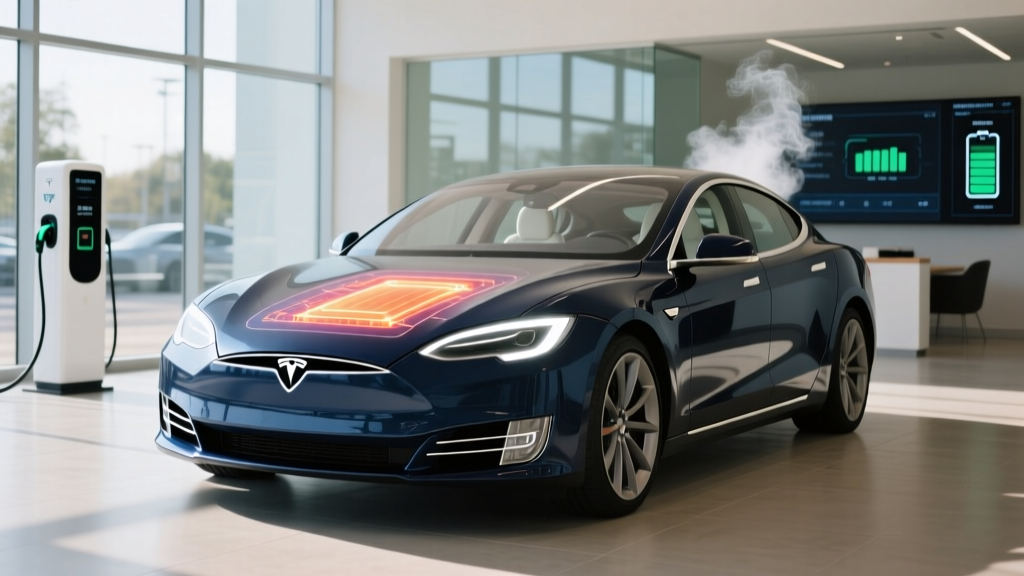
The keyword "Tesla dealership fire" typically references isolated incidents where vehicles have ignited while parked at service centers or during transport. These events, while dramatic in photos, are statistically rare. According to data from the National Highway Traffic Safety Administration and independent analyses, EV battery fires occur at a rate of approximately 25 per 100,000 vehicles — compared to roughly 1,500 per 100,000 for internal combustion vehicles.
The 2026 Model Y uses an NMC (nickel manganese cobalt) lithium-ion pack, structurally integrated into the vehicle floor. NMC offers higher energy density than LFP but is more susceptible to thermal runaway if the cell structure is physically compromised — such as in a severe collision or puncture. Tesla's battery pack includes:
- Cell-level thermal barriers to prevent propagation
- A reinforced underbody shield
- Active cooling loops monitored by the BMS (battery management system)
When dealership or service-center fires do occur, they often involve vehicles already damaged in collisions, undergoing high-voltage service, or stored in large numbers where one thermal event can spread. These are operational risks, not inherent design flaws.
Is It Worth Buying vs. Key Competitors?
The Model Y's strongest competitors in 2026 include the Hyundai Ioniq 5, Ford Mustang Mach-E, and the refreshed Kia EV6. Each offers trade-offs:
- Hyundai Ioniq 5: Faster 800V charging (10-80% in 18 min), more distinctive design, but smaller Supercharger-equivalent network access.
- Ford Mustang Mach-E: Now NACS-native with Supercharger access, competitive range, but slightly lower efficiency (more kWh/100mi).
- Kia EV6: Excellent 800V architecture and interior quality, but less cargo space (24.4 cu ft rear seats up).
The Model Y wins on efficiency (28 kWh/100mi is best-in-class), cargo volume, and charging network reliability. It loses on interior material quality and the ongoing debate over Tesla's build consistency.
Pricing, Tax Credits, and Total Cost
| Trim | MSRP | Est. Federal Credit (§30D) | Effective Price |
|---|---|---|---|
| Long Range AWD | $44,990 | Up to $7,500* | ~$37,490 |
| Performance | $51,490 | Up to $7,500* | ~$43,990 |
*Eligibility depends on buyer income (≤$150K single / ≤$300K joint), MSRP cap ($80K for SUVs), and battery critical-mineral sourcing per IRS §30D rules. Point-of-sale transfer available at participating dealers. Confirm eligibility with a tax professional.
Pros, Cons, and Who Should Buy
- Best-in-class efficiency (119 MPGe / 28 kWh/100mi)
- Supercharger network reliability
- Strong NHTSA 5-star and IIHS Top Safety Pick+ ratings
- Over-the-air updates continuously add features
- Class-leading cargo volume (72.1 cu ft)
- Panel gap inconsistency remains a complaint
- No physical stalks (turn signals on steering wheel)
- FSD (Supervised) is SAE Level 2 — driver must remain engaged
- Service center wait times can exceed 2-3 weeks in some markets
- NMC chemistry slightly more cold-sensitive than LFP competitors
Best for: Tech-forward commuters and small families who prioritize efficiency, cargo space, and road-trip charging infrastructure. Not ideal for buyers who want a traditional dealership experience, physical button controls, or who live in extreme cold climates without garage charging.
Frequently Asked Questions
Are Tesla vehicles more likely to catch fire than gas cars?
No. NHTSA and independent data show EV battery fires are significantly less frequent than gasoline vehicle fires. Gas cars experience roughly 1,500 fires per 100,000 vehicles annually; EVs experience roughly 25 per 100,000. However, EV fires can be more difficult to extinguish due to thermal runaway chemistry, which is why they receive disproportionate media coverage.
Does the 2026 Model Y qualify for the $7,500 federal tax credit?
It may, depending on your income, the vehicle's battery sourcing compliance, and point-of-sale transfer availability. The MSRP is under the $80,000 SUV cap. Check current IRS §30D eligibility and consult a tax professional.
What is the real-world highway range of the Model Y Long Range?
Expect 265–285 miles at sustained highway speeds (70-75 mph). In cold weather below freezing, plan for 225–255 miles. The EPA sticker of 320 miles reflects a mixed driving cycle with significant city/regen content.
How fast does the Model Y charge at home?
On a 240V/48A Level 2 home charger (such as the Tesla Wall Connector), the Model Y adds approximately 37 miles of range per hour, or a full charge overnight in roughly 8-9 hours.
Is Tesla's Autopilot or FSD actually self-driving?
No. Both Autopilot and FSD (Supervised) are SAE Level 2 driver-assistance systems. The driver must remain attentive, hands on or near the wheel, and ready to intervene at all times. Only Level 4 robotaxi services (Waymo, Zoox) operate without a human driver.