The Tesla Cybertruck remains one of the most polarizing vehicles on the road. Its angular stainless-steel exoskeleton grabs every headline, but the part that actually determines whether you can live with one every day is the cabin. In this review, we go inside of a Cybertruck — the 2026 model year — to evaluate its interior practicality, real-world range, charging behavior, ownership economics, and whether it stacks up against the Rivian R1T, Ford F-150 Lightning, and Chevrolet Silverado EV in the electric truck segment.
Cybertruck at a Glance: 2026 Spec Table
| Specification | AWD (Dual-Motor) | Cyberbeast (Tri-Motor) |
|---|---|---|
| EPA Range | 340 miles | 320 miles |
| Battery (usable, est.) | ~123 kWh, NMC | ~123 kWh, NMC |
| Peak DC Fast Charge | 250 kW | 250 kW |
| 10–80% DCFC Time | ~30 minutes | ~30 minutes |
| Level 2 Home Charge Rate | 11.5 kW (~37 mi/hr) | 11.5 kW (~37 mi/hr) |
| 0–60 mph | 3.9 seconds | 2.6 seconds |
| Horsepower | 600 hp | 845 hp |
| Drivetrain | Dual-Motor AWD | Tri-Motor AWD |
| Towing Capacity | 11,000 lbs | 11,000 lbs |
| MPGe (combined) | 67 MPGe | 62 MPGe |
| Efficiency | 50 kWh/100 mi | 54 kWh/100 mi |
| Base MSRP | $79,990 | $99,990 |
| Battery & Drive Unit Warranty | 8 yr / 120,000 mi | 8 yr / 120,000 mi |
Inside of a Cybertruck: Cabin, Materials, and Space
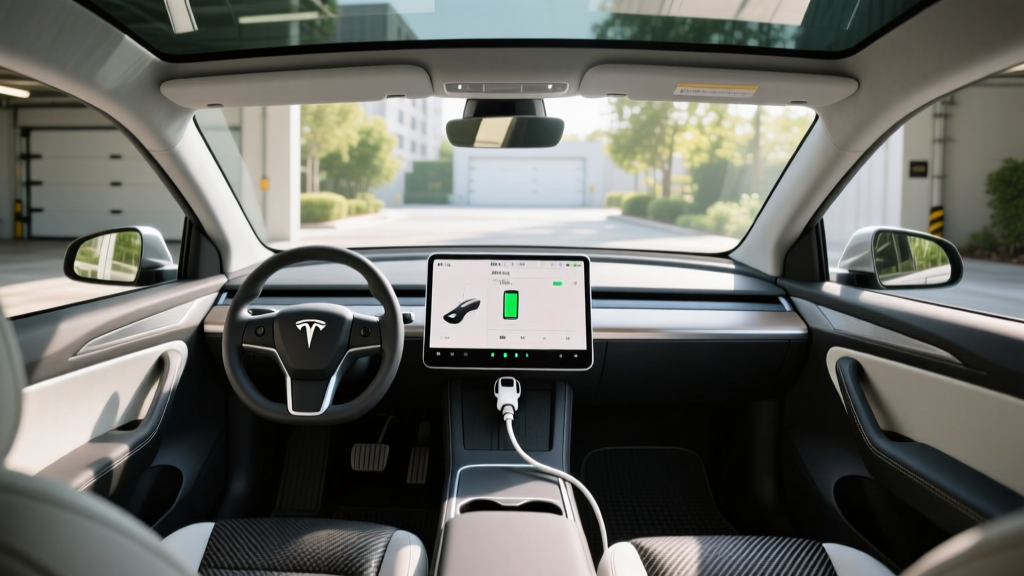
Step inside of a Cybertruck and the first thing you notice is the extreme minimalism. Tesla has stripped away nearly every physical control. The dashboard is dominated by a single 18.5-inch touchscreen that handles navigation, climate, media, vehicle settings, and even the glovebox release. A smaller rear touchscreen (9.4 inches) serves second-row passengers with climate and entertainment controls.
The steering yoke (a rectangular design) is standard — no round wheel option is available. This is a love-it-or-hate-it feature. On highway commutes, the yoke offers an unobstructed view of the sparse instrument display. During low-speed maneuvers like three-point turns or tight parking, the yoke requires hand-over-hand shuffling that a conventional wheel avoids. Tesla has not offered a steer-by-wire variable ratio that would mitigate this, unlike the Lexus RZ 450e.
Materials: The cabin uses vegan leather (synthetic polyurethane) on the seats and a microfiber-like headliner. Hard plastics appear on the lower door panels and center console base — acceptable at $50,000, more noticeable at $100,000. The stainless-steel dash trim is distinctive but a fingerprint magnet. Build quality on 2026 models has improved noticeably over the initial 2024 production units, with tighter panel gaps and fewer reported rattles, though it still falls short of Rivian's interior fit and finish.
Passenger and Cargo Dimensions
- Front headroom: 41.0 inches
- Front legroom: 42.0 inches
- Rear headroom: 38.4 inches
- Rear legroom: 38.2 inches
- Bed length: 6 feet (72 inches) with tailgate up; ~8 feet with tailgate down and bed extender
- Bed volume: ~67 cu ft (bed), plus ~67 cu ft lockable vault storage under the tonneau
- Front trunk (frunk): ~10 cu ft — fits a carry-on suitcase or charging cables
The rear seat is a legitimate three-person bench with decent thigh support, though the seat bottom sits low to accommodate the battery pack underneath, creating a somewhat knees-up posture for taller adults on longer drives. The 6-foot bed is shorter than a Ford F-150 Lightning's 5.5-foot box (comparable) but the Cybertruck's motorized tonneau cover and lockable vault make it more secure than an open bed.
Real-World Range vs. EPA Estimates
Real-World Expectation: ~270–290 miles highway at 70 mph; ~220–250 miles in sub-30°F cold weather; ~310–330 miles mixed city/highway in mild conditions.
The Cybertruck's angular, flat-panel design creates a high drag coefficient — estimated around 0.39 Cd, compared to roughly 0.33 for the Rivian R1T and 0.35 for the F-150 Lightning. That aerodynamic penalty shows up most at sustained highway speeds. In independent highway loop testing at 70 mph in 65°F conditions, the AWD model typically delivers 270–290 miles before reaching 5% state of charge. In colder temperatures (below freezing), expect a 25–35% range reduction, bringing real-world range to roughly 220–250 miles.
City driving with frequent regenerative braking opportunities returns results much closer to the EPA sticker, often 310–330 miles. The Cybertruck does not currently offer the optional range-extender battery pack that Tesla initially announced, which was projected to fit in the bed vault and add ~130+ miles. As of 2026, this accessory remains unavailable.
For context, EPA data on fueleconomy.gov lists the AWD Cybertruck at 67 MPGe combined, which translates to approximately 50 kWh per 100 miles. This makes the Cybertruck one of the less efficient EVs on the market — its heavy weight (~6,800 lbs curb) and poor aerodynamics demand more energy per mile than lighter, sleeker vehicles.
Charging Speed: DC Fast Charging and Home Level 2
Tesla equips the Cybertruck with a NACS (North American Charging Standard) port natively — no adapter needed for the Supercharger network. Here is how charging breaks down by level:
| Charging Level | Power | Speed (approx.) | Use Case |
|---|---|---|---|
| Level 1 (120V) | ~1.4 kW | ~3–4 mi/hr | Emergency/trickle only |
| Level 2 (240V, 48A) | 11.5 kW | ~37 mi/hr | Daily home charging |
| DC Fast (Supercharger V3/V4) | Peak 250 kW | 10–80% in ~30 min | Road trips |
Charging curve reality: The Cybertruck peaks near 250 kW only between roughly 5–25% state of charge. From 25–50%, the rate tapers to approximately 170–190 kW. From 50–80%, expect 100–130 kW. This is why the 10–80% time stretches to about 30 minutes despite the impressive peak number. For comparison, vehicles built on 800V architectures (Hyundai Ioniq 5, Kia EV9, Porsche Macan EV) sustain higher rates longer, achieving 10–80% in 18–22 minutes at comparable or higher peak rates.
Home charging: A full 0–100% charge on a Level 2 Tesla Wall Connector (48 amps, 11.5 kW) takes approximately 13–14 hours for the ~123 kWh battery. Most owners charging overnight from 20% to 80% (the daily recommended range for NMC chemistry) will need about 7–8 hours, which fits comfortably within a typical overnight window.
Preconditioning the battery before arriving at a Supercharger (triggered automatically when the Supercharger is set as your navigation destination) is essential. Without preconditioning, cold batteries may accept as little as 50–80 kW initially, adding 10–15 minutes to your charging stop.
Performance, Ride Quality, and Driver Assistance
The Cybertruck AWD delivers 600 horsepower and a 3.9-second 0–60 mph time — genuinely quick for a 6,800-pound truck. The Cyberbeast tri-motor variant pushes 845 hp and 2.6 seconds, placing it in supercar territory. Both versions feature adaptive air suspension with up to 16 inches of ground clearance in Extract Mode, making the Cybertruck legitimately capable off-road.
Ride quality is firm but well-controlled. The steer-by-wire system and four-wheel steering give the Cybertruck a surprisingly tight turning circle (~35 feet) for its size. However, the stainless-steel body panels are prone to showing dents from shopping carts and door dings differently than painted steel — minor impacts can leave visible creases that are difficult to repair.
Autopilot and FSD (Supervised) — SAE Level 2
Tesla Autopilot and Full Self-Driving (Supervised) are driver-assistance systems. They require continuous driver attention, hands-on (or eyes-on) supervision, and the driver is legally responsible for the vehicle at all times. These are not "self-driving" systems. True driverless operation (Level 4) is currently offered only by robotaxi services like Waymo in limited geographic zones.
Tesla's FSD (Supervised) software has continued to improve in 2026 with the latest neural-network-based vision stack. It handles highway lane changes, on-ramp merges, and many city intersections competently. However, it still struggles with construction zones, faded lane markings, unprotected left turns in heavy traffic, and adverse weather. The $8,000 one-time purchase or $99/month subscription remains a significant cost that buyers should evaluate against their actual commute needs.
Pricing, Trims, and Federal Tax Credit Eligibility
The 2026 Cybertruck lineup has simplified after the discontinuation of the initially promised $60,990 RWD model (which was never widely produced). Current trims:
- AWD (Dual-Motor): $79,990 MSRP
- Cyberbeast (Tri-Motor): $99,990 MSRP
| Cost Factor | AWD | Cyberbeast |
|---|---|---|
| Base MSRP | $79,990 | $99,990 |
| Destination Fee | $1,995 | $1,995 |
| FSD (if added) | +$8,000 | +$8,000 |
| Federal §30D Credit Eligibility | $0 — exceeds MSRP cap | $0 — exceeds MSRP cap |
| Estimated Out-the-Door | ~$81,985+ | ~$101,985+ |
Warranty and Long-Term Ownership
Tesla provides the following warranty coverage for the 2026 Cybertruck:
- Limited Vehicle Warranty: 4 years / 50,000 miles
- Battery & Drive Unit Warranty: 8 years / 120,000 miles (minimum 70% capacity retention)
The 8-year/120,000-mile battery warranty is competitive with the industry standard. Tesla guarantees the battery will retain at least 70% of its original capacity during the warranty period. If degradation drops below this threshold, Tesla will repair or replace the battery to bring it back above 70%. Based on data from Tesla's fleet, NMC batteries in their vehicles typically degrade 10–15% over the first 100,000 miles, with the degradation curve flattening significantly after the initial 20,000–30,000 miles.
For the Cybertruck's ~123 kWh pack, a full out-of-warranty replacement would likely cost between $18,000 and $25,000 based on current Tesla battery service pricing, though this figure is projected and may decrease as cell costs continue declining.
Cybertruck vs. Rivian R1T vs. Ford F-150 Lightning
The electric truck market in 2026 offers three distinct approaches. Here is how the Cybertruck compares to its primary competitors:
| Metric | Tesla Cybertruck AWD | Rivian R1T Dual-Motor | Ford F-150 Lightning Lariat |
|---|---|---|---|
| EPA Range | 340 mi | 352 mi (Max Pack) | 320 mi (Extended Range) |
| Base MSRP | $79,990 | $79,900 | $69,995 |
| Peak DCFC | 250 kW | 220 kW | 150 kW |
| 0–60 mph | 3.9 sec | 4.5 sec | 4.5 sec |
| Towing | 11,000 lbs | 11,000 lbs | 10,000 lbs |
| Bed Length | 6 ft | 4.5 ft (+ Gear Tunnel) | 5.5 ft |
| Federal Credit | No (MSRP cap) | No (MSRP cap) | Possible (trim-dependent) |
Choose the Cybertruck if: You prioritize acceleration and straight-line performance, want access to the Tesla Supercharger network natively, value the lockable vault bed with powered tonneau, and are comfortable with the minimalist interior and yoke steering.
Choose the Rivian R1T if: You want a more premium interior, better off-road capability (quad-motor option, tank turns), the innovative Gear Tunnel for secure gear storage, and a more conventional driving experience.
Choose the F-150 Lightning if: You need a proven truck platform with strong dealer support, Pro Power Onboard for job-site electricity, and the lowest entry price in the segment.
Pros, Cons, and Who Should Buy
Pros
- Class-leading acceleration (3.9 sec AWD, 2.6 sec Cyberbeast)
- Native NACS / Supercharger access — most reliable US charging network
- Lockable powered tonneau and vault storage
- Stainless-steel body resists corrosion and minor scratches
- Air suspension with up to 16" ground clearance
- 11,000-lb towing capacity
- Over-the-air updates continually add features
Cons
- No federal tax credit (MSRP exceeds §30D cap)
- Poor aerodynamics = significant highway and cold-weather range loss
- Yoke steering is impractical for low-speed maneuvers
- High energy consumption (~50 kWh/100 mi) raises home charging costs
- Hard plastics in cabin at a $80K+ price point
- Panel repair difficulty — stainless steel is non-traditional
- No range-extender battery option (announced, never released)
- Limited rear-seat comfort for tall adults on long trips
Best suited for: Tech-forward buyers who want a performance truck with secure cargo storage, primarily drive in urban/suburban environments where regenerative braking offsets the aerodynamic penalty, and have reliable home Level 2 charging. The Cybertruck works as a daily driver and weekend adventurer but is less ideal for frequent long-haul highway towing (expect range to drop to 150–180 miles when towing near max capacity) or for buyers in extreme cold climates where the range loss compounds.
Frequently Asked Questions
What is the real-world range of the Cybertruck?
The EPA rates the AWD Cybertruck at 340 miles and the Cyberbeast at 320 miles. In real-world highway driving at 70 mph, expect 270–290 miles. In cold weather (below 30°F), plan for 220–250 miles. City driving with regenerative braking can return 310–330 miles.
How fast does the Cybertruck charge at home and on the road?
On a Level 2 home charger (11.5 kW / 48 amps), the Cybertruck adds approximately 37 miles of range per hour, requiring 7–8 hours for a typical 20–80% daily charge. On a Tesla Supercharger (V3/V4), it peaks at 250 kW and charges from 10–80% in approximately 30 minutes, though the charge curve tapers significantly above 50%.
Does the Cybertruck qualify for the federal EV tax credit?
No. Under current IRS §30D rules, trucks and SUVs must have an MSRP at or below $80,000 to qualify. The Cybertruck AWD starts at $79,990 but exceeds $80,000 once the mandatory destination fee is included. The Cyberbeast at $99,990 far exceeds the cap. Verify current rules at IRS.gov.
Is the Cybertruck worth buying over the Rivian R1T or F-150 Lightning?
It depends on your priorities. The Cybertruck wins on acceleration and Supercharger network access. The Rivian R1T offers a more refined interior, better off-road capability, and the Gear Tunnel. The F-150 Lightning is the most affordable, has the strongest dealer network, and offers Pro Power Onboard for worksite use. None of these trucks currently qualify for the federal tax credit at their most popular trims.
What is the Cybertruck's battery chemistry and how long will it last?
The Cybertruck uses NMC (nickel manganese cobalt) lithium-ion cells in an estimated ~123 kWh usable pack. Tesla's battery warranty guarantees 70% capacity retention for 8 years or 120,000 miles. Historical Tesla fleet data suggests 10–15% degradation over the first 100,000 miles, with the curve flattening thereafter. NMC chemistry should be charged to 80% daily (not 100%) for optimal longevity.
Can I use non-Tesla chargers with the Cybertruck?
The Cybertruck has a native NACS port. It can charge at any NACS-equipped station (growing rapidly as other networks add the connector). For CCS-equipped stations, Tesla sells a NACS-to-CCS adapter. CHAdeMO chargers are largely legacy and not compatible without a third-party adapter.