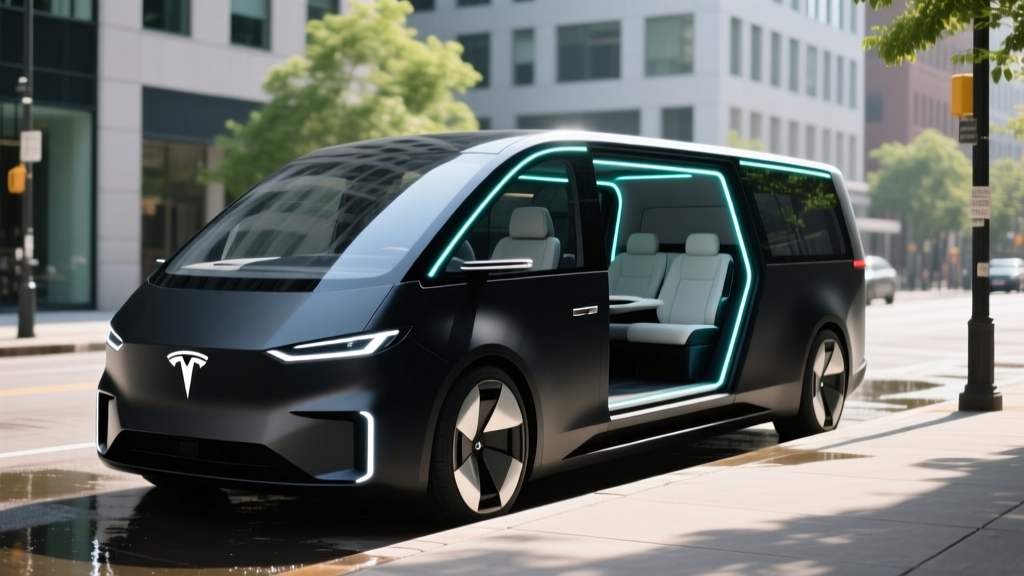
Since the Cybertruck's polarizing launch, speculation about a Tesla passenger van—colloquially dubbed the Tesla CyberVan—has circulated through EV forums, patent filings, and Elon Musk's own cryptic social media posts. As of early 2026, Tesla has not officially unveiled or listed a "CyberVan" on its configurator, but the company's Robovan reveal at the October 2024 "We, Robot" event, combined with multiple design patents and supply-chain indicators, points to a production vehicle that could reshape the electric people-mover segment.
This profile compiles every confirmed detail, credible leak, and reasonable engineering inference about what a production Tesla CyberVan would look like. Where data is preliminary or estimated, we say so explicitly. Where Tesla has gone on record, we cite them directly.
Is the Tesla CyberVan Actually Coming?
Tesla's October 2024 "We, Robot" event in Burbank featured a surprise appearance by the Tesla Robovan—a sleek, stainless-steel-clad vehicle with seating for up to 20 passengers, designed primarily for autonomous fleet service. Musk confirmed it would also be available for individual purchase, but offered no timeline, pricing, or detailed specifications.
Since then, Tesla has filed multiple patents related to modular van interiors, sliding door mechanisms, and high-capacity battery pack configurations consistent with a large-format vehicle. Industry analysts at Reuters and supply-chain reports from battery cell suppliers suggest Tesla's Austin Gigafactory is tooling for a vehicle platform larger than the Cybertruck, potentially sharing its 4680-cell structural battery architecture.
What the EV community calls the "CyberVan" appears to be the consumer variant of the Robovan platform—smaller than the 20-passenger fleet model, aimed at families, shuttle services, and adventure-oriented buyers who want a 7-to-9-seat electric van with Tesla's powertrain and software stack.
Expected Specifications: Range, Battery, and Powertrain
No official EPA certification exists yet for a Tesla CyberVan. The figures below are engineering estimates based on the Cybertruck's known architecture, Tesla's 4680 cell energy density, the Robovan's physical proportions observed at the reveal event, and typical efficiency penalties for larger, heavier vehicle formats.
| Specification | Estimated Value | Basis |
|---|---|---|
| EPA Range (est.) | 280–340 miles | Cybertruck AWD (340 mi) adjusted for heavier, taller van body |
| Battery Capacity (usable) | ~120–135 kWh | Scaled from Cybertruck's ~123 kWh pack, possible extended variant |
| Battery Chemistry | NMC (nickel manganese cobalt) with 4680 cells | Energy density requirements for large vehicle favor NMC over LFP |
| Drivetrain | Dual-Motor AWD or Tri-Motor AWD | Cybertruck platform sharing |
| Horsepower | 600–845 hp (depending on motor config) | Cybertruck Beast tri-motor: 845 hp |
| 0–60 mph | 3.9–5.5 seconds (est.) | Weight penalty vs. Cybertruck offsets motor output |
| Towing Capacity | 7,500–11,000 lbs (est.) | Cybertruck rated at 11,000 lbs; van body may reduce slightly |
| Seating Capacity | 7–9 passengers (consumer variant) | Robovan seats 20; consumer version expected smaller |
| Cargo Volume | ~80–120 cu ft (behind 3rd row, est.) | Comparable to Mercedes Sprinter / VW ID.Buzz proportions |
| Efficiency (MPGe est.) | ~65–75 MPGe combined | Cybertruck AWD: 70 MPGe; van aero/weight similar or slightly worse |
Charging Speed: DC Fast Charge and Home Level 2
Tesla's 4680-cell architecture supports aggressive DC fast charging, but sustained rates depend on pack size, thermal management, and the charge curve taper that all lithium-ion batteries exhibit above 80% State of Charge (SoC).
| Charging Level | Power / Rate | Estimated Time or Miles Added |
|---|---|---|
| DC Fast Charge (V4 Supercharger) | Peak ~325 kW (est.) | 10–80% in ~18–25 minutes; tapers significantly above 80% |
| DC Fast Charge (older V3 250 kW stall) | Peak 250 kW | 10–80% in ~28–35 minutes |
| Level 2 Home (Tesla Wall Connector, 48A / 11.5 kW) | 11.5 kW | ~30–34 miles of range per hour; full charge in ~11–13 hours |
| Level 2 Home (32A mobile connector, 240V) | 7.7 kW | ~20–23 miles per hour; full charge in ~16–18 hours |
| Level 1 (120V standard outlet) | ~1.4 kW | ~3–4 miles per hour (emergency/trickle only) |
A critical ownership consideration: a 120+ kWh battery pack takes a long time to fill on Level 2. Most CyberVan buyers will want a 48-amp hardwired Wall Connector on a 60-amp circuit to achieve overnight charging. If your home electrical panel is already near capacity, a panel upgrade ($1,500–$3,000) may be necessary—factor this into your total cost.
On the road, Tesla's Supercharger network remains the most reliable DC fast-charging ecosystem in North America. With the industry-wide shift to NACS (North American Charging Standard), the CyberVan will use the native Tesla connector, and non-Tesla networks like Electrify America and EVgo increasingly offer NACS cables or adapters.
Pricing, Trims, and Federal Tax Credit Eligibility
Tesla has not published CyberVan pricing. Based on the Cybertruck's pricing ladder and the Robovan's positioning as a premium product, we project the following trim structure:
| Trim | Est. MSRP | Key Features |
|---|---|---|
| Base (Dual-Motor AWD) | $75,000–$80,000 | 7-seat, ~280 mi range, Autopilot standard |
| Long Range (Dual-Motor AWD) | $85,000–$92,000 | Extended battery, ~340 mi range, premium interior |
| Performance (Tri-Motor) | $95,000–$105,000 | 845 hp, adaptive air suspension, tow package |
- MSRP Cap: Vans/SUVs/pickups are capped at $80,000 MSRP. Only a base-trim CyberVan might qualify, and only if priced at or below this threshold.
- Income Caps: Modified AGI must not exceed $150,000 (single), $225,000 (head of household), or $300,000 (joint).
- Battery Sourcing: Critical minerals and battery components must meet escalating domestic-content percentages. Tesla's 4680 cells use domestically produced components, but final assembly sourcing must be verified per VIN at the time of purchase.
- Point-of-Sale Transfer: Eligible buyers can transfer the credit to the dealer at purchase, reducing the out-of-pocket price immediately.
Interior, Tech, and Standout Features
The Robovan reveal showed a minimalist interior with bench-style seating, a single large central display, and no traditional dashboard—consistent with Tesla's "software-defined vehicle" philosophy. For a consumer CyberVan, expect:
- Infotainment: 15.4-inch or larger central touchscreen running Tesla's latest software, with Netflix/YouTube streaming (parked only), Arcade gaming, and over-the-air updates.
- Driver Assistance: Standard Autopilot (adaptive cruise + lane centering). Optional FSD (Supervised) for $8,000 or $99/month—still SAE Level 2, requiring active driver supervision at all times.
- Seating Configurations: Likely 2-3-2 or 2-2-3 layouts with available captain's chairs in the second row. The Robovan concept showed seats that could face each other; whether this reaches production for highway use (federal crash safety rules require forward-facing seats with belts) is uncertain.
- Frunk + Cargo: A front trunk is likely given the skateboard platform, adding 10–15 cu ft of secure storage. Rear cargo with seats folded could exceed 150 cu ft.
- Exoskeleton Construction: If Tesla carries over the Cybertruck's cold-rolled stainless steel exoskeleton, expect exceptional dent resistance but limited color options and panel-repair complexity.
- Bioweapon Defense Mode: Tesla's HEPA filtration system, likely standard given the van's passenger capacity.
- V2L (Vehicle-to-Load): Cybertruck offers 120V/240V PowerShare outlets. A CyberVan would logically include this, enabling campsite or job-site power delivery up to ~9.6 kW.
Notable drawbacks to anticipate: The stainless steel body, while durable, makes accident repairs more expensive and limits body-shop options. Tesla's build-quality consistency has improved but remains a concern for some buyers. The large footprint (~220+ inches long, est.) will challenge standard home garages and tight urban parking.
How the CyberVan Stacks Up Against Competitors
| Attribute | Tesla CyberVan (est.) | VW ID.Buzz | Mercedes EQV / eSprinter |
|---|---|---|---|
| EPA Range | 280–340 mi | 234 mi | ~200–240 mi |
| Battery (usable) | ~120–135 kWh | 86 kWh | 90–115 kWh |
| DC Fast Charge Peak | ~325 kW | 175 kW | ~115 kW |
| 10–80% DC Time | ~18–25 min | ~26 min | ~35–45 min |
| Seating | 7–9 | 6–7 | 7–8 |
| Starting Price | $75,000–$80,000 | $59,995 | $72,000+ |
| Charging Network | Tesla Supercharger (NACS) | CCS (Electrify America, etc.) | CCS |
| Autonomy Features | Autopilot / FSD (Level 2) | IQ.DRIVE (Level 2) | Drive Pilot (Level 2) |
The CyberVan's projected advantages are clear: significantly more range, faster charging, and access to the Supercharger network. The VW ID.Buzz wins on price and nostalgic design appeal but sacrifices ~100 miles of range and slower charging. The Mercedes eSprinter offers commercial-grade upfitting but at a premium price with slower DC speeds.
Who Should Wait for the Tesla CyberVan?
This EV Suits You If:
- You need 7+ seats with genuine third-row usability and cargo space
- You regularly road-trip 300+ miles and need fast DC charging
- You want Tesla's Supercharger network and OTA update ecosystem
- You tow a trailer, boat, or camper (7,500+ lbs)
- You want V2L capability for camping or job-site power
Look Elsewhere If:
- You need a vehicle in the next 6 months (CyberVan timeline is uncertain)
- Your budget is under $60,000 (ID.Buzz or used Model X are alternatives)
- You live in an apartment without home charging access
- You prefer a traditional dealership experience with local service
- You need a compact footprint for urban parking
Release Timeline: When Can You Actually Buy One?
Tesla has not confirmed a CyberVan production date. Based on the Robovan reveal (October 2024), typical Tesla development timelines, and Gigafactory Austin tooling reports, the most credible estimates place consumer deliveries in late 2027 or 2028. Tesla's history of timeline slippage (Cybertruck was announced in 2019 and delivered in late 2023) means even this estimate carries uncertainty.
Reservations—if and when they open—will likely require a refundable deposit (Tesla typically uses $100–$250). Early reservation holders historically get priority for initial production runs, which tend to be higher-priced trims before base models enter production.
Warranty and Long-Term Ownership Outlook
Based on Tesla's current warranty structure for the Cybertruck and Model X, expect the CyberVan to carry:
- Basic Vehicle Warranty: 4 years / 50,000 miles
- Battery & Drive Unit Warranty: 8 years / 150,000 miles (with minimum 70% capacity retention guaranteed)
- Corrosion Warranty: Likely limited given stainless steel body, but official terms TBD
The 4680 NMC cells in a ~130 kWh pack represent a significant asset. Replacement costs for a pack this size, based on current Tesla out-of-warranty quotes, would likely exceed $20,000–$28,000. However, Tesla's degradation data across the fleet shows most packs retain 85–90% capacity at 150,000 miles—well within the warranty threshold. See Tesla's Impact Report for fleet degradation data.
Frequently Asked Questions
What is the real-world range of the Tesla CyberVan?
Based on engineering estimates, expect 280–340 miles EPA, but real-world highway driving at 70+ mph will likely yield 250–275 miles. In cold weather (below 30°F), plan for 200–230 miles unless you consistently precondition the battery while plugged in. These are projections—the vehicle has not been EPA-certified.
How fast does the CyberVan charge?
Estimated peak DC fast charge rate is ~325 kW on a V4 Supercharger, with a 10–80% session taking approximately 18–25 minutes. On a home Level 2 Wall Connector (11.5 kW), expect ~30–34 miles of range per hour, requiring 11–13 hours for a full charge of the large battery pack.
Does the Tesla CyberVan qualify for the $7,500 federal EV tax credit?
Possibly, but only the base trim if priced at or below the $80,000 MSRP cap for vans/SUVs/pickups under IRS §30D rules. Buyer income caps ($150K single / $300K joint) and battery-sourcing requirements also apply. Higher trims will almost certainly exceed the MSRP cap and be ineligible. Always verify eligibility at the point of purchase.
Is the CyberVan worth waiting for vs. buying a VW ID.Buzz now?
If you need a vehicle now and your trips are mostly under 200 miles, the ID.Buzz ($59,995, 234 mi EPA) is available today with proven CCS charging. If you need 300+ mile road-trip capability, faster charging, Supercharger access, and can wait until 2027–2028, the CyberVan's projected specs are substantially superior—but it remains unconfirmed for production.
Will the CyberVan be self-driving?
No. Any consumer-purchased CyberVan will ship with Tesla Autopilot and optional FSD (Supervised), both of which are SAE Level 2 systems requiring continuous driver attention. Fully autonomous (Level 4) operation may apply to fleet Robovan variants in geofenced areas, but this is a separate product and regulatory pathway.
How big is the CyberVan? Will it fit in my garage?
Final dimensions are unconfirmed, but based on the Robovan's observed proportions, expect a length of 220–235 inches, width of ~80 inches (excluding mirrors), and height of ~75–80 inches. Most standard US residential garages (typically 20–22 ft deep, 7 ft door height) will be tight or incompatible. Measure your garage before planning to store one indoors.