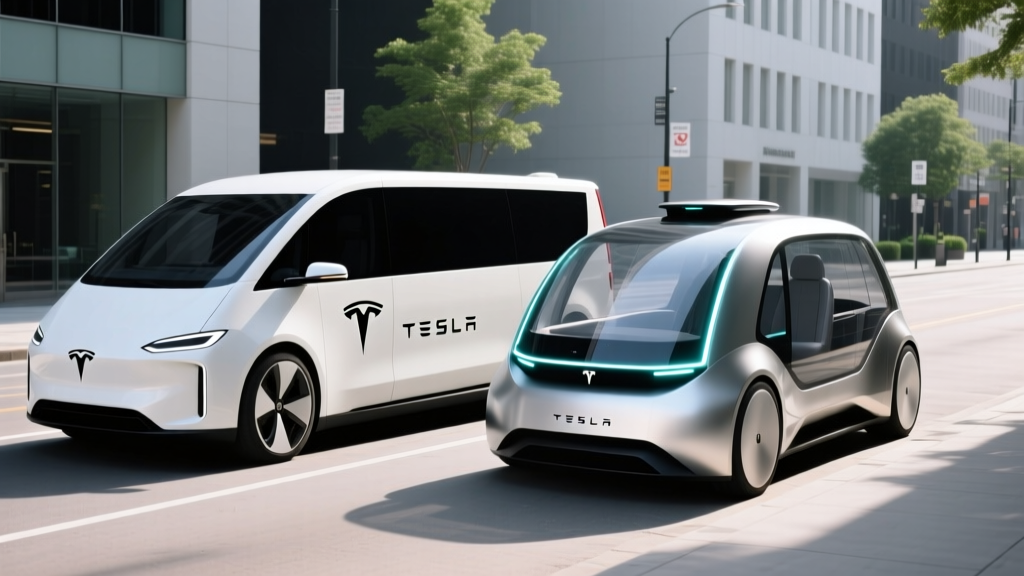
The Tesla "cybervan" search has exploded since Elon Musk unveiled the Tesla Robovan concept alongside the Cybercab at the October 2024 "We, Robot" event. As of early 2026, Tesla has not released a production van, but the Robovan prototype and the Cybercab robotaxi program provide enough confirmed and estimated data to map out what a Tesla passenger/cargo van would look like — and whether it could compete with the Ford E-Transit, Rivian EDV, and BrightDrop Zevo already serving commercial fleets.
This profile synthesizes every confirmed spec, credible estimate, and regulatory constraint around Tesla's van and robotaxi ambitions. If you're searching for a buyable Tesla cybervan today, the honest answer is that one doesn't exist yet — but the Cybercab production timeline and Robovan design language tell us exactly what's coming and when.
Tesla Robovan: What Tesla Has Actually Shown
The Robovan appeared briefly at the October 2024 Warner Bros. Studios event as a full-scale, drivable prototype. Key design elements confirmed on-stage included a monobox silhouette with no visible B-pillar, a sliding side door, a flat floor (enabled by Tesla's structural battery pack), and seating for up to 20 passengers in a shuttle configuration. Musk stated the vehicle would serve both as a passenger shuttle and a cargo hauler, with production targeted for the 2026–2027 timeframe.
As of February 2026, Tesla has not published a spec sheet, MSRP, or EPA filing for the Robovan. The following data points are estimated from the Cybercab platform, Tesla's structural 4680 battery architecture, and supply-chain reporting. Treat every number as preliminary until Tesla files with the EPA or opens reservations.
| Attribute | Estimated / Target | Source / Basis |
|---|---|---|
| Platform | Unboxed / structural pack | Tesla 2023 Investor Day |
| Battery chemistry | LFP (prismatic, structural) | Cybercab precedent, CATL supply |
| Usable battery (est.) | ~80–110 kWh | Scaled from Cybercab ~50 kWh |
| EPA range target | ~200–250 miles (shuttle) | Musk on-stage statement |
| Seating | Up to 20 (shuttle) / 6–8 (van) | Prototype interior |
| Production start | Late 2026 – 2027 | Tesla earnings calls |
| SAE automation level | Level 2 supervised (initially) | Regulatory reality |
Cybercab: The Robotaxi That's Shipping First
The Cybercab is the vehicle most likely to answer "Tesla cybervan" searchers' underlying question: when does Tesla launch a dedicated fleet vehicle? Tesla has confirmed the Cybercab will begin limited production in Austin in 2026, with a target of ~2 million units annually at full ramp. The Cybercab is a two-seat, no-steering-wheel, no-pedal robotaxi designed exclusively for the Tesla Network ride-hail service — not for individual ownership.
| Attribute | Value |
|---|---|
| Seats | 2 |
| Steering wheel / pedals | None (robotaxi-only) |
| Battery (est.) | ~50 kWh, LFP |
| EPA range target | ~200–250 miles |
| DC fast charge (est.) | ~150 kW peak, 10–80% in ~25 min |
| 0–60 mph | Not disclosed (irrelevant for robotaxi) |
| Target unit cost | <$30,000 (manufacturing cost, not MSRP) |
| Availability | Tesla Network only — not for consumer purchase |
| Production start | 2026 (Austin, limited) |
Range, Charging, and Battery: What the Numbers Mean in Practice
Charging speed is the unasked question. Tesla's structural 4680 LFP cells prioritize cycle life (5,000+ cycles) and cost over peak charge rate. Expect the Robovan to peak around 150–175 kW on a V4 Supercharger, with a 10–80% session taking roughly 25–30 minutes. The Cybercab, with its smaller pack, should hit similar peak kW but complete the session faster due to lower total kWh — roughly 20 minutes 10–80%.
For fleet operators, this charge speed is slower than the Ford E-Transit's 115 kW (which charges a smaller 68 kWh pack in ~45 minutes 10–80%) but competitive on a miles-per-minute basis because the Tesla vehicles are lighter and more aerodynamic than a box van.
Who Is the Tesla Robovan Actually For?
The Robovan is not a consumer minivan replacement. If you're a parent searching for a "Tesla cybervan" to haul kids and cargo, the Model X (despite its age) remains Tesla's only 6–7 seat option, and the Rivian R1S or Kia EV9 are more practical family haulers today.
The Robovan's target buyers are:
- Airport shuttles and hotel loops — fixed routes under 100 miles/day where depot charging works.
- Municipal transit agencies — first/last-mile connectors feeding rail stations.
- Corporate campuses — employee movers on private roads (where Level 4 autonomy is easier to permit).
- Cargo fleet operators — the flat floor and monobox shape could compete with BrightDrop Zevo 600 and Rivian EDV on last-mile delivery.
For individual consumers, the Cybercab is relevant only as a ride-hail option — you'll summon one via the Tesla app, not buy one.
Pricing, Tax Credits, and Ownership Economics
| Factor | Robovan (est.) | Cybercab |
|---|---|---|
| Base MSRP | Not announced; est. $60,000–$90,000 (fleet) | Not for sale |
| Federal §30D credit | Unlikely (MSRP cap $80k for vans; commercial-vehicle rules differ) | N/A — fleet-owned |
| Commercial clean vehicle credit (§45W) | Potentially eligible — up to $40,000 for vehicles >14,000 lb GVWR | Tesla claims as business asset |
| Ride-hail cost per mile (est.) | N/A | $0.20–$0.30/mi (Tesla target) |
Tax credit reality check: The IRS §30D credit caps vans at $80,000 MSRP and requires the buyer to meet income thresholds ($150k single / $300k joint). A Robovan priced above $80k would not qualify for the consumer credit. Fleet buyers should instead look at the §45W Commercial Clean Vehicle Credit, which has no MSRP cap and offers up to $40,000 for heavier vehicles — but requires the buyer to be a business or tax-exempt organization. Consult a tax professional before budgeting around either credit.
Competitors Already on the Road
Tesla's delay means competitors have established beachheads in the electric van segment:
| Vehicle | EPA Range | Battery | DC Charge | Starting MSRP | Status |
|---|---|---|---|---|---|
| Ford E-Transit | 126 mi | 68 kWh, NMC | 115 kW | ~$51,000 | On sale |
| Rivian EDV | ~150 mi | 111 kWh, NMC | ~200 kW | Amazon-exclusive | Limited fleet |
| BrightDrop Zevo 600 | ~250 mi | 165 kWh, NMC | 120 kW | ~$75,000 | On sale (fleet) |
| Mercedes eSprinter | ~200 mi | 113 kWh, NMC | 115 kW | ~$72,000 | On sale |
| Tesla Robovan | ~200–250 mi (est.) | ~80–110 kWh, LFP (est.) | ~150–175 kW (est.) | TBA | Prototype; 2026–2027 target |
The Robovan's theoretical advantage is cost per mile — LFP chemistry, Tesla's vertical integration, and the unboxed manufacturing process should undercut competitors on acquisition cost and energy consumption. But fleet buyers prioritize uptime, service networks, and dealer support — areas where Ford and Mercedes have decades of advantage and Tesla has a documented weakness.
Autonomy, Safety, and Regulatory Headwinds
- Operate outside NHTSA-approved geo-fenced zones without a safety driver.
- Handle unmapped construction zones, severe weather, or road closures without remote teleoperations support.
- Replace a human driver in rural or highway-corridor shuttle routes — these fall outside current Level 4 operational design domains.
Safety data for Tesla's robotaxi fleet will be scrutinized. Waymo, operating Level 4 robotaxis in Phoenix, San Francisco, and Los Angeles, has published NHTSA-reported crash data showing lower incident rates than human benchmarks in comparable urban environments — but Waymo's fleet is geofenced, weather-limited, and remotely supervised. Tesla will need to match or exceed that transparency to win fleet and regulatory trust.
Verdict: Should You Wait for the Tesla Cybervan?
- You operate a fixed-route shuttle service under 150 miles/day and can depot-charge overnight.
- You're a Tesla fleet customer already invested in Supercharger and Tesla Energy infrastructure.
- Your timeline allows a 2027+ delivery and you can absorb the risk of a first-year production ramp.
- You need a van in 2026 — the Ford E-Transit and Mercedes eSprinter are shipping today with established service networks.
- Your routes exceed 200 miles or include highway segments where Ford's dealer network provides roadside assurance.
- You require §30D or §45W tax credit certainty — Tesla's pricing and sourcing details are not yet published.
The "Tesla cybervan" is real in the sense that Tesla has shown a prototype and committed to production. It is not real in the sense that you can order one, price one, or plan a fleet around it today. For consumers, the Cybercab robotaxi will be the first tangible product of this platform — but as a ride-hail option, not a purchase. Fleet operators should monitor Tesla's 2026 earnings calls for Robovan pricing and reservation openings, but should not delay procurement decisions waiting on it.
Frequently Asked Questions
Can I buy a Tesla cybervan in 2026?
No. The Tesla Robovan is a prototype shown in October 2024 with a production target of late 2026–2027. No MSRP, reservation, or EPA certification has been published. The Cybercab robotaxi is entering limited Austin production in 2026 but is not available for consumer purchase — it will operate exclusively on the Tesla Network ride-hail service.
What will the Tesla Robovan cost?
Tesla has not announced pricing. Based on the Cybercab's sub-$30,000 manufacturing-cost target and the Robovan's larger battery and body, a reasonable estimate is $60,000–$90,000 for fleet buyers. This would position it below the BrightDrop Zevo 600 (~$75,000) and competitive with the Mercedes eSprinter (~$72,000), but Tesla's actual pricing and trim structure remain unconfirmed.
Does the Robovan qualify for the federal EV tax credit?
Uncertain. The §30D consumer credit caps van MSRP at $80,000 and has buyer income limits. If the Robovan prices above $80,000, it won't qualify for consumer buyers. Fleet buyers may instead use the §45W Commercial Clean Vehicle Credit (up to $40,000 for vehicles over 14,000 lb GVWR), which has no MSRP cap but requires business or tax-exempt ownership. Battery-sourcing and critical-mineral rules also apply under current IRS guidance.
How far can the Tesla Robovan drive on a charge?
Tesla targeted ~200–250 miles (EPA estimate, not yet certified). Real-world expectations: ~160–200 miles on highway routes, ~130–170 miles in sub-40°F weather with full passenger load and HVAC. LFP chemistry suffers more cold-weather range loss than NMC, and a 20-passenger shuttle with frequent door openings will compress range further.
How fast does the Cybercab charge?
Tesla has not published a spec sheet, but based on the ~50 kWh LFP pack and Tesla's 4680 charge-curve characteristics, expect ~150 kW peak DC charge rate and a 10–80% session in roughly 20 minutes on a V4 Supercharger. The smaller pack means faster absolute session times than the Robovan, even at similar peak kW.
Is the Cybercab actually self-driving?
Yes, within strict limits. The Cybercab is designed for SAE Level 4 autonomy — no driver, no steering wheel — but only inside geo-fenced urban zones approved by NHTSA and state regulators. Outside those zones, it will not operate. This is fundamentally different from Tesla's FSD (Supervised) in consumer vehicles, which is SAE Level 2 and requires an attentive driver at all times.
Is the Tesla Robovan worth waiting for vs. the Ford E-Transit?
For 2026 procurement, no — the E-Transit is on sale now with a 126-mile EPA range, established dealer service, and known pricing (~$51,000). The Robovan may offer superior range, lower energy cost, and Tesla's software stack, but it's at least 12–18 months from delivery and carries first-year production risk. Operators who can wait and whose routes fit the Robovan's likely range profile should monitor Tesla's announcements; everyone else should spec E-Transits or eSprinters today.