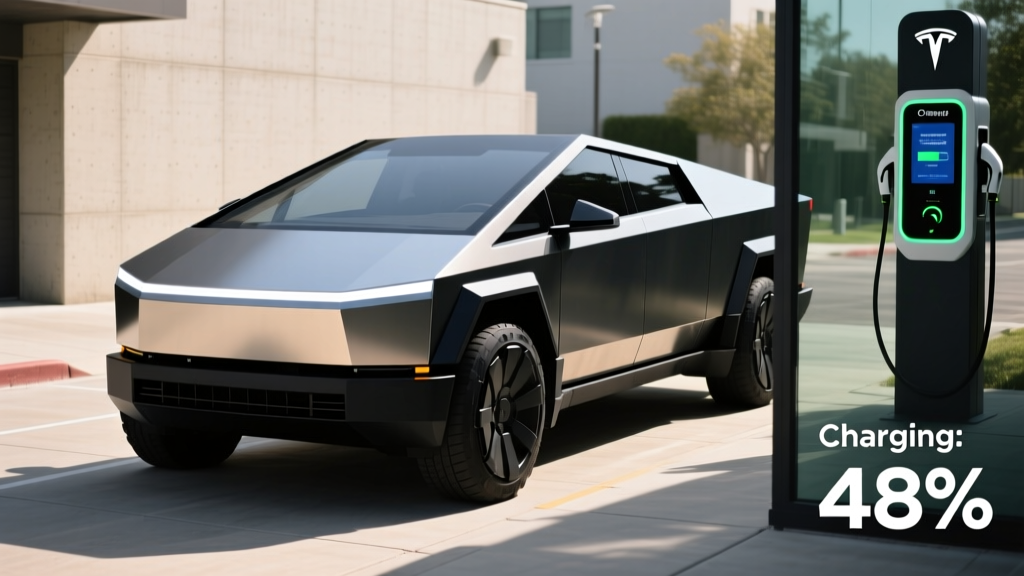
The Tesla Cybertruck is impossible to ignore—and impossible to hide on a scale. With a stainless-steel exoskeleton and a battery pack pushing past 120 kWh, the Cybertruck's curb weight lands between 6,603 and 6,843 pounds depending on the trim. That mass shapes every ownership experience: how far it goes on a charge, how fast it charges, how it handles on a mountain pass, and whether it can legally cross certain bridges. This review dissects the Cybertruck's weight-related engineering trade-offs alongside the range, charging, pricing, and tech data buyers actually need in 2026.
Spec Table: Cybertruck AWD, Foundation Series, and Cyberbeast
| Specification | AWD (Dual-Motor) | Foundation Series (Tri-Motor) | Cyberbeast (Tri-Motor) |
|---|---|---|---|
| Curb Weight | 6,603 lbs | 6,843 lbs | 6,843 lbs |
| GVWR | 8,900 lbs | 9,100 lbs | 9,100 lbs |
| Battery (Usable) | ~123 kWh (NMC) | ~123 kWh (NMC) | ~123 kWh (NMC) |
| EPA Range | 340 mi | 320 mi | 320 mi |
| Range w/ Range Extender | 470+ mi | 440+ mi | 440+ mi |
| MPGe (Combined) | 70 MPGe | 65 MPGe | 65 MPGe |
| kWh/100 mi | 48 kWh | 52 kWh | |
| Horsepower | 600 hp | 845 hp | 845 hp |
| 0–60 mph | 4.1 sec | 2.6 sec | 2.6 sec |
| Top Speed | 112 mph | 130 mph | 130 mph |
| Max Tow Capacity | 11,000 lbs | 11,000 lbs | 11,000 lbs |
| Payload | 2,297 lbs | 2,057 lbs | 2,057 lbs |
| Base MSRP | $79,990 | $99,990 | $99,990 |
| Battery/Drive Warranty | 8 yr / 120,000 mi | 8 yr / 120,000 mi | 8 yr / 120,000 mi |
Why Tesla Cybertruck Weight Matters for Range and Efficiency
The Cybertruck's 6,603-to-6,843-pound curb weight places it squarely in Class 2b/3 territory, rivaling heavy-duty diesel pickups. That mass is not incidental—it is a direct consequence of three design choices:
- Stainless-steel exoskeleton: 30X cold-rolled ultra-hard stainless steel is dent-resistant but significantly heavier than aluminum or stamped steel body panels.
- Battery pack size: The ~123 kWh usable NMC (nickel-manganese-cobalt) pack weighs an estimated 1,800–2,000 lbs alone. Tesla uses a 4680-cell structural pack that doubles as a stressed chassis member, reducing separate frame weight but concentrating mass low and central.
- Tri-motor powertrain: The Foundation Series and Cyberbeast add a front motor plus two rear motors, adding roughly 150 lbs over the dual-motor AWD.
The efficiency consequence is measurable. The dual-motor AWD consumes 48 kWh per 100 miles (70 MPGe combined per fueleconomy.gov). The tri-motor variants sip 52 kWh/100 mi (65 MPGe). For comparison, the Ford F-150 Lightning Extended Range uses 48 kWh/100 mi at a curb weight of roughly 6,300 lbs, and the Rivian R1T Dual-Motor Max uses 46 kWh/100 mi at ~7,150 lbs. The Cybertruck is less efficient per pound than both, partly due to its angular aerodynamics (Cd ~0.38 estimated) and the energy required to accelerate 6,800+ lbs repeatedly in stop-and-go driving.
EPA 340 mi (AWD) / 320 mi (tri-motor). Expect ~270–290 mi at sustained 75 mph highway speeds, and ~220–250 mi in sub-30°F cold weather without preconditioning. The optional Range Extender battery (mounted in the bed) adds ~130 mi but reduces cargo space and adds ~400 lbs, partially offsetting its benefit.
Charging Speed: DC Fast, Level 2, and the Weight Factor
Moving 6,800 lbs requires a massive battery, and recharging that battery is where Cybertruck ownership demands planning. The truck uses NACS natively and accesses the full Tesla Supercharger network plus NACS-adapted Electrify America and other stations.
| Charging Method | Peak Power | 10–80% Time | Miles Added per Hour |
|---|---|---|---|
| DC Fast Charge (V4 Supercharger) | ~350 kW peak | ~17 minutes | N/A (session-based) |
| DC Fast Charge (250 kW V3 Supercharger) | ~250 kW peak | ~22 minutes | N/A |
| Home Level 2 (Wall Connector, 48A / 11.5 kW) | 11.5 kW | ~12.5 hours (0–100%) | ~37 mi/hr |
| Home Level 2 (32A / 7.7 kW) | 7.7 kW | ~18 hours (0–100%) | ~25 mi/hr |
| Level 1 (120V / 12A) | 1.4 kW | Days | ~3–4 mi/hr |
The charging curve is the critical detail most spec sheets omit. The Cybertruck peaks near 350 kW only between roughly 10–30% state of charge on a V4 Supercharger, then tapers progressively. From 50–80%, expect sustained rates closer to 120–150 kW. This is standard lithium-ion behavior driven by cell temperature and voltage limits, but it means a "17-minute 10–80%" claim assumes ideal battery preconditioning (the truck navigates to a Supercharger and preheats the pack automatically). Cold-soak the battery and that 10–80% session stretches to 30+ minutes.
For home charging, a 48-amp Tesla Wall Connector on a 60-amp circuit delivers 11.5 kW—enough to replenish roughly 260 miles overnight in 7 hours. Most daily driving requires far less. Budget $800–$1,500 for a licensed electrician to install a 240V/60A circuit, plus potential panel upgrades if your home's service is below 150 amps.
Performance: Defying Physics at 6,843 Pounds
The Cyberbeast's 2.6-second 0–60 mph time is the headline, but the more impressive engineering feat is making a 6,843-lb vehicle handle with any composure. Tesla achieves this through:
- Steer-by-wire: No mechanical connection between the yoke and the rack. Enables a variable steering ratio (as low as 5:1 at parking speeds, ~15:1 at highway speeds) and rear-wheel steering up to 10 degrees.
- Adaptive air suspension: 12 inches of travel, adjustable ride height from 7" to 16" ground clearance. Automatically lowers at highway speed to reduce drag.
- 48-volt electrical architecture: A first for a production vehicle at this scale. Enables faster-acting suspension dampers, steer-by-wire responsiveness, and reduces wiring-harness weight by roughly 50 lbs.
The dual-motor AWD's 4.1-second 0–60 is more relevant for most buyers—quick enough for confident highway merging while returning slightly better efficiency. Towing capacity maxes at 11,000 lbs across all trims, though real-world range while towing a 7,000-lb trailer drops to roughly 120–150 miles based on owner reports and third-party testing.
Pricing, Trims, and Federal Tax Credit Eligibility
| Trim | Base MSRP | Est. Tax-Credit-Adjusted Price* | Destination |
|---|---|---|---|
| AWD (Dual-Motor) | $79,990 | $72,490 | $1,995 |
| Foundation Series (Tri-Motor) | $99,990 | $92,490 | $1,995 |
| Cyberbeast (Tri-Motor) | $99,990 | $92,490 | $1,995 |
*Assumes full $7,500 §30D federal tax credit applied at point of sale. Eligibility is not guaranteed.
The Cybertruck faces a complicated tax-credit landscape under IRS §30D rules for 2026. Here is what buyers must verify before counting on the credit:
- MSRP cap: Trucks and SUVs must have an MSRP at or below $80,000. The AWD trim at $79,990 clears this threshold. The Foundation Series and Cyberbeast at $99,990 do not qualify under the standard §30D credit for new vehicles.
- Buyer income cap: Modified adjusted gross income must not exceed $300,000 (joint), $225,000 (head of household), or $150,000 (single).
- Battery sourcing: A percentage of critical minerals and battery components must be sourced from the U.S. or FTA partners. Tesla's 4680 cells use a mix of domestic and imported materials; verify current-year compliance on the IRS Clean Vehicle Credit list at irs.gov.
- Point-of-sale transfer: Eligible buyers can transfer the credit to the dealer at purchase, reducing the purchase price by up to $7,500 upfront rather than waiting for a tax refund.
For buyers eyeing the Foundation Series or Cyberbeast: some owners have explored commercial-vehicle tax strategies (§45W) or state-level incentives that may offset cost. Consult a tax professional—do not rely on dealer assurances.
Cargo, Passenger Space, and Daily Practicality
The Cybertruck seats five across two rows with the following dimensions:
- Front legroom: 41.1 inches
- Rear legroom: 38.4 inches
- Bed length: 6 feet (72 inches) with tailgate down; 7.5 feet with mid-gate open into the cabin
- Bed width: 48 inches between wheel wells
- Cargo volume (bed): ~67 cu ft (bed alone), expandable with mid-gate
- Frunk: ~7 cu ft (lockable, front trunk)
- Bed payload: 2,297 lbs (AWD) / 2,057 lbs (tri-motor)
The motorized tonneau cover is a standout—rated to support 300 lbs of distributed weight (yes, you can stand on it). The bed's composite liner and built-in 120V/240V outlets (up to 9.6 kW of vehicle-to-load power via Powershare) make it a genuine mobile workstation. However, the angular bed design and integrated spoiler mean fitting a standard 4×8 sheet of plywood flat is tight, and the high bed walls (36+ inches from ground) make loading heavy items without a ramp more difficult than on a conventional low-slung truck bed.
Inside, the 18.5-inch front touchscreen and 9.4-inch rear screen run Tesla's latest software with integrated navigation, streaming, and a full camera-based "surround-view" that replaces traditional mirrors in some markets (U.S. still requires physical mirrors as of 2026). The yoke steering remains polarizing—excellent for screen visibility, awkward for three-point turns and low-speed maneuvering despite the variable-ratio steer-by-wire.
Tech, Driver Assistance, and What It Cannot Do
Every Cybertruck ships with Tesla's Basic Autopilot (lane centering, adaptive cruise control, automatic emergency braking). Full Self-Driving (Supervised) remains a $8,000 add-on or $99/month subscription.
Tesla Autopilot and FSD (Supervised) are Level 2 driver-assistance systems, not self-driving. The driver must remain fully engaged, hands on the yoke, eyes on the road at all times. Tesla's cabin camera monitors attention. Only Level 4 systems (Waymo, Zoox) operate without a human driver in defined service areas.
- Does not stop for all traffic lights or stop signs without confirmation
- Struggles with construction zones, faded lane markings, and unmapped roads
- Performance degrades in heavy rain, snow, and direct sun glare
- Driver is legally liable for all actions; NHTSA requires incident reporting
Unique Cybertruck tech includes "Armor Glass" (laminated composite that resists impacts far better than standard tempered glass), a HEPA bioweapon-defense air filtration mode, and the aforementioned Powershare V2L capability—enough to run a welder, power tools at a job site, or keep a home's essential circuits alive during an outage (with proper transfer-switch installation).
Pros, Cons, and Verdict
- Class-leading 11,000-lb towing capacity for an EV pickup
- 9.6 kW V2L Powershare for job-site and emergency power
- 48-volt architecture enables best-in-class steer-by-wire and suspension response
- Stainless exoskeleton eliminates paint-shop repairs for minor dents
- Tri-motor Cyberbeast defies physics: 2.6s 0–60 at 6,843 lbs
- Heavy curb weight (6,603–6,843 lbs) penalizes efficiency: 48–52 kWh/100 mi
- Real-world highway range falls 50–70 mi below EPA in cold weather
- Only the AWD trim ($79,990) clears the §30D MSRP cap for the federal tax credit
- Yoke steering and steer-by-wire require a significant adaptation period
- Large footprint (231" L × 80" W) is challenging in tight urban garages
- Stainless panels show fingerprints and are difficult to repair if deeply scratched
- Choose the AWD ($79,990) if: You want maximum range (340 mi EPA), tax-credit eligibility, and daily-driver practicality with 11,000-lb towing when needed.
- Choose the Cyberbeast ($99,990) if: Performance is the priority, you accept the efficiency trade-off, and the §30D MSRP cap disqualification does not concern you.
- Look at the Rivian R1T or F-150 Lightning if: You prefer a conventional steering wheel, more traditional truck-bed ergonomics, or need a crew-cab six-foot-bed layout with easier urban maneuverability.
Frequently Asked Questions
What is the Tesla Cybertruck's curb weight?
The dual-motor AWD weighs 6,603 lbs. The tri-motor Foundation Series and Cyberbeast weigh 6,843 lbs. Gross Vehicle Weight Rating (GVWR) is 8,900–9,100 lbs.
What is the real-world range of the Cybertruck?
The EPA rates the AWD at 340 miles and tri-motor trims at 320 miles. In real-world highway driving at 75 mph, expect 270–290 miles. In sub-freezing temperatures, range drops to 220–250 miles without consistent preconditioning.
How fast does the Cybertruck charge?
On a V4 Supercharger, the Cybertruck peaks near 350 kW and charges 10–80% in approximately 17 minutes with battery preconditioning. On a V3 (250 kW) Supercharger, 10–80% takes roughly 22 minutes. Home Level 2 at 11.5 kW adds about 37 miles per hour of charging.
Does the Cybertruck qualify for the $7,500 federal EV tax credit?
The AWD trim at $79,990 MSRP meets the §30D truck/SUV MSRP cap of $80,000. The Foundation Series and Cyberbeast at $99,990 do not qualify under the standard new-vehicle credit. All trims require the buyer to meet income caps ($150K single / $300K joint) and the vehicle must meet current-year battery-sourcing rules. Verify at irs.gov before purchasing.
Is the Cybertruck worth buying vs. the F-150 Lightning or Rivian R1T?
The Cybertruck leads in towing (11,000 lbs vs. Lightning's 10,000 and R1T's 11,000) and V2L power output (9.6 kW). The F-150 Lightning offers a more conventional truck experience and lower starting price. The Rivian R1T provides better efficiency, a front trunk, and a more refined interior. If you need a mobile power station and can accept the weight-driven efficiency penalty, the Cybertruck is uniquely capable.
How does the Cybertruck's weight affect tire wear and maintenance?
At 6,800+ lbs, tire wear accelerates significantly compared to lighter vehicles. Expect to replace tires every 25,000–35,000 miles depending on driving style. Tesla specifies high-load-rated 35×8.5R20 tires (Goodyear Territory RT or similar), which cost $350–$500 per tire. Brake wear is minimal thanks to regenerative braking handling the majority of deceleration.