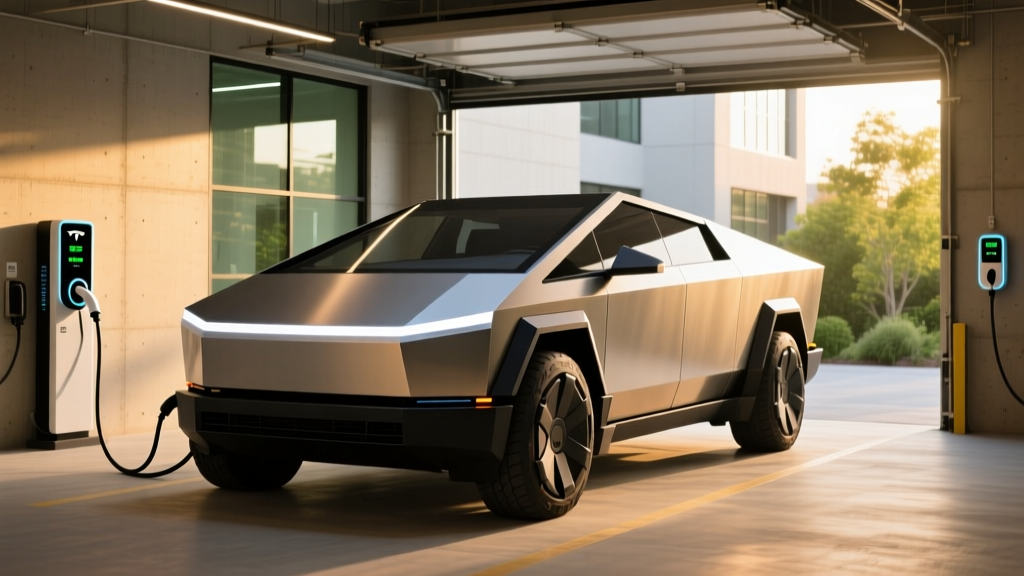
The Tesla Cybertruck is one of the heaviest consumer vehicles on the road, and that mass shapes everything about ownership — from real-world range and tire wear to charging times and payload capacity. If you're researching the Tesla truck weight and what it means for daily driving, towing, and long-term costs, this profile covers the exact numbers you need.
Below, we break down the 2026 Tesla Cybertruck lineup — the Long Range AWD, the tri-motor Cyberbeast, and the anticipated Rear-Wheel-Drive variant — with EPA figures, real-world range caveats, charging-curve realities, and current federal tax credit eligibility under IRS §30D rules.
Spec Table: Tesla Cybertruck Weight, Range & Performance at a Glance
| Spec | Long Range AWD | Cyberbeast (Tri-Motor AWD) | Rear-Wheel-Drive* |
|---|---|---|---|
| Curb Weight | 6,603 lbs | 6,843 lbs | ~6,200 lbs (est.) |
| GVWR | 9,000 lbs | 9,000 lbs | TBD |
| EPA Range | 340 miles | 320 miles | ~250 miles (est.) |
| Battery (usable) | ~123 kWh, NMC | ~123 kWh, NMC | Smaller pack, chemistry TBD |
| Max DC Fast Charge | 250 kW | 250 kW | TBD |
| 10–80% DC Charge Time | ~27 min | ~27 min | TBD |
| Level 2 Home Charging | 11.5 kW (~37 mi/hr) | 11.5 kW (~37 mi/hr) | TBD |
| 0–60 mph | 3.9 sec | 2.6 sec | ~5.5 sec (est.) |
| Horsepower | 600 hp | 845 hp | TBD |
| Drivetrain | Dual-Motor AWD | Tri-Motor AWD | RWD |
| Towing Capacity | 11,000 lbs | 11,000 lbs | TBD |
| Payload Capacity | 2,500 lbs | 2,500 lbs | TBD |
| Base MSRP | $79,990 | $99,990 | ~$60,990 (announced) |
| MPGe (combined) | 64 MPGe | 59 MPGe | TBD |
| Efficiency (kWh/100mi) | 53 kWh/100mi | 57 kWh/100mi | TBD |
*Rear-Wheel-Drive variant is announced for 2026 production. Specs are preliminary estimates based on Tesla filings and are subject to change. Do not treat as final purchasing data.
Why Tesla Cybertruck Weight Matters for Range and Efficiency
At 6,603 pounds for the Long Range AWD and 6,843 pounds for the Cyberbeast, the Cybertruck is significantly heavier than the Ford F-150 Lightning (~6,500 lbs for the Extended Range) and the Rivian R1T (~7,150 lbs for the Quad-Motor with Max Pack). This mass comes from the stainless-steel exoskeleton, the large ~123 kWh NMC battery pack, and heavy-duty suspension components rated for an 11,000-lb towing capacity.
Weight directly impacts energy consumption. The Long Range AWD consumes 53 kWh per 100 miles (64 MPGe combined), while the Cyberbeast's tri-motor setup pushes that to 57 kWh/100mi (59 MPGe). For comparison, the lighter Tesla Model Y Long Range uses roughly 28 kWh/100mi. That's nearly double the energy cost per mile — a factor that compounds on road trips and in cold weather.
The EPA rates the Long Range AWD at 340 miles and the Cyberbeast at 320 miles. In practice, expect:
- Highway driving (70–75 mph): ~270–290 miles usable range before needing to charge. Aerodynamic drag on the truck's angular body and heavy mass at sustained speed reduce efficiency by 15–20%.
- Cold weather (below 32°F): ~230–260 miles. The large battery requires significant energy for thermal management, and cabin heating further reduces range. Preconditioning while plugged in mitigates some loss.
- Towing: Range drops dramatically to an estimated 120–170 miles when towing near the 11,000-lb capacity. Plan charging stops accordingly.
Source: EPA fueleconomy.gov
Charging Speed: DC Fast Charging and Home Level 2
The Cybertruck uses the NACS (North American Charging Standard) connector natively — no adapter needed for Tesla Superchargers. Both the Long Range and Cyberbeast support a peak DC fast-charge rate of 250 kW at V3 Supercharger stalls and compatible third-party stations.
| Charging Method | Power / Rate | Time or Miles Added |
|---|---|---|
| DC Fast Charge (peak) | 250 kW | 10–80% in ~27 minutes |
| DC Fast Charge (sustained avg.) | ~140–160 kW avg. | 136 miles in 15 min (Tesla claim) |
| Level 2 Home (48A / 11.5 kW) | 11.5 kW | ~37 miles per hour of charging |
| Level 2 Home (32A / 7.7 kW) | 7.7 kW | ~25 miles per hour of charging |
| Level 1 (120V / 12A) | 1.4 kW | ~3–4 miles per hour (emergency only) |
Charging-curve reality check: The Cybertruck will not sustain 250 kW for the entire session. Like all EVs, charge rate tapers significantly above 80% state of charge (SoC) to protect the NMC battery cells. Expect peak rates between 10–50% SoC, with a sharp taper after 80%. On a road trip, plan stops around the 10–80% window for the fastest turnaround.
At home on a 48-amp Level 2 circuit (requiring a 60-amp breaker), a full overnight charge from 20% to 80% takes approximately 6.5–7 hours — adequate for most daily driving. A licensed electrician should assess your panel capacity before installation, as the Cybertruck's large battery benefits from the higher amperage.
Performance: 0–60, Horsepower, and Drivetrain
Despite the Tesla truck weight exceeding 6,600 lbs, the electric powertrain delivers acceleration that defies the mass.
The Long Range AWD uses a dual-motor setup producing 600 hp and hits 0–60 mph in 3.9 seconds. The Cyberbeast adds a third rear motor for 845 hp and a blistering 2.6-second 0–60 time — faster than most sports cars, let alone a full-size truck.
Both models feature adaptive air suspension with up to 17 inches of ground clearance in Off-Road mode, torque vectoring, and a steer-by-wire system that replaces the traditional mechanical steering column. The 48-volt electrical architecture (a first in a mass-production vehicle) enables faster-responding actuators and reduces wiring harness weight.
The steering-by-wire system and rear-wheel steering give the Cybertruck a tighter turning radius (38.1 feet) than you'd expect for a vehicle this size, but it takes some acclimation. Some drivers report a detached feel at low speeds compared to conventional hydraulic or electric power steering.
Pricing, Trims, and Federal Tax Credit Eligibility
The Cybertruck's pricing has shifted since its initial announcement, and as of 2026, Tesla offers two available trims with a third announced:
| Trim | Base MSRP | Federal §30D Credit | Effective Price |
|---|---|---|---|
| Long Range AWD | $79,990 | $0 (exceeds MSRP cap) | $79,990 |
| Cyberbeast | $99,990 | $0 (exceeds MSRP cap) | $99,990 |
| Rear-Wheel-Drive* | ~$60,990 | Potentially eligible | TBD |
Tax credit reality: Under current IRS §30D rules, the federal EV tax credit has an MSRP cap of $80,000 for trucks, vans, and SUVs (source: IRS.gov). The Long Range AWD at $79,990 technically falls under the cap, but you must also satisfy:
- Buyer income limits: Modified AGI ≤ $300,000 (joint), $225,000 (head of household), $150,000 (single)
- Battery component sourcing: Increasingly strict critical-mineral and battery-component requirements that change annually through 2032
- Point-of-sale transfer: As of 2024+, the credit can be transferred to the dealer at purchase for an immediate price reduction, or claimed on your tax return
The Long Range AWD may qualify for a partial or full $7,500 credit depending on battery-sourcing compliance for the specific production batch. The Cyberbeast at $99,990 is categorically ineligible due to the MSRP cap. Always verify current eligibility with a tax professional and the fueleconomy.gov tax credit tool before purchasing.
Cargo, Interior Space, and Utility
The Cybertruck's angular design creates unusual interior proportions. Key dimensions:
- Bed length: 72.8 inches (6 feet)
- Bed width (between wheel wells): 43.3 inches
- Cargo bed volume: ~65 cu ft (with tonneau cover closed)
- Front trunk (frunk): ~7.1 cu ft (lockable, weather-sealed)
- Front legroom: 41.3 inches
- Rear legroom: 34.8 inches (tighter than the F-150 Lightning's 40.3 inches)
- Seating: 6-passenger capacity with front bench option (configurable to 5 with front buckets)
The motorized tonneau cover is one of the Cybertruck's most practical features — it's rated to support 300 lbs of static load and locks automatically. However, the triangular bed geometry and steeply raked tailgate limit the types of cargo you can carry compared to a conventional rectangular truck bed. Standard 4×8 sheets of plywood do not fit flat on the bed floor without extending past the tailgate.
Tech, Driver Assistance, and Safety
The Cybertruck runs Tesla's current-generation infotainment on an 18.5-inch front touchscreen and a 9.4-inch rear screen. Key tech features include:
- Autopilot (standard): Adaptive cruise control, lane-keeping, automatic emergency braking — SAE Level 2 driver assistance, not self-driving
- Full Self-Driving (Supervised) (optional, ~$8,000): Enhanced city/highway navigation, auto lane changes, traffic light recognition — still SAE Level 2 requiring active driver supervision
- Steer-by-wire: Variable steering ratio that adjusts based on speed; fewer turns lock-to-lock than conventional systems
- 48V architecture: Enables faster electronic actuation and powers the steer-by-wire and rear-wheel steering
- Bioweapon Defense Mode: HEPA-grade cabin air filtration
- Exoskeleton: Ultra-hard 30X cold-rolled stainless-steel body panels (no paint required, though Tesla offers wraps)
Autopilot and FSD (Supervised) are SAE Level 2 systems. The driver must keep hands on the yoke/steering wheel, monitor the road at all times, and be prepared to take over immediately. These are not autonomous driving systems. Tesla's naming conventions ("Full Self-Driving") can be misleading — the vehicle cannot drive itself without human oversight.
Safety ratings for the Cybertruck have been published by NHTSA. The truck earned a 5-star overall rating, though its mass and stiff exoskeleton raise compatibility concerns in collisions with lighter vehicles — a factor the IIHS has flagged for heavy EVs generally.
Battery Chemistry, Warranty, and Longevity
The Cybertruck Long Range and Cyberbeast use a nickel-manganese-cobalt (NMC) lithium-ion battery pack with approximately 123 kWh of usable capacity. NMC chemistry offers high energy density — necessary to achieve 320–340 miles in a vehicle this heavy — but it's more sensitive to sustained high SoC and extreme temperatures than LFP chemistry.
Tesla's battery and drive unit warranty covers:
- Battery: 8 years / 120,000 miles, whichever comes first, with minimum 70% capacity retention
- Drive unit: 8 years / 120,000 miles
- Vehicle limited warranty: 4 years / 50,000 miles
Longevity best practices for NMC: For daily driving, Tesla recommends setting the charge limit to 80% and only charging to 100% when needed for long trips. Avoid leaving the truck at 100% SoC for extended periods, especially in hot climates. Use Scheduled Departure to precondition the battery before driving — this improves efficiency and enables faster DC charging on the road.
Pros, Cons, and Verdict: Who Should Buy the Cybertruck?
Pros
- 11,000-lb towing capacity and 2,500-lb payload
- Supercar-level acceleration (2.6 sec Cyberbeast)
- Native NACS — full Supercharger network access
- Stainless-steel body resists dents, needs no paint
- 48V architecture and steer-by-wire are genuinely innovative
- Locking tonneau cover with 300-lb load rating
Cons
- Heavy curb weight (6,603–6,843 lbs) hurts efficiency
- Real-world highway range ~270–290 mi, less in cold
- Rear legroom (34.8 in) trails F-150 Lightning
- Bed geometry limits standard cargo (no flat 4×8 plywood)
- No federal tax credit for Cyberbeast (MSRP cap)
- Steer-by-wire feel takes acclimation
- High energy cost per mile (53–57 kWh/100mi)
Decision Framework
- Choose the Long Range AWD if: You need serious towing capacity, want the best range in the lineup, and your budget is around $80K. Best for work-truck users who also want daily-driver comfort.
- Choose the Cyberbeast if: Performance is a priority, you rarely tow at max capacity, and the $99K price (with no tax credit) fits your budget. It's a luxury performance truck, not a fleet workhorse.
- Wait for the RWD if: You want a lower entry price (~$61K), don't need AWD, and primarily drive in mild climates. This variant may also be the only Cybertruck eligible for the §30D tax credit.
- Look elsewhere if: Maximum interior space, conventional truck-bed utility, or lower energy costs per mile are priorities. The Ford F-150 Lightning and Rivian R1T are strong alternatives.
Frequently Asked Questions
What is the real-world range of the Tesla Cybertruck?
The EPA rates the Long Range AWD at 340 miles and the Cyberbeast at 320 miles. In real-world highway driving at 70–75 mph, expect 270–290 miles. In freezing temperatures, range drops to approximately 230–260 miles. When towing near the 11,000-lb limit, plan for 120–170 miles between charges.
How fast does the Cybertruck charge?
At a 250 kW DC fast charger (V3 Supercharger), the Cybertruck charges from 10–80% in approximately 27 minutes. Peak charge rate is 250 kW, but sustained average is closer to 140–160 kW due to the charge-curve taper above 50% SoC. At home on a 48A Level 2 charger (11.5 kW), expect roughly 37 miles of range added per hour.
How much does the Cybertruck cost after tax credits?
The Long Range AWD starts at $79,990 and the Cyberbeast at $99,990. The Cyberbeast is ineligible for the federal §30D tax credit due to the $80,000 MSRP cap for trucks. The Long Range AWD sits just under the cap but must also meet battery-sourcing and buyer-income requirements to qualify for up to $7,500. Consult a tax professional and check IRS.gov for current rules.
Is the Cybertruck worth buying vs. the F-150 Lightning or Rivian R1T?
It depends on your priorities. The Cybertruck offers the highest towing capacity (11,000 lbs) and the fastest acceleration in the segment, plus native Supercharger access. However, the F-150 Lightning provides more rear-seat room, a more conventional bed, and potentially lower pricing with tax credit eligibility. The Rivian R1T offers superior off-road capability and a more refined interior but at a higher price point. Test-drive all three before deciding.
Does the Cybertruck's weight affect tire wear and maintenance?
Yes. At over 6,600 lbs, the Cybertruck's mass accelerates tire wear compared to lighter vehicles. Tesla specifies LT-metric (light truck) tires rated for the GVWR. Expect tire replacement every 25,000–35,000 miles depending on driving style and load. Replacement tires for the 35-inch OEM size typically cost $300–$450 each.
Does the Cybertruck qualify for the federal EV tax credit?
The Long Range AWD at $79,990 may qualify for the full or partial $7,500 §30D credit, depending on battery-sourcing compliance and buyer income. The Cyberbeast at $99,990 does not qualify due to the MSRP cap. The upcoming RWD variant may be eligible. Rules change annually — always verify current eligibility at the point of purchase.