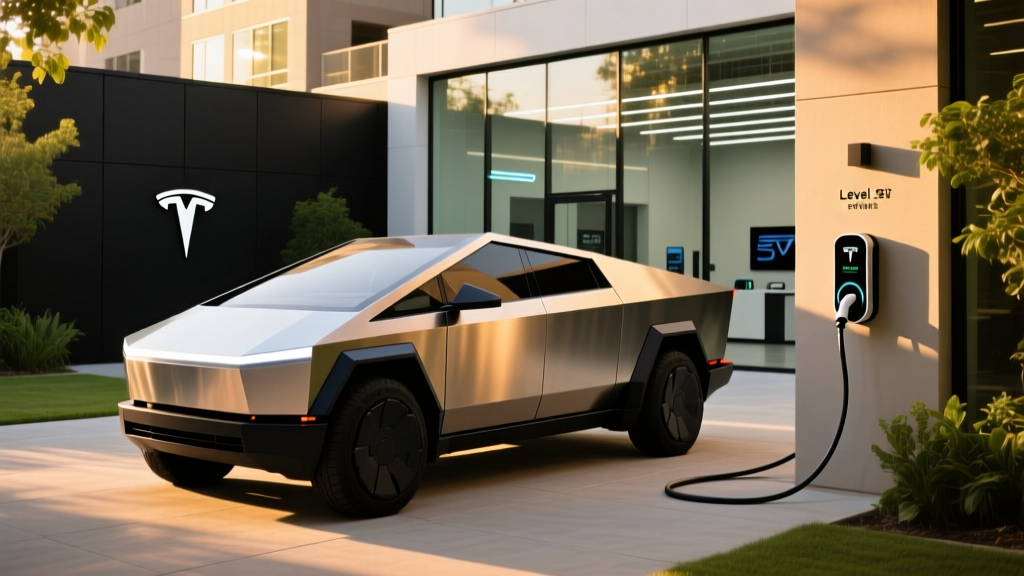
The Tesla Cybertruck is unlike anything else on the road—a stainless-steel exoskeleton, 48-volt architecture, steer-by-wire, and a starting price that still raises eyebrows. But for buyers dropping $80,000 to $100,000+ on an electric pickup, the long-term protection matters just as much as the 0-60 time. The Tesla Cybertruck warranty is a critical piece of the ownership equation, especially given the vehicle's novel construction and first-generation powertrain components.
This review dissects every layer of Cybertruck coverage—from the limited vehicle warranty to the battery and drive unit guarantees—while also delivering the hard specs buyers need: real-world range, charging speeds, efficiency, cargo dimensions, and 2026 tax credit eligibility. Whether you're weighing the AWD, Cyberbeast, or the upcoming RWD trim, this is the ownership-protection and spec guide you need before signing.
Tesla Cybertruck Warranty: Full Coverage Breakdown
Tesla structures its warranty in three tiers for the Cybertruck. Because the truck uses a radically different architecture from the Model 3/Y platform—including a 48-volt electrical system, rear-wheel steering, and steer-by-wire—the warranty categories deserve close inspection.
| Category | Coverage Period | Mileage Limit | Notes |
|---|---|---|---|
| Limited Vehicle Warranty (bumper-to-bumper) | 4 years | 50,000 miles | Covers body, interior, electronics, suspension, HVAC |
| Battery Warranty | 8 years | 120,000 miles | Minimum 70% capacity retention guaranteed |
| Drive Unit Warranty | 8 years | 120,000 miles | Covers motors, inverter, gearbox |
The 8-year/120,000-mile battery and drive unit warranty is competitive with the broader EV truck segment. Ford matches it on the F-150 Lightning (8 yr/100,000 mi on battery), while Rivian offers 8 years/175,000 miles on its battery and drive motors. Tesla's 70% capacity retention threshold is the industry standard—if your battery degrades below 70% of original capacity within the warranty window, Tesla will replace or repair it to meet that threshold.
What's not covered: Cosmetic stainless-steel panel discoloration, tire wear, damage from off-road use beyond light gravel, and modifications to the 48-volt system. Tesla's warranty also excludes "cosmetic corrosion" on the exoskeleton, which is relevant for owners in salt-belt states.
Range, Battery & Efficiency: What the EPA Says vs. Reality
The Cybertruck's angular, brick-like aerodynamics (drag coefficient of ~0.38 Cd) take a toll on highway efficiency that the EPA combined cycle doesn't fully capture. Here's what the numbers actually look like.
| Trim | Battery (usable kWh) | Chemistry | EPA Range | MPGe (combined) | kWh/100 mi |
|---|---|---|---|---|---|
| AWD (Dual Motor) | ~123 kWh | NMC (2170 cells) | 340 miles | 67 MPGe | 50 |
| Cyberbeast (Tri Motor) | ~123 kWh | NMC (2170 cells) | 320 miles | 63 MPGe | 53 |
The Cybertruck uses a structural battery pack with 2170-format NMC (nickel-manganese-cobalt) cells. Unlike the Model 3 RWD's LFP chemistry, NMC provides higher energy density—essential for a 6,700-pound truck—but requires owners to avoid routinely charging to 100% for daily use. Tesla recommends a daily charge limit of 80–90% for NMC packs, reserving 100% for road trips.
Range Extender: Tesla has announced a bed-mounted range extender battery pack that would push total range to an estimated 440+ miles. As of early 2026, this add-on remains unreleased and is not yet available for purchase. Treat any range claims involving the extender as preliminary.
Charging Speed: DC Fast, Level 2 & the 800-Volt Advantage
The Cybertruck was one of Tesla's first vehicles to ship with a native NACS charge port and an 800-volt-class battery architecture, enabling significantly faster DC charging than the 400-volt systems in earlier Teslas.
| Charging Level | Power / Rate | Speed |
|---|---|---|
| DC Fast Charge (V4 Supercharger) | Up to 350 kW peak | 10–80% in ~15–18 minutes |
| DC Fast Charge (V3 Supercharger / 250 kW) | Up to 250 kW peak | 10–80% in ~22–25 minutes |
| Level 2 (Tesla Wall Connector, 48A) | 11.5 kW | ~34 miles of range per hour |
| Level 1 (120V household outlet) | ~1.4 kW | ~3–4 miles of range per hour |
Charging-curve reality check: The 350 kW peak rate is not sustained. On a V4 Supercharger, the Cybertruck peaks near 350 kW between roughly 10–25% state of charge, then tapers to ~250 kW through 50%, ~150 kW through 70%, and drops sharply above 85%. The 10–80% time of 15–18 minutes assumes battery preconditioning is active (which happens automatically when you navigate to a Supercharger in the truck's navigation system).
Without preconditioning—say, arriving at a non-Tesla DC fast charger via a third-party app—your initial charge rate may start at 50–100 kW and take several minutes to ramp up. Always precondition for fastest results.
At home, the Tesla Wall Connector at 48 amps on a 60-amp circuit delivers 11.5 kW. With a ~123 kWh battery, a full 10–100% charge takes roughly 11–12 hours. Most owners charging overnight from 20% will reach 80% in about 7 hours. If your home electrical panel supports only a 40-amp circuit (32A / 7.7 kW), expect closer to 22 miles of range per hour and longer top-up times. Always have a licensed electrician assess your panel capacity before installing a Level 2 charger.
Performance, Drivetrain & Towing Specs
The Cybertruck's performance numbers are supercar-adjacent in the Cyberbeast trim, but even the dual-motor AWD version is remarkably quick for a vehicle this heavy.
| Spec | AWD (Dual Motor) | Cyberbeast (Tri Motor) |
|---|---|---|
| 0–60 mph | 3.9 seconds | 2.6 seconds |
| Horsepower | 600 hp | 845 hp |
| Drivetrain | AWD (dual motor) | AWD (tri motor) |
| Top Speed | 112 mph | 130 mph |
| Max Towing Capacity | 11,000 lbs | 11,000 lbs |
| Payload Capacity | 2,500 lbs | 2,500 lbs |
The tri-motor Cyberbeast uses two rear motors and one front motor with torque vectoring on the rear axle. This setup enables the 2.6-second 0–60 time, though repeated hard launches will trigger thermal management limits. For towing, the Cybertruck's 11,000-pound rating is competitive with the F-150 Lightning (10,000 lbs extended range) and Rivian R1T (11,000 lbs dual motor). Note that towing near maximum capacity will cut range by roughly 40–50%.
Pricing, Trim Levels & Federal Tax Credit Eligibility
Cybertruck pricing has shifted since the 2023 reveal, and as of the 2026 model year, the lineup includes the AWD and Cyberbeast trims. The long-promised RWD base model has not yet entered production.
| Trim | Base MSRP | As-Tested (w/ options) | §30D Tax Credit Eligible? |
|---|---|---|---|
| AWD (Dual Motor) | $79,990 | ~$85,000–$88,000 | No — exceeds $80,000 truck MSRP cap |
| Cyberbeast (Tri Motor) | $99,990 | ~$105,000–$115,000 | No — exceeds $80,000 truck MSRP cap |
Cargo Space, Interior & Standout Tech
The Cybertruck's 6-foot bed (with the tonneau cover closed) and front trunk offer practical utility, though the angular design creates some trade-offs in interior volume compared to full-size trucks.
| Dimension | Measurement |
|---|---|
| Bed Length | 72 inches (6 ft) |
| Bed Cargo Volume | 67 cu ft (with tonneau closed) |
| Frunk (Front Trunk) | ~7 cu ft (lockable) |
| Front Headroom | 40.9 in |
| Rear Legroom | 38.4 in |
| Seating Capacity | 5 passengers |
Standout Tech:
- 48-volt electrical architecture — First production vehicle to use a full 48V system, reducing wiring harness weight by ~70% and enabling thinner gauge wires.
- Steer-by-wire — No physical connection between the yoke and the wheels. Enables variable steering ratios (fewer turns lock-to-lock at low speeds) and rear-wheel steering for a tighter turning radius.
- Stainless steel exoskeleton — Ultra-hard 30X cold-rolled stainless steel panels that are dent-resistant but difficult to repair or repaint.
- 18.5-inch front touchscreen — Runs the full Tesla infotainment stack including navigation, media, and vehicle controls. Rear passengers get a 9.4-inch touchscreen.
- Autopilot / FSD (Supervised) — Tesla's Level 2 driver-assistance system. Requires full driver attention at all times—this is not autonomous driving.
- Armor glass — Laminated glass designed for impact resistance, though early production units had fitment and seal issues.
- Powershare (V2L/V2H) — Bidirectional charging allows the Cybertruck to power tools, appliances, or your home during outages (up to 11.5 kW output).
Notable Drawbacks:
- The yoke steering is polarizing and takes significant adaptation, especially for three-point turns and parking maneuvers.
- Rear visibility is poor due to the tonneau cover and sloped bed design; the digital rearview mirror is mandatory for practical use.
- Stainless-steel panels show fingerprints, water spots, and can develop surface discoloration that Tesla's warranty classifies as cosmetic.
- Build quality on early production units has been inconsistent—panel gaps, seal leaks, and software bugs are documented across owner forums.
- No Apple CarPlay or Android Auto; the Tesla-native interface is the only option.
Cybertruck vs. Competitors: Is It Worth Buying?
Pros
- Class-leading 350 kW DC fast charging
- Tri-motor Cyberbeast performance (2.6s 0–60)
- V2L/V2H bidirectional power capability
- Supercharger network access (most reliable public DC network)
- Stainless-steel exoskeleton is dent-proof
- 11,000-lb towing capacity
Cons
- No federal tax credit eligibility (above MSRP cap)
- Real-world highway range ~270–295 mi (well below 340 EPA)
- Efficiency of 50 kWh/100 mi makes it expensive to charge
- Yoke steering requires major adaptation
- Build quality inconsistency in early production
- No extended warranty option from Tesla
Decision Framework
Choose the Cybertruck if: You want the fastest-charging electric truck available, need V2H backup power, value Supercharger network access for road trips, and the polarizing design/steer-by-wire appeal to you. Best for tech-forward buyers who prioritize performance and novelty over traditional truck comfort.
Choose the Rivian R1T instead if: You want a more conventional driving experience, superior off-road capability (quad-motor with tank turns), a longer battery warranty (8 yr/175,000 mi), and better rear-seat comfort. The R1T Dual-Motor starts around $73,000 and may qualify for the tax credit depending on configuration.
Choose the F-150 Lightning if: You need a full-size truck bed (5.5–6.5 ft depending on config), Pro Power Onboard for job-site use, a more traditional interior, and dealer-service accessibility. The Lightning's range is lower (~320 mi max EPA), but it's a known quantity for fleet and work-truck buyers.
Who the Cybertruck Suits Best
Best for: Tech enthusiasts who want cutting-edge vehicle architecture, owners with reliable home charging (Level 2 required for practical daily use), light-duty truck users who tow boats or trailers under 8,000 lbs on weekends, and those who value bidirectional home backup power in areas with grid instability.
Not ideal for: Budget-conscious buyers (no tax credit, high insurance premiums, expensive kWh/100 mi efficiency), daily heavy-towing users (range plummets under load), those who prefer traditional controls over yoke/steer-by-wire, or anyone who needs a full-size crew-cab rear seat for three adults on long trips.
Frequently Asked Questions
What is the real-world range of the Tesla Cybertruck?
The EPA rates the AWD Cybertruck at 340 miles combined. In real-world highway driving at 70–75 mph, expect roughly 270–295 miles. In sub-freezing temperatures, that drops to approximately 220–250 miles. The tri-motor Cyberbeast rates at 320 miles EPA and delivers roughly 250–275 miles on the highway.
How fast does the Cybertruck charge at home and on the road?
On a Tesla V4 Supercharger, the Cybertruck peaks at 350 kW and charges from 10–80% in roughly 15–18 minutes (with battery preconditioning). On a V3 Supercharger (250 kW), 10–80% takes 22–25 minutes. At home on a 48-amp Level 2 Wall Connector (11.5 kW), you gain about 34 miles of range per hour, and a full overnight charge from 20% to 80% takes approximately 7 hours.
Does the Tesla Cybertruck qualify for the federal EV tax credit?
No. The IRS §30D clean vehicle credit has an MSRP cap of $80,000 for trucks. While the AWD trim lists at $79,990, destination charges and mandatory options push the effective MSRP above $80,000. The Cyberbeast at $99,990 is well above the cap. Even if MSRP qualified, buyers must also meet income limits ($150K single / $300K joint) and battery sourcing requirements. Verify current rules at irs.gov.
Is the Cybertruck worth buying vs. the Rivian R1T or F-150 Lightning?
It depends on your priorities. The Cybertruck wins on DC fast-charge speed (350 kW), Supercharger access, and raw acceleration. The Rivian R1T wins on off-road capability, interior refinement, and battery warranty mileage (175,000 mi). The F-150 Lightning wins on dealer service access, traditional truck ergonomics, and fleet/familiarity. None of the three currently qualify for the full federal tax credit in most configurations.
What does the Cybertruck battery warranty actually cover?
Tesla guarantees the battery will retain at least 70% of its original capacity for 8 years or 120,000 miles, whichever comes first. If degradation exceeds 30% within that period, Tesla will repair or replace the battery to bring it back above the 70% threshold. The warranty does not cover damage from accidents, flooding, or unauthorized modifications to the high-voltage system.
How much does it cost to charge a Cybertruck?
At the US average residential electricity rate of ~$0.17/kWh (2025 EIA data), a full 123 kWh charge costs roughly $20.90 at home. At Tesla Superchargers averaging $0.30–$0.40/kWh, a full charge runs $37–$49. Given the Cybertruck's 50 kWh/100 mi efficiency, your per-mile fuel cost is approximately $0.085 at home and $0.15–$0.20 at public DC chargers—still less than a comparable gas truck at $0.22–$0.28/mile, but notably higher than a Model Y.