Quick Verdict: Where Does Cybertruck Value Stand?
The Tesla Cybertruck occupies a strange position in the electric truck market. Starting at $79,990 for the Dual Motor AWD, it undercuts the Rivian R1T and Ford F-150 Lightning Platinum on paper, but its polarizing design, panel-gap build variability, and limited service-center throughput make ownership a more calculated bet than a mainstream truck purchase. For buyers who need a stainless-steel exoskeleton, 11,000-pound towing capacity, and access to Tesla's Supercharger network, the Cybertruck delivers genuine utility. For everyone else, the value equation gets complicated fast.
| Spec | Dual Motor AWD | Cyberbeast (Tri-Motor) |
|---|---|---|
| EPA Range | 340 miles | 320 miles |
| Battery (usable, est.) | ~123 kWh (NMC) | ~123 kWh (NMC) |
| Peak DC Charge Rate | 350 kW | 350 kW |
| 10-80% DCFC Time | ~19 minutes | ~19 minutes |
| Level 2 Home Charge | 11.5 kW (~37 mi/hr) | 11.5 kW (~37 mi/hr) |
| 0-60 mph | 4.1 seconds | 2.6 seconds |
| Horsepower | 600 hp | 845 hp |
| Towing Capacity | 11,000 lbs | 11,000 lbs |
| MPGe (combined) | 70 MPGe | 67 MPGe |
| Base MSRP | $79,990 | $99,990 |
| Federal Tax Credit | $0 (over MSRP cap) | $0 (over MSRP cap) |
| Battery Warranty | 8 years / 120,000 miles | 8 years / 120,000 miles |
Real-World Range: What the EPA Sticker Doesn't Tell You
Tesla's EPA-estimated 340 miles for the Dual Motor and 320 miles for the Cyberbeast are competitive with the F-150 Lightning Extended Range (320 miles EPA). But the Cybertruck's brick-like aerodynamic profile — a drag coefficient around 0.384 — punishes highway driving harder than most EVs.
EPA vs. Reality: Expect 270-300 miles of real-world range at sustained 75 mph highway speeds in moderate temperatures (60-80°F). In cold weather (below 32°F), that drops to 210-250 miles before you need to find a charger. City driving with regenerative braking recovers more energy, pushing closer to the 320-340 EPA figure. Towing a 5,000-lb trailer? Budget for 150-180 miles max.
The Cybertruck uses an estimated 123 kWh usable NMC (nickel manganese cobalt) battery pack. Tesla has not published the exact chemistry breakdown, but the energy density and charge-rate behavior align with high-nickel NMC cells similar to those in the Model S and Model X. The 4680 structural battery pack integrates cells directly into the vehicle floor, reducing weight and increasing rigidity, but it also means battery replacement — if ever needed — is a complex, high-cost procedure.
Charging Speed: 350 kW Peaks, But Read the Curve
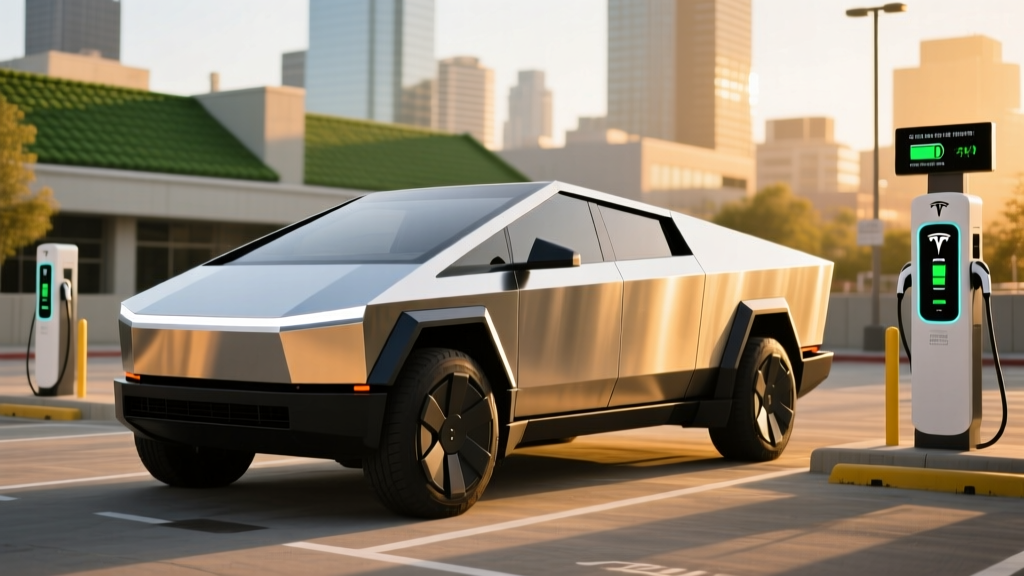
The Cybertruck supports up to 350 kW peak DC fast charging at Tesla V4 Superchargers. In controlled testing, the truck reaches 80% state of charge in approximately 19 minutes from a 10% starting point. However, sustained charge rate matters more than peak rate.
| Charging Method | Power / Rate | Time / Miles Added |
|---|---|---|
| DC Fast Charge (V4 Supercharger) | Peak 350 kW, avg ~210 kW (10-80%) | ~19 min (10-80%) |
| DC Fast Charge (V3 Supercharger) | Peak 250 kW, avg ~170 kW | ~25 min (10-80%) |
| Level 2 Home (48A / 11.5 kW) | 11.5 kW | ~37 miles per hour |
| Level 2 Home (32A / 7.7 kW) | 7.7 kW | ~25 miles per hour |
| Level 1 (120V / 12A) | ~1.4 kW | ~4-5 miles per hour |
The charge curve tapers significantly above 80% SoC. Charging from 80% to 100% can add another 25-35 minutes, which is why Tesla's navigation system typically routes you to arrive at chargers at low SoC and depart at 60-80% for optimal trip time. For daily driving, Tesla recommends charging to 80% unless you need the full range for a trip — this preserves long-term battery health.
At home, a Wall Connector on a 60-amp circuit delivers 11.5 kW, adding roughly 37 miles of range per hour. A full overnight charge (10 hours) from near-empty restores the pack. Installation typically costs $1,200-$2,500 depending on panel capacity and run length — factor in a potential $2,000-$4,000 panel upgrade if your home has a 100-amp main panel.
Performance, Efficiency, and Daily Usability
The Dual Motor AWD hits 0-60 mph in 4.1 seconds with 600 horsepower, which is genuinely quick for a 6,800-pound vehicle. The Cyberbeast's 2.6-second 0-60 time with 845 hp is supercar territory, but you'll pay $20,000 more for the privilege and sacrifice 20 miles of EPA range.
Efficiency is the Cybertruck's weakest competitive metric. At 70 MPGe combined (Dual Motor) and roughly 48 kWh per 100 miles, it consumes significantly more electricity per mile than the Rivian R1T Dual Motor (73 MPGe) and far more than the F-150 Lightning (70 MPGe combined, but with a lighter curb weight). Over 15,000 annual miles, expect to spend $900-$1,200 on electricity depending on your local utility rates — roughly $1,500-$2,000 less than a comparable gas truck at $3.50/gallon, but the gap narrows with higher electricity costs.
Cargo and Passenger Space
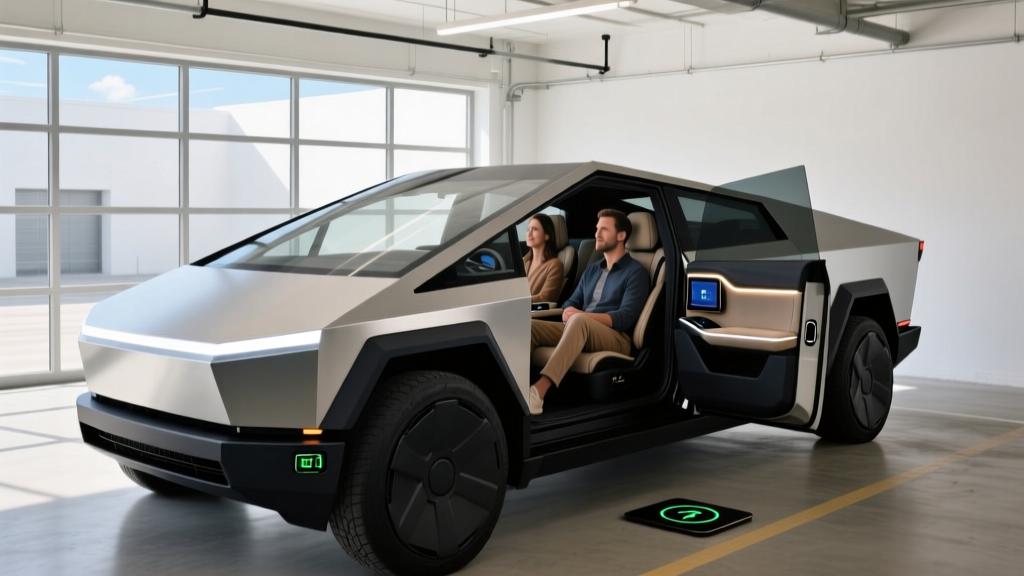
The 6-foot vault (bed) offers 67 cubic feet of lockable storage with the motorized tonneau cover closed. The bed is 4-foot wide between the wheel wells, accommodating standard 4x8 sheets of plywood only diagonally. The front trunk (frunk) is absent — the space is occupied by the HVAC system and 12V battery. Rear-seat legroom measures 38.5 inches, adequate for adults on longer trips, though the rear bench sits higher than in conventional trucks due to the battery floor.
Standout Tech and Drawbacks
The Cybertruck's 18.5-inch front touchscreen and 9.4-inch rear screen run Tesla's latest software with responsive performance. Steer-by-wire eliminates the mechanical connection between the yoke and wheels, enabling a variable steering ratio that's quick at low speeds and stable on the highway — but it demands a learning curve and has drawn scrutiny from NHTSA regarding fail-safe redundancy. The 48-volt electrical architecture is an industry first for a production vehicle, reducing wiring harness weight and enabling higher-power accessories.
Drawbacks include the absence of Apple CarPlay/Android Auto (Tesla's ecosystem only), panel-gap inconsistency across early production units, a single camera-based "Tesla Vision" approach to Autopilot that lacks radar or ultrasonic sensor redundancy, and limited rearward visibility through the narrow rear window. The yoke-style steering wheel is standard — a round wheel is not available.
Pricing, Trims, and the Tax Credit Reality
The Cybertruck's pricing has settled after early "Foundation Series" markups. Here's where the lineup stands:
| Trim | Base MSRP | Federal §30D Credit | Effective Price |
|---|---|---|---|
| Dual Motor AWD | $79,990 | $0 | $79,990 |
| Cyberbeast (Tri-Motor) | $99,990 | $0 | $99,990 |
The tax credit situation is definitive: the Cybertruck does not qualify for the $7,500 federal EV tax credit under IRS §30D. The reason is the MSRP cap — the law limits the credit to trucks with a manufacturer's suggested retail price of $80,000 or less. The Dual Motor AWD at $79,990 technically falls under the cap, but destination charges and any factory options push the transaction price above $80,000, disqualifying it. The Cyberbeast at $99,990 is well above the threshold.
Even if MSRP were not a barrier, buyers must meet income caps ($300,000 joint / $150,000 single modified adjusted gross income) and the vehicle's battery components and critical minerals must meet domestic-sourcing thresholds that tighten annually. As of 2026, very few vehicles with large battery packs clear all requirements. Always verify current eligibility on the IRS Clean Vehicle Credit page before purchasing.
Cybertruck vs. the Competition: Value Comparison
How does the Cybertruck stack up against the other electric trucks on the market? Here's a direct comparison of the key value metrics:
| Metric | Cybertruck Dual Motor | Rivian R1T Dual Max | F-150 Lightning Ext. Range |
|---|---|---|---|
| Base MSRP | $79,990 | $87,900 | $69,995 (XLT) |
| EPA Range | 340 mi | 352 mi | 320 mi |
| Towing | 11,000 lbs | 11,000 lbs | 10,000 lbs |
| 0-60 mph | 4.1 sec | 4.5 sec | 4.5 sec |
| Peak DCFC | 350 kW | 220 kW | 150 kW |
| Federal Tax Credit | $0 | $0 | $7,500 (select trims) |
| Supercharger Access | Native | Native (2024+) | Native (2024+) |
The F-150 Lightning XLT Extended Range at roughly $69,995 (before a potential $7,500 credit on eligible trims) is the clear value leader if you prioritize cost. The Rivian R1T offers superior build quality, a more conventional truck layout with a proper frunk, and a growing reputation for reliability — but at a $8,000+ premium. The Cybertruck's advantages are its faster charging, slightly better range, and the Tesla software/service ecosystem. Whether those justify the price gap is a personal calculus.
Who Should Buy the Cybertruck (And Who Shouldn't)
Pros
- Fastest DC charging in the electric truck segment (350 kW peak)
- 340-mile EPA range exceeds most electric truck competitors
- 11,000-lb towing capacity matches conventional heavy-duty half-tons
- Tesla Supercharger network access is the most reliable public charging infrastructure in the U.S.
- Stainless steel exoskeleton resists dents and corrosion
- 48-volt architecture and steer-by-wire represent genuine engineering innovation
Cons
- No federal tax credit — effective price is the sticker price
- Poor efficiency (70 MPGe) means higher charging costs per mile
- Yoke-only steering and no CarPlay/Android Auto alienate traditional truck buyers
- Build quality inconsistency reported across early production units
- No front trunk (frunk) — cargo space is bed-only
- Steer-by-wire remains unproven at scale for long-term reliability
The Cybertruck is best for: Tesla loyalists who want an electric truck, early adopters who value novel engineering, fleet/commercial buyers who can write off the full purchase price, and owners with reliable home charging who primarily drive in regions with dense Supercharger coverage.
Look elsewhere if: You want the lowest total cost of ownership (F-150 Lightning), you need proven build quality and dealer service (Rivian or wait for Cybertruck maturity), you require a frunk for secure front cargo, or you depend on the $7,500 tax credit to make the math work.
Ownership Costs and Warranty
Tesla covers the Cybertruck's battery and drive unit for 8 years or 120,000 miles, whichever comes first, with a minimum 70% capacity retention threshold over that period. The limited vehicle warranty is 4 years / 50,000 miles. These terms are competitive with Rivian (8 years / 120,000 miles on battery) and Ford (8 years / 100,000 miles on battery).
Insurance is a significant cost factor. The Cybertruck's stainless steel body panels are proprietary and require specialized repair, and Tesla's direct-to-consumer model limits body-shop availability. Expect annual insurance premiums of $3,200-$5,000 depending on your driving record and location — roughly 30-50% higher than an F-150 Lightning. Get quotes before ordering.
Maintenance costs are low by truck standards: no oil changes, no transmission fluid, and regenerative braking extends pad life to 100,000+ miles in typical driving. Budget $300-$500 annually for cabin air filters, wiper fluid, and tire rotation. Tires are expensive — the 35-inch all-terrains run $350-$450 each and may need replacement at 30,000-40,000 miles given the vehicle's weight and instant torque.
Frequently Asked Questions
What is the real-world range of the Tesla Cybertruck?
EPA estimates are 340 miles (Dual Motor) and 320 miles (Cyberbeast). In real-world highway driving at 75 mph, expect 270-300 miles. Cold weather below freezing reduces range to 210-250 miles. Towing cuts range roughly in half.
How fast does the Cybertruck charge at home and on the road?
On a V4 Supercharger, the Cybertruck peaks at 350 kW and charges 10-80% in approximately 19 minutes. At home on a 48-amp Level 2 charger (11.5 kW), it adds about 37 miles of range per hour, fully recharging overnight in roughly 10 hours.
Does the Cybertruck qualify for the $7,500 federal EV tax credit?
No. Under IRS §30D rules, the Cybertruck exceeds the $80,000 MSRP cap for trucks once destination fees and options are included. Even the base Dual Motor AWD at $79,990 typically surpasses the threshold in real transaction pricing. Verify current rules at irs.gov.
Is the Cybertruck worth buying over the F-150 Lightning or Rivian R1T?
It depends on priorities. If lowest price matters, the F-150 Lightning XLT is the value winner. If build quality and a frunk matter, the Rivian R1T is stronger. The Cybertruck wins on charging speed, Supercharger network reliability, and range — but its quirks (yoke, no CarPlay, no frunk, no tax credit) limit its appeal to a narrower buyer profile.
What is the Cybertruck's towing range when hauling a trailer?
Expect roughly 150-180 miles of range when towing a 5,000-lb trailer at highway speeds. Heavier loads near the 11,000-lb maximum will reduce range further. Plan charging stops carefully — not all Supercharger stalls are pull-through capable.
Is Tesla's Autopilot on the Cybertruck self-driving?
No. Autopilot and Full Self-Driving (Supervised) are SAE Level 2 driver-assistance systems. The driver must remain fully attentive, keep hands on the yoke, and be prepared to take over at any moment. The Cybertruck is not a self-driving vehicle.
How much does it cost to charge a Cybertruck per month?
At the U.S. average electricity rate of $0.17/kWh and 15,000 miles/year, expect $1,020-$1,200 annually ($85-$100/month) for home charging. Public DC fast charging at $0.35-$0.48/kWh costs significantly more — up to $2,500/year if you rely on it exclusively.
Sources: Tesla Cybertruck specifications, fueleconomy.gov (EPA), IRS Clean Vehicle Credit.