2026 Tesla Cybertruck: Quick Verdict After 18 Months on the Road
The Tesla Cybertruck entered a new phase in 2026 with a series of over-the-air software updates, a revised dual-motor AWD configuration on the mid-tier trim, and subtle pricing adjustments across the lineup. After more than a year and a half of real-world deliveries, the stainless-steel pickup has settled into a defined niche: a tech-forward, high-performance electric truck that excels at daily commuting and light towing, but demands compromises on range efficiency, bed utility, and public charging access relative to purpose-built competitors like the Ford F-150 Lightning and Rivian R1T.
If you're researching Cybertruck updates for 2026—whether you're a current owner tracking software improvements or a prospective buyer evaluating the latest trim changes—this profile consolidates the exact specs, real-world performance data, and ownership economics you need to make an informed decision.
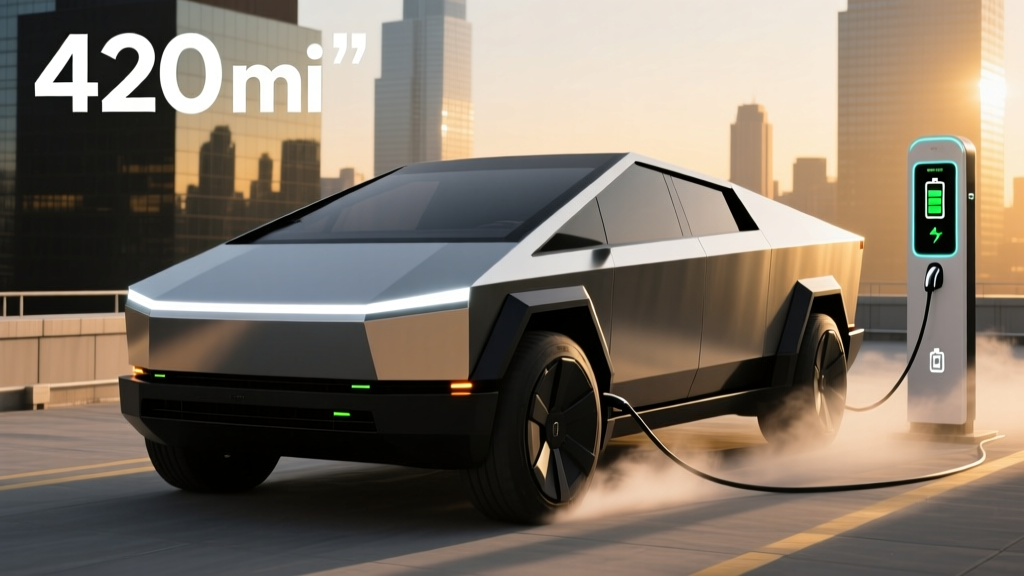
EPA-estimated range: 340 miles (AWD, 20" wheels). In real-world highway driving at 70-75 mph, expect ~270-290 miles. In cold weather (below 32°F), that drops to ~230-260 miles due to battery chemistry limitations and cabin heating load. The Cybertruck's 800+ sq ft frontal area and angular aerodynamics penalize efficiency at highway speeds more than any sedan or crossover in Tesla's lineup.
Full 2026 Cybertruck Spec Sheet
| Specification | AWD (Dual Motor) | Cyberbeast (Tri Motor) | RWD (Announced) |
|---|---|---|---|
| EPA Range | 340 mi | 320 mi | ~250 mi (est.) |
| Battery (usable) | ~123 kWh, NMC | ~123 kWh, NMC | TBD |
| Horsepower | 600 hp | 845 hp | TBD |
| 0-60 mph | 3.9 sec | 2.6 sec | TBD |
| Drivetrain | Dual-motor AWD | Tri-motor AWD | Single-motor RWD |
| Peak DC Fast Charge | 250 kW | 250 kW | TBD |
| 10-80% DCFC Time | ~28 min | ~28 min | TBD |
| Level 2 Home Charge | 11.5 kW (~37 mi/hr) | 11.5 kW (~37 mi/hr) | TBD |
| Towing Capacity | 11,000 lbs | 11,000 lbs | 7,500 lbs (est.) |
| Payload | 2,500 lbs | 2,500 lbs | TBD |
| Bed Length | 6 ft | 6 ft | 6 ft |
| Cargo Volume (bed) | 67 cu ft | 67 cu ft | 67 cu ft |
| Frunk | 7.1 cu ft | 7.1 cu ft | 7.1 cu ft |
| Efficiency | 2.0 kWh/mi (50 MPGe) | 2.1 kWh/mi (48 MPGe) | TBD |
| Base MSRP | $79,990 | $99,990 | $60,990 (announced) |
| Battery/Drive Warranty | 8 yr / 120,000 mi | 8 yr / 120,000 mi | 8 yr / 120,000 mi |
| Basic Warranty | 4 yr / 50,000 mi | 4 yr / 50,000 mi | 4 yr / 50,000 mi |
Source: Tesla Cybertruck Design Studio and fueleconomy.gov. RWD trim is announced but not yet available as of early 2026; specs listed are preliminary estimates.
2026 Software Updates: What Tesla Has Actually Changed
The Cybertruck's 2026 narrative is largely a software story. Tesla has pushed several significant OTA updates since late 2025 that have materially altered the ownership experience:
- Range improvement (~5-8 mi gain): A revised thermal management algorithm introduced in software v12.2 (Q4 2025) optimized heat pump operation and reduced parasitic battery drain, yielding a modest but measurable range bump on AWD models. Tesla revised the EPA sticker from 325 to 340 miles for the AWD trim with 20" wheels.
- Steer-by-wire refinement: The Cybertruck's fully electric steer-by-wire system received updated damping profiles in v12.4, reducing the "twitchy" on-center feel that early reviewers flagged. The variable-ratio steering now feels more natural at highway speeds above 65 mph.
- 48-volt architecture monitoring: New battery health telemetry gives owners more granular State of Health (SoH) data for the 48V low-voltage system, a first in production vehicles. This matters because the Cybertruck eliminated the traditional 12V lead-acid battery entirely.
- FSD (Supervised) v13 integration: The Cybertruck now runs Tesla's latest Full Self-Driving (Supervised) stack with end-to-end neural network processing. Remember: this remains SAE Level 2 driver assistance—the driver must remain attentive and hands-ready at all times.
- Tow mode enhancements: Improved trailer sway control and an updated range estimator that factors in trailer weight, grade, and wind conditions for more accurate trip planning while towing.
Tesla Autopilot and FSD (Supervised) are SAE Level 2 driver-assistance systems. They do NOT make the Cybertruck self-driving. The driver must continuously supervise the vehicle, keep hands on the steering yoke, and be prepared to take over instantly. Only Level 4 services like Waymo operate without a human driver—and those are geofenced robotaxis, not consumer vehicles.
Charging Speed: DC Fast, Level 2, and the NACS Advantage
The Cybertruck charges via the North American Charging Standard (NACS) connector—Tesla's proprietary plug that has now been adopted by Ford, GM, Rivian, and most major automakers. As a native Tesla, the Cybertruck has seamless access to the Supercharger network, which remains the most reliable DC fast-charging infrastructure in North America.
| Charging Level | Power (kW) | Speed (miles added/hr) | Use Case |
|---|---|---|---|
| Level 1 (120V outlet) | ~1.4 kW | ~3-4 mi/hr | Emergency / trickle only |
| Level 2 (240V, 48A) | 11.5 kW | ~37 mi/hr | Overnight home charging (~9 hrs for full) |
| Level 2 (240V, 32A Mobile Connector) | 7.7 kW | ~25 mi/hr | Portable / outlet-limited |
| DC Fast (V3 Supercharger) | 250 kW peak | ~200 mi in 15 min | Road trips (10-80% in ~28 min) |
| DC Fast (V4 Supercharger) | 250 kW peak | ~200 mi in 15 min | Same speed, newer hardware |
Charging curve reality: The Cybertruck's peak 250 kW rate is sustained only between approximately 10-30% State of Charge (SoC). Above 50% SoC, the rate tapers to ~120 kW, and above 80% it drops below 50 kW. This is standard for NMC lithium-ion chemistry—the battery management system limits current to protect cell longevity. Plan road-trip stops around the 10-80% window for optimal time efficiency.
Home charging setup: Tesla's Wall Connector ($420) on a 60-amp circuit delivers the full 11.5 kW / 48 amps. A typical professional installation runs $800-$2,000 depending on panel proximity and local permit costs. For a ~123 kWh battery, a full charge from empty takes roughly 10.5 hours at this rate—plan on plugging in nightly if you drive 60+ miles daily.
Pricing, Trims, and Federal Tax Credit Eligibility
| Trim | Base MSRP | Est. After §30D Credit | Credit Eligible? |
|---|---|---|---|
| RWD (announced) | $60,990 | $53,490 | Likely (under $80K cap)* |
| AWD (Dual Motor) | $79,990 | $79,990 | No — exceeds $80K truck cap |
| Cyberbeast (Tri Motor) | $99,990 | $99,990 | No — exceeds $80K truck cap |
*The RWD trim, once available, may qualify for the IRS §30D federal tax credit of up to $7,500, provided the buyer meets income caps ($150K single / $300K joint AGI), the vehicle meets battery critical-mineral and component sourcing thresholds, and MSRP remains under the $80,000 truck/SUV cap. The AWD and Cyberbeast trims exceed this cap and do NOT qualify. Tax credit rules are subject to change—consult a tax professional before relying on credit estimates. Point-of-sale transfer is available for eligible vehicles through participating dealers.
The AWD and Cyberbeast trims' ineligibility for the federal credit is a significant ownership-cost factor. Buyers in states like California, Colorado, and New Jersey may still qualify for state-level rebates or HOV lane access—check your local DMV and energy office for current programs.
Performance, Efficiency, and Daily Drivability
The Cybertruck's performance figures remain startling for a 6,800-lb vehicle. The Cyberbeast's 2.6-second 0-60 mph time makes it quicker than most sports cars, while the AWD's 3.9-second run is firmly in performance-SUV territory. Both trims feature torque vectoring across all driven wheels and a low center of gravity from the floor-mounted battery pack.
Efficiency, however, is the Cybertruck's weak point. At roughly 2.0 kWh per mile (AWD), it consumes significantly more energy per mile than a Tesla Model Y (~0.28 kWh/mi) or even the Rivian R1T (~2.2 kWh/mi, comparable but with a larger bed). This means higher electricity costs per mile and more frequent charging stops on road trips. On a fueleconomy.gov basis, the AWD achieves approximately 50 MPGe combined—a figure that reflects the energy density penalty of the Cybertruck's mass and aerodynamics.
Daily drivability notes from ownership:
- The steer-by-wire system requires an adjustment period, particularly for drivers accustomed to traditional rack-and-pinion feedback.
- Rear visibility is limited by the bed sail pillars; the digital rearview camera is essential and well-implemented.
- The stainless steel exoskeleton resists dents but shows fingerprints and water spots aggressively—expect to wipe it down frequently if appearance matters to you.
- The 6-foot bed with powered tonneau cover is weather-sealed and includes a 240V outlet, but the 67 cu ft volume is smaller than a standard F-150 Lightning bed (~78 cu ft for the 5.5-ft box).
- Rear-seat legroom (41.4 inches) is generous for a crew-cab truck, but the upright seatback angle compromises long-trip comfort for adult passengers.
Pros, Cons, and Who Should Buy the Cybertruck
- Class-leading acceleration and performance (2.6s Cyberbeast)
- Native NACS + Supercharger network access
- Stainless steel body requires no paint (zero chip/scratch concern on panels)
- 48V architecture eliminates traditional 12V battery failures
- 11,000-lb towing capacity
- Continuous OTA software improvements
- Bioweapon Defense Mode (HEPA cabin filtration)
- Poor efficiency (~2.0 kWh/mi) limits real-world highway range to ~270-290 mi
- AWD and Cyberbeast trims exceed $80K §30D tax credit cap
- 6-ft bed is shorter and smaller than most full-size truck competitors
- Steer-by-wire learning curve; no physical steering linkage
- High insurance premiums (specialty body panels, sensor density)
- No Apple CarPlay / Android Auto (Tesla-only infotainment)
- Build quality inconsistencies reported on early-production units
- Choose the Cybertruck if: You want a high-performance electric truck for daily commuting and weekend recreation, prioritize Tesla's Supercharger network, value continuous software updates, and don't need a full-size 8-ft bed for work.
- Choose the Ford F-150 Lightning if: You need a conventional truck bed (5.5 or 8 ft), want a more traditional driving feel, need Pro Power Onboard for job-site power, or require a lower entry price with potential tax credit eligibility.
- Choose the Rivian R1T if: You prioritize off-road capability (quad-motor tank turns), want a more refined interior, prefer a gear tunnel for storage, and are willing to pay a premium for build quality and adventure-focused design.
Frequently Asked Questions
What is the real-world range of the 2026 Cybertruck?
The AWD model carries a 340-mile EPA estimate, but real-world highway driving at 70-75 mph typically yields 270-290 miles. In cold weather (below freezing), expect 230-260 miles. The Cybertruck's large frontal area and boxy shape create significant aerodynamic drag at speed, which is the primary range killer. City driving with regenerative braking recovers more energy and can approach or slightly exceed the EPA number.
How fast does the Cybertruck charge at home and on the road?
On DC fast charging (V3/V4 Supercharger), the Cybertruck peaks at 250 kW and can add approximately 200 miles of range in 15 minutes, with a 10-80% session taking about 28 minutes. At home on a Level 2 Wall Connector (11.5 kW / 48A), you'll gain roughly 37 miles of range per hour, meaning a full overnight charge takes about 9-10 hours. The charge curve tapers significantly above 80% SoC—don't plan road-trip charges beyond 80% unless you have time to spare.
Does the Cybertruck qualify for the $7,500 federal EV tax credit?
Currently, the AWD ($79,990) and Cyberbeast ($99,990) trims exceed the $80,000 MSRP cap for trucks/SUVs under IRS §30D and do NOT qualify. The announced RWD trim at $60,990 may qualify once it enters production, subject to battery sourcing requirements, buyer income limits ($150K single / $300K joint), and any rule changes in effect at time of purchase. Always verify current eligibility on irs.gov and consult a tax professional.
Is the Cybertruck worth buying vs. the F-150 Lightning or Rivian R1T?
It depends on your priorities. The Cybertruck wins on raw performance, Supercharger access, and tech-forward features like steer-by-wire and the 48V architecture. The F-150 Lightning wins on bed utility, conventional driving dynamics, work-site features (Pro Power Onboard), and lower pricing with tax credit eligibility on select trims. The Rivian R1T wins on off-road capability, interior quality, and adventure-ready design. If performance and Tesla ecosystem integration are your top criteria, the Cybertruck is compelling. If you need a work truck, look at the Lightning.
What's the biggest concern for Cybertruck owners?
Insurance costs are the most common complaint. The Cybertruck's stainless steel body panels, dense sensor array, and steer-by-wire components make repairs expensive and specialized. Owners report annual premiums 30-60% higher than comparable full-size trucks. Additionally, the real-world highway range (270-290 mi) means more frequent charging stops on road trips compared to more aerodynamic EVs or trucks with larger battery packs. Build quality on early-production units has also been inconsistent, though 2025-2026 units show improvement.
How does the Cybertruck handle towing?
The AWD and Cyberbeast trims are rated for 11,000 lbs of towing, which is competitive with the F-150 Lightning (10,000 lbs) and exceeds the Rivian R1T (11,000 lbs). The 2026 software updates improved the tow-mode range estimator, which now accounts for trailer weight, road grade, and wind. However, towing at or near max capacity will cut range by 40-50%, meaning you'll realistically see 150-180 miles between charges while towing heavy. Plan accordingly for trailer trips.