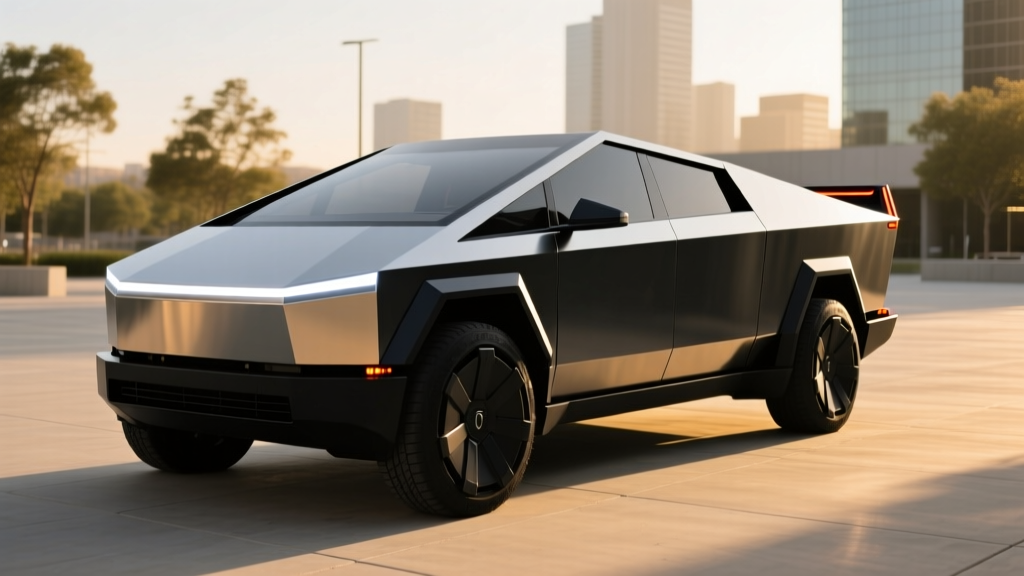
The Tesla Cybertruck is impossible to ignore. Its stainless-steel exoskeleton and angular geometry dominate any parking lot, but that polarizing shape raises a practical question every prospective buyer asks: can you actually maneuver this thing in daily driving? The Cybertruck turning radius is a legitimate concern for a vehicle stretching over 231 inches long, and it sits at the center of a broader ownership conversation that includes real-world range, 800-volt charging architecture, and a price tag that has shifted considerably since its 2023 debut.
This review breaks down the 2026 Tesla Cybertruck across every metric that matters to an EV buyer — from EPA range versus highway reality, to DC fast-charging curves, to federal tax credit eligibility under current IRS §30D rules. Whether you're cross-shopping the Rivian R1T, Ford F-150 Lightning, or Chevrolet Silverado EV, the data below gives you the exact numbers to make an informed decision.
Specs at a Glance: 2026 Tesla Cybertruck
| Specification | AWD (Dual-Motor) | Cyberbeast (Tri-Motor) |
|---|---|---|
| EPA Range | 340 miles | 320 miles |
| Battery Capacity (usable) | ~123 kWh (NMC) | ~123 kWh (NMC) |
| Max DC Fast Charge | 250+ kW (800V arch.) | 250+ kW (800V arch.) |
| 10–80% DC Charge Time | ~18–22 min | ~18–22 min |
| Level 2 Home Charging | 11.5 kW (~37 mi/hr) | 11.5 kW (~37 mi/hr) |
| 0–60 mph | 3.9 sec | 2.6 sec |
| Horsepower | 600 hp | 845 hp |
| Drivetrain | Dual-Motor AWD | Tri-Motor AWD |
| MPGe (combined) | 72 MPGe | 68 MPGe |
| Efficiency | 47 kWh/100 mi | 50 kWh/100 mi |
| Towing Capacity | 11,000 lbs | 11,000 lbs |
| Base MSRP | $79,990 | $99,990 |
| Battery/Drive Unit Warranty | 8 yr / 120,000 mi | 8 yr / 120,000 mi |
Cybertruck Turning Radius: Can It Handle Daily Driving?
The 2026 Cybertruck's curb-to-curb turning radius measures approximately 40.2 feet (wall-to-wall roughly 42.1 feet). For context, that's wider than the Ford F-150 Lightning (~39.4 ft) and the Rivian R1T (~38.2 ft with rear steer-assist), but comparable to large traditional pickups like the Ram 1500.
What does this mean in practice? In a standard two-lane residential street (about 28–30 feet wide), you will need a multi-point turn to execute a U-turn. Tight parking garages with narrow ramps will demand extra attention — the Cybertruck's 82-inch width (excluding mirrors) compounds the challenge. Tesla's 360-degree camera system and rear-wheel steering assistance help mitigate the truck's footprint, but physics is physics: a 6,800-pound, 231.7-inch vehicle will never park like a crossover.
Owner tip: Tesla's Autopark and Summon features are genuinely useful for slotting the Cybertruck into tight spaces where visibility is compromised. However, these remain SAE Level 2 driver-assist features — you must supervise every maneuver.
EPA Range vs. Real-World Range: What to Actually Expect
EPA Estimated Range (AWD): 340 miles
Real-World Highway (70–80 mph, mild weather): ~270–295 miles
Real-World Cold Weather (below 32°F, highway): ~220–255 miles
Real-World Towing (5,000+ lb trailer): ~150–180 miles
The Cybertruck AWD's EPA-rated 340 miles is a best-case composite figure. In our experience and consistent with fueleconomy.gov data, highway driving at sustained speeds of 70–80 mph reduces range by roughly 15–20% compared to the EPA sticker. The truck's flat, angular shape creates more aerodynamic drag than a teardrop-shaped sedan, and that drag penalty compounds at highway speeds.
Cold weather hits all EVs hard, but the Cybertruck's massive stainless-steel body acts as a heat sink. Expect 25–35% range loss in sub-freezing highway conditions, even with Tesla's heat pump and battery preconditioning active. The heat pump is standard and highly effective in moderate cold (35–50°F), but extreme cold still demands planning on longer trips.
For daily commuting under 80 miles round-trip with home charging, range is a non-issue. For road trips, the Supercharger network's density along major corridors makes 270-mile real-world range manageable with 15–20 minute stops every 2.5 to 3 hours.
Charging Speed: DC Fast, Level 2, and the 800V Advantage
The Cybertruck uses Tesla's 800-volt electrical architecture, which enables higher charging power with lower current — reducing heat and improving efficiency. On a V4 Supercharger or compatible 250+ kW DC fast charger, the Cybertruck can peak above 250 kW under ideal conditions (low state of charge, preconditioned battery, moderate ambient temperature).
| Charging Level | Power (kW) | Rate (miles added/hr) | Typical Use Case |
|---|---|---|---|
| Level 1 (120V household) | ~1.2 kW | ~3–4 mi/hr | Emergency / overnight trickle |
| Level 2 (240V, 48A Wall Connector) | 11.5 kW | ~37 mi/hr | Daily home charging |
| DC Fast (Tesla V4 Supercharger) | 250+ kW peak | ~12–15 mi/min at peak | Road trips |
| DC Fast (CCS adapter, EA/others) | Up to ~200 kW | ~10–12 mi/min at peak | Non-Tesla networks |
Charge curve reality: Like all EVs, the Cybertruck does not sustain peak charge rate to 80%. The curve is aggressive from 5–30% SoC (often above 240 kW), begins tapering around 40–50%, and drops significantly above 80%. A 10–80% session typically takes 18–22 minutes on a V3 or V4 Supercharger. Charging from 80–100% can add another 25–35 minutes — plan accordingly and avoid charging past 80% on road trips unless necessary.
For home charging, Tesla's Wall Connector at 48 amps (11.5 kW) is the sweet spot. A full charge from 10% to 100% takes roughly 11–12 hours — fine for overnight. Installation costs vary widely: expect $500–$2,500 for a straightforward install near your panel, or $3,000–$5,000+ if a panel upgrade or long conduit run is required. Always consult a licensed electrician for a site-specific quote.
Performance: Supercar Acceleration in a Pickup Body
The Cyberbeast's 2.6-second 0–60 mph time is absurd for a 6,800-pound truck — it out-accelerates most sports cars. The dual-motor AWD variant's 3.9-second run is hardly slow either. Both models deliver instant electric torque with no turbo lag or gear hunting, and the low center of gravity (battery pack under the floor) keeps body roll surprisingly controlled for a vehicle this tall.
Steer-by-wire is standard on the 2026 Cybertruck, replacing the mechanical steering column with electronic actuators. This enables the variable-ratio steering rack (fewer turns lock-to-lock at low speeds, more precision at highway speed) and contributes to the relatively manageable turning radius despite the truck's length. The system has proven reliable in Tesla's fleet, but it does remove tactile road feedback that some drivers prefer.
Towing is rated at 11,000 pounds for both trims. However, towing at or near max capacity will cut range nearly in half and requires the integrated trailer brake controller (standard). The Cybertruck's bed is 6 feet long with a motorized tonneau cover, and the vault-style design with no traditional tailgate hinges is distinctive — though the powered cover can be slow to operate compared to a manual tailgate.
Pricing, Trims, and Federal Tax Credit Eligibility
As of the 2026 model year, the Cybertruck lineup has stabilized after significant repricing since launch:
- AWD (Dual-Motor): $79,990 MSRP
- Cyberbeast (Tri-Motor): $99,990 MSRP
Destination fees add approximately $1,390. Tesla frequently adjusts option packaging, so verify final pricing on Tesla's configurator before ordering.
Federal Tax Credit: Does the Cybertruck Qualify?
The Cybertruck faces a key obstacle under IRS §30D rules: the MSRP cap for trucks is $80,000. The AWD trim at $79,990 technically clears this threshold, but adding any factory options or destination fees that push the total above $80,000 will disqualify it. The Cyberbeast at $99,990 does not qualify regardless.
§30D Requirements for Cybertruck AWD (2026 rules):
- MSRP must not exceed $80,000 (truck classification) — AWD base only
- Buyer AGI limits: $150K single / $225K head of household / $300K joint
- Battery critical minerals and component sourcing must meet phased-in thresholds (verify at purchase via dealer/manufacturer certification)
- Vehicle must be assembled in North America (Cybertruck is built in Austin, TX — qualifies)
- Credit can be transferred to the dealer at point of sale for an immediate price reduction
Source: IRS.gov — New Clean Vehicle Credit. Rules are subject to change; consult a tax professional for your specific situation.
Even with the full $7,500 credit applied to the AWD base model, the effective price remains around $73,880 — a premium truck by any measure. Factor in higher insurance premiums (the Cybertruck's repair costs for stainless-steel body panels are significant) and the total cost of ownership sits above most competitors.
Cargo, Interior Space, and Daily Livability
The Cybertruck seats five across two rows. Front legroom is generous at approximately 41.6 inches, while rear legroom measures around 38.2 inches — adequate for adults on shorter trips but tighter than an F-150 Lightning's back seat. The rear bench is relatively flat and firm, optimized more for utility than long-distance comfort.
Cargo capacity breaks down as follows:
- Bed (vault): 67 cubic feet with tonneau closed; ~74 cu ft with cover open
- Front trunk (frunk): ~7.1 cubic feet — useful for charging cables, groceries, or a small bag
- Behind rear seats (in-cabin): Limited; no traditional under-seat storage
The 18.5-inch central touchscreen runs Tesla's latest infotainment software, including navigation, streaming, gaming, and vehicle controls. There are no physical buttons for climate or volume — everything routes through the screen or steering-wheel controls. A rear 9.4-inch touchscreen serves back-seat passengers for climate and entertainment. The glass roof provides an open, airy cabin but offers no shade mechanism, which can be an issue in hot climates.
Notable tech includes Hardware 4 (HW4) for Autopilot and Full Self-Driving (Supervised), which remains an SAE Level 2 system requiring constant driver attention. FSD (Supervised) is available as a subscription or one-time purchase but does not make the Cybertruck autonomous. Bioweapon Defense Mode (HEPA filtration), PowerShare vehicle-to-load (V2L) capability for running tools or appliances from the bed outlets, and over-the-air software updates round out the tech suite.
Pros and Cons: The Honest Assessment
Pros
- 800V architecture delivers top-tier DC fast-charging speeds
- Supercar-level acceleration, especially Cyberbeast
- 11,000-lb towing capacity with integrated brake controller
- Stainless-steel body resists dents and eliminates paint maintenance
- Access to Tesla Supercharger network (most reliable in the U.S.)
- Steer-by-wire aids maneuverability for a truck this size
- V2L capability for job-site and camping power needs
Cons
- 40.2-ft turning radius is challenging in tight urban settings
- Real-world highway range falls 15–20% short of EPA sticker
- Cyberbeast ineligible for federal tax credit; AWD eligibility is fragile
- Stainless-steel panel repairs are expensive and specialized
- Rear seat comfort lags behind F-150 Lightning and Rivian R1T
- No physical controls — steep learning curve for climate and settings
- Higher insurance costs than comparable electric trucks
- Single-pane glass and minimal sound insulation at highway speeds
Is the Cybertruck Worth It vs. Key Competitors?
The Cybertruck occupies a unique position. Against the Ford F-150 Lightning, it sacrifices rear-seat comfort, conventional usability, and tax-credit certainty in exchange for faster charging, better acceleration, and a more distinctive (if polarizing) design. The Lightning's ~320-mile Extended Range battery and more traditional truck layout make it easier to live with daily, and it qualifies more cleanly for the federal credit at qualifying trims.
Against the Rivian R1T (tri-motor), the Cybertruck offers more range and faster charging, but the R1T's quad-motor variant delivers superior off-road capability, a more refined interior, and a tighter turning circle thanks to its shorter wheelbase. The R1T also has a more usable gear tunnel for cargo.
The Chevrolet Silverado EV offers a longer bed option, more conventional truck ergonomics, and GM's Ultium platform with competitive charging, though its Super Cruise highway driving system (also SAE Level 2) is widely regarded as one of the smoothest available.
Buy the Cybertruck if: You prioritize acceleration, Tesla's Supercharger network, 800V fast-charging speed, and you're comfortable with the unconventional ergonomics and urban maneuverability trade-offs.
Look elsewhere if: You need maximum rear-seat comfort, easy tax-credit qualification, a tighter turning radius for daily city driving, or a conventional truck experience with proven fleet-service infrastructure.
Frequently Asked Questions
What is the Tesla Cybertruck's turning radius?
The 2026 Cybertruck has a curb-to-curb turning radius of approximately 40.2 feet. Tesla's steer-by-wire system and rear steering assist help mitigate the truck's size, but it still requires more space than midsize trucks and some full-size competitors like the Rivian R1T.
What is the real-world range of the Cybertruck?
The AWD model's EPA rating is 340 miles, but expect 270–295 miles in real-world highway driving at 70–80 mph. Cold weather (below 32°F) can reduce range to 220–255 miles. Towing a 5,000+ pound trailer drops range to approximately 150–180 miles.
How fast does the Cybertruck charge?
On a Tesla V3 or V4 Supercharger, the Cybertruck peaks above 250 kW and charges from 10–80% in roughly 18–22 minutes. At home on a Level 2 Wall Connector (11.5 kW), it adds about 37 miles of range per hour, taking 11–12 hours for a full charge.
Does the Cybertruck qualify for the $7,500 federal EV tax credit?
Only the AWD trim at its $79,990 base MSRP potentially qualifies, and only if destination fees and options don't push the total above the $80,000 truck MSRP cap. The Cyberbeast at $99,990 does not qualify. Income limits, battery sourcing rules, and North American assembly requirements also apply — verify eligibility via the IRS §30D guidelines and consult a tax professional.
Is the Cybertruck good for towing?
Yes — the 11,000-pound max towing capacity is competitive with full-size gas trucks. However, towing significantly impacts range (expect roughly 150–180 miles with a heavy trailer). The integrated trailer brake controller and tow/haul mode are standard.
How does the Cybertruck handle in snow and off-road?
The AWD system with dual or tri motors provides excellent traction, and the air suspension offers up to 16 inches of ground clearance in Extract mode. The stainless-steel body won't rust. However, the truck's weight (6,800+ lbs) means longer braking distances on ice, and winter tires are strongly recommended for snow-belt climates.
What is the Cybertruck's battery warranty?
Tesla covers the battery and drive units for 8 years or 120,000 miles, whichever comes first, with a minimum 70% capacity retention threshold over the warranty period. This is competitive with the industry standard and slightly better than some rivals on mileage coverage.