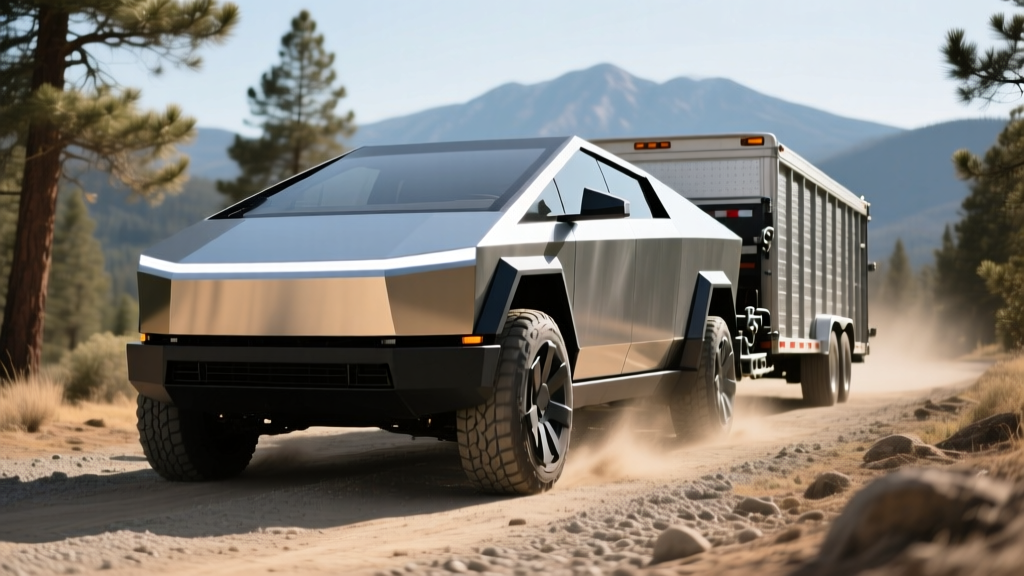
The Tesla Cybertruck entered the pickup market with polarizing design and bold claims, but for truck buyers, the numbers that matter most are payload, towing, and what happens to range when you hook up a trailer. With a maximum towing capacity of 11,000 pounds on the AWD trim and up to 340 miles of EPA-estimated range on the rear-wheel-drive model, the Cybertruck attempts to bridge the gap between daily-driver EV and work-capable hauler. This review dissects every spec that matters to a truck buyer — from battery chemistry and DC fast-charging curves to the real-world range penalty of towing at highway speeds.
Cybertruck Towing Capacity and Powertrain by Trim
Tesla offers the Cybertruck in three configurations for the 2025–2026 model year, each with different motors, battery packs, and tow ratings. The AWD dual-motor is the volume seller and the tow-rated workhorse of the lineup.
| Spec | RWD (Single Motor) | AWD (Dual Motor) | Cyberbeast (Tri-Motor) |
|---|---|---|---|
| Drivetrain | Rear-Wheel Drive | All-Wheel Drive | All-Wheel Drive (Tri-Motor) |
| Horsepower | ~315 hp (est.) | 600 hp | 845 hp |
| 0–60 mph | ~6.5 sec (est.) | 4.1 sec | 2.6 sec |
| Max Towing Capacity | 7,500 lbs | 11,000 lbs | 11,000 lbs |
| Payload Capacity | ~2,500 lbs | 2,500 lbs | 2,500 lbs |
| EPA Range | ~340 mi (est.) | 340 mi | 320 mi |
| Battery (usable, est.) | ~100 kWh | ~123 kWh | ~123 kWh |
| Battery Chemistry | NMC (est.) | NMC (4680 cells) | NMC (4680 cells) |
| Base MSRP | ~$60,990 (est.) | $79,990 | $99,990 |
The 11,000-pound tow rating on the AWD and Cyberbeast trims is competitive with the Ford F-150 Lightning (10,000 lbs with Max Tow Package) and the Rivian R1T (11,000 lbs on the dual-motor with Max Pack). Tesla equips the Cybertruck with an integrated trailer brake controller and a tow/haul driving mode that adjusts regen, throttle mapping, and thermal management for sustained loads.
Real-World Range: Sticker vs. What You'll Actually See
EPA Combined Range (AWD): 340 miles
Real-World Highway (70 mph, 75°F): ~270–290 miles
Real-World Highway (30°F, cold weather): ~220–250 miles
While Towing (5,000 lb trailer, 65 mph): ~150–180 miles
While Towing (8,000+ lb trailer, 65 mph): ~110–140 miles
The Cybertruck's angular stainless-steel body gives it a drag coefficient (Cd) estimated around 0.38–0.42 — significantly higher than a sedan like the Model 3 (Cd ~0.23). That aerodynamic penalty compounds at highway speeds, where the truck consumes energy at a much higher rate than its EPA combined cycle suggests. According to fueleconomy.gov, the AWD Cybertruck achieves approximately 70 MPGe combined, translating to roughly 48 kWh per 100 miles — one of the least efficient EVs on the market by energy consumption per mile.
When towing, the situation worsens dramatically. A 5,000-pound enclosed trailer increases energy consumption by roughly 80–100%, cutting effective range nearly in half. An 8,000-pound boat or car trailer can reduce range to 110–140 miles before you need to stop. This means long-distance towing requires careful route planning around DC fast chargers — and an acceptance that your 340-mile truck becomes a 130-mile truck under heavy load.
Tesla's onboard range calculator does account for trailer weight when a trailer is connected (via the tow mode setting), which is a useful feature for trip planning. However, the navigation system's Supercharger routing while towing may require more stops than you'd prefer on a 400-mile haul.
Charging Speed: DC Fast Charge and Home Level 2
The Cybertruck uses Tesla's NACS (North American Charging Standard) connector natively, giving it direct access to the Supercharger network — currently the most reliable DC fast-charging infrastructure in the U.S. The 4680-cell battery pack supports aggressive charge rates, but as with all EVs, peak kW is not sustained kW.
| Charging Level | Power / Rate | Miles of Range Added | Notes |
|---|---|---|---|
| Level 1 (120V, 15A) | ~1.4 kW | ~3–4 mi/hr | Emergency/trickle only; ~90+ hrs for full charge |
| Level 2 (240V, 48A) | 11.5 kW | ~30–34 mi/hr | Home Wall Connector; ~10–12 hrs for 10–100% |
| Level 2 (240V, 32A) | 7.7 kW | ~20–23 mi/hr | Mobile Connector on 14-50 outlet |
| DC Fast Charge (V3 Supercharger) | Peak ~250 kW | ~150–170 mi in 15 min | 10–80% in ~25–30 min; tapers significantly above 80% |
| DC Fast Charge (V4 Supercharger) | Peak ~350 kW (est.) | Faster 10–80% times | Availability limited; requires preconditioning |
The charge curve matters more than the peak number. In real-world DC fast charging, the Cybertruck's 4680 cells sustain roughly 200–250 kW from 10% to about 40% State of Charge (SoC), then taper progressively. By 60% SoC, you're likely seeing 120–150 kW; by 80%, it drops below 80 kW. Charging from 80% to 100% on DC is painfully slow — plan your road trips around 10–80% charges and move on.
Preconditioning is essential. If you navigate to a Supercharger using the Tesla app or in-car navigation, the battery thermal management system will preheat or cool the pack to optimize charge acceptance. Arriving at a charger without preconditioning — especially in cold weather — can reduce your peak charge rate by 30–50%.
For home charging, Tesla's Wall Connector at 48 amps (11.5 kW) adds roughly 30–34 miles of range per hour, which means a depleted AWD pack (340 mi) can fully replenish in about 10–12 hours overnight. This is adequate for most owners who charge nightly, but if you tow frequently and drain the pack to low SoC, you may want to ensure your electrical panel supports a 60-amp circuit to deliver the full 48 amps.
Interior, Cargo, and Technology
The Cybertruck seats five across two rows, with a 6.5-foot bed (approximately 74 inches long) and a lockable tonneau cover. Total cargo volume in the bed is approximately 67 cubic feet. The front trunk (frunk) adds roughly 7 cubic feet of secure, enclosed storage — useful for charging cables or groceries.
Interior dimensions are generous for a midsize-to-full-size truck:
- Front legroom: ~41.5 inches
- Rear legroom: ~38.5 inches
- Bed length: 74 inches (6'2")
- Bed width (between wheel wells): ~48 inches
- Vault (bed) volume: ~67 cu ft
The 18.5-inch center touchscreen runs Tesla's latest software, including navigation with Supercharger routing, trailer-assist camera views, and a customizable tow profile. The rear passengers get a dedicated 9.4-inch touchscreen for climate and media control — a first for Tesla.
On the driver-assistance front, the Cybertruck comes standard with Basic Autopilot (Traffic-Aware Cruise Control and Autosteer), which is an SAE Level 2 system — meaning the driver must remain fully engaged and supervise at all times. Tesla's Full Self-Driving (Supervised) is available as a $8,000 add-on or $99/month subscription, adding automatic lane changes, Navigate on Autopilot, and traffic-light recognition. Despite the name, FSD is also Level 2 and requires constant driver attention. It is not autonomous driving.
Autopilot and FSD (Supervised) are SAE Level 2 driver-assistance systems. They do NOT make the Cybertruck self-driving. The driver must keep hands on the steering wheel, eyes on the road, and be prepared to take over instantly. NHTSA has issued multiple investigations into Tesla's Autopilot/FSD systems — always drive attentively.
Notable drawbacks include the stainless-steel exoskeleton's susceptibility to visible fingerprints and smudges, the steer-by-wire system's learning curve (the yoke-style steering wheel requires adaptation for low-speed maneuvers), and the absence of Apple CarPlay/Android Auto — Tesla's infotainment is proprietary.
Pricing, Tax Credit Eligibility, and Total Cost
The Cybertruck's pricing has been a moving target since its 2023 reveal. As of the 2025–2026 model year, here's where the trims stand:
| Trim | Base MSRP | Federal §30D Credit | Effective Price (if eligible) |
|---|---|---|---|
| RWD (est. late 2026) | ~$60,990 | Up to $7,500* | ~$53,490* |
| AWD | $79,990 | Up to $7,500* | ~$72,490* |
| Cyberbeast | $99,990 | Up to $7,500* | ~$92,490* |
*Critical §30D eligibility caveats: The federal EV tax credit under IRS Section 30D is not guaranteed for every buyer or every Cybertruck configuration. To qualify for the full $7,500 credit, you must meet ALL of the following:
- MSRP Cap: The vehicle's MSRP must not exceed $80,000 for trucks/vans/SUVs. This means the Cyberbeast ($99,990) does NOT qualify. The AWD at $79,990 barely fits under the cap — any dealer-installed options pushing the MSRP above $80,000 will disqualify it.
- Buyer Income Cap: Modified Adjusted Gross Income (MAGI) must not exceed $150,000 (single), $225,000 (head of household), or $300,000 (married filing jointly).
- Battery Sourcing: The battery must meet critical-mineral and battery-component sourcing requirements that tighten each year. Tesla's 4680 cells use domestically sourced materials, but the exact credit amount ($3,750 for minerals + $3,750 for components) depends on current-year supply-chain compliance.
- Point-of-Sale Transfer: As of 2024+, you can transfer the credit to the dealer at purchase, reducing your out-of-pocket cost immediately rather than waiting for a tax refund.
The Cyberbeast at $99,990 is categorically ineligible for the §30D credit due to the MSRP cap. Consult a tax professional and check the latest rules on irs.gov before purchasing.
How Does the Cybertruck Compare to Rivals?
| Spec | Tesla Cybertruck AWD | Ford F-150 Lightning (Ext. Range) | Rivian R1T (Dual-Motor Max) |
|---|---|---|---|
| Max Tow Rating | 11,000 lbs | 10,000 lbs | 11,000 lbs |
| EPA Range | 340 mi | 320 mi | 410 mi |
| Battery (usable) | ~123 kWh | ~131 kWh | ~149 kWh |
| Peak DC Charge kW | ~250 kW | ~150 kW | ~220 kW |
| 10–80% DC Time | ~25–30 min | ~41 min | ~30 min |
| 0–60 mph | 4.1 sec | ~4.0 sec | ~4.5 sec |
| Base MSRP | $79,990 | ~$76,990 | ~$89,900 |
| Bed Length | 6'2" | 5'5" (Std) / 6'5" (w/ ext.) | 4'6" (Std) / 5'6" (w/ ext.) |
| §30D Eligible | Yes (AWD only) | Yes (varies by trim) | Yes (varies by config.) |
The Cybertruck holds a slight towing advantage over the F-150 Lightning (11,000 vs. 10,000 lbs) and matches the Rivian R1T. However, the Rivian's Max Pack delivers a commanding 410-mile EPA range — a 70-mile advantage that becomes even more meaningful when towing. The F-150 Lightning's lower starting price and traditional truck ergonomics (conventional steering wheel, familiar body style, larger bed options) make it a pragmatic choice for fleet buyers and traditionalists.
Where the Cybertruck wins: DC fast-charging speed (~250 kW peak vs. the Lightning's ~150 kW), Supercharger network access, and Tesla's software ecosystem. Where it loses: polarizing design that isn't for everyone, yoke steering adaptation, and the R1T's superior range and off-road capability.
Warranty and Long-Term Ownership
Tesla provides the following warranty coverage for the Cybertruck:
- Basic Vehicle Limited Warranty: 4 years / 50,000 miles
- Battery & Drive Unit Warranty: 8 years / 120,000 miles (whichever comes first), with a minimum 70% battery capacity retention guaranteed over the warranty period
- Stainless Steel Exoskeleton: Covered under the basic warranty; Tesla does not offer a separate corrosion warranty for the body panels
The 8-year/120,000-mile battery warranty is competitive with Ford (8yr/100,000 mi) and Rivian (8yr/175,000 mi on the battery). Tesla's 4680 cells use an NMC (nickel-manganese-cobalt) chemistry, which offers high energy density but slightly faster degradation compared to LFP (lithium iron phosphate) chemistries used in some Tesla Model 3/Y Standard Range variants. Expect approximately 8–12% capacity loss over the first 100,000 miles based on historical Tesla NMC pack data, though the 4680 cell's structural design and improved thermal management may improve longevity.
Insurance costs for the Cybertruck are notably high — early owner reports suggest annual premiums of $2,500–$4,000+ depending on location, age, and driving record, reflecting the truck's high repair costs (stainless-steel body panels, specialized glass) and performance capabilities. Factor this into your total cost of ownership.
Who Should Buy the Cybertruck (And Who Shouldn't)
- Need 11,000 lbs of towing capacity with the lowest fuel (energy) cost per mile among trucks in this class
- Have reliable home charging and primarily tow within 100–150 miles of home
- Value the Supercharger network for road trips without a trailer
- Want a truck that doubles as a 4.1-second 0–60 performance vehicle
- Appreciate Tesla's software, over-the-air updates, and tech-forward cabin
- Regularly tow heavy loads over 200+ miles (the R1T's 410-mi range is far more forgiving)
- Need a conventional steering wheel and traditional truck ergonomics
- Want a longer bed for full-sheet plywood or construction materials
- Prefer proven off-road capability (R1T quad-motor with tank turns)
- Are buying for a fleet and need commercial upfitter support (F-150 Lightning Pro)
Frequently Asked Questions
What is the real-world range of the Cybertruck while towing?
Expect roughly 150–180 miles with a 5,000-pound trailer at 65 mph, and 110–140 miles with an 8,000+ pound trailer. The EPA's 340-mile rating drops approximately 50–65% under towing conditions due to the Cybertruck's high drag coefficient and the energy demands of moving a combined vehicle-trailer weight exceeding 14,000 pounds.
How fast does the Cybertruck charge on DC fast chargers?
The Cybertruck peaks at approximately 250 kW on V3 Superchargers, achieving a 10–80% charge in roughly 25–30 minutes. However, the charge curve tapers significantly above 50% SoC. Real-world sustained charging from 10–80% averages around 150–180 kW. Always precondition the battery by navigating to the charger via the car's navigation system.
Does the Cybertruck qualify for the $7,500 federal EV tax credit?
The AWD trim at $79,990 MSRP falls under the $80,000 truck MSRP cap and may qualify for up to $7,500, provided the buyer meets income limits ($150K single / $300K married) and the battery meets critical-mineral sourcing requirements. The Cyberbeast at $99,990 is ineligible. Always verify current rules at irs.gov and consult a tax professional.
Is the Cybertruck's steer-by-wire system safe?
Steer-by-wire eliminates the mechanical connection between the steering yoke and the wheels, using electronic signals instead. Tesla has implemented multiple redundant systems, and the technology is used in aviation and other automotive applications (Lexus RZ, Toyota bZ4X). However, it requires a learning curve, especially at low speeds and in parking situations. NHTSA has not issued any recalls specific to the Cybertruck's steer-by-wire system as of early 2026.
Can I use a non-Tesla charger with the Cybertruck?
Yes. The Cybertruck uses the NACS connector natively. As of 2025–2026, many non-Tesla DC fast-charging networks (Electrify America, EVgo, ChargePoint) are adding NACS cables to their stations. For CCS-equipped chargers, Tesla sells a NACS-to-CCS adapter. For Level 2 home or public charging, the NACS connector is increasingly becoming the standard, and adapters are available for J1772 stations.
How does the Cybertruck handle in snow and ice?
The AWD and Cyberbeast trims feature dual- and tri-motor all-wheel drive with precise torque vectoring, which provides excellent traction in snow. The truck's substantial weight (~6,800 lbs curb weight) helps with stability, but also increases braking distances. Tesla's traction control system is responsive, and owners report confident winter driving with proper all-season or winter tires. The stainless-steel body is impervious to road-salt corrosion — a genuine advantage over painted steel trucks.