The Towing Promise vs. The Physics Reality
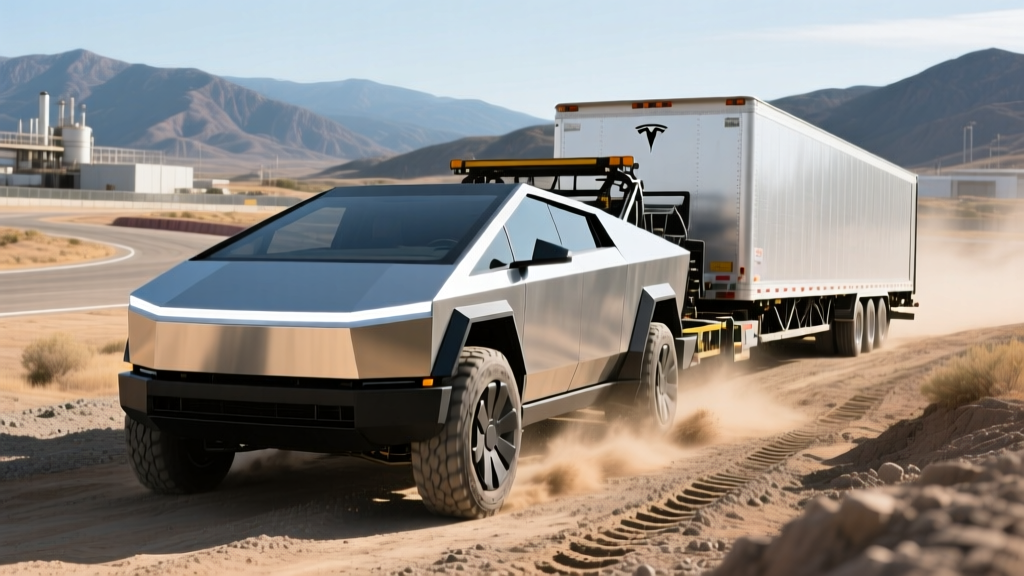
The Tesla Cybertruck enters the full-size electric pickup segment with a headline number that demands attention: an 11,000-pound maximum towing capacity on dual- and tri-motor trims. That figure matches or exceeds most half-ton gas trucks and positions the Cybertruck as a legitimate work and recreation hauler — at least on paper. But towing with an EV introduces a variable that gas truck buyers rarely calculate: range compression. Pulling a 7,000-pound trailer at highway speeds can cut an EV's range by 40-55%, and the Cybertruck's angular, brick-like aerodynamics don't help.
This review examines the Cybertruck's tow capacity in context — not just what it can pull, but what happens to range, charging logistics, and daily usability when you actually hitch up. We also cover the truck as a daily driver for buyers who may only tow a few weekends per year.
Spec Snapshot: Cybertruck AWD and Cyberbeast
| Specification | AWD (Dual Motor) | Cyberbeast (Tri-Motor) |
|---|---|---|
| EPA Range | 318 miles | 301 miles |
| Battery Capacity (usable) | ~123 kWh (NMC) | ~123 kWh (NMC) |
| Towing Capacity (max) | 11,000 lbs | 11,000 lbs |
| Payload Capacity | 2,500 lbs | 2,500 lbs |
| 0-60 mph | 4.1 seconds | 2.6 seconds |
| Horsepower | 600 hp | 845 hp |
| Drivetrain | Dual-motor AWD | Tri-motor AWD |
| DC Fast Charge (peak) | 350 kW (800V arch) | 350 kW (800V arch) |
| 10-80% DC Charge Time | ~17 minutes (peak conditions) | ~17 minutes (peak conditions) |
| Level 2 Home Charge Rate | 11.5 kW (~37 mi/hr) | 11.5 kW (~37 mi/hr) |
| MPGe (combined) | 72 MPGe | 69 MPGe |
| Efficiency | 47 kWh/100 mi | 49 kWh/100 mi |
| Bed Length | 6 ft (72 in) | 6 ft (72 in) |
| Cargo Volume (bed + frunk) | ~67 cu ft bed + ~7 cu ft frunk | ~67 cu ft bed + ~7 cu ft frunk |
| Base MSRP | $79,990 | $99,990 |
| Battery & Drive Unit Warranty | 8 yr / 120,000 mi | 8 yr / 120,000 mi |
Note: The previously announced rear-wheel-drive Cybertruck ($60,990 target) has been delayed to 2026 at the earliest and remains limited in availability. Specs above reflect currently orderable trims.
Towing Range: What Actually Happens When You Hitch Up
Towing amplifies range loss dramatically. Based on real-world testing by multiple EV owners and reviewers pulling enclosed and open trailers in the 5,000-8,000 lb range, the Cybertruck's range while towing falls to roughly 140-180 miles depending on trailer profile, weight, terrain, and speed. A boxy 7,500-pound travel trailer at 65 mph on flat terrain will consume energy at approximately 90-110 kWh/100 miles — more than double the truck's unloaded 47 kWh/100 mi efficiency.
This means a 300-mile towing trip requires at least two DC fast-charging stops. For context, a Ford F-150 with the 3.5L EcoBoost and a 36-gallon tank can cover that same 300 miles on one fill-up while towing a similar load. This is the core trade-off of electric truck towing: the capability exists, but the logistics change fundamentally.
What Reduces Towing Range Most
- Trailer frontal area: A wide enclosed cargo trailer creates far more drag than a flatbed with a low-profile load. Aerodynamics matter more than weight at highway speed.
- Speed: Towing at 70 mph vs. 60 mph can cost 15-20% additional range. Energy consumption scales with the cube of velocity for aerodynamic drag.
- Elevation changes: Mountain passes drain the battery aggressively on the climb, though regenerative braking recovers some energy on descents — typically 20-30% of the climb's energy cost.
- Temperature: Cold air increases battery internal resistance and cabin heating loads. Towing in 20°F weather can reduce range by an additional 20% vs. 70°F conditions.
Charging While Towing: The Logistical Challenge
| Charging Level | Power (kW) | Miles Added per Hour | Notes |
|---|---|---|---|
| Level 1 (120V household) | ~1.4 kW | ~3 mi/hr | Emergency/trickle only; impractical for daily use |
| Level 2 (240V home, 48A) | 11.5 kW | ~37 mi/hr | Full charge overnight (~8-9 hours from 10%) |
| DC Fast Charge (Tesla V4 Supercharger) | Up to 350 kW (peak) | Up to ~325 mi/hr (peak) | 10-80% in ~17 min; tapers significantly above 80% |
| DC Fast Charge (CCS adapter, non-Tesla) | Up to 250 kW (typical) | Up to ~220 mi/hr (peak) | Requires NACS-to-CCS adapter; speed depends on station |
The Cybertruck's 800-volt electrical architecture enables peak charging rates up to 350 kW at Tesla V4 Supercharger stations, though sustained rates average closer to 200-250 kW through the 10-80% window. In optimal conditions, a 10-80% session takes approximately 17 minutes. However, the charge curve tapers sharply above 80% — going from 80% to 100% can take an additional 25-30 minutes.
The towing-specific charging problem: Most Supercharger stalls are designed with pull-through lanes for trucks with trailers, but availability varies by location. Tesla has been expanding pull-through Supercharger sites along major highways, and the in-dash navigation will route you to trailer-friendly stations when a trailer is connected. Still, if you're towing through a rural corridor with limited Supercharger density, plan carefully — Tesla's Supercharger map shows which locations accommodate trailers.
For home charging, a Level 2 wall connector on a 60-amp circuit delivers 11.5 kW, adding roughly 37 miles of range per hour. A full overnight charge (8-9 hours) restores the battery from near-empty to full, which is sufficient for daily driving. For towing days, starting with a 100% charge is essential — and that means Level 2 home charging is practically mandatory for Cybertruck owners who tow.
Performance and Drivetrain: Power Is Not the Bottleneck
Where the Cybertruck excels at towing is raw power delivery. Electric motors produce peak torque from zero RPM, which means no downshifting, no turbo lag, and no strain on a transmission when pulling a heavy load up a grade. The dual-motor AWD produces 600 horsepower, and the tri-motor Cyberbeast delivers 845 hp — figures that make merging onto highways with a 7,000-pound trailer feel almost effortless.
The 0-60 mph time of 4.1 seconds (AWD) and 2.6 seconds (Cyberbeast) are measured unloaded. With a heavy trailer, expect 0-60 times in the 8-12 second range — still competitive with or better than most gas half-tons pulling equivalent weight.
The Cybertruck's adaptive air suspension automatically levels the truck when a trailer is connected, and the integrated trailer brake controller (standard on all trims) manages electric trailer brakes proportionally. Tesla's tow mode adjusts regenerative braking behavior to account for the trailer's momentum, reducing the "push" sensation that EVs can produce when lifting off the throttle with a heavy load.
Pricing, Trims, and Federal Tax Credit Eligibility
| Trim | Base MSRP | Est. Federal Credit (§30D) | Est. After-Credit Price |
|---|---|---|---|
| AWD (Dual Motor) | $79,990 | Up to $7,500* | ~$72,490* |
| Cyberbeast (Tri-Motor) | $99,990 | Up to $7,500* | ~$92,490* |
*Federal tax credit eligibility under IRS §30D is subject to multiple requirements that change annually. Key constraints for the Cybertruck:
- MSRP cap: Pickup trucks must have an MSRP below $80,000 to qualify. The AWD trim at $79,990 clears this threshold. The Cyberbeast at $99,990 does NOT qualify under current MSRP cap rules.
- Buyer income limits: Modified adjusted gross income must not exceed $300,000 (joint filers), $225,000 (head of household), or $150,000 (single filers).
- Battery component and critical mineral sourcing: The vehicle must meet escalating North American content requirements for battery components and critical minerals. Tesla has shifted significant supply chain sourcing, but verify current-year compliance on the fueleconomy.gov credit lookup tool before purchasing.
- Point-of-sale transfer: As of 2024, eligible buyers can transfer the credit to the dealer at purchase, reducing the upfront cost rather than waiting for a tax refund.
The Cyberbeast's $99,990 price disqualifies it from the federal credit under the $80,000 MSRP cap for trucks. This is a critical consideration: the $20,000 gap between trims becomes a $27,500 effective gap after credit adjustment. State-level incentives may apply to both trims — check your state's EV rebate program for specifics, as these vary widely by jurisdiction.
Interior, Cargo, and Daily Usability
The Cybertruck seats five across two rows. Rear legroom measures approximately 38 inches — adequate for adults on shorter trips but tighter than a Ford F-150 SuperCrew or Rivian R1T. The rear bench is relatively upright, which affects long-distance comfort for rear passengers.
The 6-foot bed (72 inches long) is shorter than the 6.5-foot beds common on competing midsize and full-size trucks, limiting what you can haul without leaving the tonneau cover open. The power-operated hard tonneau is standard and integrates with the bed's 2,500-pound payload rating. The front trunk (frunk) offers roughly 7 cubic feet of lockable storage — useful for charging cables, tools, or groceries.
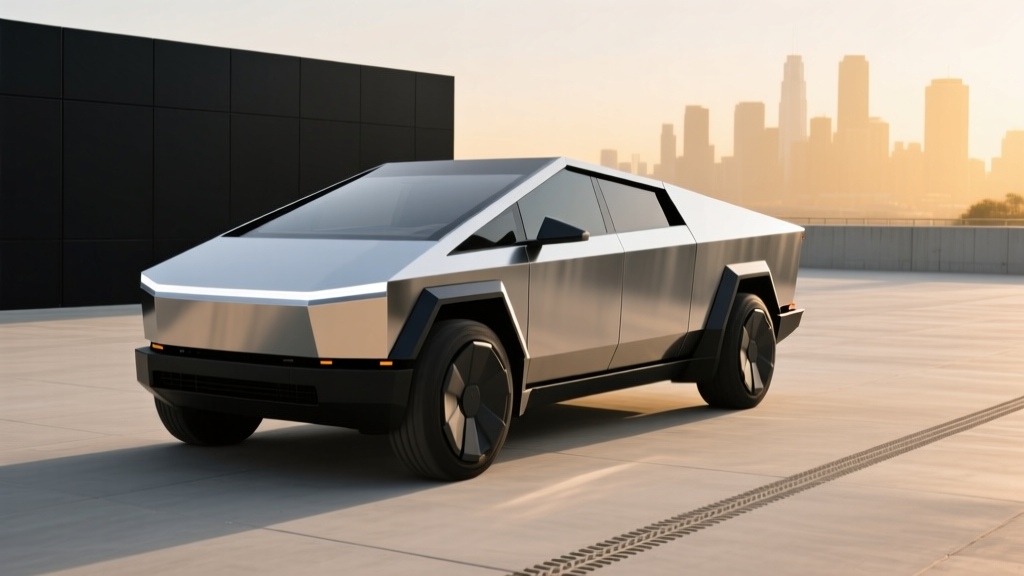
The stainless steel exoskeleton body eliminates traditional paint, which means no clear coat to scratch but also no easy way to repair dents or change color without a wrap. Panel gaps remain a topic of owner discussion, though build quality has improved on 2025 production units compared to early 2024 deliveries.
Standout Tech Features
- 18.5-inch front touchscreen with integrated navigation, streaming, and vehicle controls — no physical buttons for climate or mirrors (adjusted via screen).
- Rear 9.4-inch touchscreen for rear-seat climate and entertainment.
- Autopilot (standard) and available Full Self-Driving (Supervised) — both are SAE Level 2 driver-assistance systems requiring continuous driver engagement. FSD Supervised handles highway lane changes, on/off-ramps, and some city driving, but is not autonomous driving.
- Steer-by-wire with four-wheel steering: the rear wheels turn up to 10 degrees, giving the Cybertruck a turning circle of 37.4 feet — tighter than many midsize trucks despite its 231-inch overall length.
- Integrated trailer brake controller and tow mode with trailer sway mitigation.
- 120V and 240V bed outlets: Up to 9.6 kW of vehicle-to-load (V2L) power output, enough to run power tools, a campsite, or essential home circuits during an outage.
Notable Drawbacks
- Visibility is compromised by the thick A-pillars, small rear window, and bed-mounted camera reliance for rearward sightlines.
- No physical buttons for critical functions — mirror adjustment, glove box, and wiper controls are all screen-based.
- Stainless steel panels are fingerprint-prone and difficult to repair after collision damage.
- Charging port is located on the driver-side rear, which can make some public charger orientations awkward with a trailer attached.
- Insurance premiums run 20-40% higher than comparable gas trucks, reflecting repair costs and parts availability.
Who Should Buy the Cybertruck — and Who Shouldn't
Choose the Cybertruck if:
- You need 11,000-lb tow capacity but only tow 5-15 days per year (boat, car trailer, camper).
- You have reliable Level 2 home charging and tow within Supercharger-dense corridors.
- You value the 9.6 kW V2L capability for job sites or off-grid camping.
- You want sports-car acceleration in a truck form factor.
- You're drawn to the design and accept the attention it draws (positive and negative).
Look elsewhere if:
- You tow frequently over long distances (200+ miles) and can't accommodate charging stops.
- You need a full 8-foot bed for commercial use.
- You want traditional physical controls and proven long-term reliability data.
- You need the federal tax credit and want the top-performance Cyberbeast trim (MSRP cap disqualifies it).
- Interior rear-seat comfort for adults on long trips is a priority.
Key competitors include the Ford F-150 Lightning (max tow: 10,000 lbs, EPA range up to 320 mi, lower starting price, qualifies for §30D credit on multiple trims), the Rivian R1T (max tow: 11,000 lbs, EPA range up to 420 mi with Max Pack, more refined interior, higher price), and the Chevrolet Silverado EV (max tow: 12,500 lbs on Work Truck trim, EPA range up to 440 mi with Max Range battery, fleet-oriented availability).
Battery Longevity and Warranty Coverage
Tesla covers the Cybertruck's battery and drive units for 8 years or 120,000 miles, whichever comes first, with a minimum 70% capacity retention guarantee. The NMC (nickel manganese cobalt) chemistry in the Cybertruck's ~123 kWh pack offers high energy density but is more sensitive to sustained high state-of-charge and extreme heat than LFP chemistry. For maximum longevity:
- Avoid routinely charging to 100% for daily use — set the charge limit to 80-90%.
- Use the battery preconditioning feature before DC fast charging (the navigation system activates this automatically when routing to a Supercharger).
- Minimize repeated 0% to 100% deep cycles.
Tesla does not publish cell-level replacement costs for the Cybertruck specifically. Industry estimates for a full pack replacement on a vehicle of this capacity range from $18,000-$28,000 out of warranty. However, module-level repairs are typically possible, and most degradation issues manifest gradually rather than as sudden failure.
Frequently Asked Questions
What is the real-world range of the Tesla Cybertruck while towing?
Unloaded, expect 270-290 miles in mixed driving from the AWD trim's 318-mile EPA rating. While towing a 5,000-8,000 lb trailer at highway speeds, real-world range drops to approximately 140-180 miles depending on trailer aerodynamics, speed, terrain, and temperature. A boxy enclosed trailer at 70 mph on a cold day will push range toward the lower end of that spectrum.
How fast does the Cybertruck charge at home and on the road?
At home on a Level 2 (240V, 48A) charger, the Cybertruck charges at 11.5 kW, adding roughly 37 miles per hour — a full charge takes about 8-9 hours. On DC fast charging, the 800V architecture supports up to 350 kW peak at V4 Superchargers, with a 10-80% session taking approximately 17 minutes under optimal conditions. At non-Tesla CCS stations (with adapter), expect 150-250 kW peak rates.
Does the Cybertruck qualify for the $7,500 federal EV tax credit?
The AWD trim ($79,990 MSRP) qualifies under the $80,000 truck MSRP cap, assuming the buyer meets IRS §30D income limits ($300K joint / $150K single) and the vehicle meets current-year battery sourcing requirements. The Cyberbeast ($99,990 MSRP) exceeds the MSRP cap and does NOT qualify for the federal credit. Always verify current eligibility on fueleconomy.gov before purchasing, as sourcing rules tighten annually.
Is the Cybertruck worth buying over the F-150 Lightning or Rivian R1T?
The Cybertruck offers the best acceleration, the most distinctive design, and strong V2L capability. The F-150 Lightning is more practical for traditional truck buyers (larger bed, more physical controls, lower price, broader credit eligibility). The Rivian R1T offers superior range with the Max Pack, a more premium interior, and a gear tunnel for extra storage. For frequent long-distance towing, the Lightning's broader Supercharger-alternative charging network and the R1T's range advantage are worth considering.
What are the biggest pros and cons of the Cybertruck?
- 11,000-lb tow rating with instant electric torque
- Up to 350 kW DC fast charging (800V architecture)
- 9.6 kW V2L power output for job sites and camping
- 2.6-second 0-60 (Cyberbeast) — fastest production truck
- Stainless steel body requires no paint maintenance
- Four-wheel steering enables surprisingly tight turns
- Towing range drops to ~140-180 miles realistically
- Cyberbeast disqualified from federal tax credit (MSRP cap)
- 6-foot bed is shorter than most full-size truck beds
- No physical buttons — all controls are screen-based
- Insurance premiums significantly above segment average
- Rear-seat comfort trails F-150 and R1T
How does the Cybertruck's tow capacity compare to gas trucks?
At 11,000 lbs, the Cybertruck matches or exceeds many half-ton gas truck configurations (the F-150 with 3.5L EcoBoost max-tow package rates at 13,500 lbs; the standard 3.5L rates around 11,000-12,000 lbs depending on configuration). The Cybertruck's advantage is the instant torque delivery and smooth, shift-free acceleration under load. Its disadvantage is range — a gas truck can typically tow 400-500 miles before refueling, while the Cybertruck requires charging every 140-180 miles under similar loads.
Sources: fueleconomy.gov (EPA range and efficiency data), IRS §30D clean vehicle credit rules, Tesla official specifications.