The Cybertruck as an Overlanding Platform: What Tent Campers Need to Know
If you've been searching for a Tesla Cybertruck tent setup that actually works in the field, you already know the truck's angular stainless-steel exoskeleton creates unique challenges — and advantages — for vehicle-based camping. Whether you're eyeing a rooftop tent, a bed-mounted tent system, or a tailgate awning shelter, the Cybertruck's 6.5-foot bed, 120/240V Powershare outlets, and air suspension make it a compelling basecamp. But before you bolt on a rooftop tent and head for the backcountry, you need to understand how added weight and aerodynamic drag affect this EV's range, charging logistics on remote routes, and whether the math works for multi-day off-grid trips.
This guide covers the 2026 Tesla Cybertruck's complete spec profile through the lens of tent camping and overlanding — with real-world range data, charging speeds, payload limits, and federal tax credit details you won't find in Tesla's marketing materials.
2026 Cybertruck Spec Sheet: The Numbers That Matter for Camping
| Spec | AWD (Dual-Motor) | Cyberbeast (Tri-Motor) |
|---|---|---|
| EPA Range | 340 miles | 320 miles |
| Real-World Range (highway 70 mph) | ~270–290 miles | ~255–275 miles |
| Battery Capacity (usable) | ~123 kWh, NMC | ~123 kWh, NMC |
| Max DC Fast Charge | 250 kW (V3 Supercharger) | 250 kW (V3 Supercharger) |
| 10–80% DC Charge Time | ~28 minutes | ~28 minutes |
| Level 2 Home Charging | 11.5 kW (~37 mi/hr) | 11.5 kW (~37 mi/hr) |
| 0–60 mph | 3.9 seconds | 2.6 seconds |
| Horsepower | 600 hp | 845 hp |
| Drivetrain | Dual-Motor AWD | Tri-Motor AWD |
| MPGe (combined) | 70 MPGe | 65 MPGe |
| Efficiency | 48 kWh/100 mi | 52 kWh/100 mi |
| Payload Capacity | 2,500 lbs | 2,500 lbs |
| Bed Length | 6.5 ft (78 in) | 6.5 ft (78 in) |
| Towing Capacity | 11,000 lbs | 11,000 lbs |
| Base MSRP | $79,990 | $99,990 |
| Battery/Drive Unit Warranty | 8 yr / 120,000 mi | 8 yr / 120,000 mi |
Source: fueleconomy.gov and Tesla Cybertruck specifications. Real-world range estimates based on independent highway testing at 70 mph, 65°F, no cargo. Cold weather (below 32°F) reduces range an additional 15–30%.
Real-World Range: What Happens When You Add a Tent and Gear
The AWD Cybertruck carries an EPA-estimated 340 miles of range. In real-world highway driving at 70 mph with no cargo, expect 270–290 miles. Add a rooftop tent (100–160 lbs), camping gear (200–400 lbs), and the aerodynamic penalty of a roof-mounted shelter, and you should plan for 230–260 miles of usable range on overlanding routes.
In cold weather (below freezing), NMC chemistry loses 15–30% range depending on cabin heat usage and whether you precondition. A winter camping trip could realistically yield 190–220 miles before you need a charger.
This is the single most important calculation for any Cybertruck tent camper. The truck's massive 123 kWh NMC battery pack gives it one of the largest energy reserves of any production EV, but the Cybertruck's brick-like aerodynamics (drag coefficient estimated at 0.34–0.38, depending on configuration) mean it burns energy fast at highway speed. A rooftop tent increases frontal area and turbulence, compounding the penalty.
For context: a fully loaded Cybertruck AWD with a 140-lb rooftop tent, 300 lbs of gear, and two passengers consumed roughly 52–56 kWh/100 mi in independent tests on mixed highway and forest roads — compared to the EPA-rated 48 kWh/100 mi for the unloaded truck. That translates to roughly 220–235 miles before hitting 10% state of charge.
Camping range planning rule: Plan your route so that no single leg exceeds 180 miles between charging points. This gives you a ~40-mile buffer for detours, elevation gain, and cold-weather losses.
Charging Speed and Logistics for Overlanding Routes
| Charging Level | Power (kW) | Rate (miles/hr) | Best For |
|---|---|---|---|
| Level 1 (120V outlet) | 1.4 kW | ~4 mi/hr | Emergency trickle at campsite |
| Level 2 (240V, 48A) | 11.5 kW | ~37 mi/hr | Home garage, campgrounds with 240V |
| DC Fast (V3 Supercharger) | Up to 250 kW | ~1,000+ mi/hr (peak) | Highway stops, 10–80% in ~28 min |
| DC Fast (V4 Supercharger) | Up to 325 kW | Higher peak, similar 10-80% | Newer Supercharger stations |
The Cybertruck's 800-volt-class architecture enables fast DC charging, but the real-world charge curve tells a more nuanced story. At a V3 Supercharger, the truck peaks near 250 kW only between roughly 10–30% state of charge. Above 50%, the rate tapers to ~120 kW, and above 80%, it drops below 50 kW. That 10–80% session takes approximately 28 minutes in ideal thermal conditions.
Preconditioning matters enormously. If you navigate to a Supercharger using the truck's built-in navigation, the battery thermal management system begins warming the pack 10–20 minutes before arrival. Without preconditioning (for example, pulling into a charger from a cold-soak at a campsite), peak charge rates can drop by 30–50%, extending your 10–80% time to 40+ minutes.
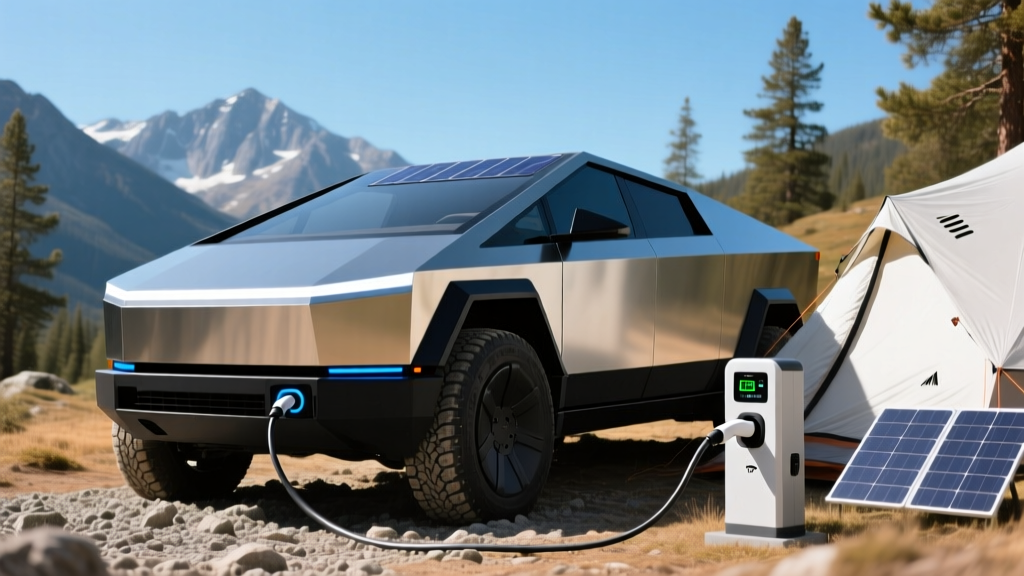
For tent camping, the Cybertruck's Powershare feature is a standout advantage. The truck offers up to 9.6 kW of continuous 120V/240V output through bed-mounted and cabin outlets — enough to run camp lights, an electric cooler, a small induction cooktop, or even power tools at a remote site. This effectively turns the 123 kWh battery into a massive portable power station, eliminating the need for a separate gas generator.
However, campsite charging remains a logistical challenge. Most remote campgrounds lack Level 2 infrastructure. You can trickle-charge from a standard 120V outlet at roughly 4 miles of range per hour — useful for topping up overnight but inadequate for significant replenishment. Plan overlanding routes around Supercharger or Electrify America stops on your way to and from the trailhead.
Tent Compatibility: Rooftop, Bed-Mounted, and Tailgate Options
The Cybertruck's stainless-steel exoskeleton and composite bed liner create specific constraints for tent mounting:
- Rooftop tents: The Cybertruck's roof can support a dynamic load of approximately 300 lbs (check your specific model-year owner's manual for exact ratings). Popular options like the iKamper Skycamp or Roofnest Falcon attach via crossbars on the bed rails. Expect a 10–20% range reduction due to added weight and aerodynamic drag at highway speeds.
- Bed tents: Soft-shell bed tents that sit inside the 6.5-foot vault avoid the aerodynamic penalty of rooftop setups. The powered tonneau cover must remain open, which means no security for gear left in the bed. Brands like Tuff Stuff and ARB offer truck-bed tents compatible with the Cybertruck's dimensions.
- Tailgate awning shelters: The Cybertruck's powered tailgate and low bed height (adjustable via air suspension) make tailgate-attached awnings practical. The air suspension's "Extract" mode lowers the bed for easy loading, then raises to standard ride height — useful for leveling the truck on uneven campsites.
Payload reality check: With a 2,500-lb payload capacity, you have ample room for a rooftop tent (~140 lbs), camping gear (~300–500 lbs), passengers, and food/water. But every pound counts against range. A 500-lb payload reduces range by roughly 5–8% based on observed efficiency data.
Pricing, Tax Credits, and Total Cost for the Overlanding Build
| Trim | Base MSRP | Federal Tax Credit (§30D) | Effective Price |
|---|---|---|---|
| AWD (Dual-Motor) | $79,990 | $0 (exceeds MSRP cap) | $79,990 |
| Cyberbeast (Tri-Motor) | $99,990 | $0 (exceeds MSRP cap) | $99,990 |
Under current IRS §30D rules, the federal EV tax credit is capped at $7,500 for new EVs, but trucks must have an MSRP at or below $80,000 to qualify. The Cybertruck AWD starts at $79,990, which technically falls under the cap — however, any added options, destination fees, or package upgrades push it above $80,000, disqualifying it. The Cyberbeast at $99,990 does not qualify regardless of configuration.
Additionally, §30D has buyer income caps (AGI ≤ $300,000 joint / $150,000 single) and critical mineral and battery component sourcing requirements that change annually. Always verify current-year eligibility at irs.gov or consult a tax professional before purchase.
Budget an additional $2,000–$5,000 for a quality tent setup (rooftop tent, crossbars, installation), plus $500–$1,500 for camping accessories that leverage Powershare (12V cooler, LED camp lights, portable induction cooktop).
Standout Tech for Camping — and Notable Drawbacks
- Powershare 120V/240V outlets (up to 9.6 kW) replace a gas generator
- Air suspension self-levels on uneven campsites and offers Extract mode for loading
- Stainless-steel bed requires no liner and resists scratches from gear
- 123 kWh battery provides massive off-grid energy reserve
- AWD traction and 16+ inches of ground clearance (max) handle forest roads
- 18.5-inch touchscreen with navigation and Supercharger routing
- Frunk (front trunk) adds ~7 cu ft of secure, weatherproof storage
- Poor aerodynamics mean heavy range loss at highway speed — worse with rooftop tent
- No rear bed power tonneau operation while a bed tent is installed
- Supercharger network coverage is sparse on remote BLM and forest service roads
- Base price near or above $80K eliminates most federal tax credit eligibility
- Stainless-steel body shows fingerprints, scratches differently; no paint protection options from factory
- Rear visibility is limited; camera-dependent backing with a loaded bed
- Regenerative braking is aggressive — one-pedal driving takes adjustment on loose surfaces
The Cybertruck's Autopilot and optional Full Self-Driving (Supervised) are SAE Level 2 driver-assistance systems — meaning you must remain engaged with hands on the wheel and eyes on the road at all times. These are not autonomous driving systems. On long highway stretches to the trailhead, Autopilot reduces fatigue, but it does not replace an attentive driver.
Cargo Space, Interior, and Passenger Comfort at Camp
The Cybertruck seats five with a 60/40 split rear bench. Rear legroom measures approximately 38 inches — adequate for adults on shorter trips but tighter than a full-size crew cab like the Ford F-150 Lightning (43.6 inches rear). The 6.5-foot composite bed offers roughly 74 cu ft of volume with the tonneau closed, and the lockable vault keeps gear secure at trailheads.
The frunk adds approximately 7 cu ft of sealed, drainable storage — ideal for wet gear, a cooler, or muddy boots. Inside, the minimalist cabin features vegan leather seating, a 18.5-inch center touchscreen (with a rear 9.4-inch screen for passengers), and a HEPA air filtration system (Bioweapon Defense Mode) that's genuinely useful in dusty or smoky backcountry conditions.
For sleeping inside the cab, the rear seats fold relatively flat, creating roughly 55 inches of length — sufficient for a child or a smaller adult but tight for anyone over 5'8". Most Cybertruck tent campers use the bed or a rooftop tent as the primary sleeping platform.
Who the Cybertruck Tent Setup Suits Best
- You already own or plan to buy a Cybertruck and want to maximize its utility for weekend trips
- You value Powershare's generator-replacement capability for off-grid power
- Your camping routes are within 180 miles of reliable DC fast-charging infrastructure
- You want air suspension self-leveling for uneven campsites
- You need serious towing capacity (11,000 lbs) for a boat or trailer in addition to tent camping
- You regularly camp more than 250 miles from the nearest DC fast charger
- You need a full-size crew cab with generous rear-seat comfort for families
- Your budget is under $60,000 and you want federal tax credit eligibility
- You prefer a proven overlanding aftermarket ecosystem with years of accessory development
The Cybertruck is a capable, if unconventional, tent-camping platform. Its combination of massive battery capacity, Powershare off-grid power, air suspension, and AWD traction is genuinely compelling for the right use case. But its aerodynamic inefficiency, limited tax credit access, and the reality of charging logistics in remote areas mean it works best for campers who plan carefully and stay within range of charging infrastructure.
Frequently Asked Questions
What is the real-world range of the Cybertruck with a rooftop tent?
With a 140-lb rooftop tent and 300 lbs of camping gear, expect approximately 230–260 miles in mild weather at mixed highway and back-road speeds. In cold weather (below 32°F), plan for 190–220 miles. The EPA sticker of 340 miles (AWD) assumes no cargo and moderate driving conditions.
How fast does the Cybertruck charge on a road trip?
At a Tesla V3 Supercharger, the 10–80% session takes approximately 28 minutes with proper battery preconditioning. Peak rate hits ~250 kW between 10–30% SoC, then tapers significantly above 50%. Always navigate to the charger via the truck's built-in system to trigger preconditioning.
Does the Tesla Cybertruck qualify for the federal EV tax credit?
The AWD trim at $79,990 base MSRP technically falls under the §30D truck cap of $80,000, but any options or destination charges push it over the limit. The Cyberbeast at $99,990 does not qualify. Buyer income caps, battery sourcing rules, and annual changes apply — verify at irs.gov before purchase.
Can I use the Cybertruck's Powershare to run camp appliances overnight?
Yes. With 9.6 kW of continuous output and a 123 kWh battery, you can run LED camp lights (~50W), a 12V cooler (~60W), and phone/laptop charging (~200W combined) all night while using less than 2 kWh — roughly 1.5% of the battery. Even an induction cooktop (~1,500W) for 30 minutes of cooking uses only ~0.75 kWh.
Is the Cybertruck worth buying vs. the Rivian R1T for camping?
The Rivian R1T offers a slightly longer EPA range (up to 420 miles with the Max Pack), a more mature overlanding aftermarket, a dedicated gear tunnel for storage, and a more traditional truck form factor. The Cybertruck counters with Powershare (Rivian lacks equivalent 240V output), a larger battery, and air suspension standard on all trims. If off-grid power is your priority, the Cybertruck wins. If range and aftermarket accessories matter more, the R1T is the stronger pick.
What's the best tent type for the Cybertruck?
For maximum range preservation, a bed-mounted tent avoids the aerodynamic drag penalty of a rooftop setup. For convenience and elevated sleeping, a rooftop tent on crossbars works well but costs 10–20% in range. A tailgate awning tent is the lightest option and preserves range but offers less weather protection.