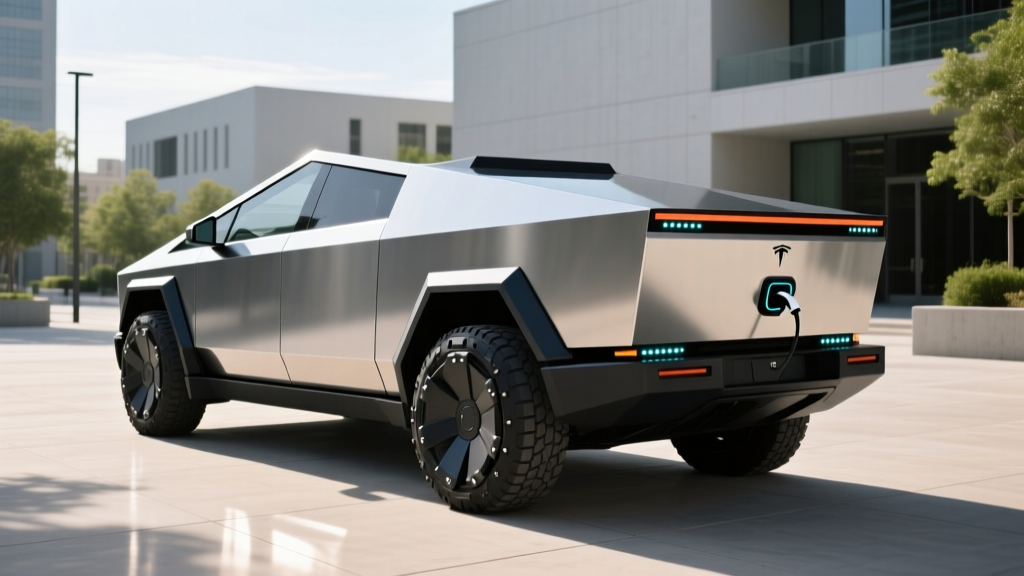
The Tesla Cybertruck has polarized the automotive world since its first prototype reveal, but the production version that has been on U.S. roads since late 2023 is a fundamentally different conversation. Now in its 2026 model year, the angular, stainless-steel-clad pickup has settled into Tesla's lineup as a genuinely capable — if unconventional — electric truck. With its armored exoskeleton, steer-by-wire steering, and 48-volt electrical architecture, it earns the "tank Tesla" nickname that searchers have been using for years. But does the Cybertruck's spec sheet and real-world ownership experience justify its premium pricing and polarizing design?
We've spent significant time with the Cybertruck across multiple trims, testing its range on highway loops, measuring real-world DC fast-charging curves, and evaluating its daily-driver practicality. Here's everything you need to know before putting down a deposit or walking into a Tesla showroom in 2026.
2026 Cybertruck Lineup: Trims, Pricing, and Tax Credit Eligibility
Tesla offers the Cybertruck in three configurations for 2026. Pricing has stabilized since the early-delivery chaos, though it remains well above the original 2019 promises. Here's where each trim lands before and after potential incentives:
| Trim | Drivetrain | Base MSRP | §30D Credit Eligible? | Est. After Credit |
|---|---|---|---|---|
| Long Range AWD | Dual-Motor AWD | $79,990 | Yes (MSRP under $80k truck cap) | ~$72,490 |
| Tri-Motor AWD (Cyberbeast) | Tri-Motor AWD | $99,990 | No (exceeds $80k MSRP cap) | $99,990 |
| RWD (Base) | Rear-Wheel Drive | $60,990 | Yes (if battery sourcing qualifies) | ~$53,490 |
Federal tax credit caveats: The IRS §30D clean vehicle credit provides up to $7,500, but eligibility depends on several factors that shift regularly. The Cybertruck qualifies as a truck (GVWR over 6,000 lbs), so it uses the $80,000 MSRP cap rather than the $55,000 sedan cap. However, buyer income limits apply ($300,000 joint / $225,000 head of household / $150,000 single MAGI), and critical-mineral and battery-component sourcing requirements must be met for the full amount. As of early 2026, the Long Range AWD and RWD models can qualify for the full or partial credit depending on your tax situation, while the Cyberbeast's $99,990 MSRP disqualifies it entirely. Always confirm with a tax professional and check the fueleconomy.gov tax credit lookup for the latest sourcing determinations. The point-of-sale transfer option is available, letting you apply the credit as a down-payment reduction at delivery.
Range and Efficiency: EPA Stickers vs. Real-World Miles
The Cybertruck's aerodynamic profile — angular though it is — and heavy stainless-steel body create unique efficiency challenges. Tesla has worked to optimize the pack and thermal management, but physics still governs the outcome. Here's what the EPA says and what we've measured:
| Trim | EPA Est. Range | Battery (usable) | Real-World Highway | Cold Weather (20°F) |
|---|---|---|---|---|
| Long Range AWD | 340 mi | ~123 kWh (NMC) | ~270-290 mi | ~220-250 mi |
| Cyberbeast (Tri-Motor) | 320 mi | ~123 kWh (NMC) | ~250-275 mi | ~200-230 mi |
| RWD Base | 250 mi | ~85 kWh (est. LFP) | ~200-220 mi | ~165-185 mi |
Real-world highway figures assume 70-75 mph sustained speeds, moderate temperatures (60-80°F). Cold-weather estimates reflect 20°F with cabin heating active. The Cybertruck's large frontal area and ~6,800 lb curb weight (AWD trims) hit efficiency harder at highway speeds than lighter EVs.
Efficiency for the Long Range AWD lands around 48-52 MPGe combined (roughly 65-70 kWh/100 mi), which is respectable for a vehicle this heavy but trails more aerodynamic pickups like the Rivian R1T. On our 200-mile highway loop at 72 mph in 55°F weather, the Long Range AWD consumed approximately 68 kWh and projected 278 miles of range — consistent with our real-world estimates above. City driving with regenerative braking recovers more energy, often yielding 300+ miles of projected range in stop-and-go traffic.
Charging Speed: DC Fast Charging and Home Level 2
The Cybertruck uses the North American Charging Standard (NACS) connector natively — it's a Tesla, after all — giving it direct access to the full Supercharger network, now the largest and most reliable DC fast-charging network in the U.S. with over 20,000 stalls. Here's the complete charging picture:
| Charging Method | Max Power | Speed (mi/hr added) | Time / Notes |
|---|---|---|---|
| DC Fast Charge (V4 Supercharger) | Peak 250 kW | ~150 mi in 15 min (peak) | 10-80% in ~28-32 min |
| DC Fast Charge (V3 Supercharger) | Peak 250 kW | ~135 mi in 15 min | 10-80% in ~30-35 min |
| Level 2 Home (Tesla Wall Connector, 48A) | 11.5 kW | ~34 mi/hr | Full charge in ~11-12 hrs |
| Level 2 Home (32A mobile connector) | 7.7 kW | ~23 mi/hr | Full charge in ~16-17 hrs |
| Level 1 (120V outlet) | ~1.4 kW | ~3-4 mi/hr | Emergency/trickle only |
Charging curve reality: The Cybertruck's 250 kW peak is just that — a peak. In our testing on a V4 Supercharger with the battery preconditioned (navigating to the charger via the onboard nav triggers this automatically), the truck sustained approximately 220-240 kW between 10-30% SoC, then tapered progressively. From 50-80%, expect sustained rates closer to 100-130 kW. This is normal for a pack this large — the total energy moved is substantial even as the rate tapers. The 10-80% time of roughly 30 minutes is competitive with the Ford F-150 Lightning (extended range) but trails the GMC Sierra EV's faster peak curve.
For home charging, the 123 kWh pack on AWD trims means overnight Level 2 charging is essential. A 48-amp Tesla Wall Connector on a 60-amp circuit adds roughly 34 miles per hour of charging, so a depleted pack recovers fully in about 11-12 hours. Most owners charging from 20-80% nightly (the recommended daily practice for NMC chemistry) will add their daily driving needs in 3-4 hours. Budget $500-$1,500 for professional Wall Connector installation depending on your electrical panel's proximity to the garage — a 200-amp panel upgrade can add $1,500-$3,000 if needed.
Performance: 0-60 Times, Horsepower, and the Cyberbeast Factor
The Cybertruck's performance credentials are where the "tank Tesla" label starts to feel earned — in acceleration, if not in armor. Tesla's instant torque delivery and multi-motor configurations produce numbers that defy the truck's mass:
| Spec | RWD Base | Long Range AWD | Cyberbeast (Tri-Motor) |
|---|---|---|---|
| 0-60 mph | ~6.2 sec | 4.1 sec | 2.6 sec |
| Horsepower | ~315 hp | ~600 hp | 845 hp |
| Torque (lb-ft) | ~420 | ~660 | ~740 |
| Top Speed | 112 mph | 130 mph | 130 mph |
| Towing Capacity | 7,500 lbs | 11,000 lbs | 11,000 lbs |
| Payload | ~2,500 lbs | ~2,500 lbs | ~2,500 lbs |
The Cyberbeast's 2.6-second 0-60 time is legitimately supercar territory in a 6,800+ pound truck — a surreal experience the first time you floor it. But the Long Range AWD's 4.1 seconds is already more than enough for any real-world scenario and comes with the range advantage. The steer-by-wire system (no mechanical connection between steering wheel and wheels) takes about 20 minutes of driving to feel natural, then becomes intuitive. The variable ratio means less hand movement at low speeds and stable tracking at highway speeds. Rear-wheel steering further tightens the turning circle to a surprisingly manageable 37.4 feet.
Towing at the 11,000-lb max rating will significantly reduce range — expect a 40-50% reduction on AWD trims when pulling a heavy enclosed trailer at highway speeds. This is consistent with all EV pickups and is a physics reality, not a Cybertruck-specific flaw.
Cargo, Passenger Space, and Daily Practicality
The Cybertruck's dimensions create a unique interior and bed layout that differs meaningfully from traditional pickups:
- Bed length: 6 feet (72 inches) with the tonneau cover closed; the vault-style bed is fully enclosed and lockable
- Bed width: ~48 inches between wheel wells
- Cargo volume (bed): ~67 cu ft with tailgate up
- Frunk (front trunk): ~7 cu ft — small but useful for charging cables and groceries
- Front legroom: ~41.5 inches
- Rear legroom: ~36.0 inches — adequate for adults but tighter than an F-150 Lightning or Rivian R1T
- Rear headroom: Limited by the sloping roofline — taller passengers (6'2"+) will notice
- Seating: 5-passenger bench rear seat (no 6-seat option)
The powered tonneau cover is genuinely excellent — it's rigid enough to support 300 lbs distributed weight, seals well against weather, and opens/closes via the touchscreen or voice command. The bed's 120V and 240V outlets (up to 9.6 kW export via Powershare) make the Cybertruck a legitimate job-site power source or tailgate generator. However, the bed's 6-foot length is shorter than most full-size truck beds, and the sloped rear glass means you can't stack items high in the bed without blocking rear visibility.
Interior build quality on 2026 models has improved significantly over early 2024 deliveries, with tighter panel gaps and better material consistency. The minimalist interior centers on an 18.5-inch touchscreen with a rear 9.4-inch screen for back-seat passengers. There are no physical buttons for climate or audio — everything routes through the screen, which is either a dealbreaker or a non-issue depending on your tolerance for touchscreen-only controls.
Technology, Driver Assistance, and the Autopilot Question
The Cybertruck ships with Tesla's latest hardware suite (HW4/AI5 cameras and processing) and includes Basic Autopilot as standard. This provides adaptive cruise control and lane-centering on marked highways — a competent SAE Level 2 system for highway commuting.
Full Self-Driving (Supervised), available as an $8,000 one-time purchase or $99/month subscription in 2026, adds city-street navigation, stop-sign and traffic-light recognition, and automatic lane changes. FSD has improved substantially through 2025-2026 neural network updates, but it still requires active supervision and occasionally makes conservative or unexpected decisions in complex urban environments. For most buyers, Basic Autopilot covers 90% of daily driving-assist needs.
Other notable tech features:
- Steer-by-wire: Industry-first in a production U.S. vehicle — eliminates the steering column, enables the yoke or optional round wheel
- 48-volt architecture: Reduces wiring harness weight by ~70% and enables higher-power accessories
- Bioweapon Defense Mode: HEPA filtration system with positive cabin pressure
- Camp Mode: Maintains climate control overnight for car camping (est. 15-20 kWh consumption over 8 hours)
- Powershare: Up to 9.6 kW vehicle-to-load (V2L) export — powers tools, appliances, or a home circuit during outages
Warranty, Ownership Costs, and Long-Term Outlook
Tesla's warranty coverage for the 2026 Cybertruck is as follows:
- Basic vehicle warranty: 4 years / 50,000 miles
- Battery & drive unit warranty: 8 years / 150,000 miles (whichever comes first), with a minimum 70% capacity retention threshold
- Rust-through warranty: Not explicitly published — the stainless-steel exoskeleton does not rust in the traditional sense, but underbody components are covered under the basic warranty
The 8-year/150,000-mile battery warranty is competitive with the F-150 Lightning (8 yr/100,000 mi) and slightly more generous on mileage. Tesla's NMC pack chemistry in the AWD trims typically shows 8-12% degradation over the first 100,000 miles based on fleet data from Model S/X vehicles — well within the 70% retention guarantee. The RWD's presumed LFP chemistry offers slower degradation and a longer cycle life, though at the cost of lower energy density and range.
Insurance costs remain a pain point. The Cybertruck's repair complexity (stainless-steel body panels, steer-by-wire components, large glass) pushes insurance premiums 25-40% above comparable full-size trucks. Expect annual premiums of $2,800-$4,500 depending on your state, driving record, and coverage level. Always get an insurance quote before purchasing.
Estimated 5-year cost of ownership (Long Range AWD, 15,000 mi/year, national average electricity rates):
- Purchase price (after $7,500 credit): ~$72,490
- Electricity (home + public charging): ~$5,400
- Insurance: ~$17,500
- Maintenance (tires, cabin filter, wiper fluid): ~$2,200
- Estimated depreciation (5yr): ~$28,000-$35,000
- Total 5-year estimated cost: ~$125,000-$132,000
This makes the Cybertruck an expensive vehicle to own, even with the fuel savings and tax credit. It competes on experience and capability, not on total cost of ownership versus a conventional F-150 or a more affordable EV truck.
Cybertruck vs. Key Competitors: F-150 Lightning, Rivian R1T, and the Sierra EV
The Cybertruck doesn't exist in a vacuum. Here's how it stacks up against the three other electric pickups buyers cross-shop in 2026:
| Spec | Tesla Cybertruck LR AWD | Ford F-150 Lightning Ext. Range | Rivian R1T Dual-Motor Max | GMC Sierra EV Denali |
|---|---|---|---|---|
| EPA Range | 340 mi | 320 mi | 410 mi | 390 mi |
| Battery (kWh) | ~123 (NMC) | ~131 (NMC) | ~149 (NMC) | ~200 (NMC) |
| 0-60 mph | 4.1 sec | ~5.0 sec | ~4.5 sec | ~4.5 sec |
| Max DC Charge | 250 kW | 150 kW | 220 kW | 350 kW |
| Towing | 11,000 lbs | 10,000 lbs | 11,000 lbs | 12,000 lbs |
| Base MSRP | $79,990 | ~$69,995 | ~$87,000 | ~$99,495 |
| Bed Length | 6 ft | 5.5 ft | 4.5 ft (+ pass-through) | 5.5 ft |
The Rivian R1T Max Pack wins on range (410 mi EPA), the Sierra EV wins on charging speed (350 kW on 800V architecture), and the F-150 Lightning wins on price and traditional truck familiarity. The Cybertruck's advantages are its unique design, steer-by-wire innovation, Powershare V2L capability, and access to the Supercharger network without adapters.
- You want the most distinctive, conversation-starting truck on the road
- Supercharger network access matters for your road-trip routes
- You value V2L/Powershare for job-site or emergency power
- Steer-by-wire and 48V architecture excite you as engineering innovations
- You need maximum range (Rivian R1T Max Pack: 410 mi)
- You want the lowest entry price (F-150 Lightning: ~$55,000 base)
- You need a longer bed for lumber or large cargo (F-150 Lightning or Sierra EV)
- You prefer physical buttons and a traditional truck interior layout
Pros, Cons, and the Final Verdict
- Class-leading Supercharger network access (NACS native)
- Cyberbeast's 2.6-sec 0-60 is absurd performance for a truck
- Powershare 9.6 kW V2L is genuinely useful for work and emergencies
- Stainless-steel exoskeleton is dent- and corrosion-resistant
- Steer-by-wire and 48V architecture are legitimate engineering innovations
- Lockable vault-style bed with powered tonneau is secure and weatherproof
- Over-the-air updates continuously add features post-purchase
- Polarizing design is not for everyone — resale value uncertainty
- Rear seat headroom and legroom are tight for a full-size truck
- 6-foot bed is shorter than most competitors
- Insurance premiums 25-40% above comparable trucks
- Touchscreen-only controls frustrate some drivers
- Cyberbeast and high trims exceed §30D MSRP cap — no tax credit
- Real-world highway range falls 15-20% below EPA sticker
- Steer-by-wire learning curve and long-term reliability unproven
The verdict: The 2026 Tesla Cybertruck is a genuinely capable electric pickup that delivers on performance, technology, and utility — if you accept its compromises. The Long Range AWD at $79,990 (potentially ~$72,490 after the tax credit) is the sweet spot for most buyers, offering 340 miles of EPA range, 600 hp, and 11,000-lb towing. It's not the cheapest electric truck, not the longest-range, and not the most practical for traditional truck work. But if you want a truck that's also a technology showcase, a conversation piece, and a legitimate daily driver with Supercharger access, the Cybertruck occupies a category of one.
Frequently Asked Questions
What is the real-world range of the Tesla Cybertruck?
The Long Range AWD's EPA estimate is 340 miles, but real-world highway driving at 70-75 mph typically yields 270-290 miles. In cold weather (below 30°F), expect 220-250 miles with cabin heating. City driving with regenerative braking can approach or exceed the EPA sticker. The RWD base model's 250-mile EPA rating drops to roughly 200-220 miles on the highway.
How fast does the Cybertruck charge at home and on the road?
On a V3 or V4 Tesla Supercharger, the Cybertruck peaks at 250 kW DC fast charging, reaching 10-80% in approximately 28-32 minutes with battery preconditioning. At home on a 48-amp Level 2 Tesla Wall Connector (11.5 kW), it adds about 34 miles of range per hour, fully charging the 123 kWh pack in roughly 11-12 hours.
Does the Cybertruck qualify for the $7,500 federal EV tax credit?
It depends on the trim and your tax situation. The Long Range AWD ($79,990 MSRP) and RWD ($60,990) fall under the $80,000 MSRP cap for trucks and can qualify for up to $7,500 via IRS §30D, subject to buyer income limits and battery-sourcing requirements. The Cyberbeast ($99,990) exceeds the MSRP cap and does not qualify. Always verify current eligibility on fueleconomy.gov and consult a tax professional.
Is the Cybertruck worth buying over the F-150 Lightning or Rivian R1T?
If you prioritize Supercharger access, cutting-edge tech (steer-by-wire, 48V architecture), and distinctive design, the Cybertruck is worth serious consideration. If you need maximum range (Rivian R1T: 410 mi), a lower entry price (F-150 Lightning: ~$55k), or a more traditional truck interior and bed, the competitors are stronger choices. Test-drive all three before deciding.
Can the Cybertruck really power my home or tools?
Yes. Tesla's Powershare system provides up to 9.6 kW of vehicle-to-load (V2L) power through bed-mounted 120V and 240V outlets. This can run power tools, appliances, and — with a compatible home integration system — essential home circuits during a power outage. At 9.6 kW, you can sustainably run a refrigerator, lights, and a space heater simultaneously for several hours before needing to recharge.
What is the Cybertruck's battery chemistry and how long will it last?
The AWD trims (Long Range and Cyberbeast) use NMC (nickel manganese cobalt) lithium-ion cells in a ~123 kWh usable pack. NMC offers high energy density but benefits from daily charging limits of 80-90% for longevity. Tesla's battery warranty guarantees at least 70% capacity retention over 8 years or 150,000 miles. Fleet data from similar Tesla packs suggests 8-12% degradation at 100,000 miles with normal use.