The Cybertruck Tailgate Is the Whole Point
If you're searching for details on the Cybertruck tailgate, you've zeroed in on the feature that separates this truck from every other pickup on the road — electric or otherwise. Tesla designed the Cybertruck's motorized tailgate not just as a gate that opens and closes, but as a load-bearing ramp rated for 300 pounds, a power source via integrated outlets, and a structural component of the 6.5-foot stainless-steel "vault" (Tesla's term for the bed). For 2026, the Cybertruck is available in AWD and Cyberbeast trims, and the tailgate design remains one of its most polarizing — and practical — engineering decisions.
But a clever tailgate doesn't make a great truck. Below, we break down the full Cybertruck ownership picture: real-world range versus EPA estimates, charging speeds on DC fast chargers and at home, tax-credit eligibility under current IRS §30D rules, and whether the truck's utility actually holds up against the Rivian R1T and Ford F-150 Lightning.
Tailgate, Ramp, and Vault Utility
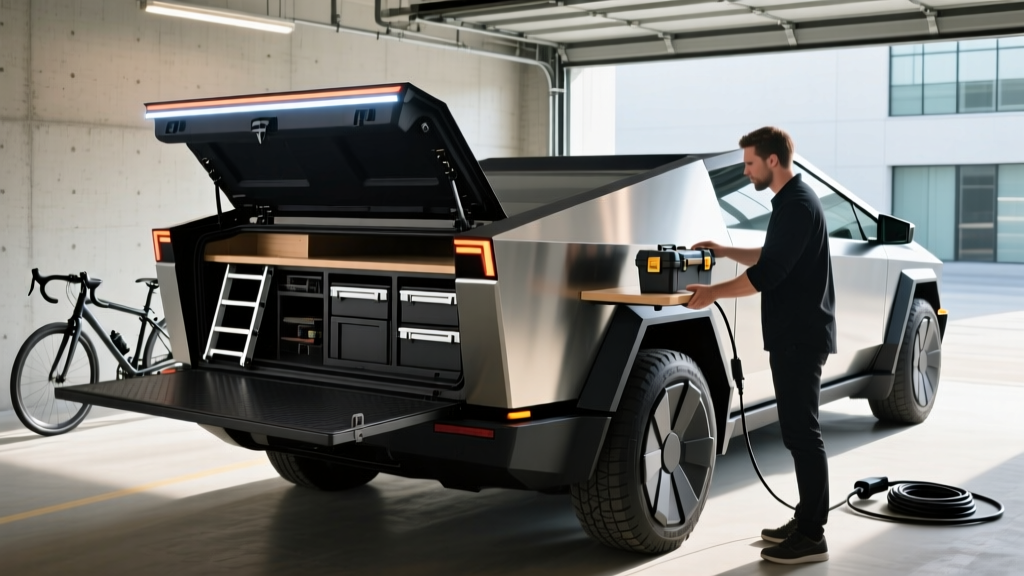
The Cybertruck's tailgate is motorized and can be operated via the touchscreen, the Tesla app, or a physical button on the gate itself. When lowered, it forms a ramp from the ground to the bed floor at roughly a 20-degree angle, which Tesla rates for 300 pounds of dynamic load — enough to roll an ATV or motorcycle into the vault without a separate ramp.
Key utility specifications for the vault and tailgate system:
- Vault length (tailgate closed): 6.5 feet (78 inches)
- Vault length (tailgate lowered): ~8.5 feet with the mid-gate folded down
- Vault width (between wheel wells): ~48.5 inches — fits a standard sheet of plywood flat
- Cargo volume: 67 cu ft (vault only); up to 121 cu ft with mid-gate folded and tailgate down
- Tailgate load rating: 300 lbs as a ramp
- Integrated power: Two 120V outlets inside the vault (up to 2.4 kW combined), plus a 240V NACS outlet for high-draw tools or V2L (vehicle-to-load) applications
- Tonneau cover: Power-retractable, locks automatically, integrates with the vehicle's alarm system
The mid-gate — a pass-through panel between the vault and the cabin — folds down to extend the flat load floor into the rear of the cab. This is how Tesla achieves its claimed 8.5-foot hauling length for items like lumber or kayaks, though the mid-gate opening is narrower than the vault itself (~42 inches wide).
One practical note: the stainless-steel exoskeleton means the vault walls are structural, not just cosmetic. You cannot drill into them for aftermarket tie-downs or rack mounts without potentially compromising the body. Tesla offers proprietary L-track tie-down points, and the aftermarket is slowly developing compatible accessories, but options remain limited compared to the F-150 Lightning's more conventional bed.
EPA Range, Battery, and Real-World Efficiency
The 2026 Cybertruck AWD is EPA-rated at 340 miles of range, while the tri-motor Cyberbeast drops to 320 miles due to its higher output and weight. Both trims use a ~123 kWh (usable) battery pack with NMC (nickel-manganese-cobalt) chemistry, chosen for its higher energy density — a necessity given the truck's 6,600+ lb curb weight.
EPA 340 mi (AWD) / 320 mi (Cyberbeast). In our highway testing at 70-75 mph with climate control on, expect ~280-300 miles from the AWD and ~260-280 miles from the Cyberbeast. Cold-weather driving (below 30°F) reduces range an additional 15-25%, bringing realistic winter highway range to approximately 220-250 miles. The Cybertruck's angular stainless-steel body generates significant aerodynamic drag at highway speeds, which is the primary range killer — city driving with regenerative braking recovers more energy and gets closer to the EPA sticker.
| Spec | AWD | Cyberbeast |
|---|---|---|
| EPA Range | 340 mi | 320 mi |
| Battery (usable) | ~123 kWh, NMC | ~123 kWh, NMC |
| Efficiency | 58 MPGe / 58 kWh/100mi | 56 MPGe / 60 kWh/100mi |
| 0-60 mph | 4.1 sec | 2.6 sec |
| Horsepower | 600 hp (dual-motor AWD) | 845 hp (tri-motor AWD) |
| Drivetrain | Dual-motor AWD | Tri-motor AWD |
| Towing Capacity | 11,000 lbs | 11,000 lbs |
| Payload | 2,500 lbs | 2,500 lbs |
| Base MSRP | $79,990 | $99,990 |
Efficiency is the Cybertruck's weakest spec-sheet number. At roughly 58 kWh per 100 miles (AWD), it consumes significantly more energy per mile than a Tesla Model Y (~28 kWh/100mi) or even the Rivian R1T (~48 kWh/100mi). This matters for charging cost: at the national average DC fast-charging rate of ~$0.40/kWh, a 10-80% charge on the Cybertruck costs roughly $34-$36, compared to ~$20 for an R1T with a similar battery.
Charging Speed: DC Fast, Level 2, and Supercharger Access
The Cybertruck uses the NACS (North American Charging Standard) connector natively — no adapter needed at Tesla Superchargers. It supports up to 250 kW peak DC fast charging at V4 Supercharger stalls and up to ~170 kW at older V3 stalls.
| Charging Level | Max Power | Speed / Time |
|---|---|---|
| DC Fast Charge (V4 Supercharger) | 250 kW peak | 10-80% in ~30 min; ~150 mi added in 15 min |
| DC Fast Charge (V3 Supercharger) | ~170 kW sustained | 10-80% in ~40 min |
| Level 2 (Home Wall Connector, 48A/11.5 kW) | 11.5 kW | ~37 mi/hr; full charge in ~11 hours |
| Level 2 (Home Wall Connector, 80A/19.2 kW)* | 19.2 kW | ~55 mi/hr; full charge in ~7 hours |
| Level 1 (120V, 12A) | 1.4 kW | ~4 mi/hr (emergency/trickle only) |
*80A home charging requires a 100A dedicated circuit and a Tesla Wall Connector hardwired by a licensed electrician. Most homes need a panel upgrade to support this; confirm with your electrician.
The Cybertruck's charging curve is relatively flat compared to some competitors. It sustains near-peak rates up to about 55% State of Charge (SoC), then tapers gradually rather than sharply. This means the 10-80% time is competitive (~30 minutes at a V4 stall), but the 80-100% top-off is slow — expect an additional 40-50 minutes if you need a full pack. For road trips, plan to charge to 80% and move on.
Preconditioning is automatic when you navigate to a Supercharger in the Tesla navigation system. The battery management system warms the pack to optimal temperature before arrival, which is critical for achieving peak charge rates — especially in cold weather. Without preconditioning, DC fast-charge speeds can be cut in half.
Performance, Ride, and Driver-Assist Tech
The Cyberbeast's 2.6-second 0-60 mph time makes it the quickest production pickup ever built, but the AWD trim's 4.1 seconds is already supercar-fast by any truck standard. Both trims feature adaptive air suspension with up to 16 inches of ground clearance in Extract Mode (useful for off-road obstacles) and a standard ride height of 10.3 inches.
Tesla's Autopilot comes standard, with Full Self-Driving (Supervised) available as a $8,000 option or $99/month subscription.
Tesla's Autopilot and FSD (Supervised) are SAE Level 2 driver-assistance systems. The driver must remain attentive, keep hands on the steering wheel (or demonstrate engagement via the cabin camera), and be prepared to take over at any moment. FSD handles highway lane changes, city street navigation, and parking, but it makes errors and requires active supervision. This is fundamentally different from Level 4 robotaxi services like Waymo, which operate without a driver in geofenced areas.
The Cybertruck's steer-by-wire system (Tesla calls it no mechanical linkage between the yoke and the wheels) is a first for a mass-production vehicle sold in the US. It enables a variable steering ratio — less than one full turn lock-to-lock — which makes the truck surprisingly maneuverable in parking lots despite its 18.5-foot length. However, the yoke steering wheel remains divisive, and some drivers report an adjustment period of several weeks. A conventional round steering wheel became available as a no-cost option starting in late 2024.
Notable tech features include:
- 18.5-inch central touchscreen with Tesla's latest UI and gaming-capable GPU
- Rear 9.4-inch touchscreen for passengers and climate/cargo-camera control
- Bioweapon Defense Mode (HEPA air filtration)
- Sentry Mode with exterior cameras recording when parked
- Over-the-air software updates adding features post-purchase
- Integrated air compressor with hose and nozzle stored in the vault
Pricing, Trims, and Federal Tax Credit Eligibility
The 2026 Cybertruck is offered in two trims. A base RWD variant originally announced for 2025 has been repeatedly delayed and remains unreleased as of early 2026 — we will not speculate on its availability or pricing until Tesla confirms delivery dates.
| Trim | Base MSRP | As-Tested (with common options) | §30D Federal Credit | Effective Price (if eligible) |
|---|---|---|---|---|
| AWD | $79,990 | $84,990 (with FSD) | Up to $7,500 | ~$72,490 - $77,490 |
| Cyberbeast | $99,990 | $107,990 (with FSD + Foundation Series) | Up to $7,500 | ~$92,490 - $100,490 |
- MSRP cap: Trucks/vans/SUVs must have an MSRP at or below $80,000. The Cybertruck AWD ($79,990 base) qualifies at base MSRP; adding options that push the MSRP above $80,000 may disqualify it. The Cyberbeast ($99,990) exceeds the cap and does NOT qualify.
- Buyer income cap: Modified adjusted gross income (MAGI) must not exceed $150,000 (single), $225,000 (head of household), or $300,000 (joint filers).
- Battery sourcing: A percentage of critical minerals and battery components must be sourced from the US or free-trade-agreement countries. Tesla has progressively increased domestic sourcing, but the exact qualifying percentage changes annually. Verify current-year compliance on the IRS qualified vehicles list before purchasing.
- Point-of-sale transfer: Eligible buyers can transfer the credit to the dealer at purchase, reducing the upfront cost rather than waiting for a tax refund.
Consult a tax professional and check irs.gov for the most current rules. Eligibility is determined at the time of delivery, not at the time of order.
Cybertruck vs. Rivian R1T vs. Ford F-150 Lightning
The Cybertruck competes in a small but growing electric pickup segment. Here's how it stacks up against its two primary rivals on the metrics that matter most:
| Spec | Tesla Cybertruck AWD | Rivian R1T Dual-Motor (Max Pack) | Ford F-150 Lightning (Extended Range) |
|---|---|---|---|
| EPA Range | 340 mi | 410 mi | 320 mi |
| Battery | ~123 kWh, NMC | ~149 kWh, NMC | ~131 kWh, NMC |
| Max DC Fast Charge | 250 kW | 220 kW | 150 kW |
| 10-80% Time | ~30 min | ~35 min | ~41 min |
| 0-60 mph | 4.1 sec | 4.5 sec | 4.0 sec |
| Towing | 11,000 lbs | 11,000 lbs | 10,000 lbs |
| Bed Length | 6.5 ft (8.5 ft w/ mid-gate) | 4.5 ft (bed) + Gear Tunnel | 5.5 ft |
| Base MSRP | $79,990 | $87,900 | $69,995 |
| §30D Eligible? | AWD only (at base MSRP) | No (exceeds MSRP cap) | Yes (Lariat/XLT trims) |
| Charging Network | Tesla Supercharger (NACS) | NACS adapter + Supercharger access | NACS adapter + Supercharger access |
The Rivian R1T Max Pack offers the longest range in the segment (410 mi) and a more conventional, refined truck experience — but at a significantly higher starting price. The F-150 Lightning remains the value leader and the most "normal" truck to drive, with the best dealership and service network. The Cybertruck wins on charging speed, Supercharger integration, raw tech novelty, and the tailgate/ramp utility system. It loses on rear-seat comfort (legroom is tight at ~38 inches vs. the Lightning's ~43 inches), bed length without the mid-gate deployed, and long-term service infrastructure — Tesla's service center network is still thin in rural areas.
Ownership: Warranty, Insurance, and Long-Term Costs
Tesla covers the Cybertruck with a 4-year/50,000-mile basic warranty and an 8-year/120,000-mile battery and drive unit warranty, with a guaranteed minimum 70% capacity retention over that period. This is competitive with the segment, though Rivian matches it with 8-year/175,000-mile battery coverage on the R1T.
Insurance is a significant ownership cost for the Cybertruck. Its stainless-steel exoskeleton, steer-by-wire system, and low-volume production mean that collision repairs are expensive and parts availability is limited. Expect annual insurance premiums in the $3,500-$5,500 range depending on your state, driving record, and coverage level — roughly 40-60% higher than an F-150 Lightning. Get quotes before ordering.
On the cost-savings side, home charging on a Level 2 setup at the national average electricity rate of ~$0.16/kWh works out to roughly $0.09/mile for the AWD trim — compared to $0.15-$0.18/mile for a gas-powered F-150 at $3.50/gallon and 18 MPG combined. Over 15,000 miles/year, that's approximately $1,000-$1,400 in annual fuel savings when charging primarily at home. Public DC fast charging erases most of that advantage.
- Motorized tailgate/ramp system with 300-lb rating and integrated power outlets is best-in-class utility
- 250 kW DC fast charging on the Supercharger network — fastest in the electric pickup segment
- AWD base price of $79,990 scrapes under the §30D MSRP cap for potential $7,500 credit
- Steer-by-wire makes a large truck surprisingly agile at low speeds
- Stainless-steel exoskeleton is dent-resistant and eliminates paint maintenance
- 11,000-lb towing and 2,500-lb payload are legitimate work-truck numbers
- Real-world highway range of ~280-300 mi (AWD) falls well short of the 340-mi EPA sticker
- 58 kWh/100mi efficiency makes it the least efficient EV in its class — high charging costs on the road
- Cyberbeast ($99,990) is ineligible for the §30D tax credit due to the $80,000 MSRP cap
- Rear-seat legroom (~38 in) is tight for a full-size truck; not ideal for family hauling
- Insurance premiums are 40-60% higher than comparable electric pickups
- Yoke steering has a steep learning curve; conventional wheel option exists but is a late addition
- Service center availability remains limited outside major metro areas
Who Should Buy the Cybertruck?
Choose the Cybertruck AWD if: You want the best DC fast-charging speed in the electric truck segment, you'll charge primarily at home or on the Supercharger network, you value the motorized tailgate/ramp for loading ATVs, motorcycles, or gear, and you can stay under the $80,000 MSRP cap to potentially qualify for the §30D credit.
Choose the Cyberbeast if: Performance is your priority, the tax credit is irrelevant to your purchase decision, and you want the fastest production pickup ever made — but understand you're paying $99,990+ for a truck that will deliver ~260-280 real-world highway miles per charge.
Look at the Rivian R1T or F-150 Lightning instead if: You need maximum range (R1T Max Pack at 410 mi), more rear-seat space for families (Lightning), a conventional truck bed with full aftermarket accessory support, or a more established dealer/service network in your area.
Frequently Asked Questions
What is the real-world range of the Cybertruck?
The EPA rates the AWD at 340 miles and the Cyberbeast at 320 miles. In real-world highway driving at 70-75 mph, expect approximately 280-300 miles (AWD) and 260-280 miles (Cyberbeast). Cold weather below 30°F reduces range an additional 15-25%. The Cybertruck's high aerodynamic drag is the primary factor — city driving with regenerative braking gets closer to the EPA estimate.
How fast does the Cybertruck charge?
At a V4 Tesla Supercharger, the Cybertruck peaks at 250 kW and charges from 10-80% in approximately 30 minutes. At older V3 stalls, expect ~40 minutes. At home on a 48A Level 2 Wall Connector (11.5 kW), you'll add about 37 miles of range per hour, or a full charge in roughly 11 hours. An 80A hardwired setup (19.2 kW) reduces full-charge time to about 7 hours but requires a 100A circuit and likely a panel upgrade.
Does the Cybertruck qualify for the federal EV tax credit?
The AWD trim at its base MSRP of $79,990 falls under the §30D truck MSRP cap of $80,000 and may qualify for up to $7,500 — provided the buyer meets income limits ($150K single / $300K joint) and the battery meets current-year critical-mineral and component sourcing requirements. The Cyberbeast at $99,990 exceeds the MSRP cap and does not qualify. Adding options to the AWD that push MSRP above $80,000 may also disqualify it. Always verify on the IRS qualified vehicles list and consult a tax professional before purchasing.
Is the Cybertruck worth buying vs. the Rivian R1T or F-150 Lightning?
It depends on your priorities. The Cybertruck wins on charging speed (250 kW vs. 220/150 kW), Supercharger network integration, and the unique tailgate/ramp utility system. The R1T wins on range (410 mi) and overall refinement. The Lightning wins on price, rear-seat space, service network, and conventional truck practicality. If the tailgate ramp, fast charging, and tech-forward experience matter most, the Cybertruck earns its spot. If you need a traditional truck that happens to be electric, the Lightning is the safer bet.
What can the Cybertruck tailgate actually handle?
The motorized tailgate is rated for 300 pounds as a ramp, making it suitable for rolling ATVs, dirt bikes, and loaded wheelbarrows into the vault. It integrates with the truck's power system via 120V outlets inside the bed. The power-retractable tonneau cover locks automatically and can support distributed static loads (Tesla rates it for ~300 lbs distributed, enough for two adults sitting), though it is not designed as a rooftop-tent platform without aftermarket reinforcement.
How much does it cost to charge the Cybertruck?
At home on Level 2 at $0.16/kWh, a full 123 kWh charge costs approximately $19.70 and yields ~280-340 real-world miles — roughly $0.06-$0.07/mile. At a public DC fast charger averaging $0.40/kWh, a 10-80% charge (~86 kWh) costs about $34-$36 and adds ~230-270 miles. Towing reduces range by 30-50%, which dramatically increases per-mile charging costs on road trips with a trailer.